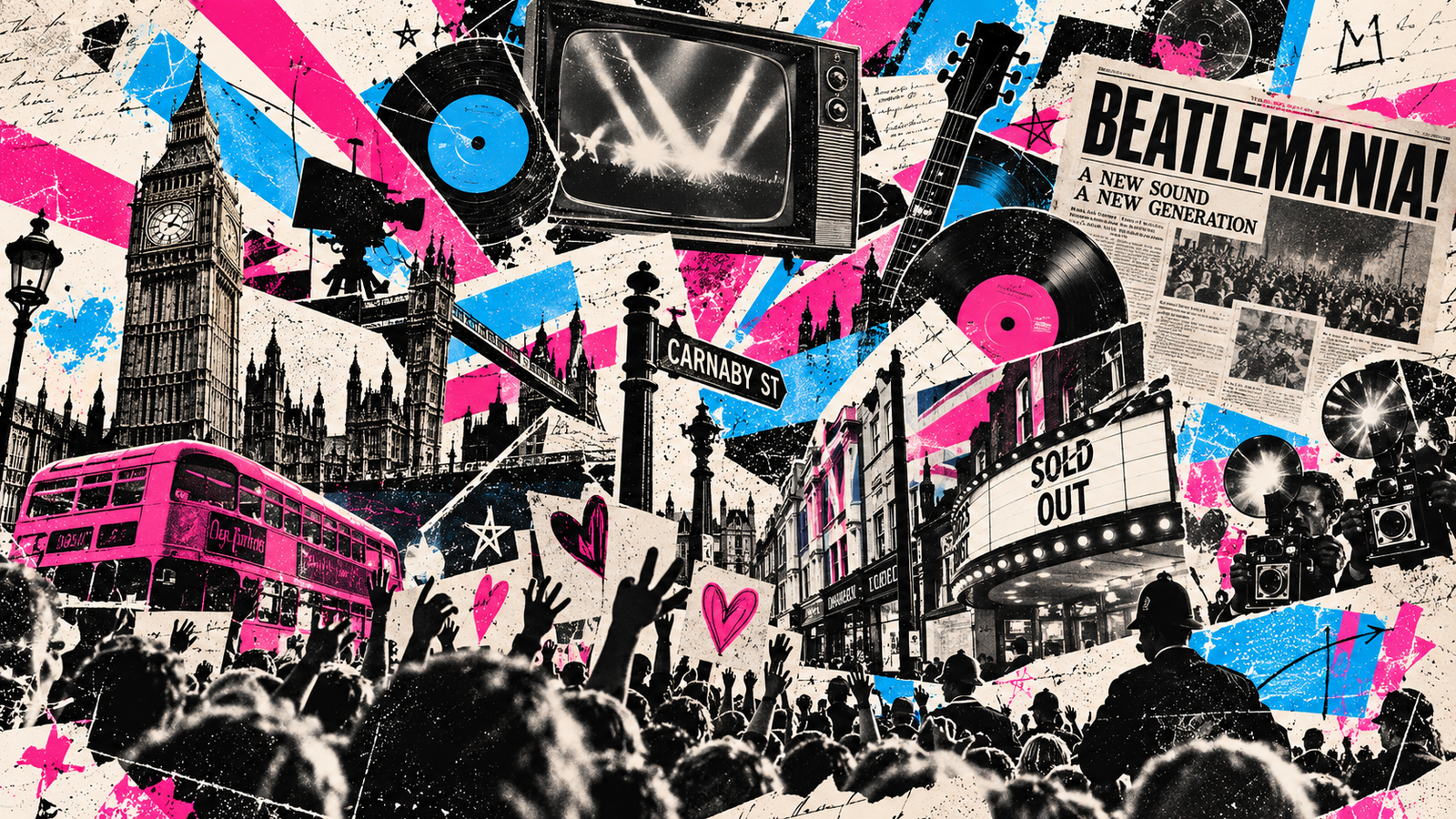
In October 1963, Britain was gripped by an extraordinary musical obsession. Teenagers crowded outside theatres, concert performances were overwhelmed by screaming audiences, and four young musicians from Liverpool found themselves at the centre of a frenzy that newspapers struggled to explain. The Beatles were no longer simply a successful pop group. They had become a national sensation.
The excitement surrounding John Lennon, Paul McCartney, George Harrison and Ringo Starr soon acquired a name: Beatlemania. Wherever the band appeared, devoted fans followed, eager for a glimpse of their idols. Their records dominated the charts, their distinctive hairstyles inspired countless imitations, and their television appearances became major events.
Within months, the excitement had spread across the Atlantic. The Beatles’ arrival in America in February 1964 triggered scenes that would become defining images of the decade, while subsequent international tours demonstrated that Beatlemania extended far beyond Britain and the United States.
But beneath the screaming crowds lay a remarkable cultural development. Beatlemania reflected the growing influence of teenagers, the expanding power of mass media and a new relationship between musicians and their audiences.
How did four young men inspire such extraordinary devotion, and why did the phenomenon that made them internationally famous eventually become too overwhelming to endure?
The Birth of Beatlemania in Britain
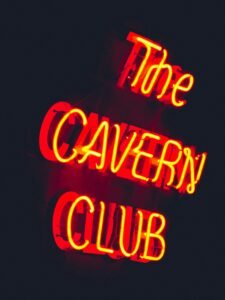
Beatlemania did not emerge overnight. By the beginning of 1963, The Beatles had spent years developing their sound and stage presence through demanding performances in Liverpool and Hamburg. At Liverpool’s Cavern Club, they attracted a devoted local following, building the reputation that would help propel them towards national recognition.
Their first major breakthrough came with the release of Love Me Do in October 1962. The single reached number 17 on the Record Retailer chart, a modest but encouraging achievement for an emerging group. Its follow-up, Please Please Me, released in January 1963, proved considerably more successful, reaching number two on the same chart while topping several competing British listings.
The band’s momentum accelerated throughout the spring. Their debut album, Please Please Me, reached number one in May 1963 and remained there for 30 weeks, while an increasingly demanding schedule of concerts, television appearances and recording sessions introduced them to audiences across the country.
From Rising Stars to National Obsession
By the summer of 1963, The Beatles were becoming impossible to ignore. From Me to You had given them their first number-one single on the Record Retailer chart, and August’s She Loves You further intensified their popularity.
Their appeal extended beyond the music. With their mop-top hairstyles, matching suits and quick-witted humour, the four musicians offered a distinctive alternative to the more conventional entertainers familiar to British television audiences.
Lennon and McCartney’s songwriting provided an increasingly impressive collection of hits, while the group’s playful public image made them seem approachable despite their growing fame.
As their audiences expanded, the atmosphere surrounding their performances changed. Fans waited outside theatres and hotels, sometimes for hours, hoping to catch a glimpse of the band. Concerts became increasingly frantic, with the excitement of the crowd often competing with the music coming from the stage.
For many teenagers, attending a Beatles performance was becoming an experience defined as much by shared enthusiasm as by the songs themselves.
The London Palladium and the Arrival of Beatlemania
The turning point came on 13 October 1963, when The Beatles appeared on Val Parnell’s Sunday Night at the London Palladium, one of Britain’s most prestigious television variety programmes.
The broadcast reached an audience commonly estimated at around 15 million viewers. Outside the theatre, crowds of excited fans gathered in scenes that attracted considerable newspaper attention.
The following day’s coverage helped bring the term Beatlemania into widespread public use. Although its precise origins remain debated, the Palladium appearance became closely associated with the moment the band’s popularity developed into a recognised national phenomenon.
By November, The Beatles were attracting extraordinary attention throughout their British tour. Their latest single, I Want to Hold Your Hand, generated enormous advance demand before its release on 29 November and quickly reached number one.
In little more than a year, the group had progressed from regional favourites to Britain’s biggest pop attraction. The excitement surrounding them was unlike anything most audiences had experienced, and the music industry was beginning to recognise its enormous commercial potential.
The next challenge lay across the Atlantic.
When Beatlemania Conquered America
Despite their remarkable British success, The Beatles initially struggled to establish themselves in the United States. Their earliest American singles attracted limited attention, and British performers had generally found it difficult to achieve sustained success in the competitive American market.
The situation changed dramatically with I Want to Hold Your Hand. Released in the United States in December 1963, the single climbed rapidly through the Billboard Hot 100, reaching number one on 1 February 1964.
Radio airplay, promotional activity and growing American curiosity about the band’s British popularity created enormous anticipation for their first visit.
The Arrival at JFK Airport
On 7 February 1964, The Beatles landed at New York’s John F. Kennedy International Airport, where an estimated 3,000 fans had gathered to welcome them.
The reception was extraordinary. Screaming teenagers crowded the airport’s observation areas, waving banners and attempting to catch sight of the musicians as television cameras recorded the chaotic scenes.
The band’s subsequent press conference offered American audiences an introduction to their distinctive personalities. Rather than responding to reporters with carefully rehearsed answers, Lennon, McCartney, Harrison and Starr exchanged jokes and delivered witty remarks that quickly won over much of the assembled press.
Their confidence and humour helped distinguish them from the carefully managed public image traditionally associated with many popular entertainers.
Although their records were already selling in impressive numbers, the airport reception demonstrated that American Beatlemania had developed before the group had performed a single concert in the country.
The Ed Sullivan Show: A Television Landmark
Two days later, on 9 February 1964, The Beatles made their first live American television appearance on The Ed Sullivan Show.
An estimated 73 million people watched the broadcast, making it one of the most significant television events of its era.
The band performed five songs across two appearances during the programme, including All My Loving, She Loves You and I Want to Hold Your Hand. Inside the studio, screaming fans provided an unmistakable reminder of the excitement that had already swept Britain.
For millions watching at home, it was their first opportunity to see The Beatles perform.
The significance of the broadcast extended beyond the group’s immediate popularity. Television had already played an important role in promoting popular music, but the sheer size of the audience demonstrated its ability to transform an emerging international act into a shared cultural experience.
The Beatles had arrived in America as successful British musicians. Within days, they were among the most talked-about entertainers in the country.
Five Singles at the Top of the Charts
The band’s American success continued at an extraordinary pace.
On 4 April 1964, The Beatles occupied all five leading positions on the Billboard Hot 100 with Can’t Buy Me Love, Twist and Shout, She Loves You, I Want to Hold Your Hand and Please Please Me.
No other act had previously achieved such complete domination of the chart’s top five positions.
Their records were appearing on multiple American labels, while shops were increasingly filled with Beatles magazines, posters and novelty merchandise.
The band’s popularity also helped create opportunities for other British performers, contributing to the musical movement that became known as the British Invasion.
When The Beatles returned for a major American tour in August 1964, they encountered packed venues and enthusiastic crowds across the country. Their Hollywood Bowl performances became particularly memorable examples of the excitement surrounding their live appearances.
Beatlemania had crossed the Atlantic with astonishing speed. Its success, however, raised a question that fascinated journalists and commentators: why were audiences responding with such intense emotion?
Screaming Fans and the Psychology of Beatlemania
Few images are more closely associated with Beatlemania than those of teenagers screaming, crying and waving homemade banners as The Beatles appeared on stage.
Contemporary news reports frequently described the scenes as hysteria, portraying the band’s followers as irrational or overwhelmed by emotions they could barely control.
Such descriptions captured the spectacle but offered little explanation for the enthusiasm behind it.
Why Did Beatles Fans Scream So Much?
The extraordinary reactions surrounding The Beatles reflected several overlapping influences, including musical excitement, teenage identity and the atmosphere created by large gatherings of devoted fans.
During the post-war years, young people had become an increasingly important audience for popular entertainment. Greater spending power among some teenagers, combined with the expansion of youth magazines, records and television, allowed them to develop cultural interests distinct from those of their parents.
The Beatles arrived at a moment when this emerging youth audience was eager for performers who reflected its own sense of identity.
Their energetic songs, humour and distinctive appearance made them particularly appealing. Each member also developed a recognisable public personality, encouraging fans to form individual attachments to their favourite Beatle.
At concerts, excitement could become contagious. Screaming was not necessarily an involuntary response to the music; it could also be a way of participating in the occasion, expressing enthusiasm and sharing an unforgettable experience with thousands of others.
The result was an atmosphere in which simply seeing The Beatles could become as important as hearing them.
Teenage Girls and a New Expression of Fandom
Young women were particularly prominent in contemporary accounts of Beatlemania, although the band’s following extended across genders and age groups.
Their enthusiasm frequently attracted criticism from older commentators, who dismissed screaming fans as immature or incapable of appreciating music seriously.
Such reactions reflected wider attitudes towards teenage girls and their cultural interests. While passionate support for sporting teams was often accepted as an ordinary part of public life, similarly intense enthusiasm for pop musicians could be portrayed as embarrassing or irrational.
For many young women, Beatlemania offered opportunities for social connection and self-expression. Fan clubs, magazines and concerts created spaces in which they could share interests, establish friendships and participate in a culture that felt distinctly their own.
Their contribution to The Beatles’ success was substantial. Fans purchased records, followed television appearances, collected photographs and helped spread the band’s popularity through personal recommendations and organised communities.
The screaming crowds may have dominated newspaper headlines, but the people within them were active participants in one of the decade’s most significant cultural developments.
How the Media Amplified Beatlemania
Newspapers, radio and television played a crucial role in turning The Beatles’ popularity into an international spectacle.
Images of crowded airports, frantic concert audiences and enthusiastic fans appeared repeatedly in news coverage. Each widely reported appearance generated further curiosity, introducing the band to people who might not otherwise have encountered their music.
The relationship between fandom and publicity became self-reinforcing. Larger crowds attracted greater media attention, which encouraged still more people to take an interest in the group.
Sensational reporting also helped shape the public understanding of Beatlemania. By concentrating on screaming, fainting and disorder, newspapers reinforced the impression that the phenomenon was an uncontrollable form of mass hysteria.
Behind those dramatic images was a more enduring change: teenagers were demonstrating that their preferences could influence the entertainment industry on an international scale.
Beatlemania Beyond the Music: Fashion and Merchandise
At the height of Beatlemania, The Beatles’ popularity extended into clothing, hairstyles and consumer products. Their appearance became almost as recognisable as their music, allowing fans to express their enthusiasm in everyday life.
The band’s distinctive mop-top hairstyle was among the most widely imitated trends. Although they had not invented the look, their popularity helped turn longer, forward-combed hair into a symbol of youthful fashion.
Young men requested similar haircuts, while novelty Beatles wigs offered an immediate way to imitate their idols.
Their clothing attracted comparable attention. Under manager Brian Epstein’s guidance, The Beatles had adopted a more coordinated stage image, exchanging their earlier leather jackets for sharply tailored suits. Their Cuban-heeled ankle boots, widely known as Beatles boots, became another fashionable accessory.
For some older observers, the band’s longer hairstyles challenged conventional expectations of male appearance. Among younger fans, copying their look offered a visible connection to the excitement surrounding the group.
The Business of Beatlemania
Businesses quickly recognised the commercial possibilities of the band’s extraordinary popularity.
By 1964, Beatles merchandise had developed into a thriving market. Fans could purchase posters, badges, magazines, clothing, toys and countless other products featuring the group’s name or likeness.
The expansion was not always carefully controlled. Unauthorised merchandise and complicated licensing arrangements created difficulties over who could profit from the band’s image.
Nevertheless, the scale of demand demonstrated that popular musicians could generate considerable commercial activity beyond record sales and concert tickets.
Beatlemania also strengthened the relationship between celebrity and consumer identity. Fans could express their devotion through the products they purchased, the magazines they collected and the clothes they wore.
The merchandising practices surrounding The Beatles were not entirely new, but their international popularity helped demonstrate how profitable a recognisable musical identity could become.
Beatlemania Around the World
By the middle of 1964, The Beatles were attracting enormous attention far beyond Britain and the United States.
Their records, films and television appearances introduced them to audiences across Europe, Australia and Asia, while international tours provided opportunities for fans to experience the phenomenon firsthand.
The reception varied between countries, reflecting different cultural expectations and attitudes towards Western popular music.
Australia’s Extraordinary Welcome
One of the most remarkable examples occurred during The Beatles’ first Australian tour in June 1964.
When the band arrived in Sydney on 11 June, thousands of fans greeted them despite heavy rain. Ringo Starr was absent after being hospitalised with tonsillitis, leaving temporary replacement drummer Jimmie Nicol to accompany Lennon, McCartney and Harrison during the opening dates.
The following day, Adelaide witnessed an extraordinary public reception.
An estimated 300,000 people lined the streets and gathered in the city to welcome The Beatles, a remarkable turnout for a population of approximately 700,000.
The scale of the gathering made it one of the most memorable receptions of the band’s career. Schoolchildren, teenagers and other spectators crowded along the route, hoping for a glimpse of the musicians as they travelled through Adelaide.
The scenes demonstrated that Beatlemania was no longer dependent on the British or American entertainment markets. Thousands of miles from Liverpool, the group inspired a level of public excitement comparable to anything they had encountered at home.
From Europe to Japan
Across continental Europe, The Beatles attracted enthusiastic audiences during visits to countries including France, the Netherlands, Italy and Spain.
Their international popularity continued into 1966, when the band travelled to Japan for a series of performances at Tokyo’s Nippon Budokan.
The venue was closely associated with martial arts, and the decision to stage pop concerts there provoked objections from some conservative and nationalist groups. Extensive security arrangements accompanied the visit, restricting the band’s movements and creating a noticeably different atmosphere from many of their earlier tours.
Japanese audiences remained enthusiastic, but the tightly controlled concerts demonstrated how Beatlemania could be shaped by local customs and official responses.
The band’s subsequent visit to the Philippines brought more serious difficulties. After they failed to attend a reception organised by First Lady Imelda Marcos, a dispute over the invitation developed into hostile publicity and a frightening departure from Manila.
The Beatles maintained that they had not agreed to attend the event, while the resulting controversy exposed the risks of international fame in politically sensitive circumstances.
By this stage, their popularity had taken them across several continents. The same attention that made their tours commercially successful was also creating increasingly difficult demands on their time, security and personal freedom.
When Beatlemania Became Too Much
For The Beatles, international fame brought opportunities that would once have seemed unimaginable. However, by 1965, the relentless demands of touring and constant public attention were becoming increasingly difficult to manage.
Police escorts, restricted hotel movements and tightly organised travel arrangements had become routine. Ordinary activities were frequently impossible without attracting crowds, leaving the musicians with little privacy during their increasingly demanding schedules.
The concerts presented an even greater frustration.
Shea Stadium and the Limits of Live Performance
On 15 August 1965, The Beatles performed at New York’s Shea Stadium before approximately 55,600 spectators.
The concert was a landmark in the development of large-scale rock performances, demonstrating that a pop group could attract an audience normally associated with major sporting events.
For the band, however, the occasion exposed serious practical limitations.
Concert amplification had not developed sufficiently to accommodate audiences of this size. The Beatles relied on comparatively modest equipment and the stadium’s public-address system, while the noise generated by the crowd made it difficult to hear their instruments and vocals.
The performance remained an exciting spectacle, but the experience highlighted a growing divide between what audiences wanted from a Beatles concert and what the musicians themselves hoped to achieve on stage.
Their increasingly ambitious recordings were also becoming difficult to reproduce under such conditions. Touring no longer offered the same musical satisfaction that had characterised their early years in Liverpool and Hamburg.
Controversy and Exhaustion in 1966
The situation deteriorated further during 1966.
In March, John Lennon told journalist Maureen Cleave that Christianity was declining and suggested that The Beatles had become more popular than Jesus. When his remarks were republished in the United States that summer, they provoked widespread controversy, particularly in parts of the American South.
Some radio stations refused to play Beatles records, while public demonstrations and record-burning events intensified the tension surrounding the band’s forthcoming tour.
Combined with their troubling experiences in the Philippines, the controversy reinforced their growing frustration with life on the road.
Concerts were becoming increasingly difficult to manage, public appearances demanded extensive security, and the musicians were finding fewer reasons to continue performing under such restrictive conditions.
The Final Concert at Candlestick Park
On 29 August 1966, The Beatles performed at Candlestick Park in San Francisco, bringing their final scheduled commercial tour to an end.
Approximately 25,000 tickets had been sold, leaving substantial areas of the stadium unfilled. The relatively modest attendance contrasted with the enormous crowds that had characterised some of their earlier American appearances.
There was already a sense within the band’s entourage that this might be their final conventional concert.
Paul McCartney asked press officer Tony Barrow to record the performance using a portable cassette recorder, preserving a personal souvenir of the occasion. The recording famously ended during the closing number, Long Tall Sally, when the tape ran out.
Although the decision to abandon touring was not formally settled by every member before the concert, Candlestick Park became the final performance of their touring career.
The Beatles would make one further public live appearance together on the rooftop of their Apple headquarters in January 1969, but they never returned to regular touring.
After years of screaming crowds, relentless schedules and extraordinary public attention, the musicians were ready to concentrate on recording.
Beatlemania had made The Beatles internationally famous. Its overwhelming intensity had also helped bring their life as a touring group to an end.
The Legacy of Beatlemania
The most intense years of Beatlemania were relatively brief, but their influence on popular entertainment proved enduring.
The Beatles had not invented teenage fandom. Earlier stars, particularly Frank Sinatra and Elvis Presley, had already inspired extraordinary devotion. What distinguished Beatlemania was its international scale, the speed of its expansion and the unprecedented visibility it gave to young music audiences.
Fan clubs, magazines, merchandise and television coverage helped establish a model of pop stardom in which an artist’s personality and public image became inseparable from their music.
The phenomenon also demonstrated the considerable influence of teenage consumers, particularly young women whose enthusiasm had frequently been dismissed by contemporary commentators.
Their dedication helped shape the commercial direction of popular music, revealing the enormous potential of organised fan communities and international celebrity culture.
Similar patterns remain recognisable in contemporary music fandom. Although social media and digital technology have transformed how audiences interact with performers, the emotional connections, shared identities and collective excitement associated with Beatlemania continue to resonate.
For The Beatles, the experience was exhilarating, exhausting and occasionally frightening. For their audiences, it offered a powerful sense of belonging during a period of considerable social change.
Beatlemania was more than the story of four musicians becoming famous. It was a defining moment in the emergence of modern music fandom, when a generation of young listeners demonstrated just how influential its collective voice could be.