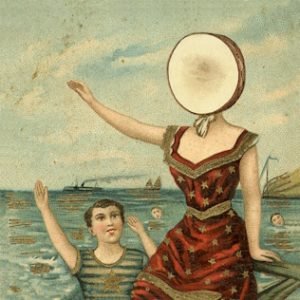
Released in 1998, In the Aeroplane Over the Sea stands as the second and final studio album by Neutral Milk Hotel. Coming on the heels of their debut, On Avery Island, this record represented both a deepening and a refining of the band’s idiosyncratic sound. While the debut hinted at lo-fi experimentation and surrealist lyricism, Aeroplane expanded those ideas into a fuller, more emotionally resonant work. It pushed the boundaries of indie rock at the time, merging folk melodies with raw punk energy and a collage of unusual instrumentation.
Led by the elusive Jeff Mangum, the band crafted an album that felt both intensely personal and eerily universal. Drawing loosely from the story of Anne Frank and filtered through a lens of dreamlike abstraction, the album pursued something greater than a narrative. It reached for an emotional truth, one that resonated with themes of loss, rebirth, and the fragile beauty of existence. Mangum himself, in rare interviews, spoke about being profoundly moved by reading The Diary of Anne Frank, which catalyzed much of the writing. But he never intended the album to be a direct biography. Instead, it became a poetic reaction, an emotional echo shaped by imagination and grief.
Sonic Exploration

From the opening burst of distorted fuzz on “The King of Carrot Flowers Pt. One,” it’s clear that In the Aeroplane Over the Sea embraces a lo-fi aesthetic with intention, not as a limitation but as a creative choice. The production, handled by Robert Schneider of The Apples in Stereo, is raw and unpolished. Rather than aiming for studio sheen, the album leans into a homespun warmth that mirrors the emotional directness of Jeff Mangum’s songwriting. This gritty sound reinforces the themes of impermanence and fragility that run through the record. It makes the music feel lived-in, like a found artifact from another world.
Musical Arrangements
Yet, within that rough framework lies a remarkable depth of arrangement. The instrumentation is one of the album’s most distinctive features. Traditional rock instruments are joined by singing saws, zanzithophones, euphoniums, and accordions, often layered in dense, swirling collages. Songs like “Holland, 1945” feel like they might collapse under their own chaotic energy, but they never do. Instead, they walk a fine line between collapse and catharsis, propelled by pounding drums and urgent brass. On the quieter end, the title track and “Two-Headed Boy” strip back to voice and acoustic guitar, revealing the album’s emotional core with striking clarity.
Vocally, Mangum’s delivery is untrained but unmistakably earnest. His voice wavers, strains, and sometimes cracks, but it always feels sincere. That vulnerability adds to the album’s emotional pull, though it may be an acquired taste for some. Where other vocalists might mask flaws with reverb or restraint, Mangum leans into his imperfections, turning them into strengths.
Genre-wise, the album resists easy classification. It borrows from folk, psychedelic rock, punk, and even elements of marching band music. Its closest alignment might be with the broader indie folk movement, yet it precedes the mainstream popularity of that genre by several years. There are moments that recall the DIY spirit of punk as well as the melodic experimentation of psych-pop. But the way it fuses these elements feels singular. Rather than hopping genres for variety, the album forges a new sound from familiar parts, resulting in something that feels both timeless and completely out of time.
Lyrical Analysis

The lyrics on In the Aeroplane Over the Sea are some of the most enigmatic and emotionally charged in indie rock history. At their core, they grapple with the weight of mortality, the ache of longing, and the delicate intersection of innocence and loss. The most well-known thematic thread is the album’s loose conceptual link to Anne Frank. References to her life and death appear in scattered but powerful fragments, particularly on “Holland, 1945” and “Ghost.” However, the album is not a direct retelling of her story. Instead, it uses her legacy as a kind of emotional scaffolding, a symbol of beauty lost too soon and the cruelty of history.
Beyond that, the album explores the fear and wonder of being alive in a world that is both magical and terrifying. Love, memory, childhood, death, and spiritual transcendence all swirl together in a lyrical fog that never fully settles. On “Two-Headed Boy,” for instance, the lyrics mix surreal imagery with gut-level vulnerability. Mangum sings of deformity, isolation, and desire in a way that is hard to parse literally but hits with emotional clarity.
Lyrical Depth
This blend of the poetic and the abstract defines much of the album’s lyrical appeal. The language is often vivid and strange, full of dream logic and fantastical symbolism. In one moment, there are girls filled with flies and pianos filled with flames; in another, there are aeroplanes, holy rattlesnakes, and fields of flowers. These images feel less like puzzles to be solved and more like feelings made tangible. They open the door for personal interpretation, which has allowed listeners to form deeply individual connections to the songs.
There are, however, moments where the lyrical abstraction can become overwhelming. Listeners who prefer direct storytelling might find some passages opaque or overly cryptic. But for others, the mystery is part of the magic. The lack of linear narrative frees the album from being pinned to one meaning. Instead, it becomes a vessel for emotion, memory, and imagination.
Emotionally, the lyrics are the heartbeat of the album. Mangum’s words carry a raw, almost spiritual intensity. Even when the meanings are elusive, the feelings come through. There’s a deep sadness throughout the record, but also flashes of joy, wonder, and transcendence. Songs like the title track and “Oh Comely” don’t just describe emotions—they evoke them in full color. This ability to bypass logic and speak directly to the heart is a rare and powerful gift.
Cohesion and Flow

In the Aeroplane Over the Sea unfolds with a sense of momentum that feels both deliberate and organic. The album is not a concept album in the strictest sense, but it plays like one. Each track feels like a chapter in a larger emotional arc, carrying motifs and musical threads that subtly recur and evolve. From the moment the distorted guitar fuzz erupts in “The King of Carrot Flowers Pt. One” to the final acoustic strum of “Two-Headed Boy Pt. Two,” there is a clear sense of journey—a progression that’s as emotional as it is musical.
The album’s sequencing is particularly effective. Early tracks like “King of Carrot Flowers Pt. Two & Three” and “Holland, 1945” hit with raw, frenetic energy, while later songs such as “Oh Comely” and “Two-Headed Boy Pt. Two” stretch out into slower, more contemplative territory. This shift is gradual and purposeful. It mirrors a descent into introspection, allowing the listener to move from the outward chaos of the world to an inward, more fragile space. The use of reprises—such as the return of “Two-Headed Boy”—adds a cyclical feel, reinforcing the sense that the album is more than a sum of its parts.
Despite the variety in tone and tempo, the album maintains a striking thematic and sonic consistency. The lo-fi production binds the tracks with a shared texture, giving the album a unified aesthetic. Similarly, the recurring instrumentation—brass, acoustic guitar, organ, and singing saw—creates a recognizable sonic palette, even as the arrangements shift from song to song.
Thematic Consistency
Thematically, the album stays rooted in its exploration of impermanence, innocence, and the search for meaning. Whether through the upbeat chaos of “Communist Daughter” or the slow-burning ache of “Oh Comely,” these emotional threads are never far from the surface. There are no jarring tonal shifts or half-baked experiments. Even the shorter, instrumental interludes like “The Fool” feel purposeful, serving as emotional breaths between heavier moments.
If there is a critique to be made, it’s that the album’s emotional intensity rarely lets up. For some listeners, the lack of a true breather track might feel overwhelming. But for others, that immersion is part of the appeal. The album doesn’t just tell a story—it creates a world, one that feels remarkably self-contained and consistent from start to finish.
Standout Tracks and Moments
While In the Aeroplane Over the Sea is often praised for its cohesion, there are several tracks and moments that rise to the surface as particularly resonant or inventive. These highlights not only define the album’s character but also offer entry points for listeners new to its world.
In the Aeroplane Over the Sea
One of the most immediately striking tracks is the title song, “In the Aeroplane Over the Sea.” Sitting early in the album, it balances melancholy with uplift, pairing a simple acoustic strum with lines about death and transcendence. The lyric “how strange it is to be anything at all” captures the album’s existential core in one unforgettable phrase. It’s both a meditation and a moment of emotional clarity, delivered with a sense of peace that contrasts with the turmoil found elsewhere on the album.
Holland, 1945
“Holland, 1945” is perhaps the most accessible and energetic song on the record. It’s a whirlwind of distorted guitars and marching horns, offering the closest thing to a sing-along chorus in Mangum’s catalog. Despite its brisk pace, the track deals with heavy themes of loss and remembrance. The juxtaposition of joyful sound and tragic subject matter heightens its emotional impact, making it one of the most enduring tracks in the indie canon.
Oh Comely
Then there is “Oh Comely,” an eight-minute epic that unfolds like a fever dream. It’s raw, almost confrontational in its delivery, and filled with dense, ambiguous imagery. The song’s stripped-down arrangement places full focus on Mangum’s voice and words, creating an intense, unbroken emotional line. When he finally lets the last syllable trail off, there’s a sense of catharsis that few songs manage to deliver.
Two-Headed Boy
“Two-Headed Boy” and its reprise, “Two-Headed Boy Pt. Two,” serve as the album’s emotional bookends. The former bursts with urgency, while the latter feels like a quiet farewell. Both are anchored by acoustic guitar and Mangum’s unfiltered vocals. Their lyrics are among the most cryptic on the album, yet they convey a powerful mix of vulnerability and yearning. The decision to open and close the record with these companion pieces adds narrative weight and symmetry.
Memorable Moments
Among the more subtle moments is “The Fool,” a wordless instrumental that acts as a strange and cinematic interlude. Its funereal brass and dirge-like rhythm offer a moment of reflection amid the surrounding chaos. It’s not often cited as a favorite, but it reveals the band’s flair for mood and atmosphere without relying on words.
Even the transitions between tracks carry emotional weight. The way “The King of Carrot Flowers Pt. One” flows into parts two and three, with its sudden shift into religious ecstasy and distortion, is jarring yet purposeful. It marks a thematic pivot and prepares the listener for the emotional volatility to come.
Artistic Contribution and Innovation

When In the Aeroplane Over the Sea arrived in 1998, it didn’t make a huge splash in the mainstream music press. But within the indie community, it planted seeds that would later reshape the landscape. In retrospect, the album stands as a landmark release—not just within indie rock, but within the broader arc of 1990s alternative music. It carved out a space where lo-fi aesthetics, surreal lyricism, and unguarded emotion could coexist in a way that felt radical at the time.
Genre-wise, the album sits somewhere between folk-punk, psychedelic pop, and lo-fi rock, but it never quite fits into any of those categories. That refusal to conform is a big part of what makes it innovative. Neutral Milk Hotel, operating under the Elephant 6 collective, weren’t following a commercial formula. Instead, they built a record from the ground up with a strange and homemade quality that felt both personal and timeless. The use of unusual instrumentation—musical saws, uilleann pipes, distorted horns—wasn’t just a gimmick. It added new textures to the indie folk template and suggested broader sonic possibilities for what a DIY album could sound like.
Innovation
What also set Aeroplane apart was its unfiltered emotional tone. While many alternative records of the ’90s trafficked in irony or detachment, this album was entirely sincere. Jeff Mangum’s voice, often pushed to the edge of its range, didn’t hide behind layers of production or emotional coolness. That level of vulnerability, paired with the album’s themes of death, love, and the unknowable, felt disarmingly open. It gave a spiritual dimension to the music that was rare in its time—and remains rare even now.
The album also defied industry expectations in terms of structure and pacing. Songs weren’t designed for radio, and the lyrical content refused to explain itself. The sprawling “Oh Comely,” which runs over eight minutes with no traditional chorus, is a perfect example of this. Its length and lack of resolution would be a liability in most commercial contexts, but here it becomes a centerpiece—an audacious artistic risk that pays off.
Looking back, In the Aeroplane Over the Sea anticipated many of the trends that would define indie music in the following decade. The rawness, the folk revivalist tendencies, the surreal storytelling—all became hallmarks of a new wave of indie artists in the 2000s. Bands like Arcade Fire, The Decemberists, and Bon Iver owe more than a passing debt to the template Mangum and company laid down.
Closing Thoughts

In the Aeroplane Over the Sea is a rare album—one that defies the traditional boundaries of genre, structure, and even time. Its strengths lie in its fearless emotional core, its inventive sonic palette, and its poetic, if at times perplexing, lyrics. Jeff Mangum and Neutral Milk Hotel created something that feels not just personal, but mythic. The album doesn’t pander to the listener; it invites them into a world where beauty and horror coexist, where dreams blur with memory, and where music becomes a kind of emotional exorcism.
That said, this is not a perfect album in the conventional sense. The lo-fi production can be abrasive, and the lyrics occasionally drift into opaque territory that may alienate listeners looking for clarity or polish. Mangum’s voice, too, is a love-it-or-leave-it proposition—raw, urgent, and prone to emotional extremes. These elements, while divisive, are also integral to the album’s identity. The roughness is not a flaw, but a texture; the ambiguity, not a barrier, but an invitation to interpret.
What elevates In the Aeroplane Over the Sea beyond its imperfections is its lasting emotional resonance. It’s an album that doesn’t just linger in the mind—it embeds itself in the heart. For many, it becomes more than a favorite record; it becomes a companion through grief, growth, and wonder. Its cult status is not driven by hype, but by a deeply personal connection felt by listeners across generations.
As the final chapter in Neutral Milk Hotel’s discography, it is both a triumph and a farewell. Mangum never returned with a follow-up, leaving this as a singular statement—one that continues to grow in influence and esteem with each passing year.
Official Rating: 10/10
This perfect score does not imply flawlessness in the technical sense. Rather, it reflects the album’s unparalleled ability to move, challenge, and endure. It is a masterpiece not because it checks every box, but because it throws out the checklist entirely and dares to be something stranger, sadder, and more beautiful than most records ever dream of being.