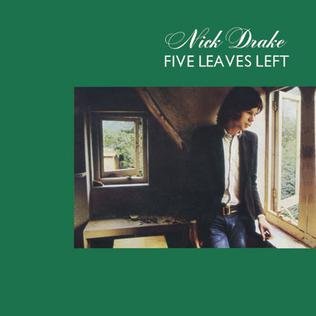
Nick Drake’s Five Leaves Left, released in 1969, marked the beginning of a short but deeply influential musical journey. As his debut album, it doesn’t follow from previous solo work, but it emerges fully formed, steeped in a quiet confidence and artistic clarity that belied his age. At a time when British folk rock was leaning toward the grand and the extroverted—with acts like Fairport Convention and Pentangle incorporating traditional motifs with electrified arrangements—Drake carved a quieter, more introspective path.
Recorded while he was still a student at Cambridge, the album feels like a world apart from the countercultural storm swirling around it. There’s no protest, no excess, no overt statement. Instead, Five Leaves Left introduces a young songwriter more concerned with evoking moods and capturing fleeting emotional states. His guitar work, intricate and fluid, serves as both rhythm and melody. The orchestrations, guided by producer Joe Boyd and arranger Robert Kirby, lend a sense of elegance without overwhelming the core of the songs.
Sonic Exploration

Five Leaves Left is a study in subtlety, both in sound and structure. The production, overseen by Joe Boyd—best known for his work with Fairport Convention and The Incredible String Band—leans toward a warm, analog clarity that avoids the gloss of commercial polish. It isn’t lo-fi, but it’s not pristine either. Instead, it captures the natural acoustics of the instruments and the intimacy of the performances. The result is an album that feels timeless, suspended in a sonic space where each element is allowed to breathe.
The standout feature is undoubtedly Nick Drake’s fingerpicked guitar. Recorded close to the mic, his playing carries a remarkable sense of presence, every harmonic and string squeak adding to the emotional texture. His voice, often murmured rather than sung outright, floats just above the guitar, never forced, always controlled. The decision to keep the vocals understated matches the introspective tone of the lyrics, though at times this quietness may challenge listeners hoping for more dynamic contrast.
Musical Arrangements
Robert Kirby’s string arrangements are perhaps the album’s most surprising asset. Where many singer-songwriters might rely on sparse accompaniment, Kirby and Drake opted for sweeping, classically influenced string parts that elevate songs like “River Man” and “Day Is Done” into something closer to chamber folk. These orchestrations never overpower the songs. Instead, they expand their emotional reach, drawing out the sadness and wonder that underpin much of the record. Occasionally, though, the strings veer close to sentimentality, a risk inherent in such lush arrangements.
Genre-wise, Five Leaves Left sits firmly in the realm of folk, but it gently brushes against jazz, classical, and baroque pop. “River Man” is a prime example, its unusual 5/4 time signature and jazzy chords hinting at a broader musical curiosity. Yet the album never feels experimental for its own sake. Drake blends these elements with care, using them to deepen his sonic palette rather than to impress.
Lyrical Analysis

Lyrically, Five Leaves Left dwells in the liminal spaces—between day and night, youth and maturity, isolation and connection. Nick Drake writes with the eye of a poet and the reserve of someone reluctant to explain too much. His lyrics are rarely literal, instead painting emotional landscapes that are rich in mood but often elusive in meaning. This ambiguity is part of what makes the album so enduring. It invites repeated listening and interpretation, each visit offering a new layer of meaning.
The dominant themes are solitude, time, and transience. Drake often seems to be observing the world at a distance, finding both beauty and sadness in its rhythms. In “Time Has Told Me,” he writes with resignation and gentle irony, reflecting on personal disappointment with a maturity that feels older than his years. “River Man,” perhaps the album’s most lyrically dense piece, mixes natural imagery with cryptic storytelling. The river becomes both a literal and symbolic guide—fluid, ungraspable, eternal.
Recurring motifs such as seasons, nature, and weather help root the songs in a pastoral, almost dreamlike setting. Lines like “They’ll all know that you were here when you’re gone,” from “Fruit Tree” evoke renewal and impermanence in equal measure. There’s a subtle fatalism throughout the album, a recognition that even beauty fades. This is most poignantly expressed in the albums title—Five Leaves Left, the phrase, borrowed from Rizla cigarette papers, signals the nearing end. It’s a quiet memento mori, understated yet ever-present.
Lyrical Depth
In terms of lyrical depth, Drake’s writing leans toward the poetic rather than the narrative. He rarely tells stories in the conventional sense. Instead, he evokes feelings through metaphor, rhythm, and tone. This can make the lyrics feel distant for some listeners. They don’t always offer clear answers or cathartic release. But for others, this openness is exactly where the album’s power lies. It reflects an inner world that feels private, yet somehow familiar.
Emotionally, the lyrics carry a gentle, aching melancholy. They don’t push for drama, but rather create space for contemplation. There’s comfort in their softness, even when the subject matter veers toward despair. The sadness is never overwhelming, more like the quiet realization of something already known but rarely voiced.
Cohesion and Flow

Five Leaves Left unfolds with the grace of a well-sequenced novel, each track placed with quiet intention. There’s no rush in its movement. The album begins with “Time Has Told Me,” a gentle, resigned opener that sets the emotional tone—thoughtful, weary, but still tender. From there, the songs glide into one another with an almost imperceptible touch. There’s little variation in tempo or volume, but this restraint works in its favor. The steady pacing mirrors the introspective quality of the lyrics, creating a meditative listening experience.
There is a subtle emotional arc at play. Early tracks like “Time Has Told Me” and “River Man” carry a sense of observation and melancholy, while the middle section—“Man in a Shed” and “Saturday Sun,” for instance—brings a slight shift in mood. These songs introduce hints of warmth and romantic frustration, breaking up the album’s heavier themes without departing from its overall mood. The closing tracks, particularly “Fruit Tree” and “Saturday Sun,” circle back to the ideas of impermanence and unfulfilled potential. They don’t resolve the album’s emotional tensions, but they give a sense of closure that feels earned.
Thematic Consistency
In terms of thematic consistency, the album is remarkably unified. The use of natural imagery, the quiet introspection, and the fusion of folk with subtle orchestral touches recur throughout without becoming repetitive. There are no jarring genre shifts or tonal departures. Even tracks that slightly stand apart—such as the jazz-influenced “River Man” or the slightly more upbeat “Man in a Shed”—are tied back into the whole by Drake’s distinctive vocal delivery and lyrical focus. Everything feels part of the same emotional landscape.
If there’s a downside to this cohesion, it’s that the album can, at times, risk feeling too even. Without sharp contrasts or standout peaks, some listeners may find it difficult to maintain full engagement across all ten tracks. Still, this consistency is also part of what gives Five Leaves Left its quiet power. It doesn’t need to shout to be heard. It asks for patience, and in return, it offers something that feels whole and considered.
Standout Tracks and Moments
While Five Leaves Left is best experienced as a cohesive whole, several tracks rise gently above the others, offering moments of particular clarity or emotional depth.
River Man
“River Man” is the most striking piece on the album, both structurally and sonically. Its 5/4 time signature gives it a drifting, almost hypnotic quality, and the interplay between Drake’s subtle guitar work and Harry Robinson’s haunting string arrangement is nothing short of masterful. The song feels untethered to time, with lyrics that blur the lines between observation and allegory. It’s here that Drake’s vision is most complete—a perfect fusion of folk, jazz, and classical influences that captures the essence of his unique sound.
Fruit Tree
“Fruit Tree” is another high point. Its theme of posthumous recognition carries an eerie prescience given Drake’s later cult status. Lines like “Fame is but a fruit tree / So very unsound” resonate deeply, not just as commentary on fame but as a reflection on the fragility of artistic legacy. The slow build of the arrangement—starting with Drake’s guitar and gradually unfolding into a mournful orchestration—gives the track a quiet, swelling power.
Time Has Told Me
“Time Has Told Me,” the album’s opener, deserves mention for its understated confidence. It sets the tone with its gentle guitar lines and softly spoken truth. The lyrics hint at romantic disillusionment, but they’re delivered without bitterness. The track is enhanced by the subtle addition of Richard Thompson on electric guitar, whose playing adds a warm texture that complements Drake’s restraint.
Memorable Moments
One of the more surprising moments comes in “Man in a Shed.” At first glance, it’s a lighter, almost whimsical detour, but beneath its breezy piano and jazzy swing lies another tale of romantic detachment. The track gives a glimpse into Drake’s range, showing that even his more playful moments are tinged with a quiet melancholy.
Perhaps the most emotionally impactful moment comes in “Day Is Done.” The transition from its sparse opening to the sudden swell of strings is one of the most dramatic shifts on the album. It’s a rare moment of outward emotional release, and it underscores just how carefully the album plays with dynamics.
Artistic Contribution and Innovation
When Five Leaves Left was released in 1969, it landed quietly in a music landscape brimming with louder, more attention-seeking records. Psychedelia was still echoing through the charts, progressive rock was gaining momentum, and the folk scene was moving in increasingly eclectic directions. In this context, Nick Drake’s debut didn’t just diverge from the mainstream—it barely registered on its radar. Yet this quietness was not a lack of ambition. Rather, it was a different kind of statement, one that refused to compromise intimacy for immediacy.
Within the folk genre, Five Leaves Left stood apart for its refined sense of restraint. Where contemporaries like Donovan or Bert Jansch flirted with broader popularity or delved into overt experimentation, Drake carved a path defined by internal exploration. His songwriting avoided the overt political leanings of the era and leaned instead into emotional and existential themes. This wasn’t protest music, nor was it escapist. It existed somewhere in between—a meditative soundworld that didn’t seek to entertain so much as to reflect.
Innovation
In terms of innovation, the album’s most notable achievement lies in its blending of genres. Drake’s use of jazz chord progressions, complex time signatures, and classically arranged strings within a folk framework was, at the time, quietly radical. “River Man” remains one of the most musically adventurous pieces in the folk canon, while the album’s overall sonic palette—acoustic guitar, subtle orchestration, soft-spoken vocals—would go on to influence generations of singer-songwriters. From Elliott Smith to José González and even artists in the indie-folk wave of the 2000s, traces of Drake’s style can be felt long after his passing.
Production-wise, the album benefits from Joe Boyd’s sensitive touch. The sound is clean without being clinical, organic without being muddy. The decision to spotlight Drake’s intricate guitar work while using strings sparingly shows a level of discipline that keeps the songs grounded. In an era when many albums were over-produced or overly ambitious, Five Leaves Left found power in simplicity.
Its real innovation, though, might be philosophical. Drake didn’t write for the spotlight. His music feels like it was made for personal necessity rather than public acclaim. In that sense, he helped redefine what success could mean for a singer-songwriter. The album didn’t sell well upon release, but its long-tail impact has been profound. It helped carve out space for quiet, emotionally honest music in a market often driven by spectacle.
Closing Thoughts

Five Leaves Left is a debut that doesn’t feel like one. It arrives with a sense of quiet maturity, revealing an artist who already seemed to understand the weight of time, the subtleties of feeling, and the power of understatement. Nick Drake’s strengths lie in his ability to evoke complex emotions with minimal means: a delicate turn of phrase, a harmonic shift, a whispered vocal line. The album’s arrangements are rich but never crowded, its production clear but never sterile. It is an album made with patience and designed to reward the same from its listeners.
That said, Five Leaves Left isn’t without its limitations. The uniform pacing, while essential to its atmosphere, may feel too subdued for those seeking variety. The emotional tone rarely strays from introspective melancholy, and some may find the lyrical vagueness distancing rather than inviting. Yet these qualities are part of what defines the album’s singular character. Its stillness is not stagnation—it’s a deliberate pause, a space carved out for reflection in a world that rarely stops to listen.
As the first step in Nick Drake’s tragically brief discography, Five Leaves Left established a voice that would become increasingly influential in the decades after its release. It didn’t chase trends, and in doing so, it quietly reshaped the singer-songwriter genre. Today, it stands not only as a deeply personal statement but also as a cornerstone for artists who choose depth over spectacle.
Official Rating: 9/10
This rating reflects the album’s near-masterful execution of its artistic vision. Its emotional depth, innovative arrangements, and enduring influence make it a landmark release. The only reason it stops short of a perfect score is due to its narrow dynamic range and occasional lyrical opacity, which may limit its accessibility for some. But for those willing to meet it on its own terms, Five Leaves Left offers a profound and lasting listening experience.