David Bowie wasn’t just an artist; he was a cultural disruptor. A master of reinvention, he blurred the lines between music, fashion, gender, and performance art with a confidence that turned the unconventional into the iconic. From Ziggy Stardust to the Thin White Duke, Bowie’s personas didn’t just reflect musical trends—they shaped them.
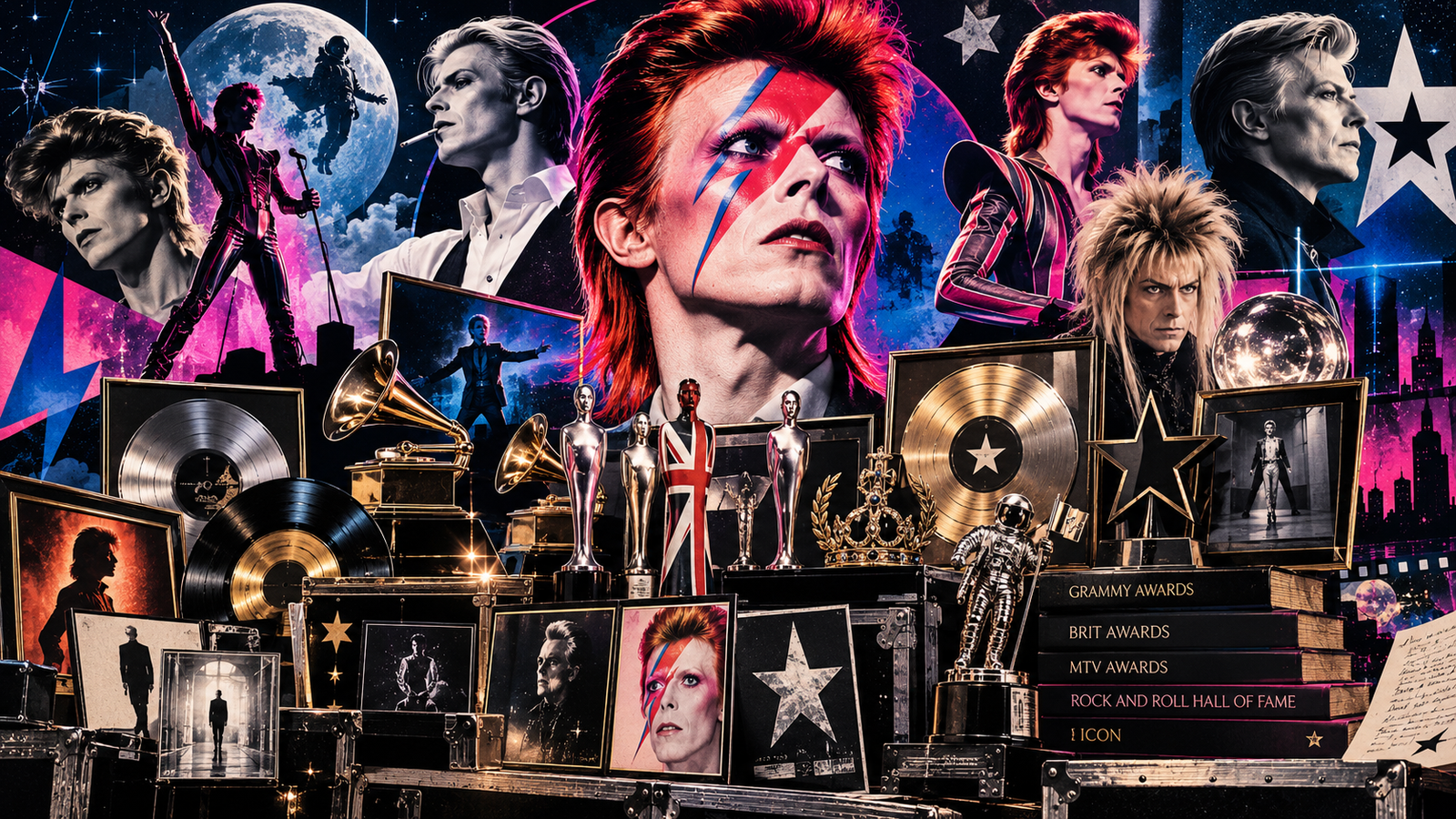
While his influence is far-reaching, this article focuses on the tangible markers of his legacy: the awards he received, the honors that recognized his contributions, and the key milestones that defined his career. These achievements help trace the path of an artist who constantly evolved and left a permanent imprint on the world of music and beyond.
Early Breakthroughs
David Bowie’s first major breakthrough came in 1969 with the release of “Space Oddity.” Timed with the Apollo 11 moon landing, the song captured public imagination and became his first UK Top 5 hit. It marked the arrival of an artist with a distinct voice and vision, one willing to merge science fiction themes with pop structure.
While “Space Oddity” introduced Bowie to a wider audience, it took a few more years before formal industry recognition followed. His early 1970s work, particularly the albums Hunky Dory and The Rise and Fall of Ziggy Stardust and the Spiders from Mars, began to attract critical attention. Although awards were still elusive at this stage, Bowie was gaining a reputation as one of the most original and daring new voices in British music.
1970s: The Chameleon Ascends
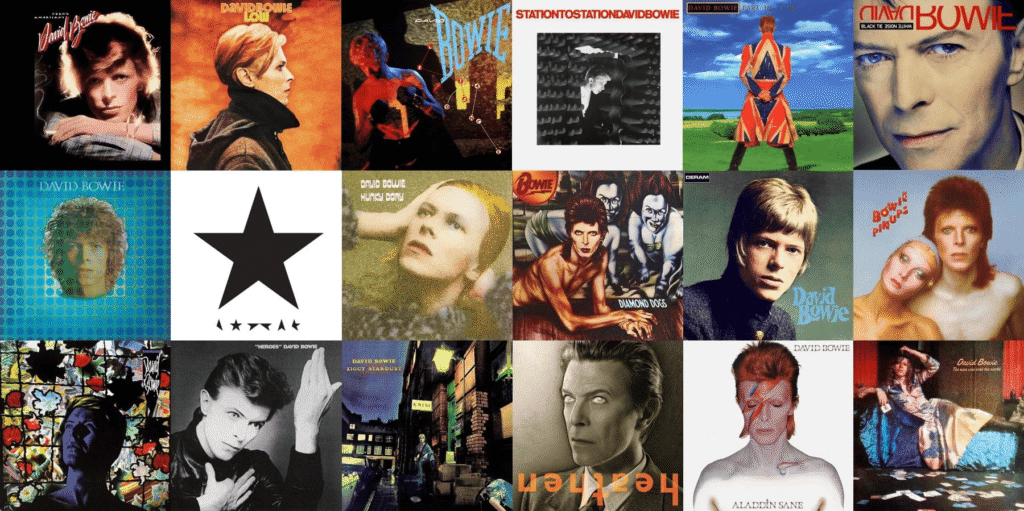
The 1970s were the decade Bowie truly came into his own. In 1971, Hunky Dory showcased his evolving songwriting, pairing introspective lyricism with theatrical flair. Just a year later, The Rise and Fall of Ziggy Stardust and the Spiders from Mars launched him into global consciousness. Ziggy wasn’t just a character—it was a full-scale redefinition of what a rock star could be. With Aladdin Sane in 1973, Bowie cemented his status as both innovator and provocateur, balancing chart success with boundary-pushing experimentation.
While Bowie didn’t yet receive major awards during this period, his influence was undeniable. Critics began taking serious notice of his work, and his albums consistently charted in the UK Top 10. The momentum was cultural as much as commercial. Appearances on programs like Top of the Pops, where he famously performed “Starman” draped over guitarist Mick Ronson, created some of the most iconic images in British music television.
By the end of the decade, Bowie had transitioned through glam rock, soul, and experimental electronica with his Berlin Trilogy (Low, “Heroes”, and Lodger), proving that his ability to evolve wasn’t a phase—it was the foundation of his artistry.
1980s: Mainstream Success & Global Recognition
The 1980s saw David Bowie shift from cult icon to global superstar. The release of Let’s Dance in 1983 marked a turning point. Produced by Nile Rodgers, the album blended pop accessibility with Bowie’s sharp sense of style, resulting in some of his biggest hits, including “Modern Love,” “China Girl,” and the title track “Let’s Dance.” The album topped charts worldwide and introduced Bowie to an even broader audience.
This decade brought a wave of formal recognition. Bowie won the BRIT Award for Best British Male in 1984 and received multiple MTV Video Music Award nominations as music videos became essential to pop stardom. Although the Grammys largely overlooked him during this period, his influence on both sound and image was hard to ignore.
Beyond music, Bowie’s cultural presence expanded into fashion and film. His role as Jareth the Goblin King in Labyrinth (1986) became a cult favorite, while his appearance at Live Aid in 1985, performing in front of a global audience, reinforced his status as a major international figure. Whether on stage, on screen, or in a magazine spread, Bowie dominated the decade with a rare blend of commercial appeal and artistic credibility.
1990s–2000s: Reinvention and Resilience
In the 1990s and early 2000s, David Bowie moved beyond chasing trends and instead began shaping the future in quieter, more strategic ways. He embraced the digital age early, launching BowieNet in 1998, a groundbreaking ISP and fan community that allowed subscribers to access exclusive content, chat with Bowie, and even collaborate on music projects. He also experimented with digital distribution, releasing music online well before it became the industry norm.
This period brought a wave of recognition for his career as a whole. In 1996, Bowie was inducted into the Rock and Roll Hall of Fame, a formal nod to his decades of influence. He also received lifetime achievement honors, including a Grammy Lifetime Achievement Award nomination and various international accolades acknowledging his artistic contributions.
Musically, he continued to evolve. Albums like Outside and Heathen showed a return to conceptual depth and experimental production, while still reflecting the maturity of an artist who had nothing to prove but still had much to say. Even as trends shifted, Bowie remained relevant by staying true to his instinct for reinvention.
Late Career: The Final Act
David Bowie’s final years were marked by a creative resurgence that caught many by surprise. In 2013, The Next Day arrived without warning, his first studio album in a decade. It was both a return and a reinvention, revisiting the sounds of his Berlin era while confronting themes of mortality, fame, and time. Critics praised it as one of his strongest works in years, and it reached the top of the charts in several countries.
But it was Blackstar, released on his 69th birthday in 2016, that defined Bowie’s final act. Dense, jazz-infused, and haunting, the album played like a farewell disguised as avant-garde art. Just two days later, Bowie passed away from cancer, a diagnosis he had kept private. Blackstar was instantly reinterpreted as a parting gift, full of coded messages and existential reflection.
In the wake of his death, the world responded with a flood of tributes and a reevaluation of his legacy. At the 2017 Grammy Awards, Blackstar won all five categories it was nominated for, including Best Rock Performance and Best Alternative Music Album. It was a posthumous recognition of an artist who had once again redefined what it meant to leave on his own terms.
Lifetime Achievements & Honors
Over the course of his career, David Bowie received a range of accolades that reflected both his artistic impact and cultural significance. He was honored with the BRIT Icon Award in 2016, recognizing his lasting influence on British music and culture. In the United States, he received the Grammy Lifetime Achievement Award in 2006, a formal acknowledgment of his decades-long contribution to music and innovation.
Internationally, Bowie was named a Commander of the Ordre des Arts et des Lettres by the French government in 1999, one of the country’s highest artistic honors. He also declined a knighthood from the British monarchy in 2003, reinforcing his reputation for independence and creative integrity.
Beyond official honors, Bowie’s legacy lives on in public spaces and cultural institutions. A street in Austin, Texas, was temporarily renamed “David Bowie Street” following his death, and a permanent memorial sculpture stands in Aylesbury, England—the town where he debuted his Ziggy Stardust persona. His costumes, handwritten lyrics, and personal artifacts have been featured in major museum exhibitions, most notably the David Bowie Is retrospective, which toured globally to widespread acclaim.