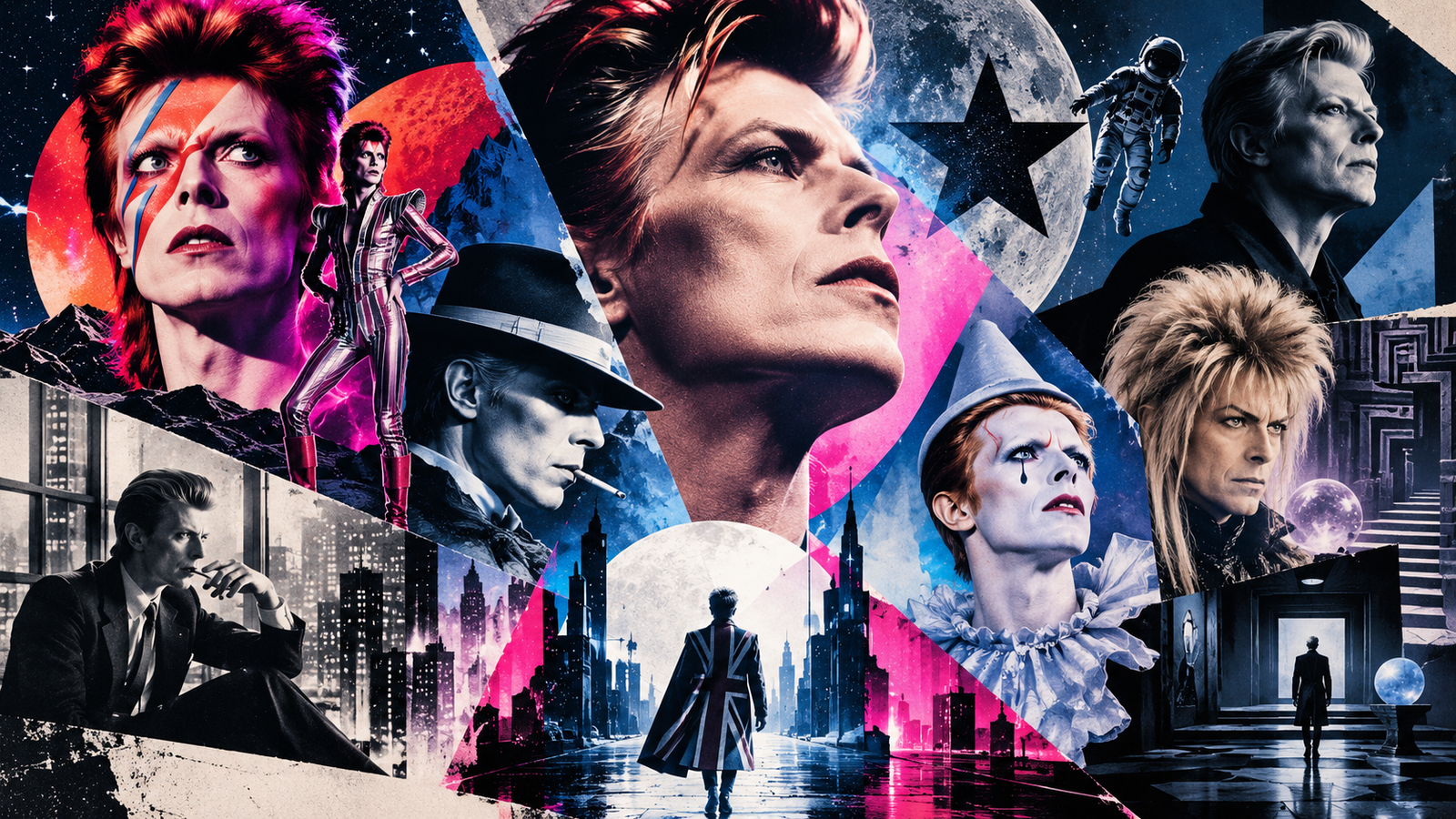
David Bowie was never just a rockstar. He was a shapeshifter, a provocateur, and an architect of sound and image. Whether stepping onto a stage as Ziggy Stardust or quietly releasing a jazz-laced swan song in Blackstar, Bowie operated on his own creative frequency.
This piece looks beyond the glitter and the glam to trace the arc of an artist who refused to stand still. From his suburban beginnings in South London to his transformation into a global cultural force, Bowie’s journey was a masterclass in reinvention. His legacy lives not just in music, but in the broader conversations he sparked about identity, artistry, and freedom of expression.
Early Life & Origins
David Bowie was born David Robert Jones on January 8, 1947, in Brixton, South London. The post-war world he entered was one of ration books and modest means, but it was also a place humming with cultural transition. His family moved to the suburb of Bromley when he was six, a quieter setting where Bowie’s fascination with music, art, and performance began to take shape.
From a young age, he was captivated by American rock and roll, especially artists like Little Richard and Elvis Presley. At school, he showed a flair for art and design, while also picking up the saxophone under the influence of his half-brother Terry, who introduced him to jazz and beat literature. Terry’s later struggles with mental health would deeply affect Bowie and echo throughout his work.
The suburban stillness of Bromley gave Bowie both space and reason to imagine new worlds. Surrounded by the safety of middle-class conformity, he began experimenting with music, fashion, and identity, sensing early on that self-expression could be a way out, or at least a way through. That curiosity became the foundation for a career built on transformation.
Rise to Fame
David Bowie’s first brush with real success came in 1969 with the release of “Space Oddity.” Timed eerily close to the Apollo 11 moon landing, the song introduced Major Tom, a character floating through space and loneliness. It struck a chord with the public and earned Bowie his first hit in the UK. Still, the years that followed saw him struggling to find a consistent audience, experimenting with styles that didn’t quite stick—until he stopped trying to blend in.
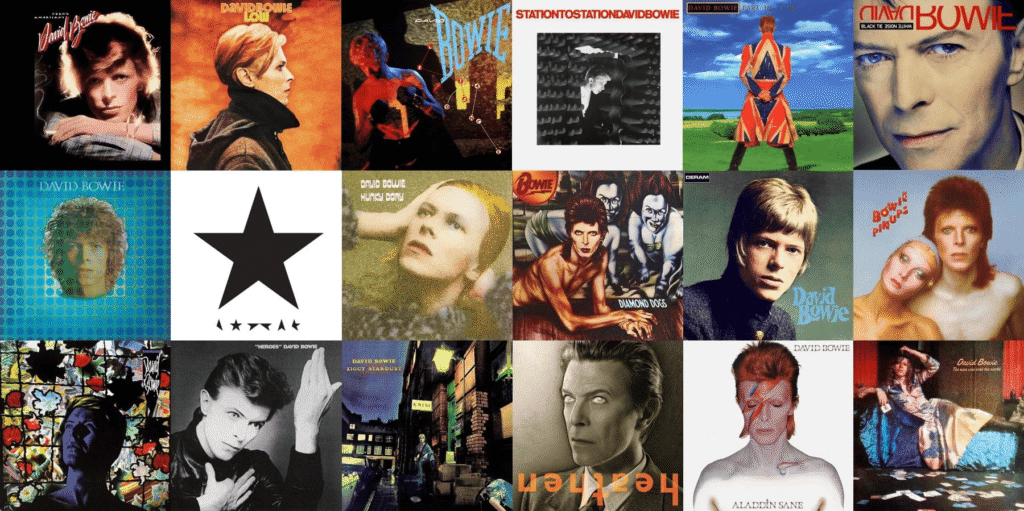
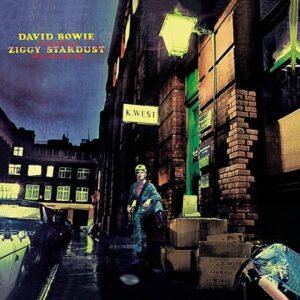
In 1972, Bowie reintroduced himself as Ziggy Stardust, a gender-bending alien rockstar wrapped in glitter and danger. The Rise and Fall of Ziggy Stardust and the Spiders from Mars was more than an album. It was a concept, a performance, and a bold rejection of musical and social norms. Ziggy’s sound pulled from glam rock, science fiction, and raw theatricality, combining distorted guitars with a sneer that felt both cosmic and intimate.
Audiences were stunned. Some saw a genius pushing boundaries, others saw pure provocation. Either way, no one looked away. Bowie had created a persona so vivid that it threatened to eclipse the man himself. His ability to embody a character while still delivering deeply personal music set him apart. Ziggy made Bowie a star, but also showed him the limits of living inside a myth. Just as the world was catching on, he killed the character on stage in 1973, ready for the next transformation.
Reinvention & Evolution
David Bowie never stayed in one skin for long. After retiring Ziggy Stardust, he unveiled Aladdin Sane in 1973, a sharper, edgier persona described as “Ziggy goes to America.” With a lightning bolt across his face and glam rock still pulsing in the background, this version of Bowie flirted with chaos and theatrical excess, mirroring the fractured state of the world around him.
By the mid-70s, Bowie turned again, this time channeling a colder, more enigmatic figure known as The Thin White Duke. Dressed in monochrome and singing with detached precision, the Duke emerged during Bowie’s cocaine-fueled time in Los Angeles. The sound shifted toward blue-eyed soul and funk on Young Americans and Station to Station, proving he could slide between genres without ever losing creative control.
His move to Berlin in the late 70s marked one of his most radical reinventions. Seeking escape from the excess, Bowie teamed up with Brian Eno for what would become the Berlin Trilogy—Low, “Heroes”, and Lodger. These records embraced ambient textures, electronic minimalism, and experimental structures that influenced countless artists in the decades to come. The trilogy stripped away ego and re-centered Bowie as a musician willing to take genuine artistic risks.
Alongside his own work, Bowie helped shape the sounds of others. He co-wrote and produced for Iggy Pop, lending his influence to The Idiot and Lust for Life, two of Pop’s most vital solo albums. Whether through direct collaboration or sonic inspiration, Bowie operated as both creator and catalyst. His transformations weren’t just about style—they were about constantly expanding the boundaries of what pop music could be.
Cultural Impact
David Bowie didn’t just change music—he changed how people saw themselves. His fearless approach to fashion and gender expression challenged rigid norms at a time when conformity ruled mainstream culture. Whether wearing sequins and platform boots or slipping into a sharply tailored suit, Bowie used clothing as a tool of transformation. He made androgyny visible, seductive, and powerful, opening doors for generations to explore identity on their own terms.
Performance was never just performance for Bowie. Every appearance was an act of intentional art, whether on stage, in a music video, or during an offbeat talk show interview. He blurred the line between the real and the invented, showing that authenticity could be found even in artifice. This tension between persona and person became a central theme in his work and an enduring influence on artists across genres.
Bowie’s cultural reach extended beyond music. He left his mark on film through roles in The Man Who Fell to Earth, Labyrinth, and The Hunger, often playing characters who mirrored his otherworldly aura. He understood the power of visual storytelling and used it to explore alienation, fame, and transformation from multiple angles.
More than a trendsetter, Bowie became a symbol of possibility. His presence in the public eye gave people permission to be fluid, strange, defiant, and bold. His influence ripples through fashion designers, pop stars, filmmakers, and activists who saw in him a blueprint for self-invention. In the realm of identity politics, Bowie didn’t preach—he embodied. And for many, that was more radical than a manifesto.
Later Career & Final Works
The 1990s saw David Bowie stepping away from the spotlight without ever fully disappearing. He explored industrial sounds on Outside, dabbled in drum and bass with Earthling, and reunited with longtime collaborators for projects that felt more like quiet reinventions than major comebacks. While the mainstream drifted elsewhere, Bowie remained creatively restless, uninterested in playing to nostalgia.
In the 2000s, health issues forced him into a more private life. After a heart attack in 2004, he largely retreated from public view, fueling speculation that his recording days were behind him. But Bowie had one final transformation in mind—one that would be his most poignant.
In 2013, he surprised the world with The Next Day, an album that looked back without being trapped in the past. It was sharp, self-aware, and full of sly references to his earlier selves. But it was Blackstar, released just two days before his death in January 2016, that delivered his most haunting farewell.
Blackstar is Bowie at his most enigmatic and fearless. Drawing from jazz, experimental rock, and cryptic lyricism, the album wrestles with mortality, identity, and legacy. Songs like “Lazarus” read like messages from beyond, steeped in vulnerability and theatrical grace. It wasn’t just an album—it was a final performance, orchestrated with the same level of precision and vision that defined his entire career.
Bowie didn’t fade out. He exited with a statement, leaving behind a record that felt like both a curtain call and a cosmic transmission. In facing death, he gave us one last act of transformation.
Legacy
David Bowie remains one of the most singular figures in music and cultural history. Few artists have moved so effortlessly between sounds, styles, and selves, and even fewer have done it with such purpose and precision. He was never chasing trends—he was building new worlds.
More than a musician, Bowie was a mirror and a map. He reflected the times while pointing toward the future, always inviting his audience to evolve with him. His influence is everywhere, not just in sound but in the courage to be different, to shift, to start over.