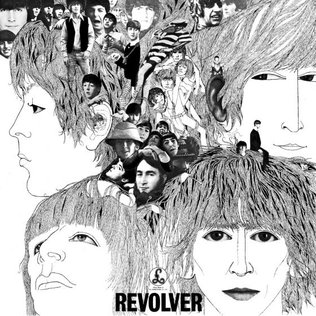
Released on 5 August 1966, Revolver captures The Beatles at a remarkable moment in their development. Less than a year after Rubber Soul had demonstrated their growing artistic ambitions, the band returned with an album that pushed their songwriting, arrangements and recording techniques into unfamiliar territory.
The musical variety is astonishing. George Harrison’s biting “Taxman” opens with an aggressive guitar-driven arrangement, while “Eleanor Rigby” replaces conventional rock instrumentation with a dramatic string octet. Elsewhere, “Here, There and Everywhere” showcases Paul McCartney’s gift for delicate melody, and “Tomorrow Never Knows” transforms John Lennon’s psychedelic vision into a hypnotic collage of manipulated sounds.
Indian musical influences, orchestral arrangements, psychedelic experimentation and infectious guitar pop coexist across fourteen tracks. Lennon, McCartney and Harrison each bring distinctive ideas, supported by producer George Martin and engineer Geoff Emerick, whose contributions help give the recordings their extraordinary character.
Not every song possesses the same emotional depth or musical sophistication, and the album’s abrupt stylistic changes occasionally challenge its cohesion. Nevertheless, Revolver succeeds because its experimentation is supported by exceptional songwriting.
More than six decades after its release, it remains one of The Beatles’ most adventurous and rewarding records, an album whose reputation rests as much upon the quality of its music as its historical influence.
The Making of Revolver: Recording and Songwriting
A New Chapter at EMI Studios
By the spring of 1966, The Beatles were approaching recording with greater creative freedom. Following the demanding schedule of previous years, the group had enjoyed an extended break, giving them an opportunity to develop new ideas away from the pressures of touring and constant public appearances.
Recording for Revolver began at EMI Studios in London on 6 April 1966, with the final new song recorded on 21 June. Working with George Martin and Geoff Emerick, who had recently become their principal recording engineer, The Beatles embarked upon some of their most adventurous sessions.
Their first recording was “Tomorrow Never Knows”, an extraordinary starting point. Built around a persistent drone and Lennon’s hypnotic vocal, the composition incorporated tape loops, manipulated sounds and unconventional production techniques that challenged established studio practices.
The sessions represented an important change in the band’s approach. Recording was no longer simply about capturing performances; the studio was becoming an instrument through which entirely new musical ideas could be realised.
Significantly, The Beatles were still a touring group during this period. Their final commercial concert would take place in San Francisco on 29 August 1966, several weeks after Revolver‘s release. The album therefore emerged during their transition towards a studio-focused career, rather than after they had already abandoned live performances.
Lennon and McCartney’s Contrasting Creative Directions
One of Revolver‘s defining qualities is the growing distinction between Lennon and McCartney’s songwriting.
Lennon increasingly explored introspection, altered perception and unconventional musical structures. “I’m Only Sleeping” transforms an everyday desire for rest into an atmospheric composition, while “She Said She Said” draws upon a disturbing personal encounter to create something restless and psychologically unsettling.
“Tomorrow Never Knows” moves further into unfamiliar territory. Inspired by The Psychedelic Experience, a book by Timothy Leary, Ralph Metzner and Richard Alpert drawing upon The Tibetan Book of the Dead, Lennon developed a composition that departed dramatically from conventional pop songwriting.
McCartney pursued an equally ambitious direction through melody, arrangement and storytelling.
“Eleanor Rigby” examines loneliness through fictional characters, while “Here, There and Everywhere” offers an intimate expression of romantic devotion. “For No One” approaches relationships from the opposite perspective, portraying emotional separation with devastating restraint.
His contributions also include the exuberant “Good Day Sunshine” and the playful “Yellow Submarine”, demonstrating an ability to embrace contrasting moods without sacrificing his melodic instincts.
These increasingly distinctive approaches strengthened the album. Lennon and McCartney were exploring different creative interests, but their contrasting perspectives gave Revolver an unusually broad emotional and musical range.
George Harrison’s Growing Confidence
George Harrison’s contributions represent another important development. For the first time, he received three compositions on a Beatles album: “Taxman”, “Love You To” and “I Want to Tell You”.
“Taxman” provides a confrontational opening, combining criticism of Britain’s taxation system with an aggressive guitar-driven arrangement. McCartney’s biting lead guitar solo adds further intensity, making it one of Harrison’s most confident early compositions.
“Love You To” reveals a different side of his musical interests. Building upon his introduction of the sitar on Rubber Soul, Harrison explored Indian classical influences more extensively, incorporating sitar, tabla and drone-based textures into a composition far removed from conventional British pop.
“I Want to Tell You” examines the frustration of struggling to communicate thoughts and feelings, its unusual harmonic tensions reinforcing the uncertainty of the lyrics.
Together, these songs demonstrate Harrison’s growing independence. His contributions were becoming an increasingly important part of The Beatles’ creative identity rather than occasional additions to Lennon and McCartney’s material.
George Martin, Geoff Emerick and the Changing Role of the Studio
The achievements of Revolver cannot be separated from the musicians’ technical collaborators.
Martin’s musical knowledge proved invaluable on recordings such as “Eleanor Rigby”, where his string arrangement brought an urgent, dramatic character to McCartney’s composition. His ability to translate the band’s ideas into practical arrangements helped broaden their musical possibilities.
Emerick brought a willingness to challenge established recording practices. His approach to microphone placement, compression and instrumental recording contributed to the album’s distinctive sound, particularly the powerful drums on “Tomorrow Never Knows”.
The sessions also benefited from artificial double tracking, developed at EMI by technical engineer Ken Townsend. By using linked tape machines to create a delayed version of a recorded performance, the technique allowed vocals and instruments to be thickened without requiring an additional performance.
Alongside backwards recordings, tape manipulation and variable-speed techniques, these developments expanded the band’s creative options.
Not every technique was new, and The Beatles were far from the only musicians experimenting with recording technology. Their achievement lay in integrating these possibilities into memorable compositions rather than treating them as novelties.
The Sound of Revolver: Psychedelia, Classical Music and Studio Experimentation

Tomorrow Never Knows: Pushing the Boundaries of Recording
Few recordings demonstrate The Beatles’ experimental ambitions more vividly than “Tomorrow Never Knows”.
Although it closes Revolver, it was the first song recorded for the album. Built around a largely unchanging C-major foundation, the composition abandons conventional harmonic development in favour of rhythm, texture and atmosphere.
Ringo Starr’s powerful drumming provides its momentum, while George Harrison’s tambura contributes to the sustained drone. Around this foundation, tape loops introduce strange, shifting sounds, including a manipulated vocal recording that produces a seagull-like effect.
Lennon’s voice was also processed through a rotating Leslie speaker, normally associated with Hammond organs, giving portions of his performance an eerie, swirling quality.
The recording’s achievement lies in its control. Despite the apparent chaos of its manipulated sounds, the underlying rhythm remains compelling, allowing the experimentation to develop without losing direction.
Rather than simply adding unusual effects to a conventional composition, The Beatles created a recording whose identity depended upon the possibilities of the studio itself.
Backwards Guitars and Unusual Instrumental Textures
The album’s experimentation extends beyond its closing track.
“I’m Only Sleeping” features Harrison’s backwards guitar lines, carefully developed to produce unusual attacks and decays when the recording was reversed. The effect complements Lennon’s languid vocal, creating the impression of drifting between sleep and wakefulness.
“She Said She Said” takes a more abrasive approach. Its distorted guitars, shifting rhythmic accents and restless performance establish a sense of psychological unease without relying upon elaborate studio effects.
Meanwhile, “And Your Bird Can Sing” demonstrates the band’s ability to create excitement through comparatively conventional instrumentation. Its exhilarating harmonised guitar figures give the recording an irresistible momentum.
These songs reveal an important aspect of Revolver: experimentation was not confined to technical manipulation. The Beatles were also discovering new possibilities through instrumental arrangements and the interaction between their performances.
Eleanor Rigby: Classical Music Meets Pop Songwriting
If “Tomorrow Never Knows” represents Revolver at its most psychedelic, “Eleanor Rigby” demonstrates how unconventional the album could be through arrangement alone.
Rather than using guitars, bass and drums, the recording features a string octet arranged by George Martin. Four violins, two violas and two cellos provide a stark accompaniment to McCartney’s account of loneliness and isolation.
The strings are unusually forceful, their sharp, closely recorded passages creating an almost percussive intensity. This contrasts with McCartney’s restrained vocal, giving the song an emotional tension that conventional pop instrumentation might not have achieved.
The Beatles had previously incorporated classical instrumentation into their music, notably on “Yesterday”, but “Eleanor Rigby” represents a more dramatic departure from their established sound.
Its success rests upon the relationship between arrangement and composition. The strings are not merely decorative; they are fundamental to the song’s emotional character.
Love You To and Harrison’s Exploration of Indian Music
Harrison’s growing interest in Indian classical music takes a significant step forward on “Love You To”.
Where “Norwegian Wood” had introduced the sitar into a largely Western folk arrangement, “Love You To” places Indian instrumentation and musical ideas much closer to the centre of the composition.
Harrison performs on sitar, McCartney contributes tambura, and tabla player Anil Bhagwat provides the distinctive percussion. The sustained drone and rhythmic patterns create a musical atmosphere unlike anything The Beatles had previously attempted on an album.
Harrison’s understanding of Indian classical music was still developing, and the recording should not be mistaken for a fully traditional Indian composition. Nevertheless, it represents a serious exploration of a musical tradition that would become increasingly important to his artistic development.
The result is one of Revolver‘s most distinctive recordings, expanding the band’s musical vocabulary while introducing a striking contrast to the surrounding songs.
Melody Remains at the Heart of the Album
For all its unconventional sounds, Revolver remains an album built upon exceptional melodies and vocal arrangements.
“Here, There and Everywhere” is among McCartney’s most beautifully controlled compositions, its delicate melody and carefully arranged harmonies creating an atmosphere of intimacy.
“For No One” achieves a similarly understated effect through a different arrangement, with its distinctive keyboard accompaniment and Alan Civil’s elegant French horn solo reinforcing the song’s melancholy.
“Good Day Sunshine” provides a brighter contrast, its piano-driven arrangement and exuberant vocals offering a burst of optimism.
These recordings demonstrate that The Beatles were not abandoning their established strengths. They were discovering how those strengths could accommodate an increasingly diverse range of musical ideas.
The Lyrics of Revolver: Loneliness, Love and Psychedelic Exploration

Eleanor Rigby: A Portrait of Loneliness
One of Revolver‘s greatest lyrical achievements is its willingness to move beyond conventional romantic subjects.
“Eleanor Rigby” is perhaps the clearest example. McCartney constructs a narrative around two isolated characters: Eleanor Rigby, whose life passes largely unnoticed, and Father McKenzie, a clergyman whose work seems to bring him little companionship.
The song’s emotional power comes from its restraint. McCartney provides fragments of their lives, leaving listeners to imagine the circumstances behind their loneliness.
Neither character receives a comforting resolution. Their stories eventually intersect, but only in circumstances that emphasise the absence of meaningful human connection.
It is a remarkably affecting piece of storytelling, demonstrating McCartney’s ability to explore difficult subjects through concise, accessible songwriting.
For No One and Here, There and Everywhere: Two Sides of Love
McCartney’s exploration of relationships becomes particularly sophisticated through the contrast between “Here, There and Everywhere” and “For No One”.
The former celebrates romantic devotion with unusual tenderness. Its straightforward language creates a sense of sincerity, allowing the melody and vocal performance to communicate much of the emotional warmth.
“For No One” approaches love from the opposite direction, depicting a relationship in which one partner has already moved on while the other struggles to accept the separation.
Rather than relying upon dramatic confrontation, McCartney describes the emotional distance between two people who no longer experience their relationship in the same way.
The detached narrative perspective makes the song particularly devastating. There is no reconciliation, only the painful recognition that affection cannot always be recovered.
Together, these compositions demonstrate McCartney’s ability to explore contrasting emotional experiences with remarkable precision.
Lennon: Dreams, Identity and Altered Perception
Lennon’s lyrics increasingly blur the boundaries between everyday experience and psychological uncertainty.
“I’m Only Sleeping” celebrates withdrawal from the demands of the outside world, its relaxed humour suggesting a narrator perfectly content to escape the constant expectations surrounding him.
“She Said She Said” is considerably more unsettling. Inspired by a conversation with actor Peter Fonda during an LSD experience in 1965, the song transforms a disturbing encounter into a fragmented reflection on identity, childhood and mortality.
“Tomorrow Never Knows” takes this exploration further, drawing upon psychedelic literature to examine consciousness and the surrender of the individual ego.
Rather than presenting conventional narratives, these songs rely upon suggestion, atmosphere and ambiguity. Lennon increasingly trusts listeners to interpret experiences that resist straightforward explanation.
Harrison’s Social Commentary and Inner Conflict
Harrison brings another perspective, beginning with the political satire of “Taxman”.
Written in response to the exceptionally high rates of taxation faced by wealthy earners in Britain, the song expresses his frustration through direct, sarcastic language.
References to Harold Wilson and Edward Heath give it an unusually topical character. Its complaints can appear self-interested, particularly given Harrison’s considerable success, but the humour and confrontational delivery make it an effective piece of satire.
“I Want to Tell You” explores a more personal frustration: the inability to express thoughts and feelings clearly.
“Love You To”, meanwhile, reflects upon the passing of time and the importance of love and physical experience within a limited lifespan.
These compositions demonstrate Harrison’s increasing willingness to explore subjects beyond conventional romance, anticipating the philosophical concerns that would become central to his later work.
Humour and Ambiguity
Not every song on Revolver pursues emotional depth or philosophical reflection.
“Yellow Submarine” offers a playful escape into an imaginary world, while “Good Day Sunshine” celebrates romantic happiness without unnecessary complications.
“Doctor Robert” adopts a more mischievous tone, presenting an enigmatic figure associated with unconventional remedies and suggesting the drug culture increasingly surrounding the band.
“And Your Bird Can Sing” is more cryptic, its dismissive attitude and ambiguous lyrics inviting interpretation without providing an obvious explanation.
These lighter compositions prevent the album from becoming overwhelmingly introspective. Revolver does not attempt to establish a unified lyrical narrative; its appeal lies partly in the variety of perspectives that Lennon, McCartney and Harrison bring to their writing.
Revolver Tracklist: Sequencing and Consistency

Side One: An Extraordinary Opening Sequence
The original fourteen-track British release of Revolver embraces musical contrast from its opening moments.
“Taxman” establishes an aggressive, confrontational character before “Eleanor Rigby” abandons conventional rock instrumentation entirely. The transition is startling, yet it immediately demonstrates the band’s confidence in presenting radically different compositions alongside one another.
“I’m Only Sleeping” introduces a dreamlike atmosphere, followed by Harrison’s Indian-influenced “Love You To”. McCartney’s delicate “Here, There and Everywhere” then offers a moment of intimacy before the playful “Yellow Submarine” changes the mood once again.
Side one concludes with “She Said She Said”, whose restless guitars and unsettling lyrics provide a striking return to Lennon’s psychedelic interests.
The sequencing is adventurous, occasionally jarring and consistently engaging. Rather than establishing a single musical atmosphere, The Beatles allow each composition to retain its distinctive identity.
Side Two: From Melodic Pop to Psychedelic Experimentation
Side two begins with the infectious optimism of “Good Day Sunshine”, followed by the exhilarating guitar work of “And Your Bird Can Sing”.
“For No One” then introduces a dramatic change of mood, its restrained arrangement and melancholy atmosphere providing one of the album’s most affecting moments.
“Doctor Robert” restores the momentum with a lively guitar-driven performance, while Harrison’s “I Want to Tell You” introduces unusual harmonic tensions.
“Got to Get You into My Life” follows with an exhilarating brass-driven arrangement inspired by American soul music, before “Tomorrow Never Knows” brings the album to its extraordinary conclusion.
The closing track feels particularly appropriate. After thirteen compositions exploring an astonishing range of musical possibilities, Lennon ends the record by pushing beyond familiar pop structures altogether.
It is a conclusion that leaves the listener with a powerful sense of how dramatically The Beatles’ creative ambitions had expanded.
Does Revolver Have Any Weak Tracks?
For an album awarded a perfect 10/10, it is worth considering whether every composition reaches the same exceptional standard.
“Yellow Submarine” is perhaps the most obvious point of debate. Its playful simplicity makes it an enjoyable recording, but it lacks the emotional depth and musical sophistication of the album’s strongest material.
Nevertheless, its humour and accessibility provide a welcome change of pace, contributing to the record’s distinctive personality.
“Doctor Robert” is another comparatively modest composition. Its energetic performance is entertaining, but the songwriting feels less substantial than much of the surrounding material.
There is also the question of cohesion. Revolver‘s abrupt stylistic changes can make it feel less unified than Rubber Soul, whose warmer production and more restrained arrangements establish a comparatively consistent atmosphere.
Yet Revolver succeeds through a different approach. Its identity emerges from the confidence with which The Beatles pursue contrasting musical possibilities, maintaining an extraordinary standard of songwriting across an ambitious collection.
The occasional weaker moment does little to diminish that achievement. A perfect rating need not imply that every song is equally accomplished; in this case, it reflects the exceptional quality of the album as a whole.
Best Songs on Revolver: Standout Tracks and Performances
With fourteen remarkably varied compositions, choosing Revolver‘s finest moments is difficult. Nevertheless, several recordings stand out as particularly impressive examples of The Beatles’ creativity.
Eleanor Rigby
“Eleanor Rigby” is among McCartney’s greatest achievements, transforming a seemingly simple story about loneliness into one of The Beatles’ most emotionally powerful recordings.
Its greatest strength is the economy of its storytelling. McCartney establishes two vividly drawn characters through a handful of observations, allowing listeners to imagine the lives and disappointments behind them.
The string arrangement gives the song an urgent, almost confrontational character, preventing its melancholy from becoming overly sentimental.
What makes “Eleanor Rigby” exceptional is how naturally its storytelling, melody and arrangement complement one another. It is both unconventional and immediately affecting, a remarkable achievement for a composition lasting little more than two minutes.
I’m Only Sleeping
“I’m Only Sleeping” is one of Lennon’s most distinctive compositions, capturing the peculiar comfort of withdrawing from everyday life.
Its gently drifting melody and relaxed vocal performance create an atmosphere that feels almost suspended in time. Even the recording’s unusual instrumental textures contribute to its unhurried character.
There is something particularly appealing about the contrast between the song’s intricate construction and its apparent effortlessness.
Rather than presenting experimentation as something overwhelming, The Beatles use it to create a beautifully understated musical experience.
Here, There and Everywhere
“Here, There and Everywhere” showcases McCartney’s extraordinary melodic instincts, offering one of the most elegant love songs in The Beatles’ catalogue.
Its gently unfolding melody and carefully controlled vocal harmonies establish an atmosphere of intimacy, while the restrained arrangement allows the composition’s emotional warmth to remain central.
The transitions between its musical phrases feel effortless, concealing the sophistication of its construction.
Unlike the album’s more adventurous recordings, the song requires little in the way of unusual instrumentation or elaborate studio effects. Its achievement rests upon the quality of the songwriting itself.
For No One
Few Beatles songs capture the quiet devastation of a failing relationship as effectively as “For No One”.
McCartney’s detached narrative perspective gives the composition an unusual emotional character. Rather than describing dramatic heartbreak, he captures the painful recognition that a relationship has already ended.
His understated vocal performance is particularly effective, conveying resignation without becoming cold or indifferent.
The French horn solo provides a beautifully melancholic instrumental passage, deepening the song’s emotional atmosphere without overwhelming its simplicity.
“For No One” is remarkable for how much it communicates through restraint. Its concise structure, memorable melody and carefully judged arrangement make it one of McCartney’s finest compositions.
Tomorrow Never Knows
“Tomorrow Never Knows” is Revolver‘s most extraordinary recording, and arguably one of the most adventurous compositions The Beatles ever released.
Its hypnotic rhythm and constantly shifting textures create an atmosphere unlike anything else on the album. Lennon’s processed vocal seems to emerge from within the soundscape rather than sit conventionally above it.
Yet the song’s underlying musical idea is surprisingly direct. Its limited harmonic movement allows the rhythm and changing instrumental textures to establish a compelling sense of momentum.
What makes “Tomorrow Never Knows” exceptional is its ability to sound radical without becoming directionless. The recording remains immersive and exciting, even after its unconventional techniques have become familiar.
As the album’s closing track, it provides a breathtaking conclusion, suggesting musical possibilities The Beatles would continue exploring throughout their later career.
Other Notable Highlights
Beyond these five compositions, Revolver contains several recordings that deserve recognition.
“Taxman” is a superb opener, combining Harrison’s sharp delivery with an aggressive arrangement. “And Your Bird Can Sing” offers some of the band’s most exhilarating guitar work, while “She Said She Said” captures psychological unease through its restless performance.
“Got to Get You into My Life” is another standout, demonstrating McCartney’s command of soul-influenced songwriting through its powerful brass arrangement and infectious vocal.
Harrison’s “Love You To” also deserves credit for its adventurous musical direction, adding a distinctive character to the album.
The strength of these additional compositions demonstrates just how difficult it is to identify a definitive selection of highlights. Revolver contains remarkably few moments that feel dispensable.
The Legacy of Revolver: A New Era for The Beatles
Redefining the Possibilities of Popular Music
When Revolver appeared in August 1966, popular music was undergoing considerable change.
Artists such as Bob Dylan, The Beach Boys and The Byrds were also challenging established conventions, exploring increasingly sophisticated songwriting, arrangements and recording techniques.
Revolver was therefore part of a broader creative movement rather than the sole catalyst for musical innovation.
What distinguished The Beatles’ contribution was the extraordinary range of ideas they brought together. The album demonstrated that commercially successful pop musicians could pursue unconventional arrangements and experimental sounds without abandoning memorable melodies.
Its importance extended beyond individual recording techniques. Revolver helped establish the album as a format through which popular musicians could present a broader and more ambitious artistic vision.
The Growing Importance of the Recording Studio
Perhaps Revolver‘s most significant legacy lies in its approach to recording.
The Beatles had already experimented with studio techniques, but this album made those possibilities central to several of its most distinctive compositions.
“Tomorrow Never Knows” was particularly important. Its manipulated sounds and complex production created a recording that could not be faithfully reproduced by the band’s conventional live setup.
Other compositions demonstrated how unusual instrumental treatments and recording methods could reshape familiar musical ideas.
These techniques were not entirely unprecedented. Experimental composers and other popular musicians had already explored tape manipulation, electronic sounds and unconventional recording practices.
Nevertheless, Revolver brought such approaches into the work of one of the world’s most commercially successful groups, helping demonstrate their potential within mainstream popular music.
Its influence can be recognised in the increasingly adventurous studio productions of the late 1960s, particularly as psychedelic rock developed and artists began creating music specifically for the recording medium.
From Revolver to Sgt. Pepper
Revolver occupies a fascinating position between the relatively restrained Rubber Soul and the elaborate production of Sgt. Pepper’s Lonely Hearts Club Band.
Its recording sessions took place while The Beatles were still performing live, although their dissatisfaction with touring was becoming increasingly apparent.
After completing their final commercial tour in August 1966, the band could concentrate more fully on studio recording. That freedom would become particularly evident on Sgt. Pepper, released in June 1967.
Yet Revolver should not be regarded simply as a transitional album.
Unlike the more unified presentation of Sgt. Pepper, it embraces musical contrast without attempting to establish an overarching concept. Its songs move freely between styles, allowing each composition to develop its own character.
For some listeners, this variety is precisely what makes Revolver so compelling. Its experimentation feels adventurous and spontaneous, while its finest melodies retain the immediacy of The Beatles’ earlier work.
Why Revolver Still Matters
More than six decades after its release, Revolver remains remarkable not simply because of its historical innovations, but because its songs continue to stand on their own merits.
“Eleanor Rigby” remains a moving portrait of loneliness, “For No One” captures romantic disillusionment with extraordinary precision, and “Here, There and Everywhere” demonstrates McCartney’s exceptional melodic craftsmanship.
Meanwhile, “Tomorrow Never Knows” retains much of its unsettling originality. Even after decades of increasingly sophisticated recording technology, its hypnotic atmosphere remains distinctive.
The album’s diversity occasionally challenges its cohesion, and not every composition possesses the same ambition. Nevertheless, those contrasts contribute to its character, revealing a band willing to pursue unfamiliar ideas without abandoning its musical instincts.
That combination explains why Revolver continues to be celebrated as one of The Beatles’ greatest achievements. Its influence is considerable, but its enduring appeal rests upon the extraordinary quality of the music itself.
Revolver Review: Final Verdict and Rating
Revolver represents one of The Beatles’ greatest artistic achievements, capturing a band whose extraordinary songwriting abilities were matched by an increasingly adventurous approach to recording.
Its finest compositions are among the strongest of their career. “Eleanor Rigby” and “For No One” demonstrate McCartney’s remarkable emotional precision, while “Here, There and Everywhere” showcases his gift for melody. Lennon brings a contrasting perspective through the dreamlike “I’m Only Sleeping”, the restless “She Said She Said” and the psychedelic ambition of “Tomorrow Never Knows”. Harrison’s increasingly confident contributions further enrich the collection.
The production is equally impressive. Backwards guitars, manipulated tape loops, Indian instrumentation and orchestral arrangements give the album an extraordinary musical range, yet these techniques rarely overshadow the compositions themselves.
There are occasional weaknesses. “Doctor Robert” is comparatively modest, while the playful simplicity of “Yellow Submarine” may not appeal to every listener. The abrupt stylistic changes can also make Revolver feel less unified than Rubber Soul. Nevertheless, these imperfections are minor when measured against the quality of the wider collection.
What ultimately distinguishes Revolver is its ability to embrace such contrasting musical ideas without sacrificing the immediacy of its songwriting. Its finest moments are emotionally affecting, melodically sophisticated and endlessly rewarding, while its most adventurous recordings retain an extraordinary sense of discovery.
Official Tune Tempest Rating: 10/10
Revolver earns a 10/10 for its exceptional songwriting, fearless experimentation and remarkable musical diversity. Despite a handful of less substantial moments, it stands as one of The Beatles’ finest albums and a defining achievement in popular music.