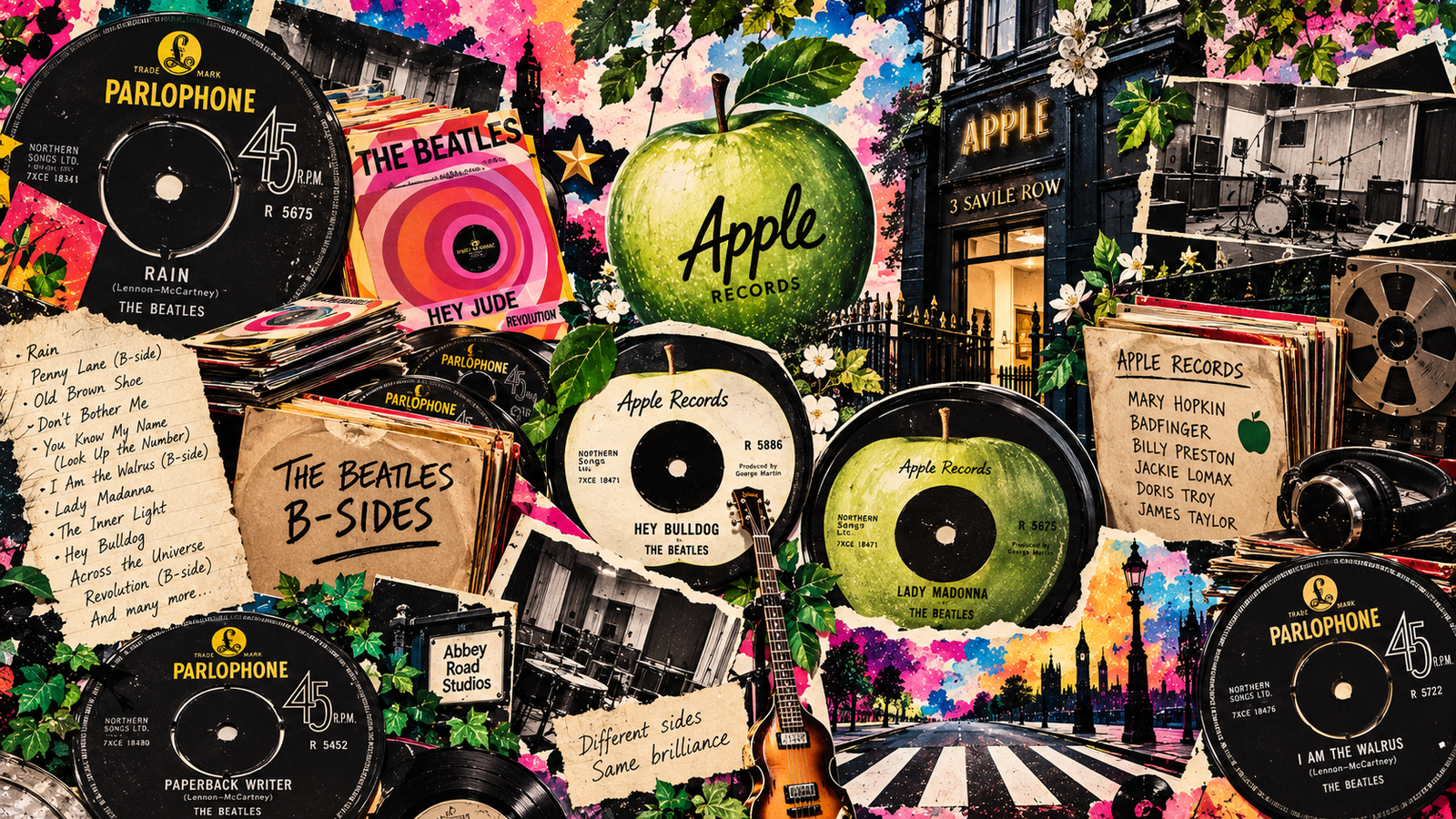
Some of The Beatles’ greatest recordings never appeared on their original British studio albums. From the irresistible energy of “She Loves You” and “I Want to Hold Your Hand” to the psychedelic experimentation of “Strawberry Fields Forever” and “Rain”, the band’s standalone singles contain some of the most important music of their career.
Throughout the 1960s, The Beatles frequently treated singles and albums as separate releases. Rather than simply extracting songs from their latest LPs, they often recorded new material specifically for the singles market. The result was an extraordinary collection of songs that developed alongside their studio albums without necessarily appearing on them.
This approach produced major hits such as “We Can Work It Out”, “Paperback Writer” and “Hey Jude”, but it also gave lesser-known recordings an opportunity to flourish. B-sides including “This Boy”, “Yes It Is”, “The Inner Light” and “Don’t Let Me Down” revealed musical ideas every bit as compelling as those found on the group’s celebrated albums.
Understanding this catalogue requires one important distinction. The Beatles’ British and American discographies differed considerably during the 1960s, with songs released independently in Britain often appearing on American LPs. Some of those configurations, particularly Magical Mystery Tour, subsequently became part of the internationally recognised album catalogue.
This guide follows the original British release history, concentrating on singles and B-sides that introduced material unavailable on contemporary UK studio albums. We’ll also explore significant EP recordings, alternate versions and selected rarities that help complete the story.
The Early Non-Album Singles (1962–1964): The Rise of Beatlemania
Before The Beatles became celebrated for their increasingly ambitious albums, their reputation was built largely upon the strength of their singles. Between 1962 and 1964, Lennon, McCartney, Harrison and Starr developed from promising newcomers into an international phenomenon, producing recordings that combined memorable melodies, energetic performances and increasingly sophisticated vocal arrangements.
Several of their biggest hits were kept off their original British LPs, making the singles an essential part of their early discography.
Love Me Do / P.S. I Love You (1962)
The Beatles’ debut British single, “Love Me Do“, was released on 5 October 1962, backed with “P.S. I Love You”.
Although both songs subsequently appeared on Please Please Me in March 1963, the original single recording of “Love Me Do” differs from the album version. Ringo Starr played drums on the single, whereas session musician Andy White performed on the album recording, with Starr contributing tambourine.
The distinction makes the single historically significant, even though neither composition qualifies as an exclusive non-album song.
Musically, “Love Me Do” is remarkably straightforward. Lennon’s harmonica provides its most recognisable feature, while the uncomplicated rhythm and close vocal interplay establish the sound of a group still developing its identity.
The single reached number 17 on the British chart. Modest compared with what followed, its success nevertheless marked the beginning of The Beatles’ extraordinary recording career.
From Me to You / Thank You Girl (1963)
Released on 11 April 1963, “From Me to You” demonstrated the growing confidence of the Lennon–McCartney partnership.
Its memorable vocal introduction, brisk rhythm and tightly arranged harmonies give the song an immediately recognisable character. The contrasting middle section introduces additional melodic variety, while Lennon’s harmonica maintains a connection with the group’s earliest recordings.
The composition is economical rather than elaborate, but that simplicity is central to its effectiveness. Every musical element supports the melody, creating a recording that captures The Beatles’ early appeal.
The B-side, “Thank You Girl”, is similarly energetic. Conceived as an expression of appreciation towards the band’s growing audience, it combines enthusiastic vocals, driving percussion and prominent harmonica.
Although less distinctive than its A-side, “Thank You Girl” demonstrates an important characteristic of the group’s singles: even their accompanying tracks were frequently original compositions rather than disposable recordings.
Neither song appeared on a contemporary British studio album, making the release an important early example of The Beatles’ independent singles catalogue.
She Loves You / I’ll Get You (1963)
By the summer of 1963, Beatlemania was transforming The Beatles into Britain’s most celebrated pop group.
Released on 23 August, “She Loves You” captured that excitement with extraordinary immediacy. Rather than beginning with a conventional instrumental introduction, the recording launches directly into an explosive vocal declaration, establishing its energetic character from the opening seconds.
The memorable refrain, close harmonies and forceful drumming create a performance that seems inseparable from the enthusiasm surrounding the band’s early success.
Its lyrical perspective is equally interesting. Instead of expressing the narrator’s own romantic feelings, Lennon and McCartney present a conversation in which someone encourages a friend to recognise that a relationship can be repaired. This relatively simple departure from conventional love-song writing gives the composition additional personality.
The B-side, “I’ll Get You”, offers a gentler contrast. Its relaxed rhythm, conversational lyrics and close Lennon–McCartney harmonies reveal a more understated approach to songwriting.
Although inevitably overshadowed by “She Loves You”, the recording possesses considerable melodic charm. It also demonstrates how much worthwhile material The Beatles were producing outside their albums during this period.
I Want to Hold Your Hand / This Boy (1963)
Released in Britain on 29 November 1963, “I Want to Hold Your Hand” became one of the defining recordings of The Beatles’ early career.
Its subsequent American success helped ignite the international explosion of Beatlemania, transforming the group into a worldwide phenomenon.
Musically, the song’s appeal is immediate. A forceful opening guitar figure establishes the rhythm, while enthusiastic vocals and carefully constructed harmonies create irresistible momentum. The arrangement is more powerful than much of the band’s earlier material, demonstrating their growing ability to generate excitement through contrasting instrumental and vocal textures.
Yet the B-side, “This Boy”, reveals a very different aspect of their abilities.
Built around beautifully arranged three-part harmonies, the composition draws upon American close-harmony traditions while developing a distinctly Beatles character. Its restrained verses provide the setting for Lennon’s passionate lead vocal in the middle section, creating a dramatic emotional contrast.
“This Boy” is among the finest B-sides of the group’s early career. Its sophistication demonstrates that The Beatles’ musical strengths extended well beyond energetic chart singles, revealing an increasingly ambitious approach to harmony and emotional expression.
The Long Tall Sally EP (1964)
Not every important Beatles recording outside the original British albums appeared on a conventional single.
Released on 19 June 1964, the Long Tall Sally EP introduced four recordings unavailable on the group’s contemporary UK LPs: “Long Tall Sally”, “I Call Your Name”, “Slow Down” and “Matchbox”.
Three were interpretations of American rock and roll or rhythm and blues material, reflecting the influences that had shaped The Beatles during their years performing in Liverpool and Hamburg.
McCartney delivers an exhilarating vocal performance on “Long Tall Sally”, originally made famous by Little Richard, while Lennon’s forceful singing gives Larry Williams’ “Slow Down” much of its energy. “Matchbox” places Starr on lead vocals for a relaxed interpretation of Carl Perkins’ rockabilly composition.
The EP’s original Lennon–McCartney contribution, “I Call Your Name”, is particularly interesting. Its unusual rhythmic shifts, including a ska-influenced passage, distinguish it from the group’s more conventional early pop recordings.
Although less celebrated than their landmark singles, Long Tall Sally provides a valuable connection between The Beatles’ early live repertoire and their developing studio identity.
I Feel Fine / She’s a Woman (1964)
The Beatles ended 1964 with one of their most adventurous singles to date.
Released on 27 November, “I Feel Fine” opens with a burst of guitar feedback, an unusually prominent use of the effect on a mainstream pop recording at the time.
Beyond that striking introduction, the song is built around an inventive guitar riff, a confident rhythm section and Lennon’s relaxed vocal delivery. The interplay between the instruments suggests a group becoming increasingly interested in the possibilities of recorded sound.
The B-side, “She’s a Woman”, is equally revealing.
Driven by McCartney’s energetic singing, the recording draws heavily upon rhythm and blues. Its offbeat guitar accents and unusually spacious arrangement create a distinctive groove, while the rhythm section maintains an insistent momentum.
Rather than simply filling the reverse side of a hit single, “She’s a Woman” presents a convincing alternative musical direction.
By the end of 1964, The Beatles had progressed from the direct charm of “Love Me Do” to a more rhythmically inventive and technically adventurous sound. Their singles were becoming an increasingly important outlet for experimentation.
The Singles Become More Ambitious (1965–1966)
During 1965 and 1966, The Beatles’ songwriting became more sophisticated, their arrangements more adventurous and their use of the recording studio increasingly imaginative.
Albums such as Help!, Rubber Soul and Revolver documented this transformation, but several important recordings remained exclusive to singles. Their B-sides, in particular, began revealing musical ideas that could comfortably stand alongside the group’s most accomplished album tracks.
Ticket to Ride / Yes It Is (1965)
Released on 9 April 1965, “Ticket to Ride” marked a significant development in The Beatles’ sound, particularly through its distinctive drum pattern and heavier guitar arrangement.
Although the A-side subsequently appeared on Help!, its accompanying B-side, “Yes It Is”, remained outside the original British studio albums.
Written primarily by Lennon, “Yes It Is” explores romantic regret through delicate three-part harmonies and Harrison’s expressive guitar playing.
The composition shares certain characteristics with “This Boy”, particularly its emphasis on close vocal arrangement. However, its atmosphere is considerably more melancholy, reflecting the increasingly introspective direction of Lennon’s songwriting.
Harrison’s use of a volume pedal gives the guitar an almost vocal quality, allowing sustained notes to emerge gradually beneath the harmonies. The effect complements the song’s emotional uncertainty without overwhelming its understated arrangement.
Although rarely discussed alongside The Beatles’ most celebrated ballads, “Yes It Is” remains one of their most rewarding mid-1960s B-sides.
Help! / I’m Down (1965)
The release of “Help!” on 23 July 1965 provided another example of The Beatles combining commercial accessibility with increasingly varied musical interests.
While the title track appeared on the accompanying album, its B-side, “I’m Down”, embraced an entirely different style.
Written primarily by McCartney, the composition draws heavily upon the exuberant rock and roll of Little Richard. McCartney delivers a forceful vocal performance, moving between shouted phrases and increasingly animated melodic passages.
The arrangement is deliberately direct, featuring driving guitars, energetic drumming and a prominent organ contribution from Lennon.
Rather than pursuing the sophistication of the group’s emerging studio work, “I’m Down” reconnects with the excitement of their earliest influences. It also became a memorable part of their live repertoire, including their performance at Shea Stadium in August 1965.
The recording demonstrates that even as The Beatles explored more introspective material, they remained capable of delivering exhilarating rock and roll.
Day Tripper / We Can Work It Out (1965)
Released on 3 December 1965, “Day Tripper” and “We Can Work It Out” formed a double A-sided single, giving both compositions equal prominence.
Neither appeared on the original British edition of Rubber Soul, despite being released on the same day as the album.
“Day Tripper” is built around one of the most recognisable guitar riffs in The Beatles’ catalogue. Its blues-influenced arrangement combines a driving rhythm with tightly controlled instrumental interplay, while Lennon’s playful vocal delivery complements lyrics that contain a degree of ambiguity absent from much of the group’s earlier romantic songwriting.
“We Can Work It Out” offers a contrasting approach.
Written primarily by McCartney, the composition explores disagreement and reconciliation through an accessible melody. Lennon’s contribution to the middle section introduces a more impatient perspective, creating a dialogue between contrasting attitudes towards a troubled relationship.
The arrangement reinforces this contrast. Its shifts between straightforward pop rhythm and a waltz-like middle section provide an unexpected change of character without disrupting the song’s melodic flow.
Together, the two recordings demonstrate the remarkable versatility of the Lennon–McCartney partnership. One embraces the direct appeal of guitar-driven rock, while the other uses contrasting musical sections to explore emotional uncertainty.
Paperback Writer / Rain (1966)
Released on 10 June 1966, “Paperback Writer” and “Rain” represent one of the most impressive combinations of A-side and B-side in The Beatles’ catalogue.
Both were recorded during the Revolver sessions, yet neither appeared on the original British album.
“Paperback Writer” marked a departure from conventional romantic songwriting. McCartney’s lyrics follow the ambitions of an aspiring novelist, presenting an unusual subject through a playful narrative.
The musical arrangement is equally distinctive. Its opening vocal harmonies lead into a powerful guitar riff, while McCartney’s prominent bass playing gives the recording a depth and rhythmic force that distinguishes it from earlier Beatles singles.
However, the accompanying B-side is arguably even more adventurous.
Written primarily by Lennon, “Rain” explores perception and the limitations of ordinary experience through deceptively simple lyrics.
The recording incorporates changes in tape speed that give the instruments and vocals an unusually heavy, dreamlike character. Starr’s inventive drumming is particularly impressive, with shifting accents and elaborate fills providing restless energy beneath McCartney’s melodic bass line.
Most famously, reversed vocals appear near the song’s conclusion, demonstrating the group’s growing fascination with manipulating recorded sound.
These techniques would become increasingly important to The Beatles’ subsequent work, but “Rain” succeeds as more than a demonstration of studio innovation. Its hypnotic melody, powerful rhythm section and unusual atmosphere make it an exceptional composition in its own right.
Few B-sides better illustrate how ambitious the band’s standalone recordings had become.
Other Recordings Outside the British Albums: Bad Boy
One additional recording deserves attention before moving into the psychedelic period.
“Bad Boy”, a cover of Larry Williams’ rhythm and blues composition, was recorded in May 1965 specifically for the American market.
It first appeared on the US album Beatles VI in June 1965, rather than on a contemporary British studio LP. British listeners eventually received the recording on the 1966 compilation A Collection of Beatles Oldies.
Lennon’s spirited vocal performance and the group’s energetic arrangement recall the American rock and roll influences that shaped their early repertoire.
Although “Bad Boy” was not an original British single or B-side, its unusual release history makes it relevant to any comprehensive account of Beatles recordings absent from the original UK studio albums.
The Psychedelic Singles of 1967: Strawberry Fields Forever, Penny Lane and Beyond

By 1967, The Beatles had abandoned touring and embraced the recording studio as their principal creative environment.
Freed from the limitations of performing new material onstage, they developed increasingly elaborate arrangements, unconventional recording techniques and compositions that challenged traditional pop songwriting.
While Sgt. Pepper’s Lonely Hearts Club Band became the defining album of this period, some of the group’s most extraordinary recordings appeared separately from their original British LPs.
Strawberry Fields Forever / Penny Lane (1967)
Released in Britain on 17 February 1967, “Strawberry Fields Forever” and “Penny Lane” formed one of the most celebrated double A-sided singles in popular music history.
Both compositions drew inspiration from Liverpool, but their musical approaches could hardly have been more different.
Written primarily by Lennon, “Strawberry Fields Forever” explores childhood memory through fragmented imagery and an atmosphere of uncertainty.
Its inspiration came from Strawberry Field, a Salvation Army children’s home near Lennon’s childhood residence. Yet the composition is far more than a straightforward recollection of a familiar place. Its lyrics move between nostalgia, introspection and questions about perception, creating a dreamlike narrative in which memory becomes difficult to separate from imagination.
The recording is equally remarkable.
Working with producer George Martin and engineer Geoff Emerick, The Beatles developed an arrangement incorporating Mellotron, unusual percussion, brass and strings.
One of its most celebrated production techniques involved combining sections from two different recordings. By manipulating their playback speeds, the production team brought performances recorded in different keys and tempos sufficiently close together to create the finished master.
The transition gives the song a changing musical atmosphere that complements its elusive lyrics.
“Penny Lane”, written primarily by McCartney, offers a contrasting perspective on Liverpool.
Where Lennon’s composition approaches childhood memory through uncertainty and abstraction, McCartney presents a colourful collection of familiar places, characters and everyday observations.
The song’s melodic brightness is reflected in its arrangement, which combines piano, bass, percussion and carefully constructed instrumental textures.
Its most distinctive contribution comes from the piccolo trumpet solo performed by David Mason, whose brilliant tone provides one of the most recognisable instrumental passages in The Beatles’ catalogue.
Despite its cheerful character, “Penny Lane” possesses a subtle sense of nostalgia. McCartney transforms ordinary childhood surroundings into something vivid and almost fantastical, capturing the way familiar places acquire greater significance through memory.
Originally developed during the sessions that led to Sgt. Pepper, both recordings were released separately rather than included on the finished British album.
The single reached number two in Britain, but its chart position scarcely reflects its artistic importance. Together, “Strawberry Fields Forever” and “Penny Lane” represent an extraordinary achievement in personal songwriting and studio experimentation.
All You Need Is Love / Baby, You’re a Rich Man (1967)
The Beatles’ next major standalone British single emerged from an ambitious international television project.
On 25 June 1967, the group performed “All You Need Is Love” during Our World, a live satellite broadcast transmitted to audiences across multiple countries.
Released as a single on 7 July, the song became closely associated with the optimism and idealism of the Summer of Love.
Written primarily by Lennon, “All You Need Is Love” presents an apparently simple message through a surprisingly sophisticated arrangement. Its changing metres and unconventional phrasing give the composition an unusual rhythmic character, while the orchestral accompaniment adds a celebratory sense of scale.
The recording incorporates musical quotations, including the opening of the French national anthem, “La Marseillaise”, and references to familiar melodies during its concluding passages.
These elements reinforce the song’s international character, transforming a direct declaration into a communal musical statement.
The B-side, “Baby, You’re a Rich Man”, is considerably stranger.
Developed from separate musical ideas by Lennon and McCartney, the composition combines a prominent bass line with lyrics that move between playful observation and social commentary.
Its most recognisable instrumental feature is the clavioline, played by Lennon to produce an unusual, reedy sound that contributes to the recording’s psychedelic atmosphere.
Although less immediately accessible than its A-side, “Baby, You’re a Rich Man” is one of The Beatles’ most rewarding experimental B-sides, demonstrating how confidently the group could combine unusual instrumental textures with memorable pop songwriting.
Hello, Goodbye / I Am the Walrus (1967)
Released on 24 November 1967, “Hello, Goodbye” and “I Am the Walrus” brought together two dramatically different approaches to psychedelic pop.
Written primarily by McCartney, “Hello, Goodbye” develops a simple lyrical concept around opposing words and ideas.
Its repeated contrasts create an immediately memorable refrain, while layered vocals, rhythmic changes and an increasingly exuberant conclusion give the recording a playful character.
The song’s accessibility made it an obvious commercial choice, but its production demonstrates the sophistication The Beatles had developed during their studio-focused period.
The B-side, “I Am the Walrus”, is among Lennon’s most imaginative and deliberately bewildering compositions.
Its lyrics combine surreal imagery, literary references and seemingly disconnected phrases, resisting attempts to establish a single coherent interpretation.
The arrangement is equally adventurous. George Martin’s orchestral scoring contributes dramatic strings and brass, while layered vocals, unusual rhythmic accents and radio-derived sound effects create a dense, unpredictable recording.
Fragments from a BBC radio broadcast of Shakespeare’s King Lear add another unexpected dimension to the song’s elaborate soundscape.
Despite its apparent chaos, “I Am the Walrus” is carefully constructed. Its musical sections develop with purpose, allowing the increasingly unusual arrangement to remain compelling rather than becoming experimentation for its own sake.
The contrast between the two sides is striking. “Hello, Goodbye” demonstrates McCartney’s gift for accessible melodies, while “I Am the Walrus” reveals Lennon’s fascination with surrealism and the possibilities of recorded sound.
The Magical Mystery Tour EP and Album Distinction
The release of Magical Mystery Tour in December 1967 introduces an important distinction when discussing The Beatles’ non-album recordings.
In Britain, the music from the television film was originally issued as a six-track double EP containing “Magical Mystery Tour”, “The Fool on the Hill”, “Flying”, “Blue Jay Way”, “Your Mother Should Know” and “I Am the Walrus”.
In the United States, Capitol Records expanded the material into an eleven-track LP by adding five recordings previously issued on singles: “Strawberry Fields Forever”, “Penny Lane”, “Baby, You’re a Rich Man”, “All You Need Is Love” and “Hello, Goodbye”.
The American album subsequently became part of the standard international catalogue, making the distinction between standalone singles and album tracks less apparent to modern listeners.
For the purposes of this guide, the original British releases provide the clearest framework. The six songs from the double EP belong to that soundtrack project, while the additional American LP tracks originated as independent singles and B-sides.
“I Am the Walrus” occupies both categories, having appeared as the B-side to “Hello, Goodbye” and on the British Magical Mystery Tour EP.
The Final Singles and B-Sides (1968–1970): A Band Moving in Different Directions
By 1968, The Beatles’ elaborate psychedelia was giving way to a broader range of musical styles, from stripped-back rock and roll to intimate ballads and increasingly personal songwriting.
Lennon, McCartney and Harrison were developing more distinct creative identities, something reflected in the contrasting compositions appearing on the group’s singles.
Despite growing tensions, The Beatles continued to produce extraordinary recordings outside their original British studio albums.
Lady Madonna / The Inner Light (1968)
Released in Britain on 15 March 1968, “Lady Madonna” marked a noticeable departure from the psychedelic experimentation of the previous year.
Written primarily by McCartney, the composition draws upon early rock and roll, particularly the piano-driven style associated with Fats Domino.
Its energetic piano arrangement provides the foundation for McCartney’s distinctive vocal performance, while brass instruments contribute to the song’s lively atmosphere.
Lyrically, “Lady Madonna” explores the responsibilities of a working mother, introducing an everyday subject that contrasts with the surreal imagery of The Beatles’ recent recordings.
The B-side, “The Inner Light”, offers an entirely different experience.
Written by Harrison, the composition draws upon Eastern philosophy and Indian classical music, reflecting his deepening engagement with Indian spirituality.
Much of the instrumental backing was recorded in Bombay with Indian musicians, creating a sound considerably removed from the conventional guitar-based arrangements of earlier Beatles singles.
Its lyrics draw upon the Tao Te Ching, exploring the relationship between knowledge, perception and inner understanding.
Harrison’s restrained vocal delivery complements the recording’s contemplative atmosphere, allowing the instrumentation to remain central to its character.
“The Inner Light” was the first Harrison composition released on a Beatles single, making it an important milestone in his development as a songwriter.
The contrast between the two sides is particularly revealing. “Lady Madonna” embraces familiar Western musical traditions, while “The Inner Light” reflects Harrison’s increasingly independent artistic interests.
Hey Jude / Revolution (1968)
Released on 30 August 1968, “Hey Jude” and “Revolution” formed one of the most significant singles of The Beatles’ later career.
The release also marked the group’s first single on their newly established Apple label.
Written primarily by McCartney, “Hey Jude” began as a song of reassurance for Lennon’s young son Julian during the breakdown of his parents’ marriage.
Its emotional appeal comes from the simplicity of its message and the gradual development of its arrangement.
Beginning with McCartney’s piano and intimate vocal delivery, the recording slowly expands through additional instrumentation and increasingly expressive singing.
The extended closing refrain transforms the composition into something approaching a communal performance, with repeated vocals and orchestral accompaniment creating a remarkable sense of scale.
At more than seven minutes, “Hey Jude” was unusually long for a major pop single, yet its enormous commercial success challenged conventional expectations about radio-friendly song lengths.
The B-side, “Revolution”, presents a dramatically different musical approach.
Written by Lennon, the song addresses the political unrest and revolutionary movements of the late 1960s, questioning the relationship between social change and violent confrontation.
Unlike the slower “Revolution 1” recorded for the White Album, the single version is a forceful rock performance built around heavily distorted guitars and an aggressive rhythmic arrangement.
Lennon’s urgent vocal delivery gives the composition a confrontational character, while the guitars create one of the heaviest sounds heard on a Beatles single.
Importantly, these are different recordings rather than alternative mixes of the same performance.
Together, “Hey Jude” and “Revolution” reveal the contrast between McCartney’s expansive melodic songwriting and Lennon’s increasingly direct political expression.
Get Back / Don’t Let Me Down (1969)
The Beatles’ next major standalone single emerged from the Get Back sessions of January 1969.
Released in Britain on 11 April, “Get Back” was credited to The Beatles with Billy Preston, whose electric piano playing had become an important part of the group’s renewed musical direction.
Written primarily by McCartney, the composition reflects the project’s original ambition to return to straightforward, live-oriented performances.
Its blues-influenced arrangement is built around a memorable guitar figure, energetic rhythm section and Preston’s distinctive keyboard contribution.
The recording avoids the elaborate orchestration and psychedelic textures of the previous two years, embracing the direct appeal of musicians performing together.
Although “Get Back” subsequently appeared on Let It Be, the album uses a different presentation of the recording, including a different ending. The original single version remains available on Past Masters.
The B-side, “Don’t Let Me Down”, is one of Lennon’s most emotionally exposed Beatles compositions.
Written during his relationship with Yoko Ono, the song expresses vulnerability and an intense desire for reassurance.
Lennon’s passionate vocal delivery provides the emotional centre, while McCartney’s melodic bass playing, Harrison’s restrained guitar contributions and Preston’s electric piano create a rich but uncluttered accompaniment.
The song was also performed during The Beatles’ rooftop concert on 30 January 1969, although the single features a separate studio performance.
Despite being omitted from the original Let It Be album, “Don’t Let Me Down” remains one of the strongest compositions associated with the project.
The Ballad of John and Yoko / Old Brown Shoe (1969)
Released on 30 May 1969, “The Ballad of John and Yoko” is among the most autobiographical recordings in The Beatles’ catalogue.
Written by Lennon, the song recounts events surrounding his marriage to Yoko Ono and their subsequent experiences with the press and public.
Its lyrics are unusually direct, presenting a sequence of personal events with relatively little of the ambiguity that characterised much of Lennon’s earlier songwriting.
The circumstances surrounding its recording were equally unusual.
Only Lennon and McCartney participated in the session, with Lennon performing guitar and vocals while McCartney contributed bass, drums, piano and backing vocals.
Despite the absence of Harrison and Starr, the result is a remarkably cohesive rock and roll performance, demonstrating the musical understanding that remained between the two songwriters.
The B-side, “Old Brown Shoe”, was written by Harrison and provides a fascinating contrast.
Its lyrics explore opposing ideas and contradictions, while the arrangement combines blues-influenced guitar playing with an energetic, rhythmically distinctive performance.
The song’s unusual melodic phrasing and shifting instrumental accents give it a restless quality that distinguishes it from more conventional Beatles rock compositions.
Although “Old Brown Shoe” has never enjoyed the recognition of Harrison’s most celebrated Beatles songs, its inventive structure and distinctive musical personality make it one of the group’s more rewarding overlooked B-sides.
Across the Universe: The Original Charity Release (1969)
Not every important Beatles recording outside the original British studio albums appeared on a conventional single.
“Across the Universe”, written primarily by Lennon, was recorded in February 1968 but did not receive its first official release until December 1969, when a version appeared on the charity compilation No One’s Gonna Change Our World.
The recording was associated with a fundraising project for the World Wildlife Fund and featured a different presentation from the version later included on Let It Be.
Musically, “Across the Universe” is among Lennon’s most contemplative compositions. Its flowing melody and imagery create an atmosphere of reflection, while the understated arrangement allows the lyrics to remain central.
The charity-album version features distinctive sound effects and backing vocals absent from some subsequent presentations.
A differently produced version later appeared on Let It Be in 1970, while the earlier charity recording was eventually collected on Past Masters.
Although not a British single or B-side, its original release history makes “Across the Universe” an important part of the wider non-album catalogue.
Let It Be / You Know My Name (Look Up the Number) (1970)
The Beatles’ final British single released before their breakup announcement arrived on 6 March 1970.
Written primarily by McCartney, “Let It Be” became one of the group’s most enduring ballads.
Inspired by a dream involving his late mother, Mary, the composition combines personal reassurance with a gospel-influenced arrangement.
Its restrained piano introduction gradually develops into a fuller performance, with harmonised vocals, organ and guitar contributing to the song’s uplifting character.
Although “Let It Be” subsequently appeared on the album of the same name, the single features a different guitar solo and production details, making it a distinct version worth recognising.
The B-side, “You Know My Name (Look Up the Number)”, could hardly be more different.
Developed from recording sessions that began in 1967, the composition is an extended exercise in musical absurdity, incorporating exaggerated vocal performances and abrupt changes in style.
Rather than following a conventional song structure, it moves through a series of comedic passages, including lounge-style singing and playful instrumental interludes.
The recording also features a saxophone contribution from Brian Jones of The Rolling Stones.
Its humour reflects a side of The Beatles that can easily be overlooked when concentrating exclusively on their celebrated albums.
The contrast with “Let It Be” is extraordinary: one side offers a deeply personal and reassuring ballad, while the other presents an intentionally ridiculous performance assembled over several years.
Few releases better demonstrate the range of The Beatles’ creative personalities.
Beyond the Singles: EPs, Rarities and Archival Recordings
The Beatles’ recording history extends beyond their familiar studio albums and chart singles. Throughout the 1960s, the group recorded exclusive EP material, seasonal messages for their fan club and numerous alternate performances that remained unavailable to the wider public for decades.
These recordings occupy a different place in the catalogue from the original singles and B-sides, but they provide another perspective on the band’s creativity.
The Beatles’ Christmas Records
Between 1963 and 1969, The Beatles recorded annual Christmas messages for members of their official fan club.
Initially consisting largely of seasonal greetings, jokes and informal conversation, the recordings gradually became more elaborate, incorporating musical sketches, sound effects and surreal humour.
One particularly notable example is “Christmas Time (Is Here Again)”, which originated on the 1967 fan-club Christmas release.
Built around a repetitive musical refrain and playful spoken passages, the recording captures the group’s fascination with absurdity, something also evident in “You Know My Name (Look Up the Number)”.
An edited version subsequently appeared as a B-side to the 1995 single “Free as a Bird”, while the complete collection of original fan-club Christmas recordings received an official limited-edition vinyl release in 2017.
Although never intended as conventional studio releases, these records remain fascinating documents of The Beatles’ personalities and experimental interests.
Free as a Bird and Real Love: The Anthology Recordings
The release of The Beatles Anthology project during the 1990s brought renewed attention to the group’s extensive archive.
Alongside previously unreleased performances, alternate takes and studio outtakes, the project introduced two new Beatles recordings developed from unfinished Lennon demos.
“Free as a Bird”, released in 1995, was completed by McCartney, Harrison and Starr using a home recording made by Lennon in 1977.
Working with producer Jeff Lynne, the surviving Beatles added instrumental and vocal contributions around Lennon’s original performance.
The result was a reflective composition combining familiar musical personalities with the unavoidable sense of distance created by Lennon’s absence.
“Real Love” followed in 1996, again developed from a Lennon demo recorded after The Beatles had separated.
Compared with “Free as a Bird”, the song possesses a more immediate melodic character, supported by layered guitars, harmonies and a polished arrangement.
Neither recording belongs to the band’s original 1960s singles catalogue. Instead, they represent an unusual continuation of The Beatles’ musical history, constructed around material Lennon had left behind.
Now and Then: The Beatles’ Final Recording
In November 2023, The Beatles released “Now and Then“, developed from another unfinished Lennon home demo.
The song had originally been considered during the Anthology sessions, but technical difficulties prevented its completion.
Advances in audio separation technology later made it possible to isolate Lennon’s vocal more effectively, allowing McCartney and Starr to complete the recording using contributions from the earlier sessions, including Harrison’s guitar.
Produced by McCartney and Giles Martin, “Now and Then” brought together performances recorded across several decades.
Musically, the song is a restrained, reflective ballad, with Lennon’s vulnerable vocal delivery providing its emotional centre. Its arrangement gradually expands through piano, guitars, strings and layered harmonies.
Although it cannot be understood in quite the same way as a recording created by all four Beatles working together during the 1960s, its historical significance is considerable.
“Now and Then” provided a final official Beatles recording incorporating contributions from all four members, bringing an unexpected conclusion to a catalogue that had continued to evolve long after the group’s separation.
Where to Find The Beatles’ Non-Album Singles and B-Sides Today
Although many of The Beatles’ standalone singles were originally unavailable on their British studio albums, most are now easily accessible through official compilations and streaming services.
For listeners wanting to explore the material covered in this guide, a handful of collections provide the clearest starting points.
Past Masters: The Essential Collection
Originally released in two volumes in 1988, Past Masters was designed to gather Beatles recordings absent from the standard British album catalogue.
Rather than functioning as a conventional greatest-hits compilation, it collects standalone singles, B-sides, EP recordings and other officially released material that would otherwise be missing from a comprehensive collection.
The first volume concentrates on the earlier years, featuring songs such as “From Me to You”, “She Loves You”, “I Want to Hold Your Hand” and “This Boy”, alongside the four recordings from the Long Tall Sally EP.
It also includes “Bad Boy” and the German-language recordings “Komm, Gib Mir Deine Hand” and “Sie Liebt Dich”, versions of “I Want to Hold Your Hand” and “She Loves You” recorded for the German market.
The second volume follows the band’s later development, including “Day Tripper”, “We Can Work It Out”, “Paperback Writer”, “Rain”, “Lady Madonna”, “The Inner Light”, “Hey Jude” and “Don’t Let Me Down”.
It also contains the single version of “Revolution”, the original charity-album version of “Across the Universe” and the wonderfully eccentric “You Know My Name (Look Up the Number)”.
For anyone exploring The Beatles’ non-album catalogue, Past Masters is the most useful starting point.
Magical Mystery Tour: The 1967 Singles
The standard album version of Magical Mystery Tour provides another essential collection.
As discussed earlier, the American LP combined the six songs from the British double EP with five additional recordings previously issued on singles.
These included “Strawberry Fields Forever”, “Penny Lane”, “Baby, You’re a Rich Man”, “All You Need Is Love” and “Hello, Goodbye”.
The resulting album was subsequently adopted into the standard international catalogue, explaining why these celebrated standalone singles do not appear on Past Masters.
Together, Past Masters and Magical Mystery Tour provide access to the principal non-album recordings explored throughout this guide.
Anthology, Expanded Editions and the Red and Blue Albums
For listeners interested in alternate performances and previously unreleased material, The Beatles Anthology offers a fascinating expansion of the catalogue.
Released across three double albums between 1995 and 1996, the collection includes demos, alternate takes, live performances and studio outtakes spanning the group’s career.
Expanded anniversary editions of albums such as Sgt. Pepper’s Lonely Hearts Club Band, The Beatles, Abbey Road, Let It Be and Revolver provide further insight through session recordings and alternative mixes.
Meanwhile, the celebrated 1962–1966 and 1967–1970 compilations, commonly known as the Red and Blue Albums, offer a more accessible introduction to The Beatles’ best-known recordings.
Their expanded 2023 editions include additional songs and newly prepared mixes, while 1967–1970 also features “Now and Then”.
These collections are not comprehensive guides to every B-side or rarity, but they provide an excellent overview of the band’s musical development.
For casual listeners, the Red and Blue Albums offer an approachable introduction. For those seeking a more complete understanding of the original non-album catalogue, Past Masters remains the essential companion to the studio albums.
Understanding Different Versions and Mixes
One final consideration is that several Beatles recordings exist in different officially released versions.
“Love Me Do” features different drummers on its original single and album recordings, while “Revolution” exists as both the forceful single recording and the slower “Revolution 1” on the White Album.
“Get Back”, “Let It Be” and “Across the Universe” also appeared in different single, compilation or album presentations.
Modern anniversary releases have introduced further mixes and archival material, allowing familiar recordings to be heard from different perspectives.
These variations can make The Beatles’ catalogue appear complicated, but they also reveal the depth of the group’s recording history.
Final Thoughts: Why The Beatles’ Non-Album Singles Matter
The Beatles’ studio albums tell an extraordinary story of musical development, but their singles and B-sides reveal an equally important side of their creativity.
From the infectious energy of “She Loves You” and the intricate harmonies of “This Boy” to the psychedelic experimentation of “Rain” and “Strawberry Fields Forever”, these recordings trace the band’s transformation across the 1960s.
What makes this catalogue particularly remarkable is the quality of material released outside their original British albums. Songs such as “Hey Jude”, “Paperback Writer” and “Don’t Let Me Down” were far more than supplementary recordings. They were major artistic statements that helped define The Beatles’ sound and influence.
The B-sides are just as revealing. Whether exploring Harrison’s growing songwriting confidence on “The Inner Light”, Lennon’s emotional vulnerability on “Yes It Is” or the group’s absurd humour on “You Know My Name (Look Up the Number)”, these recordings offer perspectives that their celebrated albums cannot always provide.
For anyone exploring The Beatles beyond their most familiar releases, Past Masters is an essential companion to the studio albums, preserving much of the music that might otherwise be overlooked.
The Beatles’ non-album singles and B-sides are not merely footnotes to an extraordinary discography. They are an essential part of what made the group one of the most inventive and influential bands in popular music history.