Released in the UK on 26 May 1967, Sgt. Pepper’s Lonely Hearts Club Band arrived at a turning point in The Beatles’ career. Having abandoned touring the previous year, the group could devote their attention to recording, creating an album that combined elaborate production, theatrical presentation and an extraordinary range of musical influences.
Following the experimental ambition of Revolver, The Beatles took their creativity in a different direction. Paul McCartney’s idea of performing as a fictional band provided a playful framework for an album filled with psychedelic imagery, orchestral arrangements, music hall influences and unconventional songwriting.
The results are wonderfully varied. “Lucy in the Sky with Diamonds” creates a surreal musical landscape, “She’s Leaving Home” transforms a story of family conflict into an affecting ballad, and George Harrison’s “Within You Without You” explores Indian classical traditions and spirituality. Above them all stands “A Day in the Life”, an extraordinary collaboration between Lennon and McCartney that brings the album to a breathtaking conclusion.
Yet Sgt. Pepper is not without its contradictions. Despite its reputation as a concept album, the fictional-band premise is only loosely developed, while several compositions depend more upon their arrangements than their underlying songwriting.
This raises an interesting question: does Sgt. Pepper deserve its legendary reputation because of its historical significance, or is the music itself sufficiently remarkable?
The answer lies in an album whose imagination, musical ambition and distinctive personality remain compelling nearly sixty years after its release.
The Making of Sgt. Pepper: Recording and Creative Vision
Life After Touring
On 29 August 1966, The Beatles performed their final commercial concert at Candlestick Park in San Francisco. Years of exhausting tours, increasingly difficult performances and audiences whose screaming frequently overwhelmed the music had left the group disillusioned with live appearances.
Abandoning touring transformed their creative possibilities. Without needing to reproduce new compositions onstage, The Beatles could experiment with arrangements and recording techniques that would have been impractical in concert.
The sessions that eventually led to Sgt. Pepper began at EMI Studios on 24 November 1966 with “Strawberry Fields Forever”. Alongside “Penny Lane”, the song reflected an early interest in childhood memories and Liverpool, although both recordings were subsequently released as a standalone single in February 1967.
Their exclusion from the album did not diminish their importance. These sessions established an ambitious approach to production that continued throughout the following months, with work on Sgt. Pepper extending into April 1967.
McCartney’s Fictional Band Concept
The album’s central idea originated with Paul McCartney, who proposed that The Beatles temporarily adopt the identity of an imaginary group.
Performing as Sgt. Pepper’s Lonely Hearts Club Band offered an opportunity to escape the expectations attached to their established image. Rather than presenting another conventional Beatles album, they could construct a theatrical identity around their increasingly adventurous music.
The opening title track introduces this fictional ensemble through distorted guitars, brass and simulated audience noise. Its transition into “With a Little Help from My Friends”, featuring Ringo Starr as Billy Shears, briefly establishes the illusion of a staged performance.
However, the concept was never developed into a continuous narrative. Most compositions exist independently of the fictional band, which returns most explicitly in the title-track reprise.
This loose framework ultimately works in the album’s favour. Rather than forcing every song into a predetermined storyline, The Beatles use the premise to establish an atmosphere of imaginative freedom.
George Martin, Geoff Emerick and the Studio
Producer George Martin and engineer Geoff Emerick were essential to translating the band’s ambitious ideas into finished recordings.
Working largely with four-track tape machines, the recording team relied upon overdubbing, tape manipulation and reduction mixes to accommodate increasingly elaborate arrangements. Combining previously recorded tracks created space for additional instruments, although it also demanded careful decisions about balance and sound.
Martin’s musical expertise proved particularly valuable. His orchestral contributions helped realise compositions that extended beyond conventional rock instrumentation, most spectacularly “A Day in the Life”.
An important exception was “She’s Leaving Home”. When Martin was unavailable to prepare an arrangement at short notice, McCartney approached Mike Leander, who wrote the song’s delicate string accompaniment.
Emerick’s technical ingenuity was equally important, helping the group achieve unusual textures through microphone placement, tape effects and inventive recording methods.
The achievement was not simply technological. The production consistently reflected the character of individual songs, turning the recording studio into an essential part of the creative process.
Creating the World of Sgt. Pepper
The album’s ambitions extended beyond its music.
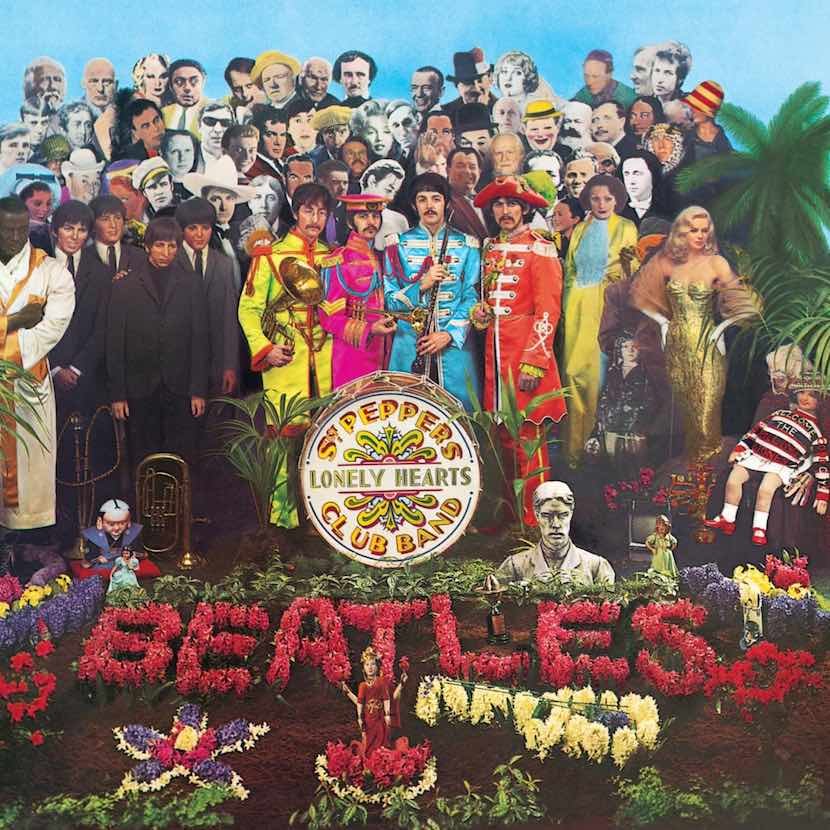
Its elaborate cover, created by Peter Blake and Jann Haworth with photography by Michael Cooper, presents The Beatles in colourful military-style uniforms surrounded by a remarkable gathering of cultural figures.
The original packaging also included printed lyrics and cardboard cut-outs, reinforcing the impression that the album was intended as a complete artistic experience.
Together, the artwork, fictional-band premise and carefully constructed recordings gave Sgt. Pepper an identity unlike anything The Beatles had previously released.
The Sound of Sgt. Pepper: Psychedelia, Orchestration and Musical Experimentation

Lucy in the Sky with Diamonds: A Psychedelic Dreamscape
“Lucy in the Sky with Diamonds” captures the album’s psychedelic atmosphere through a combination of unusual instrumentation and memorable songwriting.
The recording opens with a delicate melody played by McCartney on a Lowrey organ, establishing an otherworldly atmosphere before Lennon’s distant vocal introduces its surreal imagery.
The contrast between the floating verses and more rhythmically forceful chorus is particularly effective. Rather than relying entirely upon studio effects, the arrangement uses changes in tempo, texture and melodic emphasis to create a sense of movement.
Its greatest achievement is making such an unusual musical environment feel entirely accessible. Beneath the psychedelic presentation lies one of Lennon’s most distinctive pop compositions.
Being for the Benefit of Mr. Kite!: Bringing the Circus into the Studio
Inspired by a nineteenth-century circus poster, “Being for the Benefit of Mr. Kite!” transforms a relatively straightforward composition into an elaborate musical spectacle.
Lennon wanted the recording to capture the atmosphere of a fairground. George Martin and Geoff Emerick responded with organ and harmonium parts, instrumental overdubs and manipulated recordings of fairground organs.
Sections of archival tape were cut, rearranged and spliced together, producing a swirling background of unpredictable sounds.
The result is wonderfully eccentric, resembling a Victorian entertainment filtered through psychedelic imagination.
However, the arrangement is more compelling than the underlying melody. Its appeal rests primarily upon the extraordinary atmosphere, demonstrating both the possibilities and limitations of the album’s production-led approach.
Within You Without You: Indian Classical Influences
George Harrison’s “Within You Without You” represents the album’s most substantial departure from Western pop conventions.
Drawing upon his growing engagement with Indian classical music, Harrison constructed an extended composition featuring sitar, dilruba, tabla and tambura, alongside other Indian instruments and Western strings arranged by George Martin.
Harrison was the only Beatle to contribute to the recording, working with Indian musicians and additional players.
The sustained drones, intricate rhythmic patterns and expressive instrumental passages create a meditative atmosphere quite unlike the surrounding material.
Unlike the comparatively compact “Love You To” on Revolver, this composition allows greater space for musical development. Its deliberate pacing may challenge listeners expecting immediate pop melodies, but the arrangement rewards patience.
The interaction between Indian instruments and Western strings is particularly impressive, demonstrating Harrison’s commitment to exploring a musical tradition that had become increasingly important to him.
A Day in the Life: The Album’s Greatest Musical Achievement
If one recording demonstrates the full extent of Sgt. Pepper‘s ambition, it is “A Day in the Life”.
The composition combines Lennon’s reflective verses with McCartney’s brisk, everyday middle section. Their contrasting musical personalities are immediately apparent, yet the finished recording feels remarkably unified.
Lennon’s passages unfold with an unsettling calm, supported by piano, acoustic guitar and Ringo Starr’s expressive drumming. McCartney introduces a more urgent rhythm, capturing the hurried movement of an ordinary morning.
Connecting these sections are extraordinary orchestral crescendos, performed by approximately forty musicians under George Martin’s direction. The orchestra gradually rises through its instrumental ranges, creating an overwhelming accumulation of sound.
The recording concludes with a sustained E-major chord, struck on three pianos with harmonium contributing to the final texture. Its gradual decay provides a dramatic sense of finality.
What makes “A Day in the Life” exceptional is how naturally its contrasting elements work together. The orchestral passages are spectacular, but they never feel disconnected from the emotional character of the song.
It remains one of The Beatles’ finest achievements in composition, performance and studio production.
Music Hall, Rock and Traditional Pop
Despite its psychedelic reputation, much of Sgt. Pepper draws upon older British musical traditions.
“When I’m Sixty-Four” embraces music hall nostalgia through its jaunty clarinets and deliberately old-fashioned melody, while “Lovely Rita” combines playful pop songwriting with inventive piano and vocal arrangements.
“Getting Better” is built around an insistent rhythmic figure, whereas “Fixing a Hole” offers a more relaxed, harmonically sophisticated composition featuring a prominent harpsichord.
The title track provides one of the album’s strongest rock performances, its distorted guitars contrasting with theatrical brass and simulated concert sounds. “Good Morning Good Morning” is similarly energetic, incorporating brass, shifting metres and animal sound effects.
This variety is fundamental to the album’s identity. Rather than pursuing a single musical direction, The Beatles combine contrasting traditions into a colourful collection of recordings whose arrangements are often as memorable as their melodies.
The Lyrics of Sgt. Pepper: Identity, Nostalgia and Everyday Life

Beneath its elaborate production, Sgt. Pepper contains some of The Beatles’ most imaginative and emotionally perceptive writing.
Rather than developing a continuous story, the lyrics explore fictional characters, personal transformation, family relationships and everyday experiences. Their contrasting perspectives give the album much of its personality.
She’s Leaving Home: A Story of Generational Conflict
One of McCartney’s finest narrative compositions, “She’s Leaving Home” explores the breakdown of communication between parents and their daughter.
Inspired by a newspaper report about teenage runaway Melanie Coe, the song presents a young woman seeking independence while her parents struggle to understand her unhappiness.
Its emotional strength comes from acknowledging both perspectives. The parents’ bewilderment feels genuine, but their emphasis on material comfort reveals how little they understand their daughter’s needs.
Lennon’s contributions, expressing the parents’ perspective, contrast beautifully with McCartney’s sympathetic narration.
Although the song reflects changing attitudes towards family and independence during the 1960s, its central theme remains universal: people can care deeply for one another while failing to understand each other’s feelings.
The restraint of its storytelling makes it especially affecting.
Getting Better and Fixing a Hole: Personal Change
“Getting Better” combines McCartney’s optimism with Lennon’s more troubled perspective.
Its cheerful refrain suggests progress, but the lyrics also acknowledge past cruelty and destructive behaviour. This tension prevents the composition from becoming a simplistic celebration of self-improvement.
“Fixing a Hole” approaches independence from a quieter perspective. McCartney uses domestic imagery to explore the importance of protecting personal thoughts and creative freedom from unwanted interference.
Both songs reveal a growing interest in individual identity, although they approach the subject with contrasting degrees of openness and introspection.
Lucy in the Sky with Diamonds: Imagination and Escapism
“Lucy in the Sky with Diamonds” offers one of Lennon’s most distinctive examples of surrealist songwriting.
Inspired by a drawing made by his son Julian, the song presents fantastical landscapes and characters whose strange transformations recall Lennon’s fascination with Lewis Carroll.
Its title has long attracted speculation because of its initials, although Lennon maintained that the phrase originated with Julian’s drawing rather than a deliberate reference to LSD.
The lyrics are more effective as imaginative poetry than as a conventional narrative. Their appeal lies in the vividness of the imagery and the freedom they give listeners to construct their own interpretations.
Within You Without You: Spirituality and Human Connection
Harrison’s “Within You Without You” introduces the album’s most explicitly philosophical writing.
Influenced by Indian spirituality, its lyrics question materialism, selfishness and the divisions separating individuals from one another.
Harrison suggests that greater understanding requires looking beyond personal desires and recognising a deeper connection between people.
The language can occasionally feel earnest and didactic, particularly beside the understated storytelling of “She’s Leaving Home”. Nevertheless, the sincerity of Harrison’s perspective gives the composition considerable weight.
He is not simply experimenting with unfamiliar musical instruments but expressing ideas that had become central to his personal outlook.
A Day in the Life: The Extraordinary in the Ordinary
“A Day in the Life” brings together newspaper reports, personal observations and fragments of everyday experience.
Lennon’s verses present tragedy, public spectacle and ordinary events with an unsettling detachment. McCartney’s contrasting section captures the familiar routine of waking up and rushing through the morning.
Together, these perspectives suggest a world in which extraordinary events and mundane experiences continually overlap.
The lyrics offer no straightforward conclusion, leaving listeners to consider the relationship between perception, memory and reality.
Their greatest achievement is making apparently disconnected observations feel mysterious and emotionally significant.
Humour, Nostalgia and Everyday Characters
The album’s lighter compositions provide an important counterbalance to its introspective material.
“When I’m Sixty-Four” imagines ageing and companionship with affectionate humour, while “Lovely Rita” transforms an encounter with a traffic warden into a playful romantic fantasy.
“Being for the Benefit of Mr. Kite!” draws much of its language directly from a Victorian circus advertisement, turning historical entertainment into an eccentric collection of characters and events.
These songs may lack the emotional depth of the album’s finest writing, but they demonstrate The Beatles’ ability to find inspiration in ordinary experiences and familiar cultural traditions.
Their variety reinforces the album’s loose conceptual structure while giving it a distinctive sense of humour and personality.
Sgt. Pepper Tracklist: Sequencing, Cohesion and Consistency

The original thirteen-track running order is essential to Sgt. Pepper‘s identity. Its contrasting musical styles create an experience that feels carefully constructed, even when the songs themselves have little direct narrative connection.
Side One: Introducing the World of Sgt. Pepper
The opening title track establishes the fictional-band premise with infectious energy before moving directly into “With a Little Help from My Friends”. Ringo Starr’s warm vocal provides a charming introduction to the album’s more personal side.
“Lucy in the Sky with Diamonds” then introduces a dreamlike psychedelic atmosphere, followed by the rhythmic immediacy of “Getting Better” and the quieter introspection of “Fixing a Hole”.
“She’s Leaving Home” provides the side’s emotional centre, its restrained storytelling contrasting with the surrounding experimentation. “Being for the Benefit of Mr. Kite!” concludes the sequence with a return to theatrical spectacle.
The changes in mood are substantial, but the running order gives each composition space to establish its own character.
Side Two: Contrasts and an Extraordinary Finale
Side two opens with Harrison’s meditative “Within You Without You”, one of the album’s boldest sequencing decisions.
Its extended Indian-influenced arrangement gives way to the nostalgic charm of “When I’m Sixty-Four”, an abrupt contrast that reveals just how loosely the fictional-band concept connects the songs.
“Lovely Rita” restores a playful energy before “Good Morning Good Morning” introduces a more restless atmosphere through its forceful instrumentation and shifting rhythms.
The title-track reprise briefly returns to the fictional performance, setting up the extraordinary conclusion of “A Day in the Life”.
This final transition is among the album’s greatest achievements. After a succession of colourful characters and theatrical settings, The Beatles end with a composition whose emotional weight and musical ambition bring the entire experience into sharper focus.
Does Sgt. Pepper Have Any Weak Tracks?
Despite its reputation, Sgt. Pepper is not equally compelling throughout.
“When I’m Sixty-Four” is charming but comparatively lightweight, while “Good Morning Good Morning” can feel abrasive beside the album’s more melodic compositions.
“Being for the Benefit of Mr. Kite!” is a remarkable production achievement, although its underlying songwriting is less memorable than its arrangement.
These are not poor recordings, and each contributes something valuable to the album’s personality. Nevertheless, they demonstrate that Sgt. Pepper succeeds through more than the consistent strength of its individual songs.
Revolver arguably offers a stronger collection of standalone compositions, whereas Sgt. Pepper places greater emphasis on theatrical presentation and the relationship between contrasting musical ideas.
Its fictional-band premise is most prominent in the opening sequence and reprise, but the album maintains a recognisable identity through its sequencing, production and imaginative atmosphere.
Rather than telling a continuous story, Sgt. Pepper creates a musical world that feels coherent despite its extraordinary variety.
Best Songs on Sgt. Pepper: Standout Tracks and Performances
Although the album is often celebrated as a complete artistic statement, its finest compositions deserve recognition in their own right.
Five songs stand out, each demonstrating a different aspect of The Beatles’ remarkable versatility.
A Day in the Life: The Beatles at Their Most Ambitious
“A Day in the Life” stands among the greatest recordings of The Beatles’ career.
Its unconventional structure is impressive, but the performances make it exceptional. Lennon’s restrained vocal conveys an almost detached curiosity, while McCartney introduces a contrasting urgency that gives the composition momentum.
Ringo Starr’s drumming is particularly expressive. His inventive fills respond to Lennon’s phrasing, adding emotional movement without disturbing the reflective atmosphere.
The result is a song whose melodies, performances and ambitious arrangement work together with extraordinary assurance.
Lucy in the Sky with Diamonds: Psychedelia with a Perfect Melody
“Lucy in the Sky with Diamonds” demonstrates how effectively The Beatles could combine experimental ideas with accessible songwriting.
Lennon’s understated vocal maintains the song’s dreamlike atmosphere, while the chorus introduces an infectious melodic directness.
McCartney’s bass playing adds movement beneath the unusual instrumental textures, giving the recording a rhythmic character that complements its surreal imagery.
Its greatest strength is that the psychedelic atmosphere never overwhelms the composition. The song remains memorable because of its melody as much as its imaginative production.
She’s Leaving Home: McCartney’s Gift for Storytelling
“She’s Leaving Home” is among McCartney’s most emotionally accomplished songs.
His controlled vocal performance conveys sympathy without excessive sentimentality, while Lennon’s contrasting responses introduce a more complicated perspective on the central family conflict.
The melody unfolds with remarkable elegance, supported by an orchestral arrangement that allows the narrative to remain central.
Rather than relying upon dramatic musical gestures, the composition finds its emotional strength in restraint, demonstrating how sophisticated The Beatles’ songwriting had become.
Within You Without You: Harrison’s Defining Contribution
“Within You Without You” is the album’s most uncompromising composition.
Harrison largely abandons familiar pop structures in favour of an extended musical meditation, delivering his philosophical lyrics with calm conviction.
The instrumental interplay is especially impressive, with Indian musicians and Western strings creating a distinctive sense of movement and tension.
Its deliberate pacing may divide listeners, but the composition’s ambition and sincerity make it one of the album’s most fascinating achievements.
With a Little Help from My Friends: Ringo’s Finest Moment
Written by Lennon and McCartney specifically for Ringo Starr, “With a Little Help from My Friends” makes wonderful use of his distinctive vocal personality.
Ringo’s warm, unpretentious delivery suits the song’s themes of friendship and reassurance, while the call-and-response backing vocals give the performance a welcoming, communal atmosphere.
McCartney’s melodic bass line provides much of the instrumental character, and the restrained arrangement allows the voices to remain central.
It is a reminder that The Beatles could create something exceptional through straightforward pop songwriting, without relying upon elaborate experimentation.
Other Highlights
“Getting Better” remains one of the album’s most infectious compositions, balancing McCartney’s optimistic melodies with Lennon’s darker perspective.
“Lovely Rita” is similarly enjoyable, its lively piano, playful vocals and eccentric conclusion demonstrating The Beatles’ gift for transforming modest ideas into memorable recordings.
The opening title track and its reprise also deserve recognition for their energetic rock performances, providing an effective theatrical framework for the album.
Together, these songs demonstrate that Sgt. Pepper‘s appeal extends well beyond its historical reputation. Beneath the elaborate presentation are compositions whose melodies, performances and individual personalities remain enormously rewarding.
The Legacy of Sgt. Pepper: How It Changed Popular Music

Few albums have become as closely associated with a cultural moment as Sgt. Pepper’s Lonely Hearts Club Band.
Released shortly before the Summer of Love, it captured an audience increasingly receptive to psychedelic music, artistic experimentation and alternative forms of expression.
Its significance, however, extends beyond the atmosphere of 1967.
The Album as a Complete Artistic Statement
One of Sgt. Pepper‘s most enduring contributions was the attention it brought to the album as a unified creative work.
The Beatles were not the first musicians to approach an LP this way. Frank Sinatra’s thematic albums, The Beach Boys’ Pet Sounds and The Mothers of Invention’s Freak Out! had already demonstrated different possibilities for ambitious album-making.
Nevertheless, Sgt. Pepper brought this approach to an exceptionally wide audience.
Its elaborate packaging, fictional-band premise and carefully arranged running order encouraged listeners to experience the record as a complete work rather than a collection of potential singles.
No songs from the album were issued as contemporary UK singles, reinforcing its identity as an LP intended to be appreciated in full.
Its enormous commercial success demonstrated that ambitious, unconventional recordings could attract mainstream audiences, strengthening the growing importance of the album within popular music.
Expanding the Possibilities of Recording
The album also contributed to changing expectations of studio production.
The Beatles and their collaborators did not invent multitracking, tape manipulation or orchestral experimentation. These techniques had already been explored by other musicians and producers, including The Beatles themselves.
What made Sgt. Pepper remarkable was the imaginative combination of these approaches within a commercially successful pop album.
Recordings such as “Being for the Benefit of Mr. Kite!” and “A Day in the Life” demonstrated how the studio could become an essential part of composition rather than simply a means of documenting performances.
This approach contributed to a broader movement towards elaborate production, particularly within psychedelic and progressive rock.
Sgt. Pepper and the Summer of Love
Sgt. Pepper quickly became associated with the emerging counterculture, its colourful artwork and experimental music reflecting an era fascinated by artistic freedom, Eastern spirituality and psychedelic experiences.
Yet the album is not exclusively a psychedelic statement.
Much of its personality comes from older British traditions, particularly music hall, theatrical entertainment and nostalgic storytelling.
“When I’m Sixty-Four” and “Being for the Benefit of Mr. Kite!” draw upon influences that predate the counterculture by decades, creating an unusual relationship between past and present.
Rather than rejecting traditional popular music, The Beatles reimagined familiar styles through contemporary recording techniques.
This combination helps explain why the album feels so representative of its era while retaining a distinctive appeal beyond it.
From Sgt. Pepper to Progressive Rock
The album’s success encouraged a growing interest in ambitious recording projects, contributing to a musical environment in which extended compositions, conceptual presentation and elaborate arrangements became increasingly prominent.
Its influence can be recognised in the development of progressive rock, although it would be misleading to suggest that Sgt. Pepper single-handedly created the genre or invented the concept album.
These developments emerged from numerous musicians exploring related possibilities throughout the 1960s.
The Beatles’ contribution was to demonstrate how far such ambitions could reach within mainstream popular music.
Its visual presentation also proved influential, reinforcing the idea that artwork, packaging and musical content could contribute to a unified artistic identity.
Does Sgt. Pepper Still Deserve Its Reputation?
For decades, Sgt. Pepper was frequently presented as The Beatles’ definitive masterpiece.
More recently, albums such as Revolver, Rubber Soul and Abbey Road have increasingly challenged that position, with listeners placing greater emphasis on songwriting consistency and individual performances.
There is a reasonable argument that Revolver offers a stronger collection of standalone songs, while Abbey Road provides a more polished demonstration of The Beatles’ later musical sophistication.
However, Sgt. Pepper offers something different.
Its extraordinary variety, theatrical presentation and imaginative production create an experience that remains immediately recognisable.
The album’s historical importance is undeniable, but its reputation should not depend upon influence alone.
Ultimately, Sgt. Pepper endures because the music remains inventive, entertaining and frequently brilliant. Its finest moments demonstrate The Beatles’ ability to bring contrasting creative ideas together with remarkable confidence.
Sgt. Pepper Review: Final Verdict and Rating

Sgt. Pepper’s Lonely Hearts Club Band remains one of The Beatles’ most imaginative achievements, an album whose musical diversity and creative ambition continue to impress nearly sixty years after its release.
Its finest compositions are exceptional. “Lucy in the Sky with Diamonds” combines surreal imagery with an unforgettable melody, “She’s Leaving Home” demonstrates McCartney’s gift for emotional storytelling, and “Within You Without You” introduces a fascinating alternative to Western pop conventions.
Above them all stands “A Day in the Life”, a breathtaking collaboration that brings the album to an extraordinary conclusion.
Yet Sgt. Pepper is not entirely flawless.
Its fictional-band concept is more theatrical framework than continuous narrative, while several compositions depend more heavily upon their arrangements than their underlying songwriting. “When I’m Sixty-Four”, “Good Morning Good Morning” and “Being for the Benefit of Mr. Kite!” are enjoyable and distinctive, but they do not quite match the album’s finest moments.
Nevertheless, judging Sgt. Pepper solely by the strength of its individual songs overlooks what makes it exceptional.
Its contrasting musical styles, carefully considered sequencing and imaginative production create a listening experience whose personality extends beyond any single composition.
George Martin and Geoff Emerick’s contributions are essential, but the technical achievements never entirely overshadow The Beatles’ songwriting. Beneath the experimentation are memorable melodies, engaging performances and a remarkable willingness to explore unfamiliar musical territory.
It may not be their most consistently accomplished collection of individual songs, but as a complete artistic statement, Sgt. Pepper is among their most rewarding achievements.
Official Tune Tempest Rating: 10/10
Sgt. Pepper’s Lonely Hearts Club Band earns its perfect rating not because every composition is beyond criticism, but because the album achieves something remarkable as a whole.
Its finest songs rank among The Beatles’ greatest recordings, while its theatrical presentation and adventurous arrangements create a musical world unlike anything else in their catalogue.
For all its occasional inconsistencies, Sgt. Pepper remains a triumph of creativity, capturing The Beatles at their most playful, ambitious and artistically fearless.