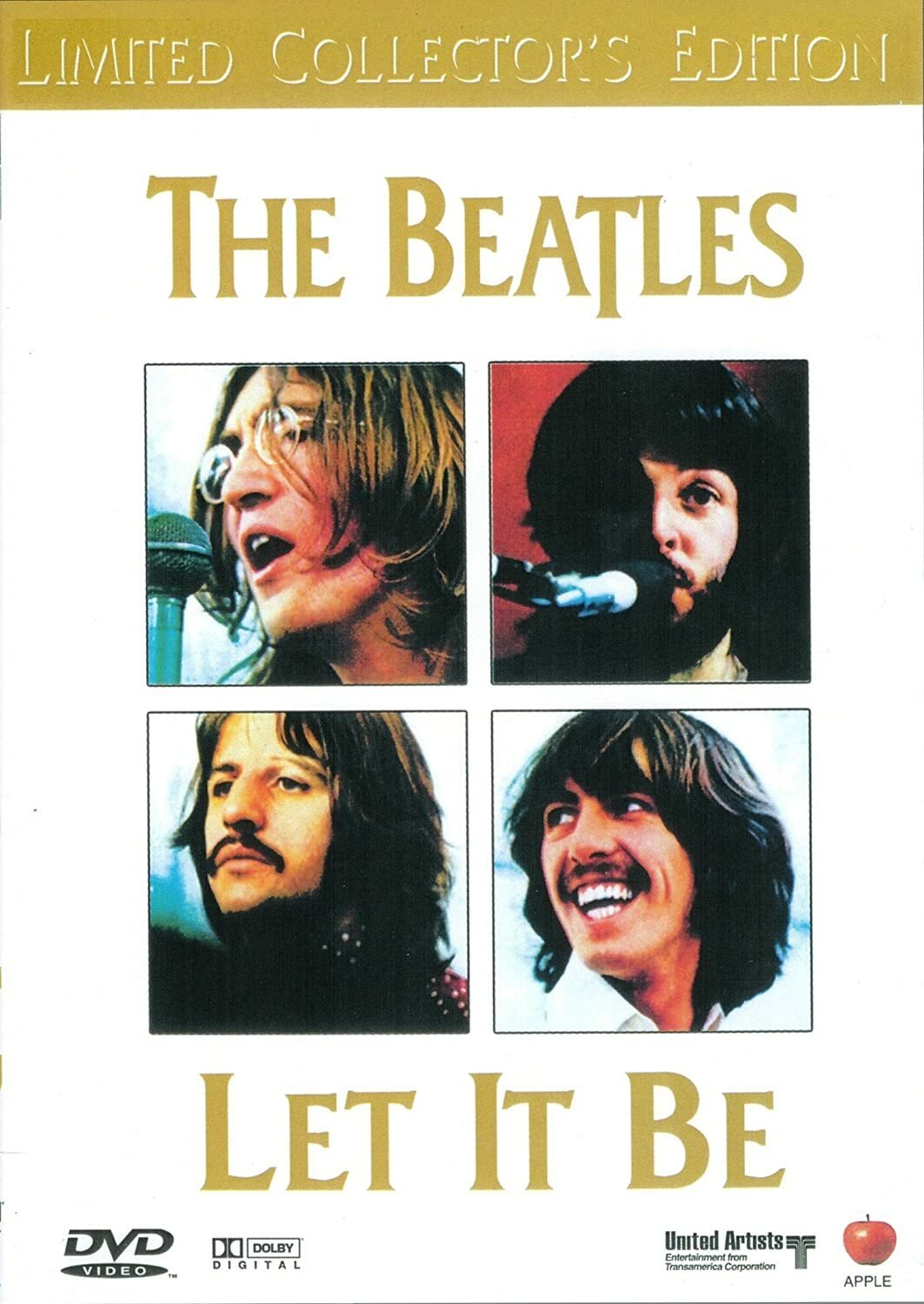
Released in May 1970, Let It Be offered audiences an unusually intimate glimpse into The Beatles’ creative world. Directed by Michael Lindsay-Hogg, the documentary followed John Lennon, Paul McCartney, George Harrison and Ringo Starr as they rehearsed new material and attempted to rediscover the spontaneity of performing together.
Yet the circumstances surrounding its release transformed how the film was perceived. By the time Let It Be reached cinemas, The Beatles’ separation had become public knowledge, casting a shadow over footage recorded in January 1969. What began as an ambitious attempt to return to live performance was increasingly interpreted as a portrait of a band approaching its end.
The documentary captures genuine tensions, but also moments of humour, experimentation and extraordinary musicianship, culminating in the group’s celebrated rooftop concert at Apple’s Savile Row headquarters on 30 January 1969.
For decades, Let It Be remained closely associated with the breakdown of The Beatles. However, Peter Jackson’s expanded documentary series The Beatles: Get Back (2021) offered a broader perspective on the same sessions, while the restoration and re-release of Lindsay-Hogg’s original film in 2024 invited audiences to reconsider its achievements.
More than simply a record of a group falling apart, Let It Be documents four musicians navigating creative disagreements, personal changes and the pressures of their own success. Its enduring fascination lies in the contrast between the difficulties surrounding the project and the remarkable music that emerged from it.
How Let It Be Began: The Get Back Project
By the beginning of 1969, The Beatles had spent more than two years concentrating primarily on studio recording. Their decision to abandon touring in August 1966 had opened the door to increasingly elaborate musical experimentation, producing albums such as Sgt. Pepper’s Lonely Hearts Club Band (1967) and The Beatles (1968), commonly known as the White Album.
However, their approach to recording had also changed considerably. Individual compositions were increasingly developed with varying levels of participation from the other members, while disagreements over musical direction and business matters complicated their working relationships.
Paul McCartney proposed a project intended to reconnect the group with the simplicity of performing together. Rather than relying upon extensive overdubbing and elaborate production techniques, The Beatles would rehearse new material, record it more directly and potentially return to the stage.
The project became known as Get Back, reflecting the desire to rediscover the musical instincts that had defined their early years.
The Original Concept
The initial plan involved filming The Beatles rehearsing and developing songs, eventually building towards a live performance that could form the centrepiece of a television special.
Michael Lindsay-Hogg was recruited to direct the production. Having previously worked with the group on promotional films for Paperback Writer, Rain, Hey Jude and Revolution, he was familiar with their personalities and approach to performing.
Unlike those earlier productions, however, the new project would follow the musicians as they worked towards a performance rather than simply presenting a finished recording.
The concept was ambitious, but its practical arrangements remained uncertain. Various concert locations were discussed, including possibilities outside Britain, without the group agreeing upon a definite plan.
Consequently, filming began before The Beatles had established exactly what they were working towards.
The Difficult Twickenham Sessions
Filming commenced on 2 January 1969 at Twickenham Film Studios in London.
The Beatles rehearsed on a large soundstage surrounded by cameras, lighting equipment and members of the production crew. The unfamiliar surroundings, early starts and pressure to develop new material contributed to an increasingly uncomfortable working atmosphere.
McCartney was particularly enthusiastic about organising the rehearsals and preparing for a live performance. However, his attempts to provide direction sometimes created friction, especially with Harrison, who had become frustrated by his limited opportunities to develop his compositions within the group.
Lennon appeared less committed to the project’s original ambitions, while Starr often found himself navigating the disagreements between his bandmates.
Nevertheless, the sessions were not characterised exclusively by conflict. The musicians continued to experiment with songs, revisit familiar material and exchange jokes, even as uncertainty about the project became increasingly apparent.
The tensions reached a critical point on 10 January, when Harrison temporarily left The Beatles.
His departure reflected broader frustrations with the group’s working relationships rather than a single disagreement. Having developed considerably as a songwriter, Harrison was increasingly dissatisfied with his position alongside the established Lennon-McCartney partnership.
Discussions followed, and he eventually agreed to return after changes were made to the working arrangements.
The Beatles abandoned Twickenham and relocated the project to their Apple headquarters at 3 Savile Row, London. Plans for an elaborate concert were also set aside, allowing the musicians to concentrate on recording without the same pressure to prepare a large-scale performance.
A Fresh Start at Apple Studios
The group resumed working together at Apple Studios on 21 January 1969.
Although the basement studio initially presented technical difficulties, its more intimate surroundings proved better suited to the musicians than Twickenham’s expansive soundstage.
The arrival of American keyboardist Billy Preston was another important development.
Preston had known The Beatles since their early years in Hamburg, and his electric piano playing brought an additional dimension to songs such as Get Back and Don’t Let Me Down. His presence also coincided with a more productive atmosphere, although the group’s underlying disagreements had not disappeared.
With the cameras continuing to record, The Beatles developed increasingly confident performances of their new material.
The sessions eventually culminated in the rooftop concert on 30 January, followed by further filming and recording the next day.
Although the original television-special concept had changed substantially, Lindsay-Hogg and his crew had captured an extraordinary record of The Beatles attempting to rediscover the experience of making music together.
What Happens in Let It Be?
Unlike The Beatles’ earlier films, Let It Be does not follow a scripted narrative. Instead, Lindsay-Hogg presents a selection of rehearsals, conversations and performances recorded during January 1969, allowing audiences to observe the group at work without narration or retrospective interviews.
The documentary moves from Twickenham Film Studios to Apple Studios before concluding with the rooftop concert. However, rather than providing a comprehensive chronological account, it concentrates on individual moments that reveal the musicians’ personalities and working relationships.
The opening sequences show The Beatles rehearsing beneath the bright lights of Twickenham, experimenting with arrangements and discussing how their performances might be improved.
These scenes reveal the less glamorous realities of recording music. Songs are repeated, ideas are abandoned and disagreements occasionally interrupt the proceedings.
One particularly memorable exchange involves McCartney offering suggestions about Harrison’s guitar playing. Harrison’s visibly frustrated response illustrates the difficulties of maintaining a collaborative relationship when the musicians have different expectations about their roles.
Yet the documentary also contains lighter moments, including playful performances and spontaneous excursions into familiar rock-and-roll material.
The contrast becomes more apparent when the film moves to Apple Studios. The musicians appear increasingly comfortable, and Preston’s participation adds energy to the developing arrangements.
Several performances demonstrate the variety of material being explored. Two of Us captures the vocal interplay between Lennon and McCartney, while The Long and Winding Road and Let It Be reveal the emotional directness of McCartney’s songwriting.
The documentary also includes Harrison’s For You Blue and I Me Mine, alongside glimpses of Across the Universe, Octopus’s Garden and other compositions.
Not every song is presented in full, and the film provides relatively little explanation of how individual recordings developed. Instead, its observational approach encourages viewers to concentrate on the interactions between the musicians.
How the Editing Shapes the Story
One of Let It Be‘s defining characteristics is its selective presentation of the January sessions.
Lindsay-Hogg and his editors condensed many hours of footage into a feature-length documentary, inevitably leaving out conversations and developments that might have provided important context.
Most notably, Harrison’s temporary departure is not directly explained in the finished film, despite being one of the most significant events of the project.
Without narration, viewers must interpret the group’s relationships through the scenes selected for inclusion.
This approach gives the documentary much of its immediacy, but it also creates limitations. Individual disagreements can appear especially significant when separated from their wider circumstances, while the progression of the recording sessions is not always clear.
The result is not a complete account of January 1969, but a particular interpretation of the events.
Nevertheless, Let It Be remains fascinating precisely because it allows audiences to observe The Beatles without the elaborate presentation associated with much of their earlier work. The musicians appear as working artists, negotiating arrangements and confronting the ordinary difficulties of making records.
That unpolished quality is among the film’s greatest strengths.
The Music and Creative Process
Despite the difficulties surrounding the Get Back project, the January 1969 sessions produced some of The Beatles’ most recognisable recordings.
The original intention was to return to a more direct approach to recording, with the musicians performing together rather than constructing songs through extensive overdubbing. Although the finished Let It Be album would eventually depart from that principle, Lindsay-Hogg’s documentary preserves much of the project’s original character.
The film is particularly revealing when it captures the interaction between individual musical personalities.
McCartney frequently provides direction, Lennon contributes instinctive musical ideas, Harrison brings increasingly distinctive guitar playing, and Starr supplies the rhythmic foundation that allows the arrangements to develop.
Their approaches do not always align, but the resulting performances demonstrate the extraordinary experience they had accumulated through years of working together.
Get Back and Don’t Let Me Down
Get Back became the defining song of the project, reflecting McCartney’s desire to reconnect with the straightforward energy of The Beatles’ early performances.
Built around a driving rhythm and a memorable guitar riff, the composition draws upon American rock and roll while retaining the group’s distinctive melodic character.
The song developed through repeated rehearsals, with McCartney experimenting with its structure and lyrics. Early versions included topical references to immigration and racial prejudice in Britain, although these were eventually abandoned in favour of the familiar narrative involving Jojo and Loretta.
Billy Preston’s electric piano became an essential element of the arrangement, contributing rhythmic movement and instrumental colour.
The strength of his participation was acknowledged when the April 1969 single was credited to The Beatles with Billy Preston, an unusual recognition of an outside musician on one of the group’s releases.
Lennon’s Don’t Let Me Down offers a contrasting emotional intensity.
Written during his relationship with Yoko Ono, the song combines vulnerable lyrics with an impassioned vocal performance. McCartney’s harmonies and melodic bass playing complement Lennon’s delivery, while Harrison and Preston contribute to its distinctive sound.
The performance demonstrates that Lennon and McCartney’s musical partnership remained productive despite the growing difficulties in their personal and professional relationship.
Rather than relying upon elaborate arrangements, both songs derive much of their impact from the musicians responding directly to one another.
Let It Be and The Long and Winding Road
Two of McCartney’s most reflective compositions reveal another side of the sessions.
Let It Be was inspired partly by a dream involving his late mother, Mary, during a period of personal uncertainty.
Its gospel-influenced melody and reassuring lyrics give the song an emotional directness that distinguishes it from the project’s more energetic rock performances.
The documentary presents McCartney at the piano, allowing the composition’s melody and vocal performance to remain central.
The Long and Winding Road is similarly restrained, combining a melancholy piano arrangement with lyrics expressing longing and uncertainty.
The film preserves a relatively understated performance, offering a revealing contrast with the orchestral and choral overdubs subsequently added by producer Phil Spector for the 1970 album.
Those additions became a source of disagreement, particularly for McCartney, who objected to the treatment of his recording.
The distinction between the documentary and the finished album is important. Although both originated from the same broader project, the film often presents the music in a more intimate form than listeners encountered on the released LP.
George Harrison’s Contributions
The sessions also demonstrate Harrison’s continuing development as a songwriter.
By January 1969, he had accumulated a substantial collection of compositions, although the established Lennon-McCartney partnership continued to dominate The Beatles’ recording output.
For You Blue provides one of his most engaging contributions to the documentary.
Inspired by traditional blues, the song features a relaxed arrangement and playful instrumental interplay, including Lennon’s lap-steel guitar performance. Its straightforward character suited the original Get Back concept, allowing the musicians to concentrate on performing together without elaborate production.
The film also includes Harrison presenting I Me Mine, a composition concerned with the relationship between individual identity and spiritual awareness.
However, the documentary footage and the released recording represent different stages of the song’s development.
Harrison was filmed rehearsing I Me Mine at Twickenham in January 1969, while the studio recording eventually included on Let It Be was made on 3 January 1970, with McCartney and Starr but without Lennon.
This distinction illustrates the complicated relationship between the film and its accompanying album.
The Value of the Unfinished Moments
Perhaps the most compelling musical passages in Let It Be are not always the polished performances.
The documentary also captures The Beatles experimenting with older songs, trying unfamiliar arrangements and occasionally playing simply for their own amusement.
These moments reveal the musical influences that had shaped the group long before their international success.
They also provide an important reminder that recording an album involves far more than the performances eventually selected for release.
Ideas emerge gradually, musicians make mistakes, and arrangements are repeatedly reconsidered.
Lindsay-Hogg’s cameras preserve that process with relatively little embellishment.
For audiences accustomed to hearing The Beatles through carefully produced recordings, the opportunity to observe these ordinary creative exchanges remains one of the documentary’s most distinctive attractions.
The Rooftop Concert: The Beatles’ Final Public Performance
On 30 January 1969, The Beatles climbed onto the roof of their Apple headquarters at 3 Savile Row, London, for what would become their final public live performance as a group.
The concert was neither announced to the public nor intended as a deliberate farewell. Instead, it emerged from the uncertain plans surrounding the Get Back project, which had originally been conceived around a return to live performance.
After weeks of discussions about possible concert locations, the rooftop offered a practical solution.
It allowed The Beatles to perform together while providing Lindsay-Hogg and his crew with a dramatic conclusion to the documentary.
What followed was approximately 40 minutes of live music that briefly transformed a central London office building into one of rock history’s most unusual concert venues.
The Performance on Savile Row
Joined by Billy Preston on electric piano, The Beatles opened with Get Back, immediately establishing the energetic rock-and-roll atmosphere that McCartney had originally hoped to recapture.
Across the performance, the group played five different songs: Get Back, Don’t Let Me Down, I’ve Got a Feeling, One After 909 and Dig a Pony.
Several were repeated, allowing the musicians to experiment with their performances while the recording equipment captured the results.
I’ve Got a Feeling was particularly effective, combining contrasting vocal sections from McCartney and Lennon into a powerful collaborative arrangement.
One After 909, meanwhile, offered a connection to the group’s earliest songwriting years. Originally developed by Lennon and McCartney long before their international success, its inclusion reflected their continuing affection for straightforward rock and roll.
Preston’s electric piano contributed substantially to the overall sound, adding rhythmic movement without overwhelming the arrangements.
Despite the cold January weather, the musicians appeared increasingly comfortable as the concert progressed.
Their exchanges, occasional mistakes and spontaneous remarks gave the performance an immediacy rarely captured in their earlier concert films.
The Streets Below
As the music echoed through central London, office workers, shoppers and passersby began gathering in the surrounding streets.
Some watched from neighbouring rooftops, while others stopped to listen from street level.
Lindsay-Hogg’s cameras captured a mixture of reactions, ranging from enthusiasm and curiosity to irritation about the noise.
By cutting between the musicians performing above Savile Row and the responses of people below, the documentary creates one of its most distinctive sequences.
The contrast is striking: one of the world’s most famous bands performing above an ordinary working street, with much of the audience unable to see the musicians responsible for the sound.
The concert eventually attracted the attention of the Metropolitan Police following complaints about the disturbance.
Officers entered the Apple building and made their way towards the rooftop as the performance approached its conclusion.
Although their presence added tension to the final moments, the concert was not abruptly stopped in the middle of a song.
The Beatles completed their final performance of Get Back, with McCartney improvising lyrics that acknowledged the police.
After the music ended, Lennon delivered a characteristically dry closing remark, expressing the hope that the group had passed its audition.
An Unplanned Farewell
The rooftop concert has frequently been interpreted as The Beatles’ farewell to live performance, although there is little reason to believe they approached it with that intention.
At the time, the group continued to work together, and the January sessions would be followed by further recording activity, most notably the sessions that produced Abbey Road.
Its significance therefore lies partly in circumstances that became clear only afterwards.
The Beatles had not performed a conventional public concert since August 1966, and the rooftop offered a rare opportunity to hear them playing together outside the controlled environment of a recording studio.
For Lindsay-Hogg’s documentary, the sequence provides a compelling conclusion.
After the difficult rehearsals at Twickenham and the more productive sessions at Apple, the film ends with The Beatles achieving something close to their original ambition: performing together as a working band.
The concert was not a carefully orchestrated farewell, but its eventual place in the group’s history gives the footage an emotional significance beyond the intentions of the Get Back project.
Release, Reception and the Break-Up Narrative
When Let It Be reached cinemas in May 1970, the circumstances surrounding The Beatles had changed dramatically.
The documentary had been filmed in January 1969, when the group was attempting to develop new material and return to live performance. By the time audiences finally saw the footage, however, their separation had become public knowledge.
McCartney’s announcement on 10 April 1970 that he had no immediate plans to work with The Beatles again brought the group’s internal divisions into the public spotlight.
Lennon had privately informed his bandmates of his intention to leave the previous September, but the full extent of the situation had remained largely unknown outside their immediate circle.
Consequently, Let It Be arrived at a particularly sensitive moment.
Scenes that might once have appeared to document the ordinary frustrations of a demanding recording project were now interpreted as evidence of an inevitable break-up.
From Get Back to Let It Be
The original Get Back project had been conceived around a return to simpler recording methods, but the accompanying album and film remained unfinished as The Beatles moved on to other commitments.
Engineer Glyn Johns prepared several proposed versions of a Get Back album, none of which was approved for release.
Meanwhile, the group returned to the studio during 1969 to record Abbey Road, released that September.
The earlier recordings subsequently underwent further production work under Phil Spector in 1970.
Spector assembled the album that became Let It Be, adding orchestral and choral arrangements to certain tracks, most controversially The Long and Winding Road.
These additions departed from the original project’s emphasis on relatively unadorned performances and became a source of disagreement, particularly for McCartney.
The album was released on 8 May 1970, shortly before the documentary’s New York premiere on 13 May.
Although the film and album shared a title, they were not identical representations of the sessions. The documentary preserved selected rehearsals and performances, while the record incorporated material from different recording dates and subsequent production decisions.
A Documentary Viewed Through the Break-Up
The timing of the film’s release profoundly influenced its reputation.
For audiences who had followed The Beatles throughout the 1960s, the opportunity to see the group working together during their final years carried considerable emotional weight.
However, Lindsay-Hogg offered little explanation of the circumstances surrounding the January sessions.
The disagreement between McCartney and Harrison became particularly significant, appearing to illustrate the difficulties within the group. Lennon’s apparent disengagement during certain rehearsals also contributed to the impression of musicians whose interests were moving in different directions.
Yet the documentary contained evidence that complicated this interpretation, particularly the more relaxed performances at Apple Studios and the rooftop concert.
The difficulty was that audiences already knew the outcome.
With the group’s separation publicly acknowledged, moments of disagreement acquired a significance they might not otherwise have carried.
This retrospective interpretation became central to Let It Be‘s reputation, encouraging viewers to approach the documentary as a record of the end rather than an account of a particular recording project.
Critical Reception and Recognition
Contemporary responses to Let It Be were mixed.
Some critics appreciated the opportunity to observe The Beatles without the scripted humour or elaborate presentation of their earlier films.
Others found the documentary’s loose structure and comparatively subdued atmosphere disappointing, particularly when contrasted with the energetic personalities presented in A Hard Day’s Night and Help!
Nevertheless, its musical performances attracted considerable attention, with the rooftop concert providing an especially memorable conclusion.
Despite the divided reception, Let It Be received significant industry recognition.
At the 1971 Academy Awards, The Beatles won the Oscar in the category of Music (Original Song Score), reflecting the strength of the film’s musical material.
Its reputation as a bleak portrait of the group’s final days nevertheless persisted.
Yet the documentary cannot fully explain The Beatles’ eventual separation, which involved personal relationships, artistic differences and increasingly complicated business arrangements.
The January 1969 sessions represented an important stage in that process, but they were not a consciously organised farewell.
Understanding that distinction is essential to appreciating the film beyond the circumstances of its release.
Reassessing Let It Be: Get Back and the 2024 Restoration
For decades, Let It Be remained one of the most difficult Beatles films to revisit.
Following its original release, the documentary gradually disappeared from general circulation, with no widely available official home-video edition for many years.
Its reputation nevertheless endured, largely through accounts of the disagreements captured during the January sessions.
However, that interpretation began to change with the release of Peter Jackson’s three-part documentary series The Beatles: Get Back in November 2021.
Drawing upon the same extensive archive of footage and audio recordings, Jackson presented a considerably broader account of the sessions, revealing interactions that had received comparatively little attention in Lindsay-Hogg’s original film.
Peter Jackson’s Get Back
Jackson and his team worked with approximately 60 hours of film footage and more than 150 hours of audio recorded during January 1969.
Unlike Lindsay-Hogg’s feature-length documentary, Get Back unfolds across nearly eight hours, allowing conversations, rehearsals and musical developments to be presented with substantially greater context.
The expanded running time changes how the sessions are perceived.
Disagreements remain an important part of the story, including Harrison’s temporary departure and the difficulties surrounding the proposed concert.
However, these moments appear alongside extended sequences of the musicians joking, experimenting with songs and enjoying one another’s company.
One particularly memorable sequence shows McCartney developing Get Back during an early rehearsal.
What begins as a loosely formed musical idea gradually acquires its recognisable rhythm and melody, offering an extraordinary glimpse into the development of a major Beatles recording.
Other scenes reveal Lennon and McCartney’s instinctive understanding of one another’s playing, Harrison’s growing confidence as a songwriter and Preston’s contribution to the Apple sessions.
The series also presents the rooftop concert in full, allowing audiences to experience the performances beyond the edited selection included in Lindsay-Hogg’s film.
These additions demonstrate how much of the original project remained unexplored in 1970.
Does Get Back Change the Meaning of Let It Be?
The release of Get Back encouraged a substantial reassessment of Lindsay-Hogg’s documentary.
For many viewers, the expanded footage challenged the belief that the January 1969 sessions had been overwhelmingly miserable.
However, it would be equally misleading to suggest that Jackson’s series proves The Beatles were entirely happy or that their disagreements had been exaggerated beyond recognition.
The tensions were genuine, and the group continued to face serious personal, artistic and business difficulties.
What Get Back demonstrates is that those disagreements existed alongside friendship, humour and productive musical collaboration.
Both documentaries draw upon the same events, but their different structures and editorial decisions produce distinct impressions.
Lindsay-Hogg created a concise film centred on rehearsals and performances, while Jackson constructed a detailed chronological account that gives greater attention to the relationships between the musicians.
Neither should be regarded as a completely unfiltered representation of reality.
Every documentary involves decisions about which moments to include, how they should be arranged and what meaning audiences might draw from them.
Viewed together, the two productions provide a richer understanding of the sessions than either offers independently.
The 2024 Restoration and Re-Release
On 8 May 2024, Lindsay-Hogg’s original Let It Be returned to audiences through a restored edition released on Disney+.
The restoration was undertaken by Peter Jackson’s Park Road Post Production team, working from the original 16mm film negative.
Modern digital techniques were used to improve the image, while the soundtrack was remastered using the MAL de-mixing technology previously employed during the production of The Beatles: Get Back.
Importantly, the project preserved Lindsay-Hogg’s original documentary rather than attempting to reconstruct it according to Jackson’s interpretation.
The restoration allowed audiences to experience the 1970 film in substantially improved quality while retaining its distinctive editing, structure and atmosphere.
Its return was particularly significant because Let It Be had been unavailable through official mainstream distribution for decades.
For younger Beatles fans, it offered an opportunity to watch the original documentary rather than encounter it primarily through descriptions, isolated clips or comparisons with Get Back.
The two productions ultimately serve different purposes.
Jackson’s series provides broader historical context, while Lindsay-Hogg’s film offers a concentrated experience of The Beatles rehearsing and performing during an extraordinary period in their history.
The original documentary also retains its importance as the film presented to audiences in 1970, shaped by the creative decisions and circumstances of its own production.
The restoration therefore represents more than the return of a long-unavailable Beatles film. It allows Let It Be to be appreciated independently while benefiting from the additional context made available through Get Back.
Why Let It Be Still Matters
More than five decades after its original release, Let It Be remains one of the most revealing and frequently misunderstood films in The Beatles’ history.
Its reputation was shaped by unfortunate timing, with the group’s separation encouraging audiences to interpret the documentary primarily as evidence of deteriorating relationships.
Yet Lindsay-Hogg’s film offers considerably more than a record of disagreements.
Its greatest achievement is the opportunity to observe The Beatles working as musicians, away from the carefully constructed image that had accompanied much of their career.
The rehearsals reveal the uncertainty and repetition involved in developing songs, while the performances demonstrate the instincts that continued to connect the four members.
The documentary is not without limitations. Its selective editing and lack of contextual information leave important developments unexplained, making it difficult to understand the full complexity of the January 1969 sessions.
However, Peter Jackson’s Get Back and the 2024 restoration have provided an opportunity to reconsider those limitations without dismissing the original film’s achievements.
The rooftop concert remains its defining moment, capturing The Beatles performing together for an unsuspecting London audience in a sequence that has acquired extraordinary historical significance.
Ultimately, Let It Be deserves recognition not simply as a documentary associated with the end of The Beatles, but as an intimate record of their enduring creativity.
It captures four musicians navigating a difficult period while continuing to produce remarkable music. That combination of uncertainty, frustration and artistic achievement is what makes the film worth revisiting.