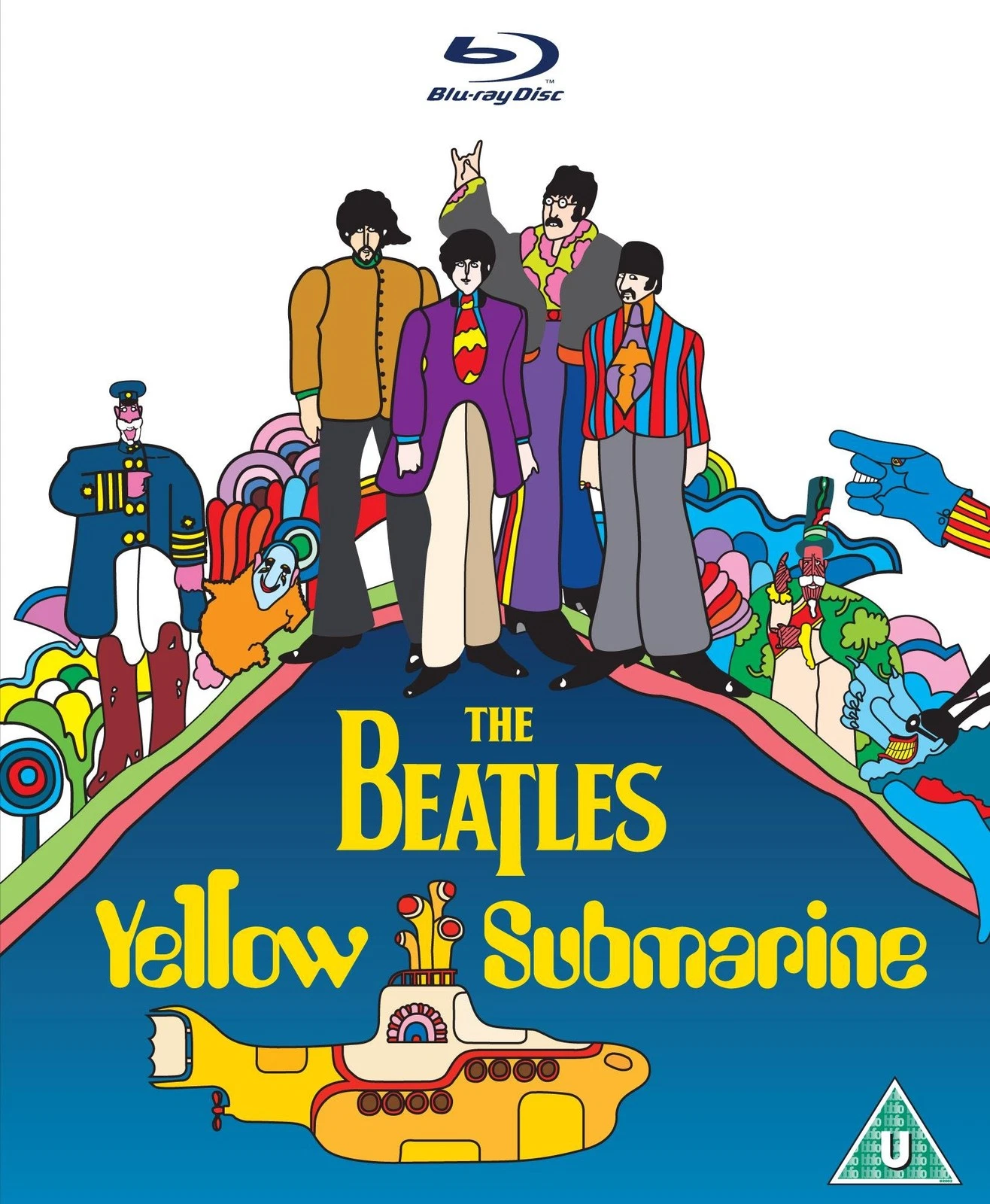
Released in July 1968, Yellow Submarine was unlike anything The Beatles had previously brought to the screen. Directed by George Dunning and shaped by the extraordinary artwork of Heinz Edelmann, the animated feature transformed the group’s music into a surreal adventure filled with bizarre creatures, psychedelic landscapes and distinctly British humour.
The story follows animated versions of John Lennon, Paul McCartney, George Harrison and Ringo Starr as they travel to Pepperland, an underwater paradise conquered by the music-hating Blue Meanies. Their journey unfolds through a succession of fantastical worlds, combining playful absurdity with a simple message about friendship, imagination and the power of music.
Yet The Beatles themselves had relatively little involvement in the production. Developed by producer Al Brodax and an experienced team of animators, the film emerged from the group’s existing relationship with United Artists. Professional actors supplied their characters’ voices, although all four musicians appeared briefly in live action at the conclusion.
What began as a relatively convenient way of producing another Beatles film became something far more ambitious. Arriving less than a year after the troubled reception of Magical Mystery Tour, Yellow Submarine demonstrated how the group’s music could inspire an imaginative cinematic experience without requiring them to take creative control.
The result remains one of the most distinctive entries in The Beatles’ filmography, owing as much to the talents of its filmmakers as to the songs that inspired it.
How Yellow Submarine Came Together
By 1967, The Beatles had become increasingly ambitious recording artists, but their enthusiasm for filmmaking had diminished. Having starred in Richard Lester’s A Hard Day’s Night (1964) and Help! (1965), the group had little interest in undertaking another conventional acting project.
Their relationship with United Artists nevertheless created an opportunity for another theatrical film. An animated feature offered an attractive alternative: The Beatles could appear as cartoon characters without committing to months of filming.
Producer Al Brodax recognised the commercial possibilities of this arrangement, although the project would eventually develop well beyond its practical origins.
From Television Cartoons to a Feature Film
Brodax had previously overseen The Beatles, an American animated television series that began broadcasting in 1965.
The programme followed fictionalised versions of the musicians through light-hearted adventures built around their songs. Although commercially successful, it had been produced with little direct involvement from the group, who were not particularly enthusiastic about their cartoon counterparts.
Nevertheless, Brodax believed that a feature-length animated adventure could offer something more ambitious.
Working through King Features Syndicate, he helped develop a proposal that would draw upon The Beatles’ music and public image while avoiding the demands of another live-action production.
The film was associated with the group’s outstanding United Artists commitments, although the precise contractual position was more complicated than simply treating the animated production as an uncontested replacement for another Beatles film.
The arrangement allowed the musicians to concentrate on recording while a separate creative team developed the project.
Developing Pepperland
Constructing a feature-length story around The Beatles’ music presented a challenge.
The filmmakers needed a narrative flexible enough to accommodate existing recordings, new songs and a succession of imaginative animated sequences.
The original story was credited to Lee Minoff, while the screenplay credits went to Minoff, Brodax, Jack Mendelsohn and Erich Segal. Segal, then an academic specialising in classical literature, would later become internationally famous for his novel Love Story.
The resulting narrative centred on Pepperland, a peaceful underwater kingdom threatened by the Blue Meanies, whose hatred of music and happiness provides the film’s central conflict.
Rather than constructing a conventional musical in which every song advances the plot, the writers created an adventure that could accommodate considerable visual freedom.
This approach allowed the animators to interpret individual recordings through distinctive settings, characters and abstract imagery.
George Dunning, Heinz Edelmann and the Animation Team
Director George Dunning brought considerable experience in commercial and experimental animation to the project.
His London-based studio, TVC, became central to the production, bringing together artists and technicians responsible for developing the film’s elaborate animated environments.
Art director Heinz Edelmann was equally important.
A German illustrator and designer, Edelmann established the striking visual identity that would distinguish Yellow Submarine from more conventional animated features.
His designs combined bold colours, exaggerated characters and surreal imagery with influences from contemporary graphic design and European illustration.
Rather than pursuing the naturalistic movement and familiar character designs associated with Disney animation, Edelmann embraced abstraction, unusual proportions and unexpected visual transformations.
However, the film was a substantial collaborative undertaking.
Animation directors Jack Stokes and Robert Balser, production supervisor John Coates and numerous other artists helped translate its ambitious designs into moving images.
Dunning supervised more than 200 artists and animators over approximately eleven months, an extraordinary undertaking for a production that employed such varied artistic techniques.
The team’s collective work was fundamental to the film’s success, giving Yellow Submarine an identity that extended beyond its famous musical subjects.
The Beatles’ Limited Involvement
Despite being the film’s central characters, The Beatles did not provide their animated counterparts’ voices.
John Clive portrayed John Lennon, Geoffrey Hughes voiced Paul McCartney, Peter Batten was credited as George Harrison, and Paul Angelis played Ringo Starr as well as the Chief Blue Meanie. Angelis also contributed to George’s dialogue during production.
The decision allowed the filmmakers to develop the animation without requiring the musicians to participate extensively in dialogue recording.
Nevertheless, The Beatles were not entirely disconnected from the project.
Their recordings provided its musical foundation, and members of the group occasionally offered suggestions during production. John Lennon later recalled proposing the vacuum-like creature that consumes objects and eventually itself.
All four Beatles also appeared together in a brief live-action sequence at the conclusion, playfully acknowledging the animated adventure.
Although their initial enthusiasm had been limited, their subsequent reactions were more favourable. George Harrison and Ringo Starr, in particular, later expressed admiration for the film’s inventive animation.
When Yellow Submarine finally reached cinemas, it represented something considerably more ambitious than the straightforward commercial project originally envisaged.
The Story: A Journey Through Pepperland
Yellow Submarine follows a relatively simple adventure, using its narrative as a framework for increasingly imaginative encounters.
The film begins in Pepperland, an idyllic underwater paradise where music, colour and happiness are central to everyday life.
Its tranquillity is shattered when the Blue Meanies launch an invasion.
Led by the sinister Chief Blue Meanie, the attackers despise music and anything associated with joy. Their bizarre arsenal includes Apple Bonkers, Snapping Turks and the enormous Flying Glove.
The invasion leaves Pepperland colourless and silent. Its inhabitants are immobilised, while Sgt. Pepper’s Lonely Hearts Club Band is rendered powerless.
With the kingdom under enemy control, the Lord Mayor sends a sailor named Fred to seek assistance.
Old Fred and the Journey from Liverpool
Travelling aboard the Yellow Submarine, Fred reaches Liverpool and encounters Ringo Starr.
After hearing about Pepperland’s predicament, Ringo agrees to help and introduces Fred to John Lennon, Paul McCartney and George Harrison.
The four Beatles board the submarine, beginning a journey through a succession of extraordinary environments.
Their voyage takes them through the Sea of Time, where ordinary chronology becomes meaningless, and the Sea of Science, filled with abstract shapes and peculiar transformations.
The Sea of Monsters introduces an assortment of fantastical creatures, including a vacuum-like monster that consumes everything around it before swallowing itself.
These encounters are less concerned with advancing the story than exploring the imaginative possibilities of animation.
Jeremy Hillary Boob and the Sea of Nothing
One of the film’s most memorable characters appears in the Sea of Nothing.
Jeremy Hillary Boob, Ph.D., is an eccentric, scholarly creature who possesses an extraordinary range of knowledge but lives in complete isolation.
His introduction is accompanied by Nowhere Man, a particularly effective pairing of music and character.
The song’s themes of loneliness and disconnection complement Jeremy’s circumstances, introducing a moment of genuine sympathy amid the surrounding absurdity.
Although John initially mocks the creature’s intellectual pretensions, Ringo takes pity on him and encourages him to join the journey.
Jeremy subsequently becomes an important companion, adding a more personal dimension to the film’s celebration of friendship and belonging.
Restoring Music to Pepperland
After passing through the disorientating Sea of Holes, the travellers eventually reach Pepperland.
They discover a kingdom deprived of its former beauty, with its inhabitants still suffering under the Blue Meanies’ control.
The Beatles set out to recover the instruments belonging to Sgt. Pepper’s Lonely Hearts Club Band, allowing music to return to the occupied paradise.
Their performances gradually restore movement and colour, undermining the authority of the invaders.
All You Need Is Love accompanies the confrontation with the Flying Glove, reinforcing the film’s preference for music and imagination over violence.
The Blue Meanies are ultimately defeated, and the conclusion offers the possibility of reconciliation rather than simple punishment.
Beneath its eccentric humour, the story presents a conflict between creative freedom and oppressive conformity. Pepperland represents imagination and collective enjoyment, while the Blue Meanies seek to eliminate anything that challenges their rigid worldview.
The narrative is undeniably episodic, and some encounters contribute little to its development. However, this looseness also provides the freedom necessary for the film’s most imaginative sequences.
Yellow Submarine succeeds less through the complexity of its story than through the extraordinary world constructed around it.
Psychedelic Animation and Visual Experimentation
The defining achievement of Yellow Submarine is its visual imagination.
Rather than presenting a consistent, realistic environment, George Dunning and his animation team created a world in which shapes, colours and physical relationships could change without warning.
Familiar objects assume impossible forms, characters move through abstract landscapes, and musical performances become opportunities for increasingly elaborate experimentation.
The film reflects the psychedelic culture of the late 1960s while establishing an artistic identity that cannot be attributed to any single movement.
Heinz Edelmann’s Artistic Vision
Heinz Edelmann’s designs combined contemporary graphic art with influences from surrealism, modernist illustration and decorative traditions.
His characters frequently feature exaggerated proportions, unusual silhouettes and striking colour combinations.
The Blue Meanies provide a particularly memorable example. Their angular appearances and exaggerated expressions make them immediately recognisable, while their absurd behaviour prevents them from becoming entirely threatening.
Pepperland, meanwhile, is filled with elaborate patterns, fantastical architecture and colourful vegetation.
These contrasting designs reinforce the film’s central conflict. The imaginative abundance of Pepperland stands against the rigid, destructive behaviour of its invaders.
Edelmann’s contribution was fundamental, but the finished animation also reflects the work of Jack Stokes, Robert Balser and the wider production team.
Together, they developed a visual approach that embraced variety rather than insisting upon a uniform appearance.
Animation Without Conventional Boundaries
Although Yellow Submarine makes extensive use of traditional cel animation, the filmmakers also incorporated photographic imagery, collage, cut-out effects and rotoscoping.
These techniques allowed individual sequences to adopt dramatically different appearances.
Some scenes employ relatively conventional character animation, while others rely upon abstract patterns, repeated images or transformations that would have been difficult to reproduce through live-action filmmaking.
The Sea of Holes is particularly effective, presenting an apparently endless landscape of openings that disrupts the viewer’s understanding of depth and perspective.
Elsewhere, the film’s creatures disregard familiar physical rules, allowing objects and characters to transform in unexpected ways.
This willingness to experiment gives the film much of its appeal, even when the narrative temporarily becomes secondary to the imagery.
Eleanor Rigby and the Streets of Liverpool
Among the film’s most effective musical sequences is its interpretation of Eleanor Rigby.
As the submarine approaches Liverpool, the recording accompanies a series of stylised images depicting the city’s streets, buildings and inhabitants.
The filmmakers incorporate photographic material and unusual compositions, creating a subdued atmosphere that contrasts with the colourful fantasy of Pepperland.
The imagery reflects the song’s themes of loneliness and isolation, demonstrating how animation could respond to the emotional character of a recording rather than simply illustrate its lyrics.
Its restrained visual approach is especially striking within a film otherwise celebrated for its exuberant colours.
Lucy in the Sky with Diamonds
The sequence accompanying Lucy in the Sky with Diamonds offers a contrasting approach.
Dancing figures, shifting colours and abstract patterns move through a constantly changing environment, creating an experience that resembles an animated interpretation of the recording.
Rather than following a conventional narrative, the imagery responds to the song’s rhythm, atmosphere and psychedelic character.
Its fluid transformations demonstrate the freedom available to the filmmakers when they abandoned realistic settings and ordinary physical movement.
Together, Eleanor Rigby and Lucy in the Sky with Diamonds illustrate the film’s remarkable stylistic range.
One uses restrained imagery to emphasise melancholy and isolation; the other embraces movement, colour and abstraction.
The contrast reveals the strength of the filmmakers’ approach: individual songs could inspire distinct visual worlds without undermining the film’s broader identity.
The Music Behind Yellow Submarine

Music provides the foundation for Yellow Submarine, shaping its characters, environments and emotional atmosphere.
The film combines familiar Beatles recordings with four previously unreleased songs and an original orchestral score composed by George Martin.
Although the musicians were not closely involved in the animation, their recordings offered the filmmakers an unusually varied collection of material to interpret.
Yellow Submarine: The Song That Inspired the Film
Originally released on Revolver in August 1966, Yellow Submarine supplied the film’s title and central concept.
Written primarily by Paul McCartney, with contributions from John Lennon, the recording features Ringo Starr on lead vocals and combines a memorable melody with playful nautical sound effects.
Its deliberately simple, communal character made it particularly suitable for animation.
Within the film, the submarine becomes the vehicle carrying The Beatles from Liverpool to Pepperland, transforming the song’s whimsical imagery into the basis of a feature-length adventure.
The Four New Beatles Recordings
Four Beatles songs made their official debut on the Yellow Submarine soundtrack album in January 1969: Only a Northern Song, All Together Now, Hey Bulldog and It’s All Too Much.
Although recorded during separate sessions in 1967 and 1968, the songs were supplied for the film rather than conceived as a unified studio album.
Their contrasting styles reflect the group’s increasingly individual songwriting interests.
Only a Northern Song
Written by George Harrison during the Sgt. Pepper’s Lonely Hearts Club Band sessions, Only a Northern Song is one of his most unusual psychedelic compositions.
Its title refers to Northern Songs, the publishing company responsible for much of The Beatles’ catalogue. Harrison uses ironic lyrics and deliberately unsettling musical ideas to express frustration with his position as a songwriter within the arrangement.
The recording combines organ, brass and dissonant instrumental effects, creating an atmosphere that is both playful and abrasive.
In the film, it accompanies the Sea of Science sequence, where abstract imagery and unusual visual transformations complement the recording’s experimental character.
Although the song had been considered during the Sgt. Pepper period, its unconventional arrangement proved particularly suitable for the animated adventure.
All Together Now
Paul McCartney’s All Together Now takes a considerably simpler approach.
Recorded in May 1967, the song combines a cheerful melody with counting, playful word combinations and a straightforward singalong arrangement.
Its resemblance to children’s music makes it an effective accompaniment to the film’s lighter moments.
The recording appears during the submarine’s journey and returns at the conclusion, reinforcing the themes of friendship and collective participation.
Although less musically ambitious than the group’s more elaborate psychedelic recordings, its simplicity suits the film’s playful personality.
Hey Bulldog
Written primarily by John Lennon and recorded in February 1968, Hey Bulldog provides one of the soundtrack’s strongest rock performances.
Built around a forceful piano riff, the song features driving bass, electric guitar and Lennon’s distinctive vocal delivery.
Its playful lyrics and exchanges between Lennon and McCartney give the recording an irreverent character, while the tightly arranged instrumental performance demonstrates the group’s continued strength as a rock band.
The song accompanies a confrontation involving a four-headed bulldog associated with the Blue Meanies.
However, the sequence has an unusual release history.
It appeared in the original British version of Yellow Submarine but was omitted from the American theatrical version. The sequence was subsequently restored for the film’s 1999 re-release.
Consequently, audiences familiar with different editions of the film may have encountered substantially different versions of this musical episode.
It’s All Too Much
George Harrison’s It’s All Too Much is among the soundtrack’s most expansive recordings.
Recorded at De Lane Lea Studios in May and June 1967, the song combines sustained organ, distorted guitar, brass and increasingly dense instrumental textures.
Its lyrics explore overwhelming feelings of love and spiritual awareness, reflecting Harrison’s interest in experiences beyond conventional material concerns.
The recording builds through repetition and layered instrumentation, creating an exuberant psychedelic atmosphere.
An edited version accompanies the restoration of Pepperland, with its energetic arrangement complementing the return of colour and movement.
It is one of the film’s most effective combinations of music and animation, transforming Harrison’s expansive recording into a celebration of Pepperland’s liberation.
Familiar Beatles Songs in the Film
Alongside the four new recordings, Yellow Submarine incorporates several previously released Beatles songs.
Eleanor Rigby accompanies the journey through Liverpool, while Nowhere Man introduces Jeremy Hillary Boob in the Sea of Nothing.
Lucy in the Sky with Diamonds inspires one of the film’s most elaborate animated sequences, and When I’m Sixty-Four provides an appropriately playful accompaniment to the Sea of Time.
Sgt. Pepper’s Lonely Hearts Club Band becomes central to the restoration of Pepperland’s musical identity, while All You Need Is Love reinforces the film’s message of unity during the confrontation with the Blue Meanies.
These recordings acquire new associations through their placement within the story.
Songs originally written for separate albums and singles become part of a shared animated world, demonstrating the filmmakers’ ability to interpret familiar music in unexpected ways.
George Martin’s Orchestral Score
Although The Beatles’ songs dominate discussions of Yellow Submarine, George Martin’s original orchestral music makes an important contribution.
As the group’s longtime producer, Martin had already played a central role in developing their increasingly sophisticated studio recordings.
For the film, he composed instrumental music to accompany its fantastical environments and dramatic encounters.
Pieces such as Pepperland, Sea of Time, Sea of Holes and March of the Meanies demonstrate his ability to create distinct musical identities for the film’s settings and characters.
The score moves between playful orchestral passages, atmospheric textures and more dramatic arrangements, providing continuity between the Beatles recordings.
Martin’s contribution is particularly valuable during scenes that do not rely upon familiar songs, allowing the animated adventure to develop its own musical atmosphere.
The 1969 Soundtrack Album
Although Yellow Submarine premiered in July 1968, its official soundtrack album did not appear until January 1969.
The LP was released in the United States on 13 January and in Britain on 17 January, featuring an unusual division between Beatles recordings and George Martin’s orchestral music.
Side one contained six Beatles songs: Yellow Submarine, Only a Northern Song, All Together Now, Hey Bulldog, It’s All Too Much and All You Need Is Love.
Side two featured seven instrumental compositions by Martin, including Pepperland, Sea of Time and Yellow Submarine in Pepperland.
The album was therefore not a comprehensive collection of music heard in the film.
Several familiar recordings, including Eleanor Rigby, Nowhere Man and Lucy in the Sky with Diamonds, were absent from the original LP.
Its unusual configuration also distinguished it from The Beatles’ principal studio albums. With only four previously unreleased Beatles songs, the release attracted some criticism for offering relatively little new material from the group.
Nevertheless, the album reached number three in Britain and number two in the United States.
In 1999, Yellow Submarine Songtrack offered a different interpretation of the film’s musical legacy.
Rather than reproducing the original soundtrack LP, the compilation brought together fifteen Beatles recordings featured in the animated production, newly remixed from the original multitrack tapes.
Martin’s orchestral score was omitted, but the collection provided a more comprehensive representation of the group’s musical contribution to the film.
The distinction between these two albums is important. The 1969 release reflects the original soundtrack presentation, while the 1999 compilation focuses specifically on The Beatles’ recordings heard throughout the adventure.
The Film’s Release and Critical Reception
Yellow Submarine received its world premiere at the London Pavilion in Piccadilly Circus on 17 July 1968.
All four Beatles attended, attracting considerable public and press attention despite their limited participation in the production.
The film arrived less than seven months after Magical Mystery Tour had received a largely hostile response following its British television broadcast on Boxing Day 1967.
Both productions embraced psychedelic imagery and unconventional storytelling, but their approaches were markedly different.
Where Magical Mystery Tour relied heavily upon The Beatles’ own creative decisions and improvisation, Yellow Submarine benefited from an experienced team of filmmakers who could translate experimental ideas into a more cohesive visual experience.
Contemporary Critical Reception
The film received a generally favourable critical response, particularly for its inventive animation and imaginative interpretation of The Beatles’ music.
Writing for the Chicago Sun-Times in December 1968, American critic Roger Ebert praised its originality, comparing its creative ambition with the innovations associated with Walt Disney’s animated features.
Ebert recognised the film’s unusual ability to operate on different levels, combining childlike simplicity with more sophisticated humour and visual ideas.
However, he also acknowledged that its appeal differed from the straightforward entertainment of A Hard Day’s Night.
This distinction captures one of Yellow Submarine‘s defining characteristics.
Its narrative is relatively simple, and the succession of loosely connected adventures can occasionally disrupt the pacing. Yet its strongest sequences are memorable precisely because they are not constrained by conventional storytelling.
The animation frequently becomes the principal attraction, allowing the film to function as both a musical adventure and an experiment in visual design.
A Film for Different Audiences
One reason for Yellow Submarine‘s enduring appeal is its ability to entertain audiences of different ages.
Younger viewers can enjoy its colourful characters, eccentric creatures and straightforward conflict between The Beatles and the Blue Meanies.
Older audiences may appreciate its psychedelic imagery, musical references, surreal humour and playful treatment of contemporary culture.
The film’s jokes frequently rely upon wordplay and visual absurdity, allowing individual scenes to operate on more than one level.
However, its broader appeal does not mean that every aspect works equally well.
The animated Beatles are entertaining caricatures rather than fully developed characters, and the story occasionally feels like a collection of musical and visual ideas loosely connected by the journey to Pepperland.
These limitations are worth acknowledging, particularly because they distinguish the film from the more character-driven humour of The Beatles’ earlier live-action productions.
Nevertheless, the freedom afforded to the animation team allowed the filmmakers to create something that would have been difficult to achieve through a conventional starring vehicle.
The Beatles’ Response
Although The Beatles had initially approached the project with limited enthusiasm, their later comments suggest a greater appreciation of the finished film.
Ringo Starr praised its innovative animation, while George Harrison described it as a classic and acknowledged that the professional voice actors were well suited to portraying cartoon versions of the group.
Paul McCartney also reflected positively on the film, despite initially imagining something closer to traditional Disney animation.
Their reactions reinforce the unusual circumstances behind Yellow Submarine.
The film’s success did not depend upon The Beatles personally directing its artistic development. Instead, it emerged from the ability of experienced filmmakers to interpret their music and public image through an entirely different medium.
In that respect, Yellow Submarine represents a distinctive achievement within their cinematic history.
Why Yellow Submarine Still Matters
More than half a century after its original release, Yellow Submarine remains one of the most imaginative films associated with The Beatles.
Its visual identity is unmistakably connected to the psychedelic culture of the late 1960s, yet its strongest sequences retain an appeal that extends beyond their original historical context.
The film did not invent experimental animation, nor can its influence on later filmmakers always be traced directly. Nevertheless, it remains an important example of how popular music, graphic design and ambitious animation could be combined within a feature-length production.
Its reputation rests not simply upon The Beatles’ popularity, but upon the originality of the world created around their recordings.
Restoration and Rediscovery
The film’s continued availability has helped introduce it to generations who never experienced its original theatrical release.
In 1999, Yellow Submarine received a major restoration and re-release, accompanied by the Yellow Submarine Songtrack album.
The restored edition reinstated the Hey Bulldog sequence for international audiences and presented the film with an updated soundtrack.
A further restoration followed in 2012, when Yellow Submarine was prepared for release on Blu-ray and DVD.
The film was restored in 4K digital resolution under the supervision of Paul Rutan Jr. and a team of specialists. Because of the delicate nature of the original hand-drawn artwork, the digital clean-up was carried out manually, frame by frame, rather than through automated processing.
This painstaking work helped preserve the elaborate designs, intricate details and vibrant colours that are fundamental to the film’s identity.
Its Place in The Beatles’ Legacy
Yellow Submarine occupies an unusual position within The Beatles’ filmography.
Unlike A Hard Day’s Night and Help!, it does not depend upon the musicians’ own performances. Nor does it resemble the largely self-directed experimentation of Magical Mystery Tour.
Instead, it demonstrates how their music could provide the foundation for an ambitious creative project developed primarily by other artists.
That separation is central to understanding its achievement.
The Beatles supplied the songs and recognisable personalities, but the film’s distinctive identity emerged from the imagination of George Dunning, Heinz Edelmann and the wider animation team.
Its episodic narrative and occasionally uneven pacing remain weaknesses, particularly when compared with the stronger storytelling of conventional animated features.
However, these limitations rarely overshadow its most inventive musical and visual sequences.
Final Thoughts
Yellow Submarine began as an unconventional solution to The Beatles’ filmmaking commitments, yet developed into one of the most original projects associated with the group.
Its story of Pepperland and the Blue Meanies is relatively simple, but that simplicity allows the animation, humour and music to take centre stage.
The film is not without flaws. Its characters lack the spontaneity of The Beatles’ earlier screen appearances, and some sequences are more memorable for their imagery than their contribution to the narrative.
Nevertheless, its artistic ambition remains impressive.
Through the work of a talented team of filmmakers and animators, Yellow Submarine transformed familiar Beatles recordings into an extraordinary visual adventure.
Its greatest achievement lies not in the complexity of its story, but in the imagination with which that story is told. Decades after its release, it remains a colourful, inventive and unmistakably unusual celebration of music’s ability to bring people together.