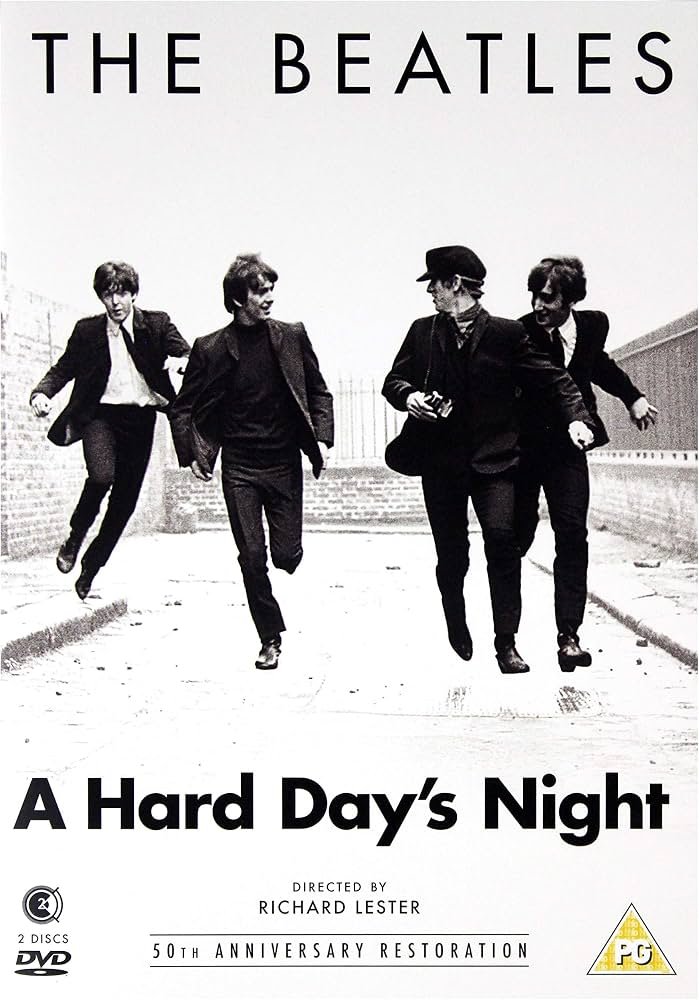
Released in July 1964, at the height of Beatlemania, A Hard Day’s Night captured The Beatles during one of the most extraordinary periods of their career. With their records dominating the charts and their popularity spreading across the Atlantic, John Lennon, Paul McCartney, George Harrison and Ringo Starr were about to make their feature-film debut.
Rather than placing the band in a conventional musical adventure, director Richard Lester created a fast-paced comedy inspired by the absurdities of their everyday lives. Filmed in black and white, the story follows fictionalised versions of the four musicians as they navigate demanding schedules, screaming fans and increasingly frustrated authority figures.
The result was far more inventive than the typical pop-star vehicle. Combining sharp dialogue, playful performances and unconventional filmmaking, A Hard Day’s Night became both a celebration of Beatlemania and a revealing portrait of its pressures. Its influence would extend beyond the cinema, helping shape the visual presentation of popular music for decades to come.
How A Hard Day’s Night Came Together
By early 1964, The Beatles had established themselves as Britain’s biggest pop group and were rapidly conquering America. Their historic appearances on The Ed Sullivan Show in February had introduced them to an enormous television audience, while their records continued to achieve remarkable commercial success.
A feature film offered an opportunity to expand their appeal, but the project initially emerged from familiar commercial ambitions. Films starring popular musicians were often designed primarily to promote recordings, relying on predictable stories and musical performances rather than distinctive filmmaking.
A Hard Day’s Night would take a different approach, building its comedy around the circumstances that had made The Beatles famous.
Walter Shenson and Richard Lester
American producer Walter Shenson developed the project for United Artists, which had secured a film agreement with The Beatles through their manager, Brian Epstein, in 1963.
United Artists was particularly interested in the commercial potential of the accompanying soundtrack. However, the production team recognised that the band’s personalities could provide the foundation for a film with broader appeal.
Richard Lester was chosen to direct. An American filmmaker working in Britain, Lester had developed an unconventional comic style through television and short films, including The Running Jumping & Standing Still Film, featuring Peter Sellers and Spike Milligan.
His work combined visual absurdity, quick editing and a willingness to challenge traditional storytelling. These qualities complemented The Beatles’ irreverent humour, which had already become a defining feature of their press conferences and public appearances.
Rather than attempting to transform the musicians into conventional actors, Lester built the film around their existing personalities.
Alun Owen’s Screenplay
The screenplay was written by Welsh dramatist Alun Owen, whose experience portraying working-class characters helped give the film its distinctive dialogue.
Owen spent time observing The Beatles, listening to their conversations and studying their relationships with one another. Their Liverpool humour, quick exchanges and experiences of sudden celebrity became important influences on his script.
The resulting story presented recognisable but exaggerated versions of the four musicians. Lennon was sharp-witted and mischievous, McCartney appeared comparatively composed, Harrison delivered dry observations, and Starr became the group’s most vulnerable comic character.
Their dialogue retained an informal quality unusual for a mainstream musical comedy. Instead of delivering carefully constructed speeches, the characters exchanged jokes, interrupted one another and responded to authority with cheerful disrespect.
The screenplay also drew upon genuine aspects of the band’s professional lives, including relentless schedules, press interviews and the constant attention of fans. Although the events were fictional, their circumstances were familiar.
Filming at the Height of Beatlemania
Principal photography began on 2 March 1964 at London’s Paddington Station, only weeks after The Beatles’ first major American breakthrough.
Working to a demanding schedule, the production was filmed largely during March and April, with the musicians balancing their cinematic commitments against recording sessions and other professional obligations.
The film’s modest budget encouraged practical choices, including black-and-white photography and extensive location filming. These limitations ultimately complemented Lester’s approach, allowing the production to resemble a documentary rather than an elaborately staged musical.
Railway stations, trains, streets and television facilities provided recognisable surroundings for the fictional events.
The supporting cast included Wilfrid Brambell as Paul’s troublesome grandfather. Already well known to British audiences through the television sitcom Steptoe and Son, Brambell brought an established comic presence to a film otherwise centred on four relatively inexperienced actors.
The combination of Owen’s screenplay, Lester’s direction and The Beatles’ natural chemistry transformed a commercially motivated project into a distinctive musical comedy.
The Story: A Day in the Life of The Beatles
A Hard Day’s Night follows The Beatles through a fictionalised period of frantic travel, rehearsals and preparations for a televised concert.
The film begins with the group attempting to escape a crowd of screaming fans before boarding a train to London. Their journey quickly becomes a succession of practical jokes, arguments and encounters with people determined to impose some order on their behaviour.
A Train Journey Full of Trouble
Aboard the train, the band’s personalities emerge through their interactions with fellow passengers and railway staff.
One particularly memorable encounter involves a disapproving businessman who objects to their behaviour. Rather than accept his authority, The Beatles respond with sarcasm, establishing the irreverent attitude that runs throughout the film.
Their journey is further complicated by Paul’s fictional grandfather, played by Wilfrid Brambell. Although repeatedly described as a clean old man, he proves manipulative, mischievous and considerably less innocent than his appearance suggests.
His interference creates problems for the band’s travelling companions and the people responsible for keeping their schedule on track.
These scenes establish the film’s comic rhythm: the musicians are constantly expected to behave responsibly, yet seem far more interested in amusing themselves.
Rehearsals, Interviews and Escaping Responsibility
Once in London, The Beatles arrive at a television studio to prepare for their performance. Rehearsals, press interviews and production arrangements leave little room for anything resembling an ordinary day.
The group repeatedly frustrate their handlers by wandering away, exchanging jokes and refusing to take their responsibilities entirely seriously.
One particularly effective sequence sees George mistaken for a model and questioned by a television producer about youth fashion. His unimpressed responses expose the absurdity of an industry attempting to manufacture trends while remaining disconnected from the young people supposedly creating them.
Elsewhere, the musicians escape the studio and enjoy a brief burst of freedom in an open field, accompanied by Can’t Buy Me Love.
The sequence offers a welcome contrast to the confined environments of trains, corridors and rehearsal rooms, while providing one of the film’s most memorable musical moments.
Ringo’s Adventure
The most substantial individual storyline belongs to Ringo, whose frustration with the demands of celebrity becomes an opportunity for a more reflective kind of comedy.
Encouraged by Paul’s grandfather to assert his independence, Ringo leaves the studio and wanders through London alone.
His adventure includes encounters with ordinary members of the public, an unsuccessful attempt to enjoy a quieter existence and a series of misunderstandings that eventually bring him into trouble with the police.
Starr’s understated expressions and physical comedy give these scenes a different atmosphere from the band’s more energetic exchanges.
His temporary disappearance also creates the film’s central crisis. With the television recording approaching, the others must locate Ringo and return him to the studio before the performance begins.
The story concludes with the band reunited on stage, delivering the musical performance that has been repeatedly threatened by the day’s disorder.
Rather than relying on an elaborate dramatic resolution, the film finds its humour in the contrast between The Beatles’ extraordinary public status and their determination to behave like four ordinary young men.
Richard Lester’s Filmmaking: Humour, Freedom and the Music Video
Much of A Hard Day’s Night‘s lasting reputation comes from its visual style. Richard Lester rejected the polished presentation associated with conventional pop musicals, favouring restless camerawork, rapid editing and carefully staged moments of apparent spontaneity.
His approach made the film feel immediate and unpredictable, complementing The Beatles’ personalities without reducing them to a series of musical performances.
A Documentary-Inspired Approach
Although the story is fictional, the film frequently adopts the appearance of documentary filmmaking.
Lester uses location shooting, mobile cameras and observational details to create the impression of events unfolding around the musicians. Cinematographer Gilbert Taylor’s black-and-white photography reinforces this atmosphere, balancing naturalistic surroundings with more imaginative compositions.
The opening railway sequence establishes the style immediately. The Beatles race to escape pursuing fans, while the camerawork and editing communicate the speed and confusion surrounding their movements.
The technique draws on contemporary documentary practices and developments in European cinema, particularly the experimentation associated with the French New Wave.
Yet the film is never simply realistic. Lester regularly interrupts its documentary-like presentation with visual jokes, absurd situations and deliberately exaggerated behaviour.
The contrast between realism and comic invention gives A Hard Day’s Night much of its distinctive character.
Comedy and the Rejection of Authority
The film’s humour frequently emerges from encounters between The Beatles and people determined to control them.
Disapproving passengers, television executives and journalists represent a world of rules and expectations that the musicians seem unwilling to accept without question.
Their resistance is rarely confrontational. Instead, they undermine authority through sarcasm, playful misunderstandings and an apparent refusal to recognise its importance.
Lester reinforces these exchanges with visual comedy, unexpected camera angles and abrupt changes of pace, drawing upon the anarchic traditions of British television humour.
The result reflects broader cultural changes taking place during the 1960s. The Beatles’ confidence and irreverence challenge established assumptions about class, respectability and the behaviour expected of successful entertainers.
Their humour becomes part of the film’s appeal, suggesting that young people need not abandon their personalities simply because they have entered the world of commercial entertainment.
The Influence on Music Videos
One of the film’s most significant contributions was its demonstration of how popular music could be presented through imaginative visual storytelling.
The sequence accompanying Can’t Buy Me Love is particularly influential. Rather than placing The Beatles on a conventional stage, Lester films them running and playing in an open field, using movement, editing and camera angles to complement the recording.
The result resembles a self-contained promotional film, with the music providing the structure for a sequence that does not depend on dialogue or a conventional performance setting.
A Hard Day’s Night did not invent the music video. Musical shorts, promotional films and inventive screen performances existed long before 1964.
Its achievement was to bring these possibilities together in a commercially successful feature film, demonstrating that popular songs could inspire visually distinctive sequences rather than simply accompany footage of musicians performing.
The Beatles would explore similar possibilities in later promotional films, including those made for Paperback Writer and Rain in 1966.
The Contradictions of Celebrity
Beneath its comedy, A Hard Day’s Night offers a subtle commentary on the consequences of extraordinary fame.
The Beatles are surrounded by admirers and constantly required to satisfy professional obligations. Their public success has given them remarkable opportunities, but it has also restricted their independence.
Lester communicates this contradiction through the film’s environments. Confined railway compartments, busy corridors and tightly controlled television facilities contrast with the open spaces where the musicians briefly escape supervision.
The film never becomes a serious examination of celebrity, nor does it suggest that The Beatles are unhappy with their success. Instead, these observations give its humour an additional dimension.
Its playful treatment of fame, combined with inventive filmmaking, helps explain why A Hard Day’s Night remains engaging beyond its immediate historical setting.
The Music Behind A Hard Day’s Night

Music is central to A Hard Day’s Night, but its songs serve different purposes throughout the film. Some accompany energetic visual sequences, while others emerge from rehearsals and performances, providing a natural connection between the fictional story and The Beatles’ real musical identity.
The soundtrack also reflects an important stage in the development of Lennon and McCartney’s songwriting, combining the exuberance of early Beatlemania with increasingly sophisticated melodies and arrangements.
The Title Track and Its Famous Opening Chord
Few musical introductions are as immediately recognisable as the opening of A Hard Day’s Night.
Its explosive first chord accompanies the sight of The Beatles racing through a railway station, establishing the film’s frantic atmosphere before the story has properly begun.
The title originated from one of Ringo Starr’s characteristic expressions, describing the exhaustion of working through a demanding day. The phrase became the name of the film, inspiring Lennon and McCartney to write a song to accompany it.
Driven by Lennon’s energetic vocal, McCartney’s contrasting middle section and the band’s tightly arranged instrumentation, the recording captures the excitement associated with their early success.
Its lyrics also complement the film’s premise, contrasting exhausting work with the prospect of returning home to someone special.
Can’t Buy Me Love: A Moment of Freedom
Released as a single in March 1964, Can’t Buy Me Love was already a major hit before the film reached cinemas.
Its appearance in A Hard Day’s Night provides one of the clearest examples of Lester’s imaginative approach to musical sequences.
As the song plays, The Beatles run, jump and play in an open field. Rather than miming a conventional performance, they become the subjects of a playful montage in which the camera and editing respond to the recording’s energy.
The sequence gives the film a moment of visual freedom while demonstrating how a familiar song could acquire a new identity through its presentation on screen.
The Film’s More Intimate Performances
Not every musical sequence relies on exuberance. Several performances reveal the growing range of Lennon and McCartney’s songwriting.
If I Fell showcases their close vocal harmonies and interest in emotional uncertainty, while And I Love Her offers a gentler contrast through McCartney’s restrained delivery and the song’s acoustic arrangement.
Meanwhile, I Should Have Known Better is performed in the train’s luggage compartment, surrounded by young admirers. The informal setting allows the performance to feel like a natural extension of the band’s journey.
Other songs, including I’m Happy Just to Dance with You, Tell Me Why and She Loves You, reinforce The Beatles’ appeal as energetic performers.
Together, these sequences offer a varied musical portrait, demonstrating that the group were already moving beyond the straightforward rock-and-roll arrangements associated with their earliest recordings.
The British and American Soundtrack Albums
Although both markets received an album titled A Hard Day’s Night, the British and American releases were substantially different.
Issued in the UK on 10 July 1964, the British album contained thirteen Lennon–McCartney compositions. Seven featured in the film, while the remaining six expanded the release into a complete studio album.
It was the first Beatles album consisting entirely of original compositions, an important milestone in the band’s development.
The American soundtrack, released by United Artists Records on 26 June 1964, followed a different format. It contained eight Beatles recordings alongside four instrumental arrangements associated with George Martin’s orchestral score.
One of the Beatles tracks, I’ll Cry Instead, appeared on the American soundtrack despite being absent from the completed film.
The distinction reflects the different purposes of the two releases. The American edition was assembled specifically as a film soundtrack, while the British album presented a broader collection of new Beatles material.
Both contributed to the commercial success of A Hard Day’s Night, but the British release also marked a significant step forward for the band as songwriters.
The film’s musical achievement lies in how naturally these recordings fit its shifting atmosphere. From energetic opening sequences to quieter performances, the songs complement the comedy without making the story feel like an extended advertisement for an album.
Release, Reception and Cultural Impact
A Hard Day’s Night received its world premiere at the London Pavilion in Piccadilly Circus on 6 July 1964, arriving during a year of extraordinary international success for The Beatles.
The event attracted enormous crowds, with fans gathering in central London hoping to see the group. Princess Margaret and Lord Snowdon attended, reflecting the band’s growing prominence within British popular culture.
The premiere took place one day before Ringo Starr’s 24th birthday. He had rejoined The Beatles in June after recovering from tonsillitis, having temporarily missed part of their international touring schedule.
Critical and Commercial Success
Despite its relatively modest budget, A Hard Day’s Night became a substantial commercial success and attracted considerable critical praise.
Reviewers recognised that the film offered more than the predictable formula associated with many earlier pop-star vehicles. Its humour, energetic performances and unconventional direction gave it an appeal extending beyond the band’s existing audience.
Alun Owen’s screenplay and George Martin’s musical work also received recognition from the Academy of Motion Picture Arts and Sciences.
At the 1965 Academy Awards, Owen was nominated for Writing (Story and Screenplay—Written Directly for the Screen), while Martin received a nomination for Music (Scoring of Music—Adaptation or Treatment).
Neither won, but the nominations demonstrated the film’s standing beyond its original commercial ambitions.
A Lasting Influence on Music Films
The success of A Hard Day’s Night helped establish new possibilities for films featuring popular musicians.
Instead of presenting The Beatles as aspiring entertainers seeking their big break, the story treated their existing celebrity as the source of its comedy. Their music, personalities and experiences became the material from which the film was constructed.
This approach influenced subsequent attempts to combine popular music with unconventional storytelling, visual experimentation and self-aware humour.
The Beatles themselves returned to cinema in 1965 with Help!, again directed by Lester. Their second feature adopted a more elaborate adventure storyline, but retained elements of the visual comedy and irreverence that had distinguished their debut.
The film’s reputation has also endured because it preserves a particular stage in The Beatles’ career.
Within a few years, the group would abandon touring and increasingly concentrate on ambitious studio recordings. Their public image would change alongside their music, moving away from the matching suits and cheerful presentation associated with their earliest international success.
A Hard Day’s Night therefore offers an unusually vivid record of the group’s early chemistry, even though the events depicted are fictional.
Its combination of comedy, music and cinematic experimentation continues to distinguish it from many other films built around popular performers.
Why A Hard Day’s Night Still Matters
More than sixty years after its release, A Hard Day’s Night remains an entertaining reminder of The Beatles’ extraordinary early success. What began as a commercially motivated project became a film with its own creative identity, shaped by Richard Lester’s inventive direction, Alun Owen’s sharp screenplay and the band’s natural humour.
Its significance extends beyond the familiar songs and images of Beatlemania. By allowing The Beatles’ personalities to drive the story, the film captured a sense of spontaneity that conventional pop musicals often struggled to achieve.
Perhaps its greatest achievement is preserving the group at a moment when everything seemed possible. Before their musical ambitions took them in increasingly experimental directions, John, Paul, George and Ringo were four young musicians meeting worldwide fame with quick wit, infectious energy and an unmistakable sense of fun.
A Hard Day’s Night captures that moment with a freshness that has proved remarkably enduring.