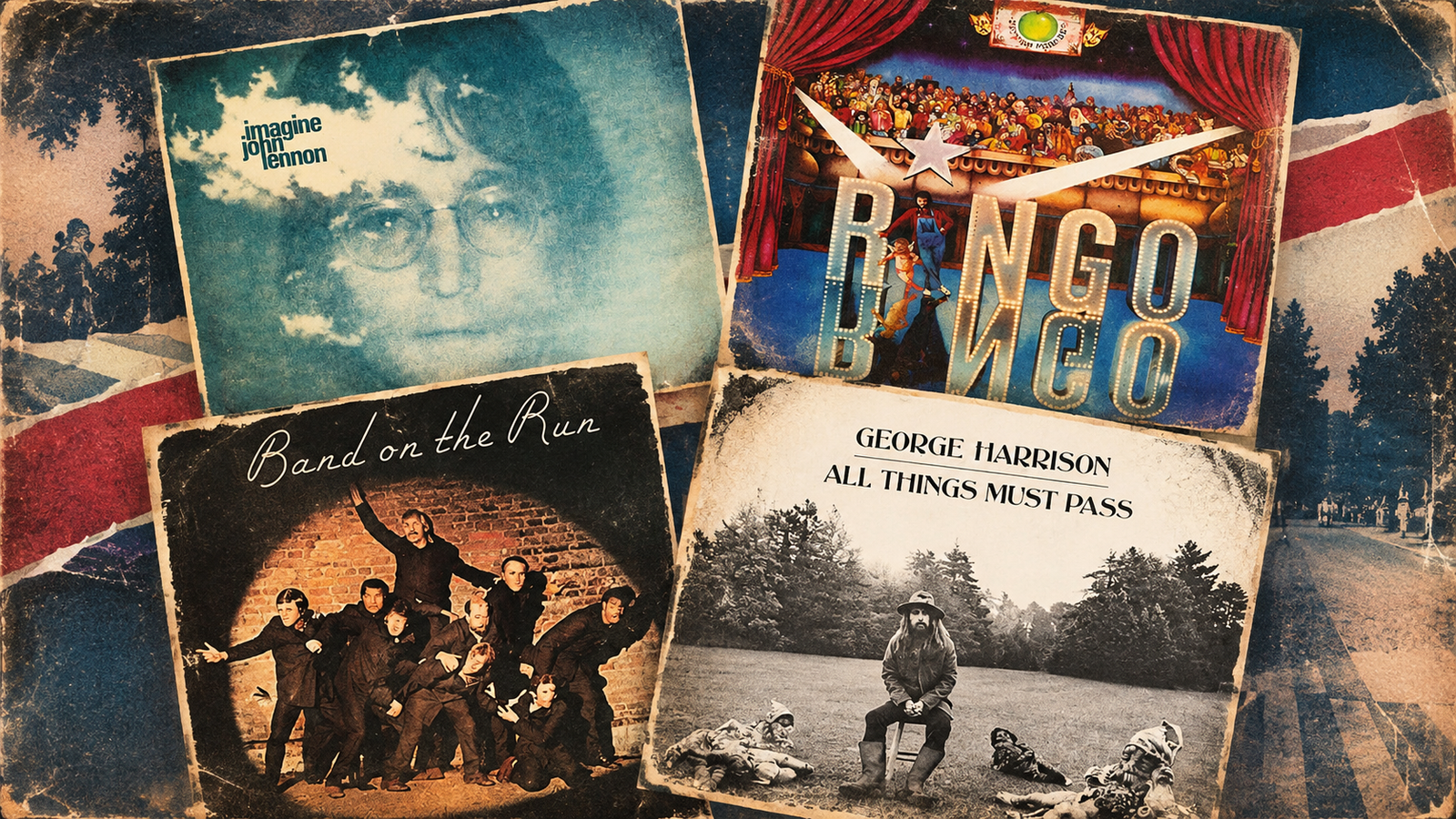
When The Beatles separated in 1970, John Lennon, Paul McCartney, George Harrison and Ringo Starr faced the challenge of establishing themselves beyond the band that had transformed popular music throughout the previous decade.
Each followed a remarkably different path. Lennon embraced intensely personal songwriting and political expression, McCartney pursued melodic rock and pop through Wings and his solo recordings, Harrison explored spirituality and musical collaboration, while Starr developed an unexpectedly successful career as a singer and entertainer.
All four achieved significant success, producing chart-topping singles, acclaimed albums and enduring contributions to popular culture. However, their commercial fortunes differed considerably, and their artistic achievements remain difficult to compare directly.
So, which Beatle had the most successful solo career?
The answer depends upon how success is measured. Record sales, chart positions and career longevity provide useful indicators, but they cannot fully account for artistic influence or the lasting reputation of individual recordings.
The comparison also requires some perspective. Lennon was murdered in 1980, while Harrison died in 2001, giving McCartney and Starr considerably more time to develop their careers.
Nevertheless, examining their commercial achievements, strongest recordings and cultural influence reveals a compelling picture of four musicians establishing their identities beyond The Beatles.
John Lennon: Artistic Freedom and Cultural Influence
John Lennon’s solo career was arguably the most emotionally revealing of the four Beatles. Having spent much of the 1960s balancing personal expression with the demands of the Lennon-McCartney partnership, he increasingly embraced songwriting that confronted his relationships, political beliefs and psychological struggles.
His musical independence had begun before The Beatles officially separated. Alongside Yoko Ono, Lennon released experimental recordings during the late 1960s, exploring avant-garde sound and unconventional composition.
However, his first major post-Beatles studio album would take a very different approach, stripping away elaborate production in favour of direct, intensely personal songwriting.
Plastic Ono Band and Imagine: Two Defining Albums
Released in December 1970, John Lennon/Plastic Ono Band represented a striking departure from the elaborate arrangements associated with The Beatles’ later recordings.
Influenced partly by Lennon’s experiences with primal therapy, the album explored childhood trauma, grief, disillusionment and personal identity. Its sparse instrumentation placed his voice and lyrics at the centre, creating an atmosphere that could feel both uncomfortable and deeply affecting.
Mother confronted feelings of abandonment, while Working Class Hero examined social expectations and the pressures of conformity. Elsewhere, God rejected many of the beliefs and cultural figures that had shaped Lennon’s identity, including The Beatles themselves.
The album was not his greatest commercial achievement, but its uncompromising character established him as an artist determined to challenge expectations rather than preserve his former group’s mythology.
His follow-up, Imagine (1971), adopted a more accessible musical approach without abandoning his interest in personal and political themes.
The title track became his defining solo composition, presenting an idealistic vision of a world without the divisions created by nationalism, religion and material possessions.
Jealous Guy explored vulnerability and regret, while Gimme Some Truth delivered an angry response to political dishonesty. The bitter How Do You Sleep?, widely understood as an attack on McCartney, also revealed the tensions that continued to surround the former Beatles.
Musically, Imagine combined Lennon’s direct songwriting with richer arrangements and polished production. The album reached number one in Britain, demonstrating that his artistic independence could also produce substantial commercial success.
Together, these two recordings established the foundations of Lennon’s solo reputation: emotional honesty, political conviction and a willingness to expose aspects of his personality that conventional pop songwriting often avoided.
Political Activism and an Uneven Middle Period
Lennon’s political beliefs became increasingly prominent during the early 1970s.
His campaigning alongside Ono, including their Bed-Ins for Peace and the 1969 recording Give Peace a Chance, demonstrated his determination to use his celebrity to promote social and political causes.
That approach became especially pronounced on Some Time in New York City (1972), a collaborative album addressing subjects including women’s rights, racial injustice and political imprisonment.
However, its confrontational lyrics and frequently blunt arrangements attracted criticism. The urgency of Lennon’s message did not always translate into equally convincing music.
His subsequent recordings offered a more varied picture.
Mind Games (1973) contained moments of considerable melodic strength, particularly its title track, while Walls and Bridges (1974) proved more commercially successful.
The latter included Whatever Gets You Thru the Night, which became Lennon’s first solo number-one single on the American Billboard Hot 100. It also featured #9 Dream, an atmospheric composition that demonstrated his continuing interest in imaginative production.
His 1975 covers album Rock ‘n’ Roll returned to the American music that had inspired him during his youth. Although less significant as an original artistic statement, it revealed his enduring affection for the foundations of rock and roll.
These albums demonstrated Lennon’s versatility, but they also exposed the inconsistency that characterised parts of his solo catalogue.
Double Fantasy and His Final Recordings
Following the birth of his son Sean in 1975, Lennon largely withdrew from the recording industry to concentrate on family life.
His return came in November 1980 with Double Fantasy, a collaborative album with Ono that explored domestic relationships, parenthood and personal contentment.
Songs such as (Just Like) Starting Over, Woman and Watching the Wheels presented a more reflective Lennon, combining accessible pop arrangements with observations about his changing priorities.
Initial reviews were mixed, with some critics finding the domestic themes and alternating contributions from Lennon and Ono less compelling than his earlier work.
However, the album’s reception was profoundly altered when Lennon was murdered in New York on 8 December 1980, just three weeks after its release.
His death at the age of 40 brought an abrupt end to a career that had already undergone several transformations. Double Fantasy subsequently achieved enormous commercial success, while earlier recordings, particularly Imagine, acquired renewed prominence.
Lennon’s artistic reputation rests primarily upon the emotional intensity and cultural significance of his strongest material rather than the consistency of his entire catalogue.
John Lennon/Plastic Ono Band remains a landmark in confessional rock songwriting, while Imagine produced one of the most recognisable songs of the twentieth century.
Although his commercial achievements were less sustained than McCartney’s, Lennon’s willingness to confront personal vulnerability and political authority established an influential solo identity that continues to distinguish his work.
Paul McCartney: Wings, Commercial Dominance and Longevity
Paul McCartney has the strongest claim to being the most commercially successful solo Beatle. His achievements extend far beyond the popularity of his former group, encompassing decades of hit singles, chart-topping albums and major international tours.
However, his transition into a post-Beatles career was not immediately straightforward.
His earliest recordings received mixed reviews, while his decision to form another band attracted scepticism. Rather than relying exclusively upon his established reputation, McCartney gradually developed a new musical identity through Wings, combining his gift for melody with an adventurous approach to rock and pop.
McCartney, Ram and the Early Solo Years
Released in April 1970, McCartney marked the beginning of his post-Beatles recording career.
Recorded largely by McCartney himself, with vocal contributions from his wife Linda, the album embraced a deliberately informal approach. Its mixture of acoustic sketches, instrumental experiments and more fully developed compositions contrasted sharply with the elaborate production of The Beatles’ later work.
The standout was Maybe I’m Amazed, an emotionally direct love song that demonstrated McCartney’s ability to combine powerful vocals with memorable melodies.
Although the album received mixed reviews, its homemade character subsequently gained appreciation, particularly among musicians interested in independent recording techniques.
His follow-up, Ram (1971), recorded with Linda and additional musicians, expanded upon this approach.
Featuring elaborate vocal harmonies, playful arrangements and an eccentric mixture of styles, the album included Uncle Albert/Admiral Halsey, Too Many People and The Back Seat of My Car.
Contemporary reviews were frequently dismissive, but Ram has since undergone a substantial critical reassessment, with its inventive production and melodic imagination earning greater recognition.
Commercially, it was successful, reaching number one on the UK Albums Chart and demonstrating that McCartney could attract a substantial audience independently of The Beatles.
Wings and the Triumph of Band on the Run
In 1971, McCartney formed Wings with Linda, guitarist Denny Laine and drummer Denny Seiwell.
The decision reflected his desire to experience the collaborative environment of a working band again, although Wings initially struggled to establish a convincing identity.
Their debut, Wild Life (1971), received a disappointing critical response, while subsequent recordings attracted criticism for uneven songwriting.
The breakthrough arrived with Band on the Run (1973), an album that transformed Wings’ reputation.
Following the departures of Seiwell and guitarist Henry McCullough, McCartney, Linda and Laine continued as a trio. Recording sessions took place in Lagos, Nigeria, and London, with McCartney handling much of the instrumentation himself.
Despite the difficult circumstances, the resulting album became one of the defining achievements of his post-Beatles career.
The title track demonstrated his talent for combining contrasting musical sections into a cohesive composition, moving from a restrained opening towards an energetic rock arrangement.
Jet delivered guitar-driven pop, while Bluebird revealed his ability to create memorable melodies through comparatively understated instrumentation. Elsewhere, Let Me Roll It and Nineteen Hundred and Eighty-Five gave the album additional musical variety.
Band on the Run topped the album charts in Britain and the United States, establishing Wings as a major commercial force and helping restore McCartney’s critical reputation.
Its combination of accessible songwriting, ambitious arrangements and musical confidence remains one of the strongest arguments for his artistic achievements beyond The Beatles.
Chart Success and the Peak of Wings
The success of Band on the Run was followed by an extraordinary period of commercial popularity.
Venus and Mars (1975) and Wings at the Speed of Sound (1976) both topped the American Billboard 200, producing successful singles including Listen to What the Man Said, Silly Love Songs and Let ‘Em In.
Wings also became a formidable live act, embarking upon an extensive 1975–76 world tour that produced the successful live album Wings over America.
McCartney’s songwriting during this period was frequently criticised for prioritising melody and accessibility over lyrical depth, particularly when compared with Lennon’s more confrontational work.
Yet such criticism could overlook the sophistication of his arrangements and his ability to create distinctive songs through musical invention rather than personal confession alone.
His commercial appeal extended beyond conventional rock audiences.
In 1977, Mull of Kintyre, released as a double A-side with Girls’ School, became a phenomenal British success. Its Scottish folk influences and pipe-band instrumentation helped it become the first single to sell more than two million copies in the UK.
Although Wings experienced further personnel changes before disbanding in 1981, the group had firmly established McCartney as a successful artist independently of The Beatles.
Reinvention Beyond Wings
McCartney’s career continued evolving beyond the end of Wings.
His 1980 album McCartney II returned to the largely self-recorded approach of his debut, this time embracing synthesisers, electronic textures and unconventional pop arrangements.
Coming Up demonstrated his willingness to experiment with contemporary sounds, while the album’s more eccentric material has subsequently attracted appreciation for its adventurous production.
Tug of War (1982), produced by George Martin, marked another important chapter.
Featuring Take It Away, Here Today and the Stevie Wonder collaboration Ebony and Ivory, the album combined polished arrangements with reflections on personal loss and changing musical ambitions.
Here Today, written in response to Lennon’s death, remains among McCartney’s most affecting post-Beatles compositions.
He also enjoyed international success through collaborations, including Say Say Say with Michael Jackson, which topped the American singles chart in 1983.
His subsequent recordings were not uniformly acclaimed. Albums such as Press to Play (1986) reflected the difficulties of adapting to changing musical trends, but McCartney continued producing significant work.
Flaming Pie (1997) brought renewed critical appreciation, while Chaos and Creation in the Backyard (2005) adopted a more introspective approach to songwriting.
Later albums, including New (2013), Egypt Station (2018) and McCartney III (2020), demonstrated his continuing interest in recording and experimentation.
McCartney’s greatest advantage in this comparison is the breadth of his achievements.
From intimate home recordings to elaborate rock arrangements, electronic experimentation and mainstream pop, his catalogue demonstrates a versatility that few artists have maintained across such an extended career.
Although not every album has matched his strongest work, his combination of commercial success, musical diversity and enduring popularity makes him the most convincing overall contender.
George Harrison: Artistic Independence and Spiritual Exploration
George Harrison entered the post-Beatles era with an extensive collection of songs awaiting release.
Throughout the group’s later years, he had developed into an increasingly accomplished songwriter, contributing compositions such as While My Guitar Gently Weeps, Something and Here Comes the Sun.
However, the dominance of the Lennon-McCartney partnership meant that his opportunities to feature original material on Beatles albums remained comparatively limited.
The group’s separation therefore offered Harrison the freedom to establish himself without those restrictions, leading to one of the most impressive early breakthroughs of any former Beatle.
All Things Must Pass: A Remarkable Breakthrough
Released in November 1970, All Things Must Pass represented Harrison’s first major statement as a conventional solo rock artist.
It was not technically his debut solo album. He had previously released the experimental soundtrack Wonderwall Music (1968) and the electronic album Electronic Sound (1969).
However, All Things Must Pass marked his emergence as a songwriter capable of sustaining an ambitious project independently of The Beatles.
Produced by Harrison and Phil Spector, the triple album brought together material accumulated during the group’s later years alongside newer compositions.
Its expansive arrangements, layered instrumentation and spiritual themes created a distinctive musical identity.
My Sweet Lord became Harrison’s defining solo hit, combining devotional lyrics with an accessible melody that appealed to audiences far beyond his established fan base.
The song reached number one in Britain and the United States, making Harrison the first former Beatle to top the American Billboard Hot 100 as a solo artist.
Elsewhere, What Is Life demonstrated his ability to write energetic, melodic rock, while Isn’t It a Pity explored regret and human relationships through an unusually expansive arrangement.
The title track offered a more reflective perspective, using the inevitability of change as the foundation for one of Harrison’s most enduring compositions.
Although the original release included a third disc of largely instrumental jams, its principal songs formed a remarkably substantial collection.
The album topped the American chart and challenged the perception that Harrison had been a secondary creative force within The Beatles.
Given the freedom to develop his own material, he produced one of the most celebrated albums of any former member.
The Concert for Bangladesh and Spiritual Songwriting
Harrison’s interests increasingly extended beyond his own recording career.
On 1 August 1971, he and Ravi Shankar organised two concerts at Madison Square Garden in New York to raise awareness and funds for people affected by the humanitarian crisis surrounding the Bangladesh Liberation War.
The performances featured musicians including Bob Dylan, Eric Clapton, Billy Preston and Ringo Starr.
Although benefit concerts were not a new concept, the event helped establish an influential model for large-scale humanitarian music performances, demonstrating how prominent musicians could mobilise international attention around a crisis.
Harrison returned to studio recording with Living in the Material World (1973), an album that placed his spiritual concerns even more prominently at the centre of his songwriting.
Its leading single, Give Me Love (Give Me Peace on Earth), reached number one in the United States, while the album itself topped the Billboard chart.
Musically, the record adopted a more restrained approach than All Things Must Pass, allowing Harrison’s lyrics and melodies greater prominence.
However, its persistent religious themes attracted mixed responses. Some listeners admired the sincerity of his convictions, while others found the material overly solemn.
This tension became a recurring feature of Harrison’s career. His spiritual interests gave his music a distinctive identity, but they could also limit its accessibility when the message overshadowed the songwriting.
Changing Fortunes During the 1970s
Following his early successes, Harrison experienced a noticeable decline in commercial momentum.
Dark Horse (1974) emerged during a difficult period marked by personal upheaval and problems with his voice.
His accompanying North American tour attracted criticism, partly because of his strained singing and the prominence given to Indian classical music within the performances.
Extra Texture (Read All About It) (1975) continued this uneven period, favouring a smoother, more restrained sound that divided listeners.
Nevertheless, Harrison’s later 1970s recordings contained worthwhile material.
Thirty Three & 1/3 (1976) demonstrated renewed confidence, with songs such as Crackerbox Palace and This Song combining humour, melody and polished arrangements.
The latter also addressed the copyright dispute surrounding My Sweet Lord, which had been found to have subconsciously copied elements of the Chiffons’ He’s So Fine.
His self-titled album George Harrison (1979) offered a gentler collection, including Blow Away, one of his most accessible later singles.
Although these recordings demonstrated his continuing songwriting abilities, Harrison struggled to maintain the commercial and critical momentum established by his earliest post-Beatles work.
Cloud Nine and the Traveling Wilburys
Harrison enjoyed an unexpected resurgence during the late 1980s.
Released in 1987 and produced with Jeff Lynne, Cloud Nine combined contemporary production with the melodic songwriting and distinctive guitar playing that had characterised his earlier recordings.
Its most successful single, a cover of Rudy Clark’s Got My Mind Set on You, reached number one on the American Billboard Hot 100.
The album also featured When We Was Fab, a playful reflection on his Beatles years, and This Is Love, which demonstrated his continuing ability to produce engaging pop-rock.
The following year, Harrison became a founding member of the Traveling Wilburys alongside Bob Dylan, Roy Orbison, Tom Petty and Jeff Lynne.
Their debut, Traveling Wilburys Vol. 1 (1988), was a substantial critical and commercial success.
Songs such as Handle with Care and End of the Line highlighted the group’s relaxed collaborative chemistry, with Harrison playing an important role in bringing the musicians together.
Rather than competing for individual prominence, he appeared increasingly comfortable working within an ensemble of established songwriters.
Although the Wilburys were not exclusively his project, their success strengthened Harrison’s reputation as a respected and influential musician beyond The Beatles.
Harrison’s Wider Cultural Legacy
Harrison’s achievements were not confined to recording and performing.
In 1978, he became involved in establishing HandMade Films, which helped finance Monty Python’s Life of Brian (1979) after the production encountered financial difficulties.
The company’s subsequent films included Time Bandits (1981), Mona Lisa (1986) and Withnail and I (1987), contributing to an important period of independent British filmmaking.
His interest in Indian music also remained central to his cultural influence.
Through his friendship and collaborations with Ravi Shankar, Harrison helped bring Indian classical traditions to the attention of many Western rock listeners.
Although cross-cultural musical exchanges had existed long before his involvement, Harrison used his international prominence to provide greater visibility for Indian musicians and their work.
He died in November 2001 at the age of 58. His final studio album, Brainwashed, was completed by his son Dhani and Jeff Lynne and released posthumously in 2002.
Harrison’s solo career was less commercially consistent than McCartney’s, but his finest achievements were exceptional.
All Things Must Pass remains a formidable artistic statement, while the Concert for Bangladesh, the Traveling Wilburys and HandMade Films demonstrate the breadth of his creative interests.
His strongest recordings provide a compelling challenge to those of Lennon and McCartney, even if his overall commercial performance was less sustained.
Ringo Starr: Unexpected Hits and Enduring Popularity
Ringo Starr entered the post-Beatles era with a different reputation from his former bandmates.
While Lennon, McCartney and Harrison had established themselves as accomplished songwriters, Starr was primarily recognised for his distinctive drumming, understated humour and occasional lead vocals.
Nevertheless, his transition into a solo career proved surprisingly successful.
During the early 1970s, he achieved several major international hits, demonstrating an ability to connect with mainstream audiences through accessible pop-rock and an engaging vocal style.
Early Recordings and His First Solo Hits
Starr’s first solo album, Sentimental Journey, appeared in March 1970, shortly before The Beatles’ separation became public.
Rather than attempting to recreate his former group’s sound, he recorded a collection of traditional pop standards associated with his childhood and family background.
His second album, Beaucoups of Blues (1970), embraced country music, a genre he had admired throughout his career.
Although neither album achieved major commercial success, they established Starr as a performer willing to explore material outside conventional rock music.
His breakthrough arrived with It Don’t Come Easy in 1971.
Released under Starr’s sole songwriting credit but developed with substantial assistance from Harrison, the single combined an infectious melody with a confident rock arrangement.
It reached number four in both Britain and the United States, becoming Starr’s first major international solo hit.
The following year, Back Off Boogaloo reached number two in Britain, further demonstrating his commercial potential.
These recordings revealed that Starr’s distinctive voice could work effectively within carefully constructed pop songs, particularly when supported by strong songwriting and experienced collaborators.
Ringo: His Greatest Commercial Achievement
Released in November 1973, Ringo became the defining album of Starr’s solo career.
The record featured contributions from all three of his former Beatles bandmates, although they did not perform together as a reunited group.
Lennon wrote I’m the Greatest and played piano on the recording, Harrison contributed to several tracks, and McCartney provided Six O’Clock.
Their involvement attracted considerable attention, but the album’s success also reflected Starr’s ability to bring together musicians whose contributions complemented his personality and vocal style.
Its leading single, Photograph, co-written with Harrison, became Starr’s first number-one hit on the American Billboard Hot 100.
The song combined a memorable melody with lyrics exploring loss and nostalgia, demonstrating that Starr could deliver an emotionally engaging performance without relying upon elaborate vocal techniques.
His follow-up single, a cover of You’re Sixteen, also reached number one in the United States.
Although its light-hearted character contrasted with the introspective songwriting of Lennon and Harrison, its success demonstrated Starr’s considerable mainstream appeal.
The album itself reached number two on the American Billboard 200, becoming his most commercially successful studio release.
Ringo established a formula that suited his strengths: accessible songwriting, accomplished collaborators and performances that prioritised personality over technical complexity.
It remains the strongest evidence that his early solo career deserves greater recognition than it sometimes receives.
Goodnight Vienna and Declining Popularity
Starr continued his commercial momentum with Goodnight Vienna (1974).
Featuring contributions from musicians including Lennon, Elton John and Harry Nilsson, the album maintained the accessible pop-rock approach that had made Ringo successful.
Its prominent singles included Only You (And You Alone) and No No Song, both of which became substantial American hits.
However, Starr’s commercial fortunes declined during the second half of the decade.
Albums including Ringo’s Rotogravure (1976), Ringo the 4th (1977) and Bad Boy (1978) struggled to match the popularity of his earlier recordings.
Although these projects featured experienced musicians, they generally lacked the memorable songwriting that had characterised his most successful releases.
Unlike McCartney, who could sustain a career through his extensive catalogue of original compositions, Starr depended more heavily upon collaboration and the quality of material available to him.
This did not diminish his abilities as a performer, but it made sustained commercial success considerably more difficult.
The All-Starr Band and Lasting Appeal
Starr established a different approach to his musical career in 1989 with the formation of Ringo Starr & His All-Starr Band.
The touring group brought together established musicians for concerts combining Starr’s recordings with songs associated with the other performers.
Its changing line-ups allowed him to collaborate across different styles of rock and pop, while his relaxed stage presence and humour remained central to the performances.
Starr also continued releasing studio albums, including Time Takes Time (1992), Vertical Man (1998) and Ringo Rama (2003), although these attracted considerably less commercial attention than his 1970s work.
His wider career included film and television appearances, most notably his role as the original narrator of Thomas the Tank Engine & Friends, beginning in 1984.
These activities helped maintain his public profile, but his musical achievements remain the strongest basis for assessing his success.
Starr’s early American number-one singles and the popularity of Ringo demonstrated that he could establish himself as a mainstream recording artist independently of The Beatles.
Although his later catalogue lacks the critical standing and commercial consistency of his former bandmates’ work, his longevity as a performer and entertainer represents an achievement in its own right.
Comparing the Four Beatles: Commercial Success, Artistic Influence and Longevity
The four solo careers reveal a fundamental distinction between commercial popularity and artistic significance.
McCartney achieved the greatest sustained commercial success, Lennon developed an especially influential body of personal songwriting, Harrison produced an extraordinary early solo album and extended his influence beyond music, while Starr enjoyed a remarkable period of mainstream popularity.
However, determining an overall winner requires considering how these achievements compare.
Who Was the Most Commercially Successful?
Paul McCartney emerges as the strongest contender.
His recordings with Wings and as a solo performer produced numerous chart-topping albums and internationally successful singles across several decades.
Band on the Run, Venus and Mars and Wings at the Speed of Sound established his dominance during the 1970s, while later releases demonstrated his ability to maintain a substantial audience long after his original commercial peak.
His achievements were particularly impressive because they extended across different musical eras, rather than being concentrated within a relatively brief period.
Lennon also enjoyed substantial success, particularly with Imagine, Walls and Bridges and Double Fantasy, but his recording career was interrupted by periods of inactivity and ended tragically in 1980.
Harrison’s greatest commercial achievements were concentrated around All Things Must Pass, Living in the Material World and his late-1980s resurgence with Cloud Nine.
Starr achieved several major hits during the early 1970s, but his popularity as a recording artist declined considerably afterwards.
Although the precise comparison depends upon how Wings, collaborations and posthumous releases are counted, McCartney’s sustained success gives him the clearest commercial advantage.
Who Produced the Most Acclaimed Solo Music?
Artistic quality is considerably harder to measure.
Lennon’s John Lennon/Plastic Ono Band and Imagine remain central to his reputation, distinguished by their emotional directness, political themes and uncompromising songwriting.
Harrison presents an equally compelling argument through All Things Must Pass, whose ambitious arrangements and substantial collection of songs established him as a major artist in his own right.
McCartney’s reputation is more complicated.
Although Band on the Run has long been recognised as a major achievement, recordings such as Ram and McCartney II initially divided critics before undergoing significant reassessment.
His catalogue contains considerable variation in quality, but it also demonstrates remarkable musical versatility.
Starr’s strongest recordings generally attracted appreciation for their accessible songwriting and engaging performances rather than their artistic innovation.
There is no objective winner in artistic quality. Lennon arguably possesses the strongest reputation for intensely personal songwriting, Harrison produced an exceptional early solo album, and McCartney demonstrated greater stylistic breadth across a much longer career.
The distinction depends upon whether innovation, consistency or the achievements of individual albums are considered most important.
Does Longevity Change the Ranking?
McCartney and Starr possess an obvious advantage in career longevity, having continued recording and performing long after the deaths of Lennon and Harrison.
McCartney has been particularly successful in maintaining his position as a major international performer, reaching successive generations through new releases and extensive touring.
Starr has similarly sustained a substantial live career through his All-Starr Band, even as his later recordings attracted comparatively limited attention.
However, longevity alone cannot determine the importance of an artist’s work.
Lennon’s comparatively brief solo career produced recordings that continue to influence popular music, while Harrison’s contributions to humanitarian concerts and cross-cultural collaboration extended beyond conventional commercial measures.
The fairest assessment therefore considers longevity as one element of success rather than allowing it to overshadow artistic achievement.
Which Beatle Had the Most Successful Solo Career? The Final Ranking
Considering commercial performance, artistic reputation and career longevity together produces the following ranking.
1. Paul McCartney — The Most Successful Overall
McCartney takes first place through his exceptional combination of commercial success, musical versatility and longevity.
His achievements with Wings established him as a major artist independently of The Beatles, while albums such as Band on the Run, Ram and McCartney II demonstrated his willingness to explore different musical approaches.
Although his extensive catalogue contains uneven material, he maintained a level of sustained commercial popularity that none of his former bandmates consistently matched.
Verdict: The most commercially successful solo Beatle, with the artistic breadth and longevity to justify first place overall.
2. John Lennon — An Enduring Artistic Legacy
Lennon takes second place primarily because of the artistic significance and cultural influence of his finest recordings.
John Lennon/Plastic Ono Band and Imagine established a distinctive approach to personal songwriting, combining emotional vulnerability with political and social commentary.
Although his catalogue was comparatively small and occasionally inconsistent, its strongest material remains among the most influential recordings produced by any former Beatle.
Verdict: An exceptionally influential songwriter whose artistic achievements give him a strong claim to second place, despite his comparatively brief career.
3. George Harrison — An Extraordinary Early Breakthrough
Harrison takes third place, although the distinction between his achievements and Lennon’s is considerably closer than their positions might suggest.
All Things Must Pass remains one of the most accomplished albums released by any former Beatle, while My Sweet Lord established him as an immediate commercial force.
His later career experienced significant fluctuations, but his resurgence with Cloud Nine and involvement in the Traveling Wilburys demonstrated his continuing musical relevance.
Verdict: An artist of considerable depth whose finest recordings rival those of his former bandmates, despite less consistent commercial success.
4. Ringo Starr — An Underrated Solo Success
Starr finishes fourth, but his position should not obscure the achievements of his early solo career.
His 1973 album Ringo and American number-one singles Photograph and You’re Sixteen demonstrated that he could achieve mainstream popularity independently of The Beatles.
Although his later recordings rarely matched that success, he established a lasting career through touring, collaboration and his All-Starr Band.
Verdict: A successful solo performer whose early chart achievements deserve recognition, even if his wider catalogue lacks the commercial consistency and critical standing of the other three.
Final Verdict: Paul McCartney Comes Out on Top
Paul McCartney emerges as the most successful solo Beatle when commercial performance, artistic achievements and longevity are considered together.
His ability to establish Wings as a major band, maintain an extensive solo catalogue and reach audiences across successive generations gives him an advantage that is difficult to dispute.
However, the distinction between commercial success and artistic importance remains essential.
Lennon’s most celebrated recordings possess an emotional directness that continues to resonate, while Harrison’s All Things Must Pass represents an extraordinary creative achievement. Starr, meanwhile, demonstrated that his appeal extended well beyond his role as The Beatles’ drummer.
McCartney may take first place overall, but deciding which Beatle produced the best solo music remains a far more subjective question.
What their individual careers demonstrate is that The Beatles’ musical legacy did not end with their separation in 1970. Each member continued contributing to popular culture in his own distinctive way, ensuring that the group’s influence extended far beyond their final recordings together.