Released in October 1970, Atom Heart Mother finds Pink Floyd pursuing their most ambitious studio project to date. Combining a 23-minute orchestral suite with intimate songwriting and unconventional sound experiments, their fifth studio album captures a band expanding its musical possibilities without always knowing how best to control them.
At its centre is an extraordinary collaboration with composer Ron Geesin, whose brass, choral and cello writing transforms Pink Floyd’s instrumental ideas into something approaching a miniature symphony. The results are frequently impressive, although moments of genuine beauty sit alongside passages where the arrangements become excessive.
The album’s quieter compositions are equally revealing. Roger Waters’ reflective “If”, Richard Wright’s bittersweet “Summer ’68” and David Gilmour’s pastoral “Fat Old Sun” offer three distinct songwriting perspectives, demonstrating that the band’s development was not confined to increasingly elaborate experimentation.
Yet Atom Heart Mother remains inconsistent. Its strongest ideas occasionally lose direction, while the closing “Alan’s Psychedelic Breakfast” stretches an intriguing concept beyond its musical potential.
Nevertheless, there is considerably more to admire here than its uneven reputation might suggest. Atom Heart Mother is not the fully realised masterpiece Pink Floyd would eventually produce, but its finest moments reveal growing melodic confidence, instrumental sophistication and a willingness to pursue ideas that few contemporary rock groups would have attempted.
Artistic Intentions & Making of the Album
From Psychedelic Experimentation to Orchestral Ambition
By 1970, Pink Floyd had established themselves as an adventurous live band, but their studio recordings continued to move between conventional songwriting and increasingly abstract experimentation.
The previous year’s Ummagumma had exposed both sides of this approach. Its live performances demonstrated the group’s ability to develop extended compositions through collective improvisation, while the individual studio contributions frequently struggled to turn unusual ideas into satisfying music.
For Atom Heart Mother, the band pursued a more collaborative direction.
The album’s centrepiece developed from an extended instrumental composition they had been performing under the working title “The Amazing Pudding”. Built around contrasting musical themes and atmospheric passages, the piece was already substantial before the band decided to expand it through orchestral arrangements.
This decision brought composer and experimental musician Ron Geesin into the project.
Working from Pink Floyd’s existing instrumental recordings, Geesin composed substantial new brass, choral and cello passages. His contribution went beyond conventional orchestration, helping shape the musical identity of the completed suite rather than simply decorating the band’s original material.
However, integrating these elements was not straightforward. The orchestral recordings presented considerable practical difficulties, with Geesin encountering problems coordinating the session musicians and combining his compositions with the band’s performances.
The finished work occasionally reveals this tension. At its best, the collaboration produces music of remarkable grandeur. Elsewhere, the additional instrumentation threatens to overwhelm ideas that might have been more effective with greater restraint.
Nevertheless, the project represented an important development in Pink Floyd’s approach to recording. They were beginning to explore how elaborate arrangements and outside musical contributions could transform their compositions rather than merely document their live performances.
Three Songwriters, Three Different Perspectives
Although the title suite dominates the album’s reputation, its second side reveals another significant development: the emergence of more clearly defined songwriting identities within the group.
Roger Waters contributed “If”, an understated acoustic composition concerned with vulnerability and emotional insecurity. Its personal character offers a striking contrast to the elaborate opening suite.
Richard Wright’s “Summer ’68” combines melodic piano-led songwriting with dramatic brass arrangements, while David Gilmour’s “Fat Old Sun” explores a gentler, pastoral atmosphere built around acoustic textures and expressive guitar.
These compositions demonstrate that Pink Floyd’s ambitions were developing in different directions. Extended instrumental experimentation remained important, but the band were also discovering the expressive possibilities of more direct songwriting.
The closing “Alan’s Psychedelic Breakfast” takes another approach entirely, incorporating recordings of everyday morning activities into an extended instrumental composition.
Together, these contrasting pieces make Atom Heart Mother an unusually varied album, even by Pink Floyd’s early standards.
Recording and the Unusual Album Cover
Recorded at EMI Studios on Abbey Road in London, Atom Heart Mother emerged from a period in which the band were increasingly interested in ambitious arrangements and unconventional production techniques.
Its visual presentation was equally distinctive.
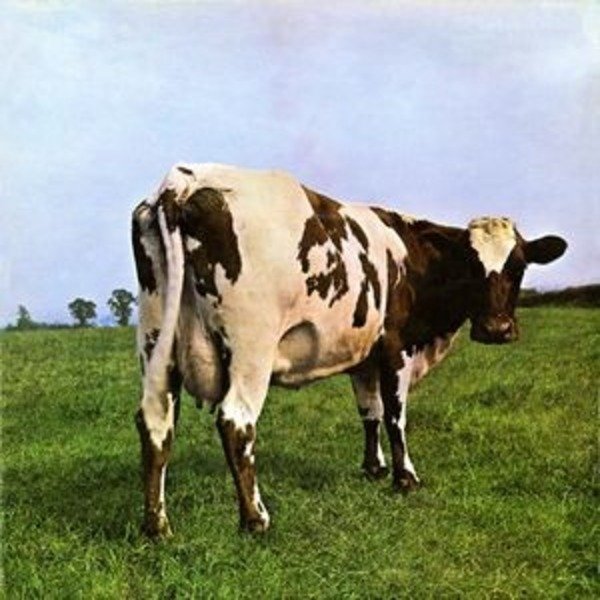
Rather than featuring the musicians or an elaborate psychedelic illustration, the album sleeve displayed a photograph of a cow standing in a field.
Created by Hipgnosis and photographed by Storm Thorgerson, the cover deliberately rejected conventional rock imagery. The cow, named Lulubelle III, had no obvious connection to the music, while the original sleeve omitted the band’s name and album title from its front.
The title itself was inspired by a newspaper headline concerning a woman fitted with a nuclear-powered pacemaker. The unlikely combination of words appealed to the band, giving the album a name that was memorable without attempting to explain its music.
There is an appealing contradiction between this deliberately ordinary artwork and the grand musical ambitions contained within. Pink Floyd were attempting their most elaborate recording yet, but presented it through an image almost aggressively uninterested in grandeur.
That contrast captures something essential about Atom Heart Mother: a record that takes its musical ambitions seriously without entirely abandoning the band’s taste for the unexpected.
Sound & Production

Orchestral Grandeur Meets Atmospheric Rock
The defining sound of Atom Heart Mother emerges from the combination of Pink Floyd’s atmospheric instrumentation and Ron Geesin’s orchestral writing.
The title suite introduces commanding brass themes, expansive choral passages and dramatic changes in intensity. Beneath these additional musicians, however, the band’s familiar instrumental relationships remain recognisable.
Roger Waters’ bass and Nick Mason’s drumming provide a steady rhythmic foundation, while Richard Wright’s keyboards help connect the orchestral arrangements with David Gilmour’s increasingly expressive guitar work.
The most successful passages allow these different elements to complement one another. Brass introduces dramatic weight, the choir creates an occasionally unsettling atmosphere, and the solo cello provides moments of lyrical beauty.
Yet the production also reveals the limitations of this approach.
The orchestral arrangements occasionally dominate the recording, obscuring the subtler contributions beneath them. At other moments, the transitions between musical ideas feel abrupt, as though the composition is moving between contrasting experiments rather than developing naturally.
The recording’s dense textures can also make individual instrumental parts difficult to distinguish. Its ambition is undeniable, but the production does not always provide the clarity needed to accommodate such an extensive arrangement.
The Importance of Restraint
Away from the orchestral suite, the album reveals a more understated side of Pink Floyd’s developing sound.
Gilmour’s guitar is particularly effective when allowed to develop simple melodic ideas. His sustained notes, carefully shaped phrases and restrained electric passages provide an expressive contrast to the grander arrangements.
Wright’s piano and organ work is equally important, moving between delicate accompaniment and more substantial harmonic textures. His contributions frequently give the music warmth without demanding attention through technical display.
The three shorter songs on the second side demonstrate how effective this restraint can be.
“If” relies upon sparse acoustic instrumentation, allowing Waters’ vulnerable delivery to carry the song. “Summer ’68” uses its brass arrangements more selectively, creating dramatic contrasts within a clearly defined structure. “Fat Old Sun” develops gradually from gentle acoustic textures towards a fuller electric conclusion.
These recordings often feel more natural than the album’s elaborate experiments because their arrangements serve recognisable melodies and emotional ideas.
Nevertheless, Pink Floyd’s fascination with unconventional sounds remains apparent. The title suite incorporates abstract textures and studio effects, while “Alan’s Psychedelic Breakfast” places recordings of ordinary domestic activities alongside instrumental music.
The results vary considerably, but the album demonstrates a growing awareness of the studio as a creative instrument in its own right.
The Music: A Track-by-Track Examination
Atom Heart Mother Suite – An Extraordinary but Uneven Experiment
Occupying the entire first side, the 23-minute “Atom Heart Mother Suite” represents Pink Floyd’s most elaborate recorded composition up to that point.
Developed from the band’s instrumental material and expanded through Ron Geesin’s writing, the suite combines imposing brass themes, expressive guitar passages, experimental choral arrangements and extended abstraction.
Its six movements contain some of the album’s most impressive music, although the composition’s considerable scale does not always translate into consistent musical development.
Father’s Shout
The opening movement establishes the suite’s grandiose character immediately.
A low, sustained organ note gives way to a commanding brass theme, creating an atmosphere closer to an epic film score than a conventional rock composition. The arrangement is bold and deliberately imposing, introducing musical ideas that will return later in the suite.
As Pink Floyd’s instruments enter, Waters’ bass and Mason’s drumming provide a measured rhythmic foundation beneath the brass. Wright’s keyboards add harmonic depth, while Gilmour’s guitar introduces a more expressive melodic voice.
The contrast is effective. Geesin’s arrangements supply dramatic scale, but the band’s instrumental contributions prevent the music from becoming entirely ceremonial.
There is something almost absurdly theatrical about the opening, yet its memorable themes and confident progression make it one of the suite’s most successful passages.
The brass occasionally threatens to dominate the arrangement, but the movement establishes a strong musical identity and provides a compelling introduction to the composition.
Breast Milky
Following the imposing opening, “Breast Milky” moves into quieter, more reflective territory.
A lyrical cello solo introduces a gentler atmosphere, accompanied by understated bass and organ. The instrument’s rich, expressive tone provides a striking contrast to the commanding brass arrangements heard earlier.
As the movement develops, Gilmour’s slide guitar introduces another melodic voice. His sustained phrases complement the cello’s warmth, creating one of the suite’s most affecting instrumental passages.
Rather than relying upon dramatic orchestration, the music develops through subtle changes in texture and carefully balanced instrumental contributions. Wright’s organ provides a gentle harmonic foundation, while the rhythm section gradually adds greater movement.
The result is music that feels more intimate and emotionally direct than the preceding section.
Gilmour’s playing is particularly effective, bringing melodic clarity to a composition that can otherwise become overwhelmed by its own ambition.
“Breast Milky” demonstrates how successfully Pink Floyd and Geesin could sustain an extended instrumental passage through atmosphere and expressive musical ideas.
It is among the suite’s strongest movements precisely because it understands the value of restraint.
Mother Fore
“Mother Fore” develops the suite’s choral writing into one of its most distinctive musical features.
Over a repeating organ progression, soprano voices gradually emerge before the fuller choir expands the arrangement towards a dramatic crescendo.
Rather than presenting a conventional vocal melody, the voices move through sustained harmonies and unusual syllabic patterns, creating an atmosphere that is simultaneously solemn, theatrical and unsettling.
The human voice becomes another instrumental texture, expanding the composition’s sound beyond anything Pink Floyd could have achieved through their usual instrumentation.
At its best, the effect is striking. The gradual accumulation of voices introduces an almost ritualistic quality, with the arrangement moving from relative simplicity towards considerable grandeur.
However, the movement is less consistently convincing than the preceding cello- and guitar-led passage.
Some of the exaggerated vocal performances seem more concerned with producing unusual sounds than developing the composition’s underlying musical ideas. The theatricality occasionally becomes distracting, reducing the emotional impact of otherwise impressive arrangements.
Nevertheless, “Mother Fore” remains an intriguing experiment. Its unusual treatment of the human voice gives the suite a distinctive character, even when the execution feels excessive.
Funky Dung
Despite its peculiar title, “Funky Dung” contains some of the suite’s most enjoyable instrumental interplay.
The movement develops around a loose, groove-oriented rhythm, with Waters’ bass and Mason’s drumming establishing a more relaxed foundation.
Gilmour’s guitar moves between melodic phrases and expressive improvisation, while Wright’s keyboards contribute to the arrangement’s increasingly animated character.
After the elaborate choral passages of “Mother Fore”, this return to the band’s core instrumentation is particularly welcome.
The music feels spontaneous and rhythmically engaging, recalling the improvisational confidence of Pink Floyd’s live performances.
However, the movement gradually becomes more eccentric as the choir returns with increasingly animated, almost gospel-like vocal passages.
These additions introduce a playful sense of disorder, but they also interrupt a groove that is compelling enough to stand on its own.
“Funky Dung” is therefore both entertaining and slightly frustrating. Its strongest moments emerge from the musicians’ interaction, while the more exaggerated arrangements occasionally distract from that natural momentum.
Mind Your Throats Please
“Mind Your Throats Please” represents the suite at its most abstract.
Recognisable melodies and rhythmic structures give way to dissonant textures, electronic effects and fragments of earlier musical ideas.
The passage includes distorted speech and unusual keyboard effects, with Nick Mason’s processed voice adding to the increasingly disorientating atmosphere.
Sounds emerge and disappear unpredictably, creating a sense of instability as the composition appears to disintegrate.
There is a clear structural purpose to this disorder. Following several movements built around identifiable musical themes, the passage disrupts the suite’s established identity before its eventual resolution.
However, understanding that intention does not necessarily make the experience more rewarding.
The experimentation offers relatively little musical progression, relying instead upon its unsettling textures and fragmented arrangement to sustain interest.
Unlike the suite’s strongest passages, where contrasting instruments develop recognisable ideas, “Mind Your Throats Please” frequently seems content to create confusion.
It is one of the composition’s weakest movements, illustrating how easily Pink Floyd’s experimental instincts could overwhelm their more substantial musical achievements.
Remergence
The final movement restores the suite’s sense of direction, gradually reintroducing familiar themes and building towards an imposing conclusion.
The return of the opening brass material is particularly effective. After the fragmented atmosphere of “Mind Your Throats Please”, its recognisable melody provides a welcome sense of resolution.
Gilmour’s guitar and Wright’s keyboards contribute to the growing intensity, while Waters and Mason establish a firm foundation beneath the increasingly elaborate arrangements.
The choir also returns, adding weight to the concluding passages as the composition draws together elements introduced earlier.
What makes “Remergence” successful is its ability to give the suite a recognisable structure. Rather than introducing another unrelated experiment, it revisits established musical ideas and develops them towards a dramatic finale.
The conclusion is undeniably grandiose, occasionally approaching the same excess that weakens other movements. Nevertheless, the return of familiar themes provides a satisfying payoff.
After more than twenty minutes of contrasting musical approaches, the composition achieves a degree of unity that occasionally seemed uncertain.
Does the Atom Heart Mother Suite Succeed?
The “Atom Heart Mother Suite” is both impressive and frustrating.
Its opening and closing movements provide a memorable dramatic framework, while “Breast Milky” demonstrates the expressive power of its more restrained instrumentation. “Funky Dung” also contains engaging interplay, particularly before its choral arrangements become more prominent.
However, the suite’s experimental passages are less consistently successful. The choir occasionally becomes excessive, while “Mind Your Throats Please” disrupts the musical development without offering enough substance of its own.
The result is a composition whose individual achievements are often more convincing than its overall execution.
Nevertheless, unlike much of the studio material on Ummagumma, the suite possesses recognisable themes, a substantial structure and passages of genuine emotional impact.
It is not among Pink Floyd’s finest extended compositions, but its strongest moments make it considerably more than an interesting historical curiosity.
If – Roger Waters at His Most Vulnerable
Following the grandeur of the title suite, Roger Waters’ “If” offers a striking change of atmosphere.
Built around gentle acoustic guitar, restrained vocals and delicate accompaniment, the song abandons elaborate experimentation in favour of personal reflection.
Its lyrics develop through a succession of imagined transformations and hypothetical situations. Beneath their occasionally whimsical imagery lies an examination of insecurity, emotional distance and the difficulty of maintaining meaningful relationships.
Waters’ understated vocal delivery is particularly affecting. Rather than expressing these anxieties through dramatic performances, he adopts an almost fragile tone that reinforces the vulnerability of the words.
The arrangement complements this approach. Subtle keyboard textures and restrained guitar contributions add warmth without disturbing the song’s intimacy.
However, “If” is not without limitations. Its melodic structure is relatively modest, while the repeated lyrical pattern occasionally makes the composition feel static.
Nevertheless, its sincerity is difficult to dismiss.
The song offers an early indication of Waters’ growing interest in psychological vulnerability and personal relationships, subjects that would become increasingly important to Pink Floyd’s later work.
“If” may lack the ambition of the title suite, but its emotional honesty makes it one of the album’s quietly rewarding moments.
Summer ’68 – Richard Wright’s Overlooked Highlight
Richard Wright’s “Summer ’68” is arguably the finest conventional song on Atom Heart Mother, combining memorable melodies, bittersweet lyrics and dramatic instrumentation.
Written and sung by Wright, the composition reflects upon a fleeting romantic encounter, capturing the emotional distance between two people whose lives briefly intersect before moving in different directions.
The lyrics are unusually direct, expressing a mixture of affection, frustration and resignation. Rather than romanticising the encounter, Wright acknowledges the emptiness that can follow a temporary relationship.
Musically, the song begins with a relatively intimate piano-led arrangement. Wright’s warm vocal delivery establishes a reflective atmosphere, while the melody possesses an immediacy that distinguishes it from much of Pink Floyd’s earlier material.
However, the composition gradually reveals a more ambitious character.
Prominent brass arrangements introduce an almost celebratory intensity, contrasting sharply with the melancholy of the lyrics. This tension between emotional uncertainty and musical exuberance gives “Summer ’68” much of its personality.
Unlike some moments in the title suite, the additional instrumentation feels closely connected to the songwriting. The brass reinforces the composition’s dramatic changes rather than simply providing spectacle.
Wright also demonstrates considerable skill in managing the transitions between quieter verses and more forceful instrumental passages. The arrangement develops through contrasting sections without losing its central melodic identity.
There is a slightly theatrical quality to the production, and some transitions feel abrupt. Nevertheless, these characteristics contribute to the song’s distinctive character rather than seriously undermining it.
“Summer ’68” deserves greater recognition within Pink Floyd’s early catalogue.
It demonstrates Wright’s abilities not merely as a keyboardist and atmospheric arranger, but as a songwriter capable of combining emotional complexity with accessible, memorable music.
Its mixture of intimacy, melodic confidence and instrumental grandeur makes it one of the album’s strongest achievements.
Fat Old Sun – David Gilmour Finds His Voice
David Gilmour’s “Fat Old Sun” provides another of the album’s highlights, although its appeal is quite different from the dramatic character of “Summer ’68”.
The composition opens with church bells, immediately establishing a pastoral atmosphere. Gentle acoustic guitar and Gilmour’s soft vocal delivery evoke the warmth and tranquillity of an English summer evening.
Its lyrics draw upon images of sunlight, birdsong and the passing of time. Rather than developing an elaborate narrative, Gilmour creates a series of impressions that reinforce the song’s nostalgic character.
There is an appealing naturalness to the arrangement. The understated instrumentation allows the melody to emerge gradually, while the relaxed pace gives the music room to breathe.
Yet “Fat Old Sun” is more than a pleasant acoustic interlude.
As the composition develops, electric guitar becomes increasingly prominent, introducing greater movement and emotional intensity.
Gilmour’s playing is expressive without becoming unnecessarily elaborate, with melodic phrases that complement the song’s reflective atmosphere.
The transition from gentle acoustic songwriting towards a fuller instrumental conclusion is particularly effective. Unlike some of Pink Floyd’s earlier experiments, the extended passages feel connected to the musical ideas established at the beginning.
The studio recording is relatively restrained compared with the more expansive live arrangements the band would subsequently develop. Nevertheless, that simplicity is part of its charm.
The song’s relaxed character occasionally approaches a lack of urgency, but its warmth and melodic appeal more than compensate.
“Fat Old Sun” demonstrates Gilmour’s growing confidence as both a songwriter and vocalist. Its evocative imagery, understated melody and expressive guitar work point towards the more emotionally resonant compositions that would become an important part of Pink Floyd’s sound.
It remains one of Atom Heart Mother‘s most consistently enjoyable tracks.
Alan’s Psychedelic Breakfast – Everyday Life Becomes an Experiment
Closing the album, “Alan’s Psychedelic Breakfast” returns Pink Floyd to the unconventional territory explored on their earlier recordings.
The composition transforms an ordinary morning routine into an extended sound collage, combining recordings of breakfast preparation, casual conversation and eating with three contrasting instrumental passages.
The spoken contributions come from Alan Styles, a member of the band’s road crew, whose matter-of-fact descriptions of his breakfast give the piece its unusual identity.
Recorded in Nick Mason’s kitchen, Styles’ everyday activities become part of the composition itself. The sounds of preparing food, eating and washing up are presented alongside Pink Floyd’s instrumental performances, blurring the distinction between music and ordinary domestic noise.
There is a distinctly playful quality to the concept. Rather than pursuing the grandeur of the title suite, Pink Floyd turn their attention towards mundane activities, finding opportunities for experimentation in sounds that would ordinarily pass unnoticed.
However, the musical results are considerably more rewarding in some sections than others.
Rise and Shine
The opening movement introduces the breakfast recordings alongside gentle instrumental textures, establishing the composition’s mixture of everyday realism and psychedelic atmosphere.
Sounds of food preparation and casual conversation become part of the arrangement, creating an unusual listening experience in which ordinary activities compete with the music for attention.
There is a certain charm to this approach, although the instrumental material initially feels secondary to the novelty of the recordings.
The concept is intriguing, but its appeal depends heavily upon the listener’s willingness to embrace the deliberately mundane subject matter.
Sunny Side Up
The middle movement is arguably the composition’s strongest section.
Built around Gilmour’s acoustic guitar, “Sunny Side Up” offers a gentle instrumental passage that feels surprisingly complete despite its relatively simple arrangement.
The layered guitar parts create a warm, relaxed atmosphere, with subtle melodic variations providing enough movement to sustain interest.
Its pastoral character also connects naturally with the atmosphere established earlier on “Fat Old Sun”.
Unlike the surrounding sound effects, this section works convincingly as music in its own right.
Indeed, its appeal highlights one of the composition’s central weaknesses: the instrumental ideas are frequently more rewarding than the experimental concept surrounding them.
Morning Glory
The final movement introduces a fuller instrumental arrangement, with piano, organ and guitar contributing to a gradually developing atmosphere.
Wright’s keyboards are particularly appealing, providing melodic warmth beneath the continuing domestic recordings.
As the instrumentation becomes more substantial, the piece briefly achieves an effective balance between its unconventional concept and the band’s musical abilities.
However, the breakfast sounds become increasingly repetitive, interrupting passages that might have benefited from more sustained development.
The composition ends with the sound of a dripping tap, an apparently insignificant domestic detail given an unusual prominence.
On some original vinyl pressings, the dripping continued into the record’s run-out groove, allowing the sound to repeat indefinitely on turntables that did not automatically lift the stylus.
It is an amusing final touch, extending the experiment beyond the conventional boundaries of the recording itself.
An Experiment That Outstays Its Welcome
“Alan’s Psychedelic Breakfast” is not without merit.
Its playful concept reflects Pink Floyd’s curiosity about the boundaries between music and recorded everyday life, while “Sunny Side Up” and parts of “Morning Glory” contain genuinely appealing instrumental performances.
However, at approximately thirteen minutes, the composition struggles to justify its duration.
The breakfast recordings gradually lose their novelty, while the musical passages frequently seem more compelling when allowed to develop independently.
As a conclusion to Atom Heart Mother, the piece is undeniably eccentric, but its experimental ambition ultimately proves more interesting than its execution.
Cohesion & Flow

Two Sides of a Very Different Album
One of Atom Heart Mother‘s defining characteristics is the contrast between its two sides.
The opening suite occupies more than twenty minutes of elaborate instrumental music, while the second side moves between intimate songwriting, melodic rock and experimental sound collage.
This division might suggest an album struggling to establish a consistent identity. Yet the contrast is not entirely unsuccessful.
The title suite provides an ambitious opening statement, with recurring themes and dramatic changes in instrumentation giving its six movements a recognisable structure.
Following that intensity, Waters’ understated “If” offers a welcome change of atmosphere. Wright’s “Summer ’68” then introduces a stronger melodic and rhythmic presence, while Gilmour’s “Fat Old Sun” returns to gentler territory before developing towards a fuller instrumental conclusion.
These three songs form an effective sequence, revealing the musicians’ individual personalities without sacrificing the album’s melodic appeal.
The greatest disruption comes with “Alan’s Psychedelic Breakfast”.
Although its instrumental passages share some of the pastoral warmth of “Fat Old Sun”, the recurring domestic recordings create a fragmented conclusion.
There is a certain logic to ending the album with another extended experiment, loosely balancing the orchestral ambition of the opening side. However, that symmetry is more conceptual than musical.
Where the title suite eventually returns to familiar themes, “Alan’s Psychedelic Breakfast” offers no equally satisfying resolution.
Consequently, Atom Heart Mother works better as a collection of contrasting musical approaches than as a fully unified artistic statement.
Its variety is frequently appealing, but the album’s strongest moments emerge from individual compositions rather than a consistent sense of direction.
Legacy & Contributions to Music

Pink Floyd’s First UK Number One
Released in October 1970, Atom Heart Mother became Pink Floyd’s first album to reach number one on the UK Albums Chart.
Its success marked an important commercial breakthrough for a band whose music remained far removed from conventional pop.
With an entire side devoted to an instrumental suite and a closing composition built around recordings of breakfast, the album made few obvious concessions to mainstream expectations.
Nevertheless, its popularity demonstrated the growing audience for Pink Floyd’s adventurous approach.
Commercial success did not necessarily indicate complete artistic achievement, however. The album’s musical inconsistencies remained apparent despite its popularity.
Its significance lay in demonstrating how far the band could expand their ambitions while continuing to reach a wider audience.
An Unusual Contribution to Progressive Rock
By 1970, progressive rock was increasingly associated with extended compositions, unconventional structures and the incorporation of classical instrumentation.
Pink Floyd’s collaboration with Ron Geesin belonged to this broader movement, although their approach differed from the more technically elaborate music of some contemporaries.
Rather than concentrating upon instrumental virtuosity or intricate rhythmic structures, the band developed lengthy compositions through atmosphere, recurring themes and gradual changes in intensity.
The “Atom Heart Mother Suite” expanded this approach through orchestral writing, occasionally achieving moments of extraordinary grandeur.
However, it also exposed the difficulties of combining contrasting musical traditions without sacrificing coherence.
The suite is therefore better understood as an adventurous experiment than as a definitive achievement in orchestral rock.
Its importance lies partly in demonstrating that increasing a composition’s scale does not necessarily strengthen its musical substance.
Towards Meddle and a More Focused Sound
The following year’s Meddle would reveal a more confident balance between extended instrumental development and accessible songwriting.
Its closing composition, “Echoes“, shares Atom Heart Mother‘s interest in lengthy structures, contrasting atmospheres and gradual musical progression.
However, the later work achieves a stronger sense of unity through the interaction of the band’s own instruments.
Where the “Atom Heart Mother Suite” sometimes relies upon additional arrangements for dramatic impact, “Echoes” develops its atmosphere more organically through the musicians’ performances.
This distinction illustrates Pink Floyd’s growing ability to sustain substantial compositions without depending upon orchestral spectacle.
Meanwhile, “If”, “Summer ’68” and “Fat Old Sun” had already demonstrated the increasing importance of melody, emotional expression and individual songwriting.
These developments would contribute to the band’s later achievements, although their progression was gradual rather than the result of any single breakthrough.
An Album the Band Would Later Question
Interestingly, Atom Heart Mother has not always enjoyed the admiration of its own creators.
Both Roger Waters and David Gilmour subsequently expressed strong reservations about the record, particularly its extended title suite.
Their retrospective criticism reflects the distance between Pink Floyd’s early ambitions and the more refined musical approach they eventually developed.
Nevertheless, those opinions should not determine how the album is judged.
Its weaknesses are significant, but so are its achievements. The title suite contains passages of considerable imagination, while the second side offers some of the band’s most appealing early songwriting.
Atom Heart Mother is neither a neglected masterpiece nor an embarrassing experiment best forgotten.
It remains a distinctive, occasionally remarkable album whose musical achievements deserve recognition beyond its place in Pink Floyd’s development.
Closing Thoughts

Atom Heart Mother captures Pink Floyd at a fascinating point in their development, balancing increasingly ambitious experimentation with a growing confidence in melody and songwriting.
Its orchestral title suite remains an extraordinary undertaking, containing moments of genuine beauty and dramatic intensity alongside passages where the arrangements become excessive. The results are impressive without being consistently convincing.
Yet the album’s finest achievements extend beyond its opening composition.
“Summer ’68” and “Fat Old Sun” rank among the band’s most rewarding early songs, while the understated “If” reveals a more vulnerable dimension to Roger Waters’ writing.
The closing “Alan’s Psychedelic Breakfast” is less successful, offering appealing instrumental passages within an experiment that ultimately outstays its welcome.
These inconsistencies prevent Atom Heart Mother from reaching the heights of Pink Floyd’s greatest work. Nevertheless, its strongest compositions demonstrate enough imagination, melodic sophistication and emotional appeal to make the album genuinely worthwhile.
It is an ambitious, eccentric and occasionally beautiful record whose musical achievements deserve appreciation on their own terms.
Official Tune Tempest Rating: 7/10
An imaginative but uneven album, elevated by its finest instrumental passages and some of Pink Floyd’s strongest early songwriting. Its ambition is admirable, even when its execution falls short.