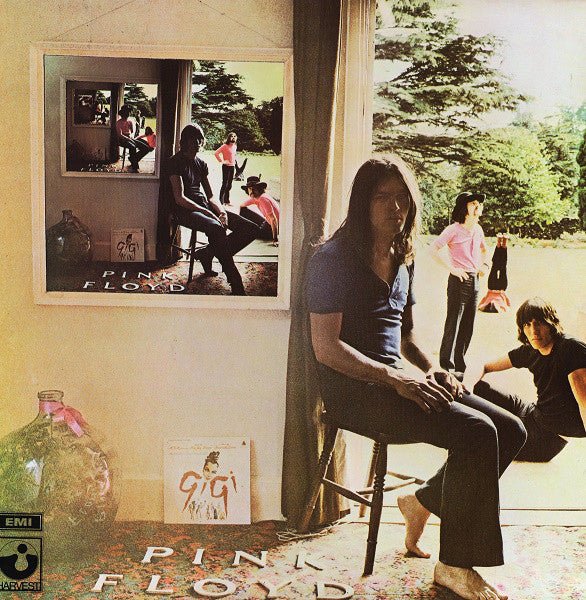
Few albums in Pink Floyd’s discography are as divided in quality as Ummagumma. Released on 7 November 1969, the band’s fourth album presented two strikingly different sides of their musical identity: a live record capturing the intensity of their psychedelic performances and a studio collection in which each member was given the freedom to experiment independently.
The contrast is revealing. Across the live recordings, Pink Floyd transform familiar compositions into expansive performances driven by atmosphere, improvisation and carefully controlled tension. The studio material, however, tells a different story. Although occasionally imaginative, its fragmented compositions and abstract sound experiments frequently struggle to develop into rewarding pieces of music.
There is something admirable about the ambition behind Ummagumma. At a time when rock musicians were increasingly challenging conventional songwriting, Pink Floyd embraced a format that placed individual creativity alongside collective performance. Yet artistic freedom does not necessarily produce artistic success.
The result is an album of considerable contradictions. Its strongest performances reveal the potential of a band still finding its direction, while its weakest passages feel indulgent, underdeveloped and difficult to revisit. Ummagumma remains an intriguing document of Pink Floyd’s early development, but its historical interest is often greater than its musical rewards.
Artistic Intentions & Making of the Album
Two Sides of Pink Floyd
By 1969, Pink Floyd had established themselves as one of Britain’s more adventurous live acts. Following Syd Barrett’s departure, Roger Waters, David Gilmour, Richard Wright and Nick Mason were developing a sound increasingly dependent on extended instrumental passages, improvisation and atmospheric experimentation.
Rather than producing another conventional studio album, the band adopted an unusual approach for Ummagumma. The double LP would devote one record to live performances and the other to individual compositions, giving each musician approximately half a side of vinyl to explore their own ideas.
The concept offered two perspectives on the same group. The live recordings would demonstrate what Pink Floyd could achieve through collaboration, while the studio material provided an opportunity to explore the creative interests of its individual members.
It was an ambitious arrangement, particularly for a band whose musical identity was still evolving. However, it also placed considerable pressure on each musician to produce material capable of standing independently.
Capturing the Band on Stage
The live recordings were drawn from performances at Mothers in Birmingham on 27 April 1969 and Manchester College of Commerce on 2 May 1969.
Rather than presenting a complete concert, Pink Floyd selected four established compositions: “Astronomy Domine”, “Careful with That Axe, Eugene”, “Set the Controls for the Heart of the Sun” and “A Saucerful of Secrets”.
Each had developed beyond its original studio arrangement through regular live performance. Extended instrumental passages, improvisation and dramatic changes in intensity allowed the musicians to explore ideas that were less prominent in the original recordings.
These performances capture Pink Floyd at an important stage in their development. Although their studio work had yet to achieve the sophistication of their later albums, their concerts already demonstrated considerable confidence in sustaining atmosphere across lengthy compositions.
Four Musicians, Four Experiments
The studio recordings were developed at EMI Studios in London during 1969, with Norman Smith credited as producer.
Richard Wright contributed “Sysyphus”, a four-part instrumental suite influenced by classical and avant-garde composition. Roger Waters produced two contrasting pieces: the pastoral acoustic song “Grantchester Meadows” and the manipulated vocal sound collage “Several Species of Small Furry Animals Gathered Together in a Cave and Grooving with a Pict”.
David Gilmour recorded “The Narrow Way”, a three-part composition combining acoustic guitar, experimental textures and psychedelic rock, while Nick Mason explored percussion through “The Grand Vizier’s Garden Party”.
The approach gave each musician considerable freedom, producing a studio record of remarkable stylistic variety.
At the same time, Pink Floyd were developing increasingly elaborate concert presentations, including The Man and The Journey, which combined existing material with new compositions and theatrical ideas. Their interest in unconventional musical structures was therefore not confined to the studio.
The question facing Ummagumma was whether these individual experiments could produce music as compelling as the band’s collective performances.
Sound & Production

The Character of the Live Recordings
The live disc possesses a raw, occasionally indistinct sound that reflects the limitations of concert recording during this period. Instruments sometimes merge into dense layers of organ, guitar and percussion, particularly during the more aggressive passages of “Astronomy Domine” and “A Saucerful of Secrets”.
Yet the recording retains a sense of immediacy. Rather than sounding excessively polished, the performances preserve the interaction between the musicians, including the gradual changes in intensity that give their extended arrangements much of their impact.
David Gilmour’s guitar introduces sustained notes, distortion and atmospheric effects, while Richard Wright’s keyboards provide both harmonic foundations and unsettling textures. Roger Waters’ repetitive bass figures frequently establish the central musical idea, with Nick Mason’s drumming shifting between restraint and sudden bursts of intensity.
The balance is particularly effective on “Set the Controls for the Heart of the Sun”, where subdued percussion, bass and organ combine to create a hypnotic atmosphere.
The recording is not flawless. Some instrumental details become obscured, and the quieter passages occasionally lack definition. Nevertheless, its roughness rarely diminishes the strength of the performances.
Studio Techniques and Sonic Experimentation
The studio disc places far greater emphasis on the manipulation of recorded sound.
Tape effects, layered instruments, dissonant keyboards and unconventional percussion appear throughout, reflecting the musicians’ willingness to explore possibilities beyond their established roles.
Richard Wright uses contrasting keyboard textures and abrasive piano passages to create unsettling shifts in atmosphere. Roger Waters experiments with changes in tape speed and manipulated vocal recordings, while Nick Mason investigates the rhythmic and tonal possibilities of percussion.
David Gilmour’s contributions are more closely connected to guitar-based arrangements, incorporating acoustic passages, distortion and layered instrumentation.
These techniques demonstrate considerable curiosity, but their effectiveness varies. Some create distinctive atmospheres, while others feel like isolated demonstrations of what the recording equipment could achieve.
The issue is not the absence of conventional melodies or familiar song structures. Experimental music can be compelling through texture, tension, rhythm or unexpected contrasts alone. Much of Ummagumma‘s studio material, however, struggles to sustain those qualities across its extended running time.
The contrast with the live disc is striking: the concert recordings achieve their effects largely through musical interaction, while the studio pieces often depend on the novelty of their individual sounds.
The Studio Experiments
Richard Wright – Sysyphus: Ambition Without Direction
Richard Wright opens the studio disc with “Sysyphus”, a four-part instrumental suite inspired by the Greek myth of Sisyphus, condemned to push a boulder uphill for eternity.
The opening movement establishes an imposing atmosphere through grand keyboard passages and an almost ceremonial sense of scale. Its classically influenced arrangement suggests considerable dramatic potential.
However, the second movement moves into far more abrasive territory. Dissonant piano figures, abrupt changes in intensity and disconnected musical phrases create an unpredictable listening experience.
There is a clear interest in tension and contrast, but the piece rarely develops those elements into a compelling progression. Its unpredictability becomes exhausting rather than absorbing.
The third movement introduces quieter, more atmospheric textures, offering some relief from the preceding dissonance. Nevertheless, its abstract character makes it difficult to identify a particularly memorable musical idea.
The final movement returns to the grandeur of the opening, giving the suite a degree of structural symmetry. Yet this conclusion cannot entirely compensate for the lengthy passages that precede it.
Wright’s willingness to explore unfamiliar musical territory is admirable, particularly given his importance to Pink Floyd’s atmospheric sound. However, “Sysyphus” frequently feels more concerned with dramatic contrasts than with creating a sustained musical experience.
Its ambition is evident, but the results are considerably less convincing.
Roger Waters – Grantchester Meadows: A Welcome Moment of Restraint
After Wright’s abrasive experimentation, Roger Waters’ “Grantchester Meadows” offers an almost startling change of atmosphere.
Built around gentle acoustic guitar and understated vocals, the composition evokes the tranquillity of the English countryside. Recordings of birdsong and other natural sounds reinforce its pastoral character, creating a vivid sense of place.
The arrangement is deliberately simple, allowing the melody and atmosphere to develop without elaborate instrumentation. There is also a subtle melancholy beneath its apparent serenity, with the lyrics suggesting an idealised rural landscape removed from the pressures of everyday life.
However, the song’s length becomes a weakness. At more than seven minutes, its limited melodic variation is increasingly noticeable, and the arrangement offers little development beyond its initial atmosphere.
Nevertheless, “Grantchester Meadows” remains one of the studio disc’s more enjoyable pieces. Its understated charm provides a welcome contrast to the surrounding experiments, demonstrating Waters’ ability to create evocative music through relatively modest means.
Roger Waters – Several Species of Small Furry Animals: Experimentation for Its Own Sake
Waters’ second contribution could hardly be more different.
“Several Species of Small Furry Animals Gathered Together in a Cave and Grooving with a Pict” abandons conventional instrumentation in favour of manipulated vocal recordings, animal-like noises and an assortment of unusual effects.
Through changes in tape speed and layered sounds, Waters constructs a bizarre collage that culminates in an exaggerated, mock-Scottish vocal performance.
There is an unmistakable sense of humour running through the recording. Its absurd title and strange vocal transformations suggest that Waters was enjoying the possibilities of studio technology without taking the results entirely seriously.
As an experiment in recorded sound, the piece is imaginative. Its transformations of the human voice demonstrate how ordinary recordings could be manipulated into something almost unrecognisable.
Yet the initial novelty quickly wears thin. The composition offers little sense of progression beyond the introduction of increasingly peculiar noises, and its textures rarely develop into anything particularly absorbing.
This is not a criticism of its rejection of conventional songwriting. Rather, the recording struggles to create sufficient rhythmic interest, tension or variation to reward repeated listening.
“Several Species” remains an entertaining curiosity, but it is difficult to regard it as a particularly successful musical composition.
David Gilmour – The Narrow Way: The Studio Disc’s Strongest Contribution
David Gilmour produces arguably the most consistently rewarding studio material with “The Narrow Way”, a three-part suite combining acoustic guitar, psychedelic experimentation and more conventional songwriting.
The opening movement is particularly appealing. Layered acoustic guitar passages establish a reflective atmosphere through delicate melodic figures and subtle changes in texture.
The second movement moves into darker territory, introducing distorted guitar sounds, sustained notes and unsettling instrumental effects. Although more abstract, its contrasting textures provide an effective transition towards the suite’s conclusion.
“The Narrow Way, Part Three” is the strongest movement. Introducing Gilmour’s vocals and a recognisable song structure, it combines atmospheric guitar arrangements with a more substantial melodic foundation.
The composition gradually develops in intensity, allowing its layered instrumentation to support rather than overwhelm the central musical ideas.
There are still weaknesses. The transitions between movements can feel abrupt, and the middle section occasionally lacks direction. Nevertheless, the suite possesses a clearer sense of musical development than most of the studio disc.
Gilmour’s contribution offers an encouraging indication of his developing abilities as a songwriter and multi-instrumentalist. It is not a fully realised masterpiece, but its strongest passages demonstrate how experimental textures and conventional musical ideas could complement one another.
Nick Mason – The Grand Vizier’s Garden Party: Rhythm Without Substance
The studio disc concludes with Nick Mason’s “The Grand Vizier’s Garden Party”, a three-part composition centred on percussion and unconventional rhythmic textures.
The opening movement, “Entrance”, introduces a delicate flute melody performed by Lindy Mason, establishing a gentle atmosphere before the music shifts towards more abstract territory.
The central section, “Entertainment”, forms the majority of the composition. Mason explores contrasting percussion sounds, rhythmic patterns and recording effects, drawing attention to instruments that would ordinarily remain part of a larger arrangement.
There are occasional moments of interest, particularly in the variety of tones and textures. However, the piece rarely develops a compelling rhythmic idea.
Instead, it moves through a succession of loosely connected passages that struggle to establish momentum or emotional impact.
This is particularly disappointing given Mason’s effectiveness as a drummer within Pink Floyd. His restrained performances on the live disc demonstrate an impressive understanding of timing and tension, qualities that are less apparent when percussion becomes the sole focus.
The closing movement, “Exit”, returns to the flute-led atmosphere of the opening, giving the composition a recognisable structure. Yet this framing device does little to resolve the weaknesses of its central section.
“The Grand Vizier’s Garden Party” contains interesting sounds, but its extended percussion experiments rarely become an absorbing musical experience.
Creative Freedom and Its Limitations
Taken together, the four studio contributions reveal considerable differences in the musicians’ approaches.
Wright pursues dramatic instrumental composition, Waters alternates between pastoral songwriting and vocal manipulation, Gilmour explores guitar-based arrangements, and Mason investigates percussion.
There is genuine imagination throughout, and dismissing the entire studio disc as meaningless noise would overlook its occasional achievements.
Nevertheless, the most rewarding passages are those in which the experiments establish a convincing atmosphere, progression or musical identity. Too frequently, the compositions introduce intriguing ideas without developing them sufficiently.
The studio record therefore offers an interesting portrait of four creative personalities, but a considerably less satisfying collection of music.
Cohesion & Flow

Does the Double-Album Concept Work?
The division between live and studio recordings gives Ummagumma a distinctive identity, but it also creates an unusually uneven listening experience.
The live disc forms a surprisingly effective sequence. “Astronomy Domine” provides an energetic opening, “Careful with That Axe, Eugene” introduces a dramatic shift towards restraint and tension, and “Set the Controls for the Heart of the Sun” sustains a hypnotic atmosphere.
Finally, “A Saucerful of Secrets” brings the record towards a grand conclusion through its solemn “Celestial Voices” finale.
Despite their contrasting moods, the four performances share a recognisable musical character. Their extended arrangements and gradual changes in intensity create a sense of continuity.
The studio disc is far more fragmented. Its organisation reflects the decision to allocate space to each musician rather than an attempt to construct a unified musical journey.
The abrupt transition from Wright’s dissonant “Sysyphus” to Waters’ peaceful “Grantchester Meadows” is striking, while the subsequent shift into “Several Species” disrupts that tranquillity almost immediately.
Gilmour’s “The Narrow Way” restores a stronger melodic foundation, but Mason’s percussion experiments provide an unconventional and somewhat unsatisfying conclusion.
Stylistic variety is not inherently a weakness. However, these compositions rarely establish meaningful relationships with one another, leaving the studio disc feeling more like a collection of individual projects than a coherent album.
The double-LP format therefore magnifies Ummagumma‘s inconsistency. Its two records are fascinating to compare, but they are considerably less convincing as equally essential halves of a complete musical statement.
Standout Tracks & Memorable Moments
Astronomy Domine – A Psychedelic Classic Reimagined
Opening the live disc, “Astronomy Domine” demonstrates how significantly Pink Floyd’s performances had developed since the song first appeared on The Piper at the Gates of Dawn.
David Gilmour’s guitar gives Syd Barrett’s composition a sharper, more sustained sound, while Richard Wright’s organ adds weight to its psychedelic atmosphere.
The extended instrumental passages allow the musicians to explore changes in intensity and texture, transforming the original recording into a more commanding performance.
Although the arrangement occasionally becomes dense, its energy and improvisational confidence make it one of the album’s strongest moments.
Careful with That Axe, Eugene – A Masterclass in Tension
“Careful with That Axe, Eugene” is arguably the finest performance on Ummagumma.
Built around Roger Waters’ repetitive bass figure, atmospheric keyboards and restrained percussion, the composition develops an extraordinary sense of unease through relatively limited musical material.
Its greatest strength is patience. Small changes in volume and instrumental emphasis gradually intensify the atmosphere before Waters’ piercing scream triggers an explosive climax.
The sudden eruption is startling precisely because the preceding music has been so carefully controlled.
Rather than relying upon constant activity, the band demonstrate how silence, restraint and repetition can become powerful dramatic tools.
It is one of the clearest examples of Pink Floyd’s early ability to transform a simple musical idea into an absorbing performance.
Set the Controls for the Heart of the Sun – Hypnotic and Immersive
The live rendition of “Set the Controls for the Heart of the Sun” expands upon the original recording from A Saucerful of Secrets, allowing its repetitive rhythms and atmospheric textures greater room to develop.
Waters’ subdued vocals reinforce the mysterious atmosphere, while Mason’s percussion maintains a steady rhythmic pulse.
Wright’s organ is particularly effective, introducing subtle changes in texture that prevent the arrangement from becoming entirely static.
The performance lacks the dramatic climax of “Careful with That Axe, Eugene”, but its hypnotic character demonstrates how effectively Pink Floyd could sustain interest through gradual musical development.
A Saucerful of Secrets – Finding Beauty Within the Chaos
The live version of “A Saucerful of Secrets” remains one of the album’s most ambitious performances.
Its extended instrumental passages move through abrasive textures, aggressive percussion and dissonant experimentation before reaching the solemn finale known as “Celestial Voices”.
Not every section is equally successful. Some of the more chaotic passages remain difficult to engage with, relying heavily upon unsettling sounds rather than sustained musical development.
However, the closing movement is genuinely affecting.
As Wright’s organ introduces its stately harmonic progression, Gilmour’s wordless vocals lend the arrangement an almost ceremonial quality.
The transformation from disorder to grandeur provides one of Ummagumma‘s most memorable moments, demonstrating the emotional power Pink Floyd could achieve through extended instrumental music.
The Studio Disc’s Brightest Moments
Although the live recordings dominate the album’s highlights, the studio disc contains two particularly worthwhile contributions.
Roger Waters’ “Grantchester Meadows” offers an appealing combination of gentle acoustic guitar, understated vocals and pastoral atmosphere. Its simplicity provides a welcome contrast to the more demanding experiments.
David Gilmour’s “The Narrow Way, Part Three” is arguably the studio disc’s strongest individual movement, combining melodic songwriting with layered guitars and atmospheric instrumentation.
Neither composition is without limitations, but both demonstrate how effectively Pink Floyd’s experimental interests could complement recognisable musical ideas.
These moments offer glimpses of the band’s potential, even when the surrounding material struggles to reach the same standard.
Legacy & Contributions to Music
Pink Floyd at an Experimental Crossroads
Ummagumma occupies an unusual position in Pink Floyd’s discography. Having moved beyond Syd Barrett’s psychedelic songwriting, the band were exploring increasingly ambitious musical structures without yet establishing the compositional confidence of their most celebrated recordings.
The album captures that transitional period particularly clearly.
Its unconventional format and adventurous recording techniques reflect a broader movement in which rock musicians were challenging the boundaries of popular music.
However, experimentation should not automatically be confused with innovation. Tape manipulation, musique concrète, dissonance and unconventional percussion had already been explored extensively within avant-garde music.
Pink Floyd’s interest in these approaches was part of a wider artistic movement rather than an entirely unprecedented development.
What makes Ummagumma distinctive is its presentation of these techniques alongside the band’s established concert repertoire. It offers an unusually direct perspective on the different creative interests emerging within the group.
Nevertheless, its historical significance should not obscure the inconsistent quality of the resulting music.
Towards a More Focused Musical Identity
Several aspects of Ummagumma anticipate directions Pink Floyd would continue exploring during the early 1970s.
The live recordings demonstrate their increasing confidence in constructing extended performances around gradual changes in atmosphere and intensity. These techniques would remain important as the band developed more ambitious compositions.
Atom Heart Mother continued their interest in large-scale musical structures, particularly through its orchestral and choral title suite.
By Meddle in 1971, however, Pink Floyd had developed a considerably more satisfying balance between experimentation and musical direction.
“Echoes” is particularly revealing. Its extended structure incorporates unconventional sounds, instrumental improvisation and recognisable melodic passages, but these elements contribute to a coherent musical journey.
Where much of Ummagumma‘s studio material feels disconnected, “Echoes” establishes stronger relationships between its contrasting sections, allowing the composition to evolve without losing its underlying identity.
Gilmour’s “The Narrow Way” also provides an early indication of his developing abilities as a songwriter, although the band’s later achievements emerged through several years of collaboration and musical refinement rather than any single experimental project.
It would therefore be misleading to suggest that Ummagumma directly established the approach heard on The Dark Side of the Moon or Wish You Were Here.
Its significance lies instead in documenting a period of exploration, when Pink Floyd were still discovering how to transform their increasingly ambitious ideas into cohesive musical statements.
An Interesting Record Rather Than an Essential One
More than five decades after its release, Ummagumma remains one of the band’s most unusual albums.
For listeners interested in Pink Floyd’s early performances, the live disc offers considerable rewards. Its expansive arrangements capture a group whose confidence and musical identity were developing rapidly.
The studio material is harder to recommend. Although it contains occasional moments of genuine imagination, much of its appeal lies in the opportunity to hear the musicians exploring unfamiliar techniques rather than in the quality of the finished compositions.
That makes Ummagumma an intriguing historical document, but not necessarily an essential listening experience.
Its value lies as much in what it reveals about Pink Floyd’s development as in the music itself.
Closing Thoughts

Ummagumma is one of Pink Floyd’s most fascinating contradictions: an album that demonstrates the band’s considerable musical abilities while exposing the limitations of their experimental ambitions.
Its live recordings are unquestionably the stronger half. Across four expansive performances, Pink Floyd display an impressive command of atmosphere, improvisation and dramatic tension. “Careful with That Axe, Eugene” is particularly compelling, while “Astronomy Domine” and “Set the Controls for the Heart of the Sun” capture a group increasingly confident in its musical direction.
The studio disc, however, is considerably less rewarding. Giving each musician complete creative freedom produces occasional moments of genuine imagination, particularly in Waters’ “Grantchester Meadows” and Gilmour’s “The Narrow Way”. Yet much of the remaining material feels indulgent, fragmented and insufficiently developed.
There is historical value in hearing the band explore these possibilities, particularly knowing how their sound would develop over the following years. Nevertheless, an album should be judged by what it achieves rather than what its creators would eventually accomplish.
As a document of Pink Floyd’s transition towards more ambitious music, Ummagumma remains intriguing. As a complete double album, however, its inconsistency is impossible to overlook.
Official Rating: 5/10
An ambitious but deeply uneven double album, with compelling live performances overshadowed by a studio record that too often confuses experimentation with musical achievement.