How do you follow one of the most successful albums in rock history when that very success has left you questioning what made the music meaningful in the first place?
For Pink Floyd, the extraordinary achievements of The Dark Side of the Moon (1973) brought international recognition, financial security and expectations unlike anything they had previously experienced. Yet beneath that success, the band were becoming increasingly disconnected from the creative enthusiasm that had once united them. Their next album would confront that disillusionment rather than attempt to recreate their previous triumph.
Released in September 1975, Wish You Were Here emerged as a deeply personal reflection on absence, alienation and the uncomfortable relationship between artistic expression and commercial success. At its emotional centre stood Syd Barrett, Pink Floyd’s former frontman, whose departure had left a lasting impression on the musicians who continued without him. His absence became a powerful symbol of something broader: the distance that can develop between people, their ambitions and the lives they once imagined.
Musically, the album moves between the expansive, elegiac passages of “Shine On You Crazy Diamond”, the mechanical unease of “Welcome to the Machine” and the disarming simplicity of its title track. These contrasting compositions reveal a band capable of expressing profound emotional uncertainty through both elaborate experimentation and remarkable restraint.
Where The Dark Side of the Moon examined the pressures of human existence, Wish You Were Here explores the emptiness that can remain when apparent success fails to provide fulfilment. It is an album about someone who is no longer there, but also about the unsettling possibility of becoming absent from your own life.
The Making of Wish You Were Here
The extraordinary success of The Dark Side of the Moon had transformed Pink Floyd’s career, but it also left the band facing an unfamiliar creative challenge. Having achieved international recognition through an album that seemed to bring together everything they had been working towards, where could they go next?
By 1974, the musicians were experiencing growing fatigue and a sense of disconnection. The demands of touring, commercial expectations and their changing relationships had begun to undermine the enthusiasm that once accompanied their experimentation.
The problem was not simply a lack of musical ideas. Pink Floyd had already begun developing new compositions in concert, including material that would eventually appear on Animals (1977). What they lacked was a shared sense of purpose comparable to the concept that had unified their previous album.
That uncertainty would become the foundation of Wish You Were Here.
Finding Direction After The Dark Side of the Moon
Pink Floyd had experimented with an unusual project involving music created using everyday household objects. Although the idea reflected their continuing interest in unconventional sounds, the practical difficulties eventually led them to abandon it as a complete album. Recordings involving tuned wine glasses nevertheless contributed to the atmospheric opening of “Shine On You Crazy Diamond”. Meanwhile, new material was emerging through live performances.
During their 1974 British tour, the band introduced “Shine On You Crazy Diamond”, alongside “Raving and Drooling” and “You’ve Got to Be Crazy”. The latter two compositions would eventually evolve into “Sheep” and “Dogs” on Animals.
“Shine On You Crazy Diamond” proved particularly important.
Developed around a distinctive four-note guitar phrase from David Gilmour, the composition gradually became an extended musical reflection on Syd Barrett, the band’s former singer, guitarist and principal early songwriter.
Barrett’s departure in 1968 had marked a decisive turning point in Pink Floyd’s history. His imaginative songwriting and experimental approach had helped establish their original identity, but his increasingly unpredictable behaviour and difficulties with his mental health had made his continued involvement untenable. By the mid-1970s, his absence had acquired a different significance. Pink Floyd had achieved a level of success far beyond anything they had experienced during Barrett’s time in the band, yet that success had also introduced feelings of estrangement and dissatisfaction.
The contrast was difficult to ignore. Barrett represented both a person the musicians had lost touch with and a reminder of an earlier period when their creative ambitions had been less entangled with the machinery of international fame. Roger Waters increasingly recognised absence as a theme capable of connecting these experiences.
Rather than creating a straightforward tribute album, Pink Floyd began exploring different forms of disconnection: the loss of a friend, the erosion of artistic sincerity and the uncomfortable distance between commercial success and personal fulfilment.
Recording at Abbey Road
Recording began at Abbey Road Studios in January 1975, with sessions continuing intermittently until July. The atmosphere was not always productive.
Despite the band’s enormous commercial achievements, the musicians struggled at times to recover the collective enthusiasm that had driven their earlier work. Their personal lives, professional responsibilities and changing relationships contributed to sessions that could feel frustratingly directionless. There was also the practical challenge of following an album whose success had exceeded almost every expectation.
Where The Dark Side of the Moon had benefited from extensive live development and a clearly established concept, Wish You Were Here emerged through a more uncertain process. The recording sessions were interrupted by touring commitments, requiring the band to return repeatedly to material that was still developing. Brian Humphries served as the principal recording engineer, replacing Alan Parsons, who had worked on The Dark Side of the Moon. Peter James assisted with engineering, while Pink Floyd again produced the album themselves.
Despite the difficulties, the recording gradually acquired a distinctive sonic character. Richard Wright’s synthesisers and keyboards became central to the expansive atmosphere of “Shine On You Crazy Diamond”, while Gilmour’s guitar provided much of its melodic identity. Elsewhere, the band pursued a more confrontational sound. “Welcome to the Machine” combined acoustic guitar with imposing electronic textures, while “Have a Cigar” adopted a more direct rock arrangement to deliver its cynical portrayal of the music business.
These contrasting approaches reflected the album’s developing themes. The music could be intimate and mournful when addressing personal absence, then cold or abrasive when examining the industry surrounding the band.
Syd Barrett’s Unexpected Visit
One of the most extraordinary moments in Pink Floyd’s history occurred during the 1975 recording sessions. Syd Barrett unexpectedly appeared at Abbey Road while the band were working on Wish You Were Here. Several years had passed since Barrett’s departure, and his appearance had changed so significantly that members of the group initially struggled to recognise him.
The encounter was deeply affecting.
The musicians were confronted with someone whose early creativity had been fundamental to Pink Floyd’s identity, but whose life had followed a very different course from their own. The circumstances were especially poignant because the band were recording music inspired, in part, by his absence. Yet it is important not to treat Barrett’s visit as the event that inspired “Shine On You Crazy Diamond”. The composition had already been developed and performed before he appeared at the studio.
His arrival instead created an extraordinary coincidence, bringing the subject of the band’s reflections unexpectedly into the room. Accounts of the encounter have understandably acquired an almost mythical quality over the decades. However, its emotional significance does not depend on exaggeration. For Pink Floyd, Barrett was not simply a symbolic figure or a character from their past. He was someone they had known personally, worked alongside and eventually lost contact with.
His visit gave the album’s exploration of absence a particularly painful immediacy.
Completing the Album
As recording progressed, the band made an important structural decision. Rather than presenting “Shine On You Crazy Diamond” as one uninterrupted composition, they divided it into two extended sequences that would open and close the album. Between them, three contrasting songs explored different aspects of alienation. “Welcome to the Machine” and “Have a Cigar” confronted the impersonal and frequently cynical nature of the music industry, while “Wish You Were Here” offered a more intimate reflection on distance, connection and loss.
This arrangement gave the album a clear emotional identity without requiring a conventional storyline. The recording also featured contributions from musicians outside the band.
Saxophonist Dick Parry returned, adding expressive passages to “Shine On You Crazy Diamond”, while Roy Harper provided the lead vocal on “Have a Cigar”. Backing singers Venetta Fields and Carlena Williams contributed to the album’s richer vocal arrangements. French jazz violinist Stéphane Grappelli also recorded a part for the title track, although his playing is almost inaudible in the original album mix. By July 1975, the recording and mixing process was nearing completion.
Wish You Were Here was released in the United Kingdom on 12 September 1975 and in the United States the following day. What had begun as a difficult attempt to follow an extraordinary commercial breakthrough had developed into something unexpectedly personal.
Pink Floyd had not simply produced another ambitious progressive rock album. They had turned their own uncertainty into its central subject, creating a work in which the pressures of success, the loss of artistic innocence and the absence of an old friend became inseparable.
Where The Dark Side of the Moon had examined the anxieties shared by humanity, Wish You Were Here confronted the uncomfortable realities of the band’s own experience.
The Sound of Wish You Were Here

If The Dark Side of the Moon demonstrated Pink Floyd’s ability to unite contrasting musical ideas, Wish You Were Here revealed how effectively they could use space, repetition and restraint to create a sustained emotional atmosphere.
The album is often remembered for David Gilmour’s expressive guitar playing, particularly the haunting opening of “Shine On You Crazy Diamond”. Yet its distinctive character emerges just as strongly from Richard Wright’s keyboards, Roger Waters’ increasingly assertive songwriting and Nick Mason’s measured percussion.
Rather than filling every moment with elaborate instrumentation, Pink Floyd frequently allow individual sounds to linger. Melodies emerge gradually, arrangements develop patiently, and moments of silence or near-silence become as important as the notes themselves. The result is an album that can feel simultaneously expansive and intensely personal.
David Gilmour: Emotion Through Restraint
David Gilmour’s guitar work is among the album’s greatest strengths, but its effectiveness comes from the precision of his phrasing rather than technical extravagance. The opening movements of “Shine On You Crazy Diamond” provide perhaps the finest example. After several minutes of slowly developing keyboard textures, Gilmour introduces the composition’s famous four-note motif. Its simplicity is striking, particularly within such an elaborate musical setting.
Each note is given sufficient space to resonate, allowing subtle changes in tone, sustain and expression to carry considerable emotional weight.
The motif has become inseparable from the album’s association with Syd Barrett, but its musical effectiveness does not depend on that context. It communicates longing through the tension between its sparse melodic shape and the enormous space surrounding it. As the composition develops, Gilmour expands upon this restrained opening with blues-influenced solos that gradually become more forceful. His playing retains a distinctly vocal quality. Sustained bends and carefully shaped phrases suggest emotions that the lyrics themselves cannot fully articulate.
The title track reveals a different aspect of his musicianship. Its acoustic guitar arrangement is comparatively simple, yet the contrast between the distant, radio-like introduction and the fuller sound that follows creates an unusually intimate musical experience. Rather than relying on an elaborate solo or dramatic climax, Gilmour allows the melody and understated performance to establish the song’s emotional character. This ability to recognise when simplicity is more powerful than complexity is central to the album’s appeal.
Richard Wright: The Architecture of Atmosphere
Richard Wright’s contributions are fundamental to the sound of Wish You Were Here. His keyboards provide much of the album’s harmonic depth, particularly throughout the extended passages of “Shine On You Crazy Diamond”.
The composition’s opening develops through slowly shifting synthesiser textures that create an almost suspended sense of time. Rather than establishing a conventional rhythm immediately, Wright constructs an atmospheric foundation from which the other instruments gradually emerge. His playing demonstrates a remarkable understanding of musical space. The sustained chords do not simply provide background accompaniment. Their harmonic movement introduces subtle changes in tension, shaping the emotional direction of the music before Gilmour’s guitar becomes prominent.
Wright’s work also gives the album much of its distinctive warmth.
Although synthesisers are frequently associated with mechanical or futuristic sounds, his approach often feels organic and expressive. The electronic textures blend with piano, organ and guitar to create arrangements that are expansive without becoming impersonal.
His instrumental contributions become especially important during the later movements of “Shine On You Crazy Diamond”, where keyboard passages help maintain the composition’s momentum without relying on conventional verse-and-chorus structures. Elsewhere, his playing adopts a more unsettling character. On “Welcome to the Machine”, imposing synthesiser textures contribute to an atmosphere of industrial oppression, demonstrating how the same instruments can communicate radically different emotions depending on their arrangement.
Wright’s versatility is therefore essential to the album’s identity. Without his harmonic imagination and sensitivity to atmosphere, Wish You Were Here would lose much of the musical character that distinguishes it from Pink Floyd’s other recordings.
Waters and Mason: Rhythm, Tension and Control
Roger Waters and Nick Mason provide the rhythmic foundations that allow the album’s expansive arrangements to develop without losing direction. Waters’ bass playing is generally economical, favouring supportive patterns over elaborate instrumental displays.
On “Shine On You Crazy Diamond”, his playing helps establish the measured momentum beneath the developing guitar and keyboard passages. The bass becomes part of the composition’s gradual expansion, introducing weight without disrupting its reflective atmosphere. “Have a Cigar” offers a contrasting approach. Its prominent bass line contributes to a more immediate, groove-driven sound, giving the song a physical energy largely absent from the album’s quieter material.
Mason’s drumming is similarly sensitive to the demands of each composition.
During “Shine On You Crazy Diamond”, he often allows the music to develop before introducing a fuller rhythmic presence. His measured playing gives the arrangement a sense of scale, making the eventual arrival of the complete band more satisfying. On “Have a Cigar”, he adopts a tighter, more assertive style, reinforcing the song’s rhythmic momentum. Neither musician dominates the album through technical exhibitionism.
Instead, their contributions demonstrate the importance of understanding how rhythm can shape atmosphere. The absence of percussion can generate anticipation, while a relatively simple drum pattern can transform an expansive instrumental passage into something more forceful. That control is particularly important on an album whose emotional impact depends so heavily on changes in intensity.
Synthesisers, Sound Effects and Studio Experimentation
Electronic experimentation had been central to Pink Floyd’s music for years, but Wish You Were Here uses it with a particularly strong sense of dramatic purpose. “Welcome to the Machine” is the clearest example. Its mechanical pulses, imposing synthesiser sounds and heavily processed textures create an environment that feels deliberately hostile. The electronic arrangement contrasts sharply with the warmth of the acoustic guitar, producing an unsettling tension between recognisably human musicianship and the artificial world surrounding it.
This contrast reinforces the song’s criticism of an industry that treats artistic expression as something to be manufactured and controlled. The recording does not simply describe a machine. It creates the sensation of being trapped within one. Elsewhere, Pink Floyd use studio effects more subtly.
The title track begins with an acoustic guitar sound deliberately filtered to resemble a radio transmission. A second guitar then joins the performance, creating the impression of someone playing along with music emerging from a distant source. It is a deceptively simple production idea. The contrast between the thin, restricted sound of the radio and the fuller acoustic performance establishes a musical sense of separation before the lyrics begin.
The effect also provides a powerful illustration of the album’s broader concerns. Music becomes a means of reaching towards something distant, even when genuine connection remains uncertain. Across the record, these techniques are employed with considerable discipline. Pink Floyd do not use electronic sounds simply to demonstrate technological sophistication. They select textures that contribute directly to the emotional identity of individual compositions.
Production, Dynamics and Musical Space
One of the album’s most impressive characteristics is the way its production accommodates both enormous instrumental passages and moments of remarkable intimacy. The opening of “Shine On You Crazy Diamond” unfolds gradually, with individual sounds emerging from a spacious background. As the arrangement develops, the instruments acquire greater presence without losing their distinct identities. This measured progression creates a sense of anticipation that would be difficult to achieve through constant musical intensity.
The title track occupies the opposite end of the spectrum.
Its comparatively modest instrumentation allows the acoustic guitars and vocal performance to remain central, making the song feel unusually direct after the imposing electronic atmosphere of “Welcome to the Machine” and the cynical energy of “Have a Cigar”. These contrasts give the album its emotional range. Brian Humphries’ engineering contributes to the clarity and depth of the recording, but the production’s success also reflects Pink Floyd’s willingness to leave space within their arrangements.
Not every musical idea needs to be developed into an elaborate passage. Sometimes a sustained chord, a distant synthesiser or a simple acoustic melody communicates more than additional instrumentation could achieve. This restraint distinguishes Wish You Were Here from albums that equate progressive ambition with constant complexity. Its sound is sophisticated, but rarely complicated for its own sake. More importantly, its musical decisions consistently reinforce the album’s central concerns.
The expansive instrumental passages evoke distance and reflection. The oppressive electronics suggest dehumanisation. The acoustic simplicity of the title track offers a moment of vulnerability amid the surrounding disillusionment. Together, these elements create a distinctive musical world in which absence is communicated not only through the lyrics, but through the very spaces between the instruments.
Lyrics and Themes: Absence and Alienation

While The Dark Side of the Moon examined the pressures shared by humanity, Wish You Were Here turns towards something more personal: the unsettling experience of feeling disconnected from people, places and ambitions that once seemed familiar.
Roger Waters’ lyrics explore absence in several forms. There is the physical absence of Syd Barrett, whose departure remained an unresolved part of Pink Floyd’s history. There is the emotional absence experienced by musicians increasingly disillusioned with their own success. And there is the loss of individuality within a music industry more interested in commercial potential than artistic expression.
These concerns are closely related, but they are not interchangeable. What gives the album its emotional complexity is the way Waters moves between personal grief and wider social criticism without offering a simple explanation for either.
Shine On You Crazy Diamond: Remembering Syd Barrett
“Shine On You Crazy Diamond” provides the album’s most direct connection to Syd Barrett.
As Pink Floyd’s original frontman and principal early songwriter, Barrett had played a fundamental role in establishing the band’s identity. His imaginative lyrics, unconventional guitar playing and distinctive approach to composition helped shape their early psychedelic sound. By 1975, however, his involvement belonged to a very different period in the group’s history. Waters’ lyrics look back upon Barrett’s creativity while confronting the painful distance between the person the band remembered and the circumstances of his later life.
The song’s central imagery contrasts youthful brilliance with vulnerability and isolation. Rather than presenting Barrett solely as a tragic figure, it acknowledges the extraordinary imagination that had made him such an important presence in the first place. There is admiration in this perspective, but also sadness. The lyrics suggest that exceptional creativity does not necessarily protect someone from psychological difficulties or the pressures surrounding artistic success.
However, it would be reductive to interpret Barrett’s experiences simply as the consequence of the music industry. His mental health difficulties were complex, and the precise relationship between his personal circumstances, drug use and psychological condition cannot be established through the song alone. Waters instead uses Barrett’s absence as an emotional starting point. The composition becomes a reflection on the fragility of human connection and the difficulty of reconciling memories of someone with the reality of their changed circumstances.
Its tenderness is particularly striking because Waters avoids turning the tribute into a straightforward biography. The lyrics are relatively brief, leaving the extended instrumental passages to communicate feelings that resist precise explanation. In this sense, “Shine On You Crazy Diamond” is as much about the experience of remembering someone as it is about Barrett himself.
Welcome to the Machine: When Art Becomes a Product
Where “Shine On You Crazy Diamond” approaches absence through memory and affection, “Welcome to the Machine” examines the forces that can strip artistic expression of its individuality. Waters presents the music industry as an impersonal system in which musicians are treated less as creative individuals than as products to be developed, marketed and controlled. The song adopts the perspective of an authoritative voice addressing a young musician. Its apparent encouragement conceals something more sinister: the suggestion that ambition, identity and even personal dreams can be shaped by commercial expectations.
The central metaphor is deliberately oppressive. A machine does not recognise artistic vulnerability or personal uncertainty. It operates according to established processes, reducing individual creativity to something that can be managed and reproduced. The lyrics also expose the uneasy relationship between rebellion and commercial success. An artist’s apparent independence can itself become a marketable identity, allowing the industry to profit from the very attitudes that seem to challenge it.
For Pink Floyd, this criticism carried particular significance. The success of The Dark Side of the Moon had given the band considerable artistic freedom, but it had also transformed them into a major commercial enterprise. Their dissatisfaction therefore emerged from within the system they were criticising.
That contradiction makes “Welcome to the Machine” more interesting than a simple condemnation of record companies. It suggests that commercial success can create a form of dependence even for musicians who possess considerable control over their work. The song’s cold, confrontational language reflects a fear of losing the qualities that originally made artistic expression meaningful.
Have a Cigar: The Absurdity of Commercial Success
“Have a Cigar” addresses similar concerns through satire rather than intimidation. Instead of the threatening authority heard in “Welcome to the Machine”, Waters introduces an enthusiastic music-business figure whose exaggerated praise reveals a profound lack of genuine interest in the artists themselves. The character is concerned with commercial opportunity, financial success and the appearance of enthusiasm. What matters is not the music’s emotional or artistic value, but its ability to generate profit.
The song’s most memorable joke comes when the supposedly knowledgeable industry representative reveals that he does not even understand the band’s identity.
It is a wonderfully economical piece of satire.
The humour exposes the distance between the people creating music and those attempting to capitalise upon it. Professional admiration becomes meaningless when it is disconnected from any genuine understanding of the work. Yet the song’s cynicism also reveals something about Pink Floyd’s changing relationship with success.
The musicians had spent years developing an audience through increasingly ambitious recordings and live performances. Their commercial breakthrough was therefore the result of sustained creative effort, but it also attracted attention from people whose priorities were very different. “Have a Cigar” captures the frustration of discovering that recognition does not necessarily bring understanding. Its humour prevents the criticism from becoming excessively solemn, providing a sharp contrast with the emotional vulnerability elsewhere on the album.
Wish You Were Here: The Distance Between People
The title track brings the album’s concerns into their most intimate form. Unlike the elaborate imagery of “Shine On You Crazy Diamond” or the confrontational satire of the preceding songs, “Wish You Were Here” relies on comparatively simple language. Waters explores the difficulty of distinguishing genuine experience from imitation, certainty from confusion and meaningful connection from the routines that can replace it. The lyrics repeatedly question whether people can recognise the difference between what is authentic and what merely appears familiar.
These uncertainties eventually give way to a more personal expression of distance. Although the song is frequently associated with Syd Barrett, its meaning extends beyond the absence of one individual. It can be understood as a reflection on friendship, separation and the uncomfortable recognition that people may become emotionally disconnected even when their circumstances appear unchanged. This wider interpretation is particularly relevant to Pink Floyd’s situation in 1975.
The band had achieved the commercial success they had once worked towards, yet the relationships and creative enthusiasm that sustained their earlier development were becoming increasingly strained. The song’s emotional force comes partly from its refusal to explain precisely who is missing. Its central sentiment can apply to a departed friend, a distant relationship or even an earlier version of oneself. That ambiguity gives the composition an unusually personal quality.
Listeners are not required to understand Pink Floyd’s history to recognise the feeling it expresses. Where the surrounding songs examine the systems and circumstances that produce alienation, “Wish You Were Here” concentrates on its emotional consequences. It is the album’s most direct expression of longing, and perhaps its most universally relatable moment.
The Meaning of Absence
What makes Wish You Were Here compelling is the relationship between these different perspectives.
“Shine On You Crazy Diamond” remembers someone whose presence has been lost. “Welcome to the Machine” and “Have a Cigar” examine an industry capable of reducing individuals to commercial assets. The title track confronts the emotional distance that remains when genuine connection becomes difficult to sustain. Together, the songs suggest that absence is not always a matter of physical separation. People can lose contact with their ambitions, their creativity and their sense of identity while continuing to occupy the same familiar surroundings.
This interpretation gives the album a significance extending beyond Pink Floyd’s circumstances. Its concerns are recognisable wherever success becomes disconnected from fulfilment, or where external expectations begin to overwhelm personal relationships. Waters does not offer a solution to these problems. Instead, he contrasts the coldness of commercial systems with the vulnerability of individual experience, allowing the tension between them to define the album’s emotional character.
There is also a fundamental contradiction at the heart of the record. Pink Floyd’s immense commercial success provided the resources to create music of extraordinary ambition, yet the musicians increasingly questioned whether that same success had distanced them from the reasons they began making music. Rather than concealing this uncertainty, Wish You Were Here makes it the subject of the work itself. That is what gives the album its lasting emotional resonance.
Beneath its elaborate arrangements and progressive rock experimentation lies a deceptively simple question: what does achievement mean if the people, relationships and experiences that once gave it purpose have begun to disappear?
Standout Tracks and Musical Highlights
With just five tracks spanning approximately 44 minutes, Wish You Were Here demonstrates how much Pink Floyd could achieve through a relatively small collection of compositions.
The album moves between extended instrumental exploration, confrontational rock and intimate acoustic songwriting. Yet its most impressive moments are often surprisingly understated: a four-note guitar phrase emerging from silence, a saxophone entering an already expansive arrangement, or an acoustic melody gradually revealing its full character. Each composition contributes something distinctive, and together they reveal a band whose musical ambitions extended far beyond conventional rock songwriting.
Shine On You Crazy Diamond (Parts I–V)
The opening sequence of “Shine On You Crazy Diamond” is among the most extraordinary passages in Pink Floyd’s catalogue. Rather than introducing the listener with an immediate melody or rhythmic statement, the composition begins almost imperceptibly.
Sustained tones from tuned wine glasses blend with Richard Wright’s keyboards, creating an atmosphere that feels suspended between tranquillity and unease. The harmonic movement is subtle, allowing the listener to become absorbed in the sound before a recognisable musical structure takes shape. David Gilmour’s guitar then enters with a series of expressive phrases, each separated by enough space to allow its emotional character to register.
There is remarkable patience in this arrangement.
Pink Floyd resist the temptation to accelerate towards a conventional climax, instead allowing anticipation to develop through small changes in tone and intensity. When Gilmour finally introduces the famous four-note motif, its simplicity feels almost startling. The phrase becomes the composition’s defining musical identity, providing a recognisable point of reference amid the surrounding instrumental development. As the full band enters, the music acquires greater rhythmic momentum without abandoning its reflective character.
Gilmour’s subsequent guitar playing becomes increasingly forceful, combining blues-influenced phrasing with carefully sustained melodic lines. Mason’s measured drumming and Waters’ bass provide a solid foundation, while Wright’s keyboards maintain the harmonic richness established during the introduction. The arrival of the vocals marks another significant transformation. After such an extended instrumental opening, Waters’ lyrics feel less like the beginning of a conventional song than the emergence of a human voice from within an already established emotional landscape.
The final movement introduces Dick Parry’s saxophone, whose warm, expressive playing provides a compelling contrast to Gilmour’s guitar. His performance gives the composition a different melodic character, introducing a soulful quality that complements its reflective atmosphere. What makes this opening sequence so remarkable is its control of musical development. Over more than thirteen minutes, Pink Floyd move from near-silence to a full-band arrangement without making the progression feel forced.
Every new element appears to have a purpose, and the extended structure allows the music to establish an emotional depth that a shorter composition might struggle to achieve. It is one of progressive rock’s finest opening statements.
Welcome to the Machine
After the warmth and melancholy of “Shine On You Crazy Diamond”, “Welcome to the Machine” introduces a deliberately unsettling change in atmosphere. The composition is dominated by electronic textures, with imposing synthesiser sounds and mechanical effects creating an environment that feels cold and oppressive. Its opening immediately establishes a sense of confinement. Rather than relying on a conventional drum-led arrangement, Pink Floyd construct much of the song around electronic pulses and sustained synthesiser patterns.
The acoustic guitar provides an important contrast. Its recognisably human sound cuts through the surrounding electronics, creating a tension that becomes central to the composition’s character. Gilmour’s vocal performance is equally effective. He delivers the lyrics with an increasingly strained intensity, allowing the melody to rise above the dense instrumental backing without sacrificing the song’s oppressive atmosphere. The arrangement becomes progressively more imposing, with synthesiser textures expanding around the vocal lines.
Unlike the gradual development of “Shine On You Crazy Diamond”, however, this progression offers little sense of emotional release.
The music remains deliberately uncomfortable.
That is precisely what makes it successful.
“Welcome to the Machine” is not designed to provide the warmth or melodic reassurance found elsewhere on the album. Its electronic textures communicate something impersonal and intimidating, transforming the song’s subject into a physical listening experience. The concluding sound effects reinforce that impression, bringing the composition to an unsettling close. It is one of Pink Floyd’s most effective examples of using electronic instrumentation to establish an atmosphere that conventional rock arrangements would struggle to reproduce.
Have a Cigar
“Have a Cigar” provides a welcome burst of rhythmic energy after the oppressive electronics of “Welcome to the Machine”. Built around a muscular bass groove and prominent electric guitar, the composition adopts a more direct rock sound while retaining the instrumental sophistication associated with Pink Floyd. Waters’ bass line is particularly important. Its rhythmic movement gives the song an immediate physical momentum, while Mason’s tight drumming reinforces the groove without allowing the arrangement to become excessively heavy.
Wright’s keyboards add colour and depth, contributing to a sound that is considerably more energetic than much of the surrounding album. The most distinctive feature, however, is the lead vocal. Rather than having Waters or Gilmour perform the song, Pink Floyd invited Roy Harper, who was recording at Abbey Road, to sing it. Harper’s delivery is wonderfully suited to the material. His forceful, slightly theatrical performance captures the exaggerated enthusiasm of the music-business character without turning the song into outright comedy.
The result is a vocal that feels simultaneously confident and insincere, perfectly complementing the satire. Gilmour’s guitar work provides another highlight. His solo combines blues-rock aggression with melodic precision, giving the song a satisfying instrumental release without disrupting its rhythmic momentum. The arrangement is comparatively straightforward by Pink Floyd’s standards, but that directness is one of its strengths.
Rather than relying on extended atmospheric development, “Have a Cigar” demonstrates the band’s ability to construct a compelling rock composition around a strong groove, memorable vocal performance and tightly controlled instrumentation. Its conclusion is especially effective. The full-bodied recording gradually gives way to a thin, radio-like sound, creating a transition into the title track that is both musically distinctive and conceptually appropriate.
Wish You Were Here
The title track is perhaps the album’s most emotionally immediate composition. After the elaborate arrangements and electronic experimentation of the preceding songs, its acoustic simplicity feels almost disarming. The opening is particularly ingenious. A distant acoustic guitar emerges through a filtered, radio-like sound, establishing the impression of music being heard from somewhere beyond the listener’s immediate surroundings. A second acoustic guitar then joins the performance.
The contrast between the restricted sound of the recording and the fuller tone of the accompanying instrument creates a subtle sense of connection across distance. It is a remarkably effective production choice, establishing the song’s emotional atmosphere before the vocals begin. Gilmour’s performance is central to its success. His singing is understated and vulnerable, avoiding the dramatic intensity heard elsewhere on the album. Rather than attempting to overwhelm the listener, he allows the melody and phrasing to communicate a sense of longing.
The acoustic guitar arrangement is equally restrained. Its familiar chord progression provides a gentle foundation, while the instrumental passages introduce just enough melodic variation to sustain interest. What makes the composition exceptional is the relationship between its simplicity and its emotional weight. There are no elaborate solos or dramatic rhythmic changes. The music develops naturally, allowing the vocal performance and acoustic textures to remain central.
The result is a song that feels unusually intimate within an album otherwise characterised by expansive soundscapes. Its accessibility should not be mistaken for a lack of sophistication. The opening production effect, carefully balanced instrumentation and measured vocal delivery demonstrate considerable attention to detail. Yet none of those elements draws attention away from the song itself. “Wish You Were Here” remains one of Pink Floyd’s finest achievements precisely because it communicates so much through so little.
Shine On You Crazy Diamond (Parts VI–IX)
The album’s concluding sequence returns to the musical world established at its beginning, but with a noticeably different character. Where Parts I–V develop gradually from atmospheric stillness, Parts VI–IX introduce a stronger sense of movement and rhythmic tension. The opening emerges from wind-like electronic textures before Waters’ bass and the surrounding instrumentation establish a darker, more insistent atmosphere.
Gilmour’s guitar playing is especially expressive, with sustained slide-guitar phrases contributing a mournful quality that contrasts with the more recognisable melodic statements of the opening sequence. As the composition develops, Pink Floyd introduce a succession of contrasting instrumental ideas. The rhythm becomes more pronounced, Wright’s keyboards move between atmospheric accompaniment and more prominent melodic passages, and the arrangement briefly adopts a more energetic character.
These changes prevent the second half from functioning merely as a reprise. Instead, it feels like a continuation of an emotional journey that has been altered by the intervening songs. The return of the vocals provides a connection with the earlier movements, but the composition’s most affecting moments arrive towards its conclusion. Richard Wright’s closing keyboard passage gradually moves away from the preceding intensity, allowing the music to settle into a gentler, more reflective atmosphere.
Its restrained character is especially appropriate. After an album concerned with absence, alienation and the uncomfortable consequences of success, Pink Floyd resist the temptation to conclude with an overwhelming climax. Instead, the music gradually recedes, leaving the listener with a sense of unresolved melancholy. Wright’s subtle musical reference to “See Emily Play”, an early Syd Barrett composition, adds another poignant dimension to the ending. It is a brief acknowledgement of the band’s past, woven into the final moments without interrupting the composition’s emotional flow.
The conclusion is quietly devastating.
Rather than offering a definitive resolution, “Shine On You Crazy Diamond” returns to the sense of distance and remembrance that established the album’s identity.
Together, its two extended sequences form one of Pink Floyd’s greatest musical achievements: an ambitious composition whose emotional power comes not from complexity alone, but from the extraordinary care with which every passage is allowed to develop.
An Album Framed by Absence

One of the defining achievements of Wish You Were Here is the way Pink Floyd construct a unified listening experience from just five compositions.
Unlike The Dark Side of the Moon, which moves through a succession of interconnected songs and recurring sound effects, Wish You Were Here relies on a more deliberate structural contrast. Its two extended sequences of “Shine On You Crazy Diamond” surround three shorter compositions, creating an album that begins and ends in remembrance while confronting the realities of commercial success in between. This arrangement gives the record an emotional direction that extends beyond the individual songs.
The Two Halves of Shine On You Crazy Diamond
Dividing “Shine On You Crazy Diamond” across the beginning and end of the album was a particularly effective decision. The opening sequence introduces an atmosphere of reflection, allowing the listener to become absorbed in the music before the album’s more confrontational material emerges. By the time the composition returns on side two, however, the intervening songs have altered its significance.
The criticism of the music industry and the vulnerability of the title track provide a different context for the closing movements. What initially felt like a personal tribute now seems connected to the broader difficulties of maintaining artistic identity and meaningful relationships. The two halves therefore serve different purposes. The first establishes the album’s emotional foundations, while the second brings its concerns together without attempting to resolve them completely.
There is also something fitting about the absence of the composition’s central material during the middle of the record. Its eventual return creates a sense of recognition, as though the listener is revisiting something familiar after passing through a series of unsettling experiences. Pink Floyd had explored extended compositions before, but here they use the format to give an entire album a distinctive emotional shape.
Contrasting the Personal and the Impersonal
The three central songs create a particularly effective progression. “Welcome to the Machine” introduces an oppressive, artificial environment, replacing the warmth of the opening composition with electronic sounds that feel deliberately intimidating. “Have a Cigar” continues the criticism of commercial exploitation, but approaches it through humour and rhythmic energy rather than outright menace. The title track then removes much of that elaborate instrumentation, returning the listener to a comparatively intimate musical setting.
This progression is significant.
The album moves from the machinery of commercial success towards a direct expression of personal longing. After two songs dominated by the attitudes and expectations of the music business, “Wish You Were Here” restores a recognisably human voice to the centre of the record. The contrast makes its simplicity more affecting.
Heard independently, the title track is a beautifully restrained acoustic composition. Within the album, it becomes a moment of vulnerability following an extended confrontation with the forces that can undermine genuine artistic connection. That relationship between the songs is one of the clearest examples of Pink Floyd’s understanding of album sequencing.
The Importance of the Original Vinyl Format
The album’s original vinyl presentation reinforces its carefully considered structure. Side one contains “Shine On You Crazy Diamond” (Parts I–V) and “Welcome to the Machine”, moving from elegiac reflection towards an increasingly oppressive conclusion. Side two begins with the comparatively energetic “Have a Cigar”, before progressing through the title track and returning to “Shine On You Crazy Diamond” (Parts VI–IX). The physical break between sides creates a natural pause rather than an entirely uninterrupted musical journey.
Pink Floyd use that division effectively, allowing the second side to begin with renewed momentum before gradually moving towards the album’s reflective ending. The transitions within each side also contribute to its cohesion, particularly the radio effect connecting “Have a Cigar” with “Wish You Were Here”. Rather than simply placing the songs in a convenient order, the band use changes in sound and intensity to guide the listener between contrasting emotional perspectives.
An Ending Without Resolution
Perhaps the most affecting aspect of the album’s structure is its refusal to conclude with a triumphant statement. The closing movements of “Shine On You Crazy Diamond” gradually withdraw from the more forceful instrumental passages, allowing Richard Wright’s keyboards to establish a gentler atmosphere. There is no dramatic lyrical declaration explaining what the listener should take away from the experience. Instead, the music fades with a sense of melancholy that feels consistent with everything preceding it.
This distinguishes Wish You Were Here from The Dark Side of the Moon. Where the earlier album builds towards the overwhelming culmination of “Eclipse”, Wish You Were Here retreats into reflection. Neither approach is inherently superior, but the difference reveals how carefully Pink Floyd adapted their musical structures to the subjects they were exploring. An album concerned with absence does not need to end with certainty. Its unresolved emotional character is part of what makes the conclusion so convincing.
The strength of Wish You Were Here lies not simply in the quality of its five compositions, but in the relationships between them. The expansive opening, the confrontational middle and the subdued conclusion create a listening experience in which each section changes how the others are understood. It is an album designed to be experienced as a whole, and one whose emotional impact becomes considerably greater when its complete structure is allowed to unfold.
Does Wish You Were Here Have Any Weaknesses?
Few albums in Pink Floyd’s catalogue inspire the same level of admiration as Wish You Were Here. Its emotional sincerity, ambitious compositions and extraordinary musicianship have established it as one of the band’s defining achievements.
Yet its reputation should not place it beyond criticism.
For all its strengths, Wish You Were Here is not an album designed to offer immediate gratification. Its extended instrumental passages, subdued atmosphere and deliberate pacing demand considerable patience, particularly from listeners more accustomed to conventional rock songwriting. The opening of “Shine On You Crazy Diamond” is perhaps the clearest example.
Pink Floyd spend several minutes developing atmospheric textures before introducing the composition’s principal melodic ideas. For some listeners, this gradual progression will be deeply absorbing. Others may find that the music takes too long to establish its direction. There is a legitimate question about whether every instrumental passage justifies its duration. The second half of “Shine On You Crazy Diamond” also moves through several contrasting musical ideas, and its extended structure can occasionally feel less tightly focused than the opening sequence.
Nevertheless, these passages are not simply exercises in technical indulgence. Their measured development gives the album much of its distinctive character, creating a sense of scale and emotional reflection that would be difficult to achieve through shorter arrangements.
A Small Collection of Songs
With only five tracks, Wish You Were Here offers a relatively narrow selection of compositions compared with many other major rock albums. This places considerable responsibility on each piece. There is little room for weaker material, but equally little opportunity for the variety that a larger collection might provide. “Welcome to the Machine” illustrates this tension particularly well.
Its imposing electronic arrangement is extraordinarily effective in establishing an oppressive atmosphere, yet it is not necessarily a composition listeners will return to as frequently as the title track or “Shine On You Crazy Diamond”. Its deliberately uncomfortable character can make it more impressive as part of the album than enjoyable in isolation. However, judging the record exclusively by the standalone appeal of its individual songs would overlook the purpose of its structure.
Pink Floyd were not attempting to assemble five interchangeable highlights. Each composition serves a distinct musical and emotional function, and the contrasts between them are fundamental to the complete experience. The limited track selection therefore becomes less a weakness than a reflection of the band’s concentrated approach.
Does It Lack the Variety of The Dark Side of the Moon?
Another potential criticism concerns the album’s relatively consistent emotional atmosphere. The Dark Side of the Moon moves rapidly between contrasting musical styles, from the urgency of “Time” to the rhythmic energy of “Money” and the expansive grandeur of “Us and Them”. Wish You Were Here is more restrained. Much of its running time is devoted to reflection, melancholy and carefully controlled instrumental development. Even its more energetic passages remain connected to an underlying sense of dissatisfaction.
Listeners who favour the variety and immediacy of its predecessor may find this approach less engaging. Yet the difference is central to the album’s identity. Where The Dark Side of the Moon explores a broad range of human experiences, Wish You Were Here concentrates on a smaller collection of closely related concerns. Its musical consistency reflects that narrower emotional focus. The result is not necessarily a more ambitious album in terms of stylistic diversity, but arguably a more intimate one.
Do Its Limitations Diminish the Album?
The question is whether these qualities represent genuine weaknesses or necessary consequences of Pink Floyd’s artistic intentions.
The extended instrumental passages occasionally test the listener’s patience, while the album’s consistently melancholic atmosphere offers less immediate variety than The Dark Side of the Moon. These are reasonable criticisms, particularly when considering how individual compositions function outside the complete record.
Yet the album’s deliberate pacing also provides the space necessary for its most affecting musical moments. The contrasting arrangements create an emotional progression that would lose much of its power if the material were shortened or made more conventionally accessible.
Wish You Were Here is not beyond criticism, nor does every passage possess the same immediate appeal. Its achievement lies in the conviction with which Pink Floyd pursue their musical ideas and the emotional sincerity that gives those ideas meaning. Whether that balance justifies the album’s extraordinary reputation is a question best answered by considering the complete work rather than its individual limitations.
The Legacy and Lasting Significance of Wish You Were Here

When Wish You Were Here arrived in September 1975, Pink Floyd faced expectations unlike anything they had previously experienced.
The Dark Side of the Moon had transformed the band into an international phenomenon, establishing a commercial benchmark that would have been difficult for almost any subsequent release to match. Yet rather than attempting to reproduce its predecessor’s formula, Pink Floyd delivered a more introspective and occasionally confrontational album. The decision proved remarkably successful. Wish You Were Here reached number one on both the UK Albums Chart and the American Billboard 200, confirming that the band’s audience remained receptive to ambitious, album-oriented music.
Its success was particularly significant given the nature of the material. With only five tracks, two of which formed an extended composition spread across both sides of the record, Wish You Were Here was hardly designed around conventional singles or immediate commercial accessibility. Nevertheless, it demonstrated that Pink Floyd could maintain their extraordinary popularity while pursuing a more personal artistic direction.
A Defining Moment in Pink Floyd’s Career
The album occupies a particularly important position in Pink Floyd’s development. Where The Dark Side of the Moon represented the culmination of their earlier experimentation, Wish You Were Here revealed the tensions beginning to emerge within their new circumstances. The band’s growing disillusionment with commercial success would become increasingly significant during the remainder of the decade.
Animals (1977) adopted a more aggressive approach to social criticism, while The Wall (1979) explored isolation, psychological vulnerability and the destructive consequences of emotional withdrawal on a far larger scale. These later albums developed their own distinctive identities, but the concerns expressed on Wish You Were Here provide an important connection between them. The record also captures a particular balance within the band’s creative relationships.
Roger Waters’ increasingly prominent conceptual direction coexists with substantial musical contributions from David Gilmour and Richard Wright, whose contrasting approaches are fundamental to the album’s character. Wright’s atmospheric keyboards and Gilmour’s expressive guitar playing are especially important to “Shine On You Crazy Diamond”, demonstrating the collaborative strengths that had helped establish Pink Floyd’s reputation. As the decade progressed, the band’s internal relationships would become increasingly strained.
Heard in retrospect, Wish You Were Here therefore represents both an artistic achievement in its own right and a revealing moment before those divisions became more pronounced.
An Album Cover That Reflects Its Themes
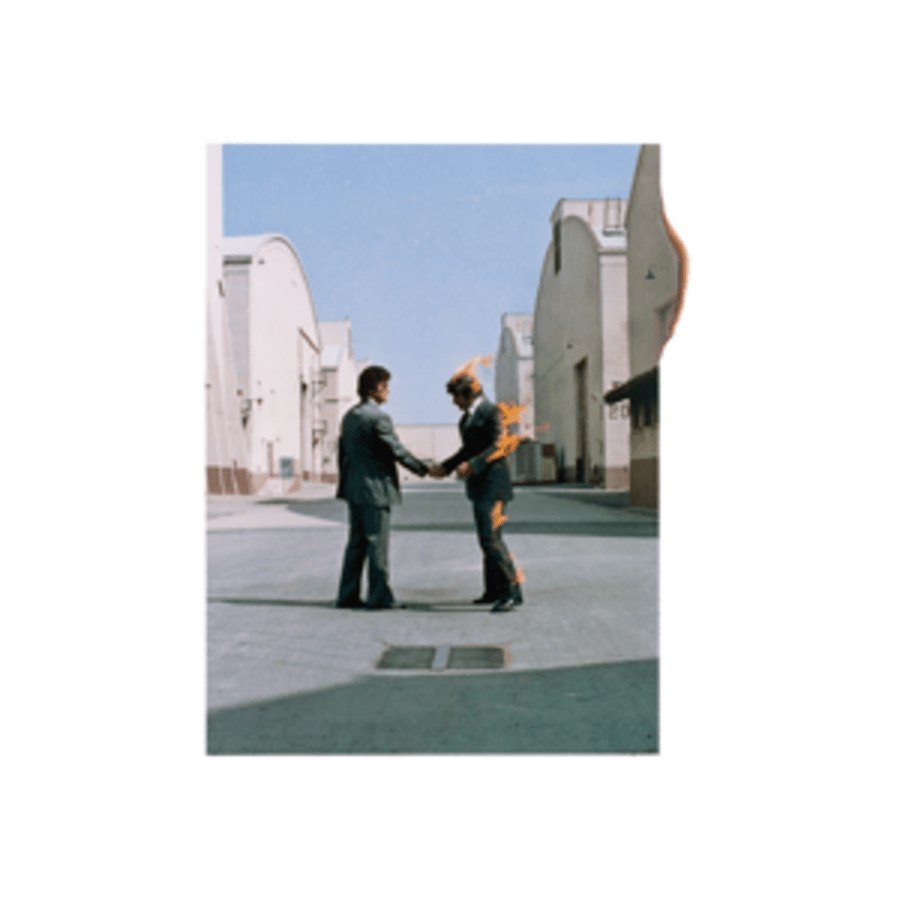
The visual presentation of Wish You Were Here is another important part of its identity. Created by Hipgnosis, the design partnership of Storm Thorgerson and Aubrey Powell, the artwork explores ideas of absence, concealment and insincerity. Its most recognisable image depicts two businessmen shaking hands, one of whom is engulfed in flames. Photographed by Aubrey Powell using stunt performers, the scene creates a striking visual metaphor for the dangers concealed beneath apparently ordinary professional interactions.
The image complements the album’s criticism of the music industry, particularly the artificial enthusiasm and commercial calculation expressed in “Have a Cigar”. The original packaging extended these ideas further.
The album was initially presented inside an opaque black shrink-wrap, concealing the artwork beneath. A circular sticker designed by George Hardie featured two mechanical hands shaking within a design referencing the four classical elements: earth, fire, air and water. This deliberate concealment made the physical presentation part of the album’s concept. Rather than treating the sleeve as a decorative accompaniment, Pink Floyd and Hipgnosis used the packaging to explore the same questions of authenticity and absence found in the music.
It remains one of the band’s most distinctive visual designs, demonstrating how closely their album artwork had become connected to their musical identity.
Why Wish You Were Here Still Resonates
The album’s lasting appeal cannot be explained by its chart performance or historical significance alone. Its central concerns remain recognisable well beyond the circumstances that inspired them. The uncomfortable relationship between professional success and personal fulfilment is hardly unique to musicians. Neither is the experience of losing contact with someone who once played an important role in one’s life. Wish You Were Here explores these feelings without attempting to resolve them through easy reassurance.
Its most affecting moments acknowledge that distance cannot always be overcome, and that remembering someone does not necessarily restore the relationship that has been lost. This emotional honesty gives the album a distinctive place within Pink Floyd’s catalogue.
Where The Dark Side of the Moon achieves much of its power through the breadth of its themes, Wish You Were Here is more concentrated in its concerns. It feels less like an examination of the wider world and more like an attempt to understand what happens when the world changes around people who are no longer certain of their place within it. The music reinforces that intimacy. Gilmour’s restrained guitar playing, Wright’s atmospheric arrangements and the vulnerability of the title track remain affecting without requiring listeners to understand every detail of the band’s history.
That accessibility is an important part of the album’s enduring reputation. Wish You Were Here may have emerged from a specific period of creative uncertainty, but its emotional significance extends far beyond Pink Floyd’s experiences. More than fifty years after its release, it remains a compelling reminder that recognition, achievement and material success cannot replace the human connections that give those accomplishments meaning.
Final Verdict: A Masterpiece of Melancholy and Reflection

Wish You Were Here stands among Pink Floyd’s greatest achievements, not because it attempts to surpass the scale of The Dark Side of the Moon, but because it pursues something altogether more personal.
Across five compositions, the band transform feelings of absence, disillusionment and creative uncertainty into an extraordinarily affecting musical experience. The result is an album whose emotional weight emerges as much from its instrumental performances as from Roger Waters’ increasingly introspective songwriting.
David Gilmour’s expressive guitar playing gives “Shine On You Crazy Diamond” much of its poignancy, while Richard Wright’s atmospheric keyboards provide the harmonic depth that makes its extended passages so compelling. Elsewhere, the oppressive electronics of “Welcome to the Machine” and the biting satire of “Have a Cigar” expose the uncomfortable realities of an industry increasingly detached from the music it promotes.
Yet the album’s most revealing moment may be its simplest.
The acoustic intimacy of “Wish You Were Here” strips away the elaborate production to reveal a sentiment that requires little explanation: the longing for a connection that can no longer be taken for granted.
The album’s deliberate pacing and melancholic atmosphere will not appeal equally to every listener, but these qualities are essential to its artistic identity. Its greatest strength lies in knowing when to allow the music to expand and when to leave an emotion unresolved.
Where The Dark Side of the Moon examines the pressures of existence on a universal scale, Wish You Were Here reveals their consequences through the experiences of the musicians themselves. It is a remarkable achievement: deeply personal yet universally relatable, musically ambitious yet capable of extraordinary simplicity.
Official Tune Tempest Rating: 10/10
An intimate, haunting masterpiece that transforms absence and disillusionment into some of the most emotionally powerful music Pink Floyd ever recorded.