
Christmas music is filled with familiar images of snow, celebration and childhood wonder, but few festive songs approach those traditions quite like Kate Bush’s “December Will Be Magic Again”. Released in 1980, the single combines playful vocals, unusual rhythms and vivid seasonal imagery, creating a Christmas song that feels both nostalgic and unmistakably her own.
First performed on British television in December 1979, the song emerged during a particularly creative period in Bush’s career, as she began moving beyond the musical conventions of her earliest recordings. Although it never became a perennial chart fixture alongside Britain’s best-known Christmas hits, it remains one of the more intriguing standalone singles in her catalogue.
Behind its whimsical surface lies a fascinating combination of musical experimentation, traditional Christmas references and contrasting recorded interpretations. More than a seasonal novelty, “December Will Be Magic Again” offers an insight into how Bush could transform even the most familiar subject into something unexpected.
The Story Behind “December Will Be Magic Again”
Although “December Will Be Magic Again” was released in November 1980, its origins stretch back to the previous year. Bush had already recorded an earlier version in 1979, during a period of intense activity that included her first concert tour and a growing interest in the theatrical possibilities of television.
The song was originally intended for release during Christmas 1979, but scheduling difficulties meant its commercial appearance was postponed until the following festive season. This explains why audiences had already encountered the composition through Bush’s television performances before the single reached record shops.
The 1980 Single Release
“December Will Be Magic Again” was released by EMI on 17 November 1980, shortly after Bush’s third studio album, Never for Ever.
The album had marked another important stage in her artistic development, incorporating increasingly elaborate arrangements, unconventional storytelling and a growing interest in studio experimentation. Songs such as “Breathing”, “Babooshka” and “Army Dreamers” demonstrated her willingness to explore subjects far removed from conventional pop songwriting.
Against this backdrop, a Christmas single might have seemed an unexpected choice. Yet “December Will Be Magic Again” was hardly a straightforward attempt to reproduce the familiar formula of a festive hit. Its unusual rhythms, imaginative lyrics and theatrical vocal performance made it a natural extension of Bush’s developing musical approach.
The single was released independently of any studio album, with “Warm and Soothing” appearing on the B-side. A comparatively intimate piano-led recording, “Warm and Soothing” offered a striking contrast to the elaborate, playful character of the Christmas song.
Chart Performance and Reception
Despite Bush’s established popularity, “December Will Be Magic Again” achieved relatively modest commercial success. It peaked at number 29 on the UK Singles Chart, spending seven weeks in the rankings.
The single therefore fell short of the chart positions achieved by several of her earlier releases, including “Babooshka”, which had reached number five earlier that year.
Unlike a conventional album single, however, “December Will Be Magic Again” was tied to a particular season, limiting the period in which it was likely to receive widespread attention.
It also occupied an unusual position in Bush’s catalogue. Released between Never for Ever and the increasingly experimental recordings that would lead to The Dreaming, the song demonstrated that even a festive composition could become an opportunity for musical exploration.
Inside the Music: An Unconventional Festive Arrangement
Musically, “December Will Be Magic Again” occupies an unusual space between traditional Christmas music and the increasingly adventurous arrangements Bush was developing around 1980. Its piano-led melodies and seasonal percussion offer moments of familiarity, but the shifting harmonies and unpredictable vocal phrasing prevent the song from settling into a conventional festive formula.
Piano, Percussion and Instrumentation
The piano provides an important foundation for the recording, establishing a melodic thread beneath Bush’s expressive vocals. Rather than relying on a simple, repetitive accompaniment, the arrangement moves through contrasting passages, alternating between intimate moments and more expansive sections.
Published recording credits for the original version identify several musicians associated with Bush’s early career, including guitarist Alan Murphy, bassist Kuma Harada and drummer Preston Heyman. Bush herself played piano, while Heyman’s contribution also included sleigh bells and maracas, introducing recognisable festive textures without dominating the arrangement.
The percussion is particularly interesting. Instead of maintaining the relentlessly cheerful rhythm associated with many Christmas singles, the drums give the music a measured, sometimes dramatic momentum. Guitar flourishes and layered vocal passages add further colour, creating a fuller sound than the song’s playful subject might initially suggest.
The result is an arrangement that incorporates familiar festive sounds while remaining distinctly individual, allowing the instrumentation to support the song’s changing moods rather than simply reinforce its seasonal setting.
An Unusual Sense of Rhythm and Harmony
One of the song’s most interesting characteristics is the relationship between its melody and underlying harmonies.
Although the rhythm maintains a recognisable pulse, Bush’s vocal phrasing frequently moves around it. Some phrases stretch across the accompaniment, while others arrive with a playful urgency, making the melody feel almost conversational.
The harmonic writing is equally distinctive. Rather than relying entirely on the bright major-key progressions often associated with festive pop, the song moves through passages that can feel harmonically ambiguous or unexpectedly subdued. These moments introduce subtle tension beneath the cheerful lyrics, giving the music an atmosphere that is sometimes mysterious rather than simply celebratory.
That tension becomes particularly effective when the arrangement opens into more exuberant passages. Moments of uncertainty give way to bursts of warmth and excitement, allowing the song to convey anticipation without remaining in one emotional register.
Kate Bush’s Expressive Vocal Performance
Perhaps the most recognisable feature of “December Will Be Magic Again” is Bush’s vocal performance.
Her delivery moves between delicate, intimate phrases and bright, high-register passages, sometimes changing character within a single melodic line. Rather than treating the song as a straightforward festive sing-along, she approaches it with the theatrical instincts that characterised much of her early work.
The higher notes carry an almost childlike excitement, while her softer delivery introduces moments of reflection. These contrasts make the performance feel spontaneous, even though the phrasing is carefully shaped around the arrangement.
Bush also uses layered backing vocals to expand the song’s atmosphere. At certain moments, the additional voices provide warmth and depth; elsewhere, their unusual placement and phrasing contribute to the recording’s slightly otherworldly character.
Throughout the performance, Bush moves between delight, curiosity and occasional wistfulness, conveying the anticipation of Christmas without reducing it to a single emotion.
Christmas Through Kate Bush’s Imagination
While the musical arrangement of “December Will Be Magic Again” is unconventional, its lyrics are equally revealing. Bush draws upon familiar Christmas traditions, childhood memories and winter landscapes, combining them with unexpected literary references and surreal imagery.
Rather than telling a conventional story, the song unfolds as a succession of scenes and impressions. Memories of Christmas past sit alongside imagined experiences, creating a world in which the boundaries between nostalgia, fantasy and reality become increasingly blurred.
Bing Crosby and the Nostalgia of Christmas Past
One of the song’s most recognisable references is to Bing Crosby’s “White Christmas”, a recording that had become synonymous with the festive season long before Bush began her musical career.
Written by Irving Berlin and first released by Crosby in 1942, “White Christmas” expresses a longing for the familiar comforts of an idealised Christmas. Its enduring popularity helped establish nostalgia as one of the defining characteristics of seasonal popular music.
Bush draws upon that tradition, placing Crosby alongside images of huskies, snow and Saint Nicholas. These references establish a recognisable Christmas setting while suggesting something more personal: the way familiar songs and seasonal rituals can evoke memories of earlier celebrations.
The word “again” in the title is particularly important. Bush isn’t simply celebrating the arrival of December; she’s anticipating the return of something previously experienced. The magic of Christmas becomes something remembered, revisited and perhaps briefly recovered.
This gives the song an emotional dimension beneath its playful surface. Its excitement is rooted partly in the anticipation of experiencing familiar pleasures once more, capturing the way Christmas can reconnect adults with feelings associated with childhood.
A Winter Landscape Seen from Above
The song becomes considerably more imaginative when Bush introduces the image of herself descending towards a snow-covered city by parachute.
It’s an unexpected perspective for a Christmas song. Rather than describing a festive scene from the ground, Bush imagines floating above rooftops and observing the world beneath her.
The contrast between the white snow and the darkened buildings is especially evocative. The city is transformed by winter weather, its ordinary appearance temporarily concealed beneath a brighter, more beautiful surface.
Bush then extends the imagery by comparing her descent to falling snow. The distinction between the narrator and the surrounding landscape begins to disappear, as though she has become part of the winter scene itself.
There is also a playful suggestion that snow can conceal the less attractive aspects of everyday life. It covers rooftops, streets and imperfections, briefly transforming the familiar world into something more inviting.
Yet this transformation is temporary. Snow eventually melts, and the ordinary world returns. Although the song doesn’t dwell explicitly on this idea, its imagery allows for a more reflective interpretation of Christmas magic as something beautiful precisely because it cannot last forever.
Why Does Kate Bush Mention Oscar Wilde?
Perhaps the most unexpected moment in “December Will Be Magic Again” is its reference to Oscar Wilde.
The Irish playwright, novelist and poet is hardly an obvious figure to encounter in a Christmas single. Yet his appearance makes sense within Bush’s wider interest in literature, imagination and unconventional characters.
Wilde’s writing frequently explored the relationship between beauty, fantasy and reality, while works such as The Happy Prince demonstrated his ability to combine fairytale storytelling with emotional and moral complexity.
In the song, Bush imagines summoning Wilde into a quiet Christmas night through candlelight, before briefly entering the imaginative space associated with his mind.
It’s a curious image, introducing a literary figure into a scene otherwise populated by familiar seasonal characters and traditions.
The precise meaning remains open to interpretation. Bush may be invoking Wilde as a symbol of artistic imagination, or simply introducing a writer whose work she admired into her own Christmas fantasy.
Either way, the reference expands the song beyond conventional festive nostalgia. Christmas becomes a setting in which historical figures, childhood memories and imaginary experiences can coexist.
The moment also illustrates Bush’s willingness to follow an unusual creative idea without necessarily explaining it. Rather than resolving the image into a straightforward message, she leaves listeners to make their own connections.
Childhood Wonder, Romance and the Mystery of Christmas
Although childhood nostalgia plays an important role, “December Will Be Magic Again” isn’t concerned exclusively with children’s experiences.
Its references to mistletoe, lovers and shared laughter introduce a more romantic dimension, suggesting that the anticipation of Christmas can retain its appeal throughout adulthood.
The recurring winter imagery also connects these different experiences. Snow becomes a presence that moves through the city, covering buildings and surrounding couples, bringing separate moments together within the same imagined landscape.
Bush’s fascination with the season seems to lie not simply in its familiar traditions, but in the atmosphere they create. Ordinary experiences become charged with anticipation, while memories and imagination give familiar surroundings a different significance.
Her images are often whimsical, occasionally strange and sometimes deliberately elusive, yet the feelings behind them remain recognisable. Christmas becomes an occasion where memory, anticipation and fantasy briefly overlap.
The Different Recordings of “December Will Be Magic Again”
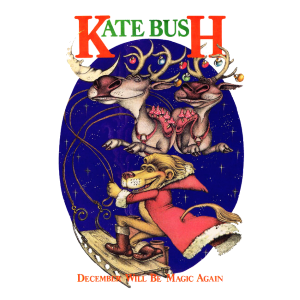
One of the more fascinating aspects of “December Will Be Magic Again” is that two substantially different studio arrangements exist. Although most listeners are familiar with the version released as a single in November 1980, an earlier recording presents the song with a noticeably different musical character.
Commonly known among fans as the bongo version, this alternative arrangement offers an insight into how Bush experimented with the composition before its commercial release. Television performances and later mixes add further layers to its recording history.
The Original 1980 Single
The best-known recording is the version issued by EMI in November 1980, with “Warm and Soothing” on the B-side.
Built around a piano-led arrangement and a fuller instrumental accompaniment, it balances the song’s unusual melodic structure with relatively polished production. The drums, guitar and festive percussion provide a substantial musical foundation, while Bush’s expressive vocals remain at the centre of the recording.
This version gives the song a sense of theatrical grandeur, particularly as the arrangement develops around its increasingly elaborate vocal passages.
Although recorded during the period surrounding Bush’s first three albums, it remained a standalone single rather than appearing on Never for Ever.
The Alternative Bongo Version
An earlier recording, generally referred to as the bongo version, takes a different approach.
Recorded in 1979, it features a more percussion-driven arrangement, with prominent hand percussion associated with Preston Heyman, who had worked with Bush during her Tour of Life. Slide whistles also contribute to its unusual sound, introducing an almost playful, cartoon-like quality.
The lighter, more rhythmically prominent instrumentation gives the recording a different atmosphere from the 1980 single. Rather than building towards the same expansive sound, the arrangement places greater emphasis on the interaction between percussion and Bush’s vocals.
Her performance also differs, with changes in phrasing and delivery that make the recording feel like a separate interpretation rather than a straightforward alternative mix.
The result is arguably the more eccentric of the two versions. Its unusual instrumental textures bring the song’s whimsical character to the foreground, while the fuller single arrangement gives greater weight to its melodic and dramatic qualities.
The bongo version later appeared on Christmas compilation albums, becoming available to listeners interested in Bush’s less familiar recordings.
The 1979 Television Performances
The song’s history becomes even more interesting when its television appearances are considered.
On 22 December 1979, Bush performed “December Will Be Magic Again” for the BBC’s Christmas Snowtime Special, using an arrangement associated with the earlier, percussion-led version.
Six days later, on 28 December, she included the song in her own BBC television special, Kate.
For this performance, Bush presented the composition at the piano, offering a more intimate interpretation that differed from both the bongo arrangement and the subsequently released single.
The piano-led television performance places particular emphasis on the melody and vocal phrasing. Without the same elaborate instrumental backing, the song’s unusual structure becomes more apparent, demonstrating how much of its character comes from Bush’s songwriting rather than its production.
These appearances also underline the song’s unusual release history. Audiences had opportunities to hear different interpretations during Christmas 1979, almost a year before the single finally reached record shops.
Different Arrangements, Different Atmospheres
Comparing the recordings reveals how significantly an arrangement can influence the character of a composition.
The bongo version emphasises rhythm and eccentricity, bringing the playful elements of Bush’s writing to the foreground. The 1980 single creates a fuller musical landscape, allowing the song’s festive warmth and dramatic passages to develop more extensively.
Meanwhile, the piano-led television performance strips away much of the production, exposing the melodic and harmonic ideas beneath the familiar seasonal imagery.
None of these interpretations fundamentally changes the song’s subject, yet each offers a different perspective on its musical possibilities. Together, they provide an interesting example of Bush’s willingness to explore how different arrangements could transform the atmosphere of a composition.
An Unconventional Christmas Single
By the time Kate Bush released “December Will Be Magic Again” in November 1980, the British Christmas single had become something of a musical tradition. The previous decade had produced some of the country’s most enduring festive recordings, including Slade’s “Merry Xmas Everybody” (1973), Wizzard’s “I Wish It Could Be Christmas Everyday” (1973) and Greg Lake’s “I Believe in Father Christmas” (1975).
These songs approached the season in different ways, from Slade’s exuberant celebration to Lake’s more reflective examination of childhood belief and disillusionment. Yet each offered a memorable central melody and a relatively direct musical identity.
Bush’s contribution was considerably harder to categorise. Although it embraced recognisable Christmas imagery, its unusual vocal delivery and shifting musical atmosphere made it a less conventional seasonal release.
A Different Approach to Festive Pop
Many successful Christmas singles are built around an immediately recognisable chorus, encouraging audiences to sing along and associate the recording with familiar seasonal celebrations.
“December Will Be Magic Again” takes a more theatrical approach. Its melody moves through a series of expressive phrases, while Bush’s vocals frequently become as important to the song’s character as the words themselves.
Rather than maintaining a consistently exuberant atmosphere, the arrangement moves between playful passages and quieter, more reflective moments. The result is a recording that rewards attentive listening rather than relying entirely on an instantly memorable refrain.
This doesn’t make Bush’s song inherently more sophisticated than other festive recordings. Slade, Wizzard and Lake each created distinctive songs with their own musical and emotional qualities. What separates Bush’s approach is the way she uses Christmas as a setting for her particular interests in unusual melodies and theatrical performance.
The song feels less like an invitation to a communal celebration and more like an exploration of one person’s experience of the season.
Why It Never Became a Christmas Standard
Given Bush’s popularity by 1980, it might seem surprising that “December Will Be Magic Again” never became a regular fixture of the festive charts.
Its original release reached number 29 in the UK, a respectable position but considerably below the commercial heights achieved by some of her earlier singles.
However, chart performance alone cannot explain why certain Christmas songs become annual favourites while others remain comparatively obscure.
Festive standards often benefit from repeated radio exposure, television appearances and inclusion in seasonal playlists over many years. Their familiarity becomes part of their appeal, with each December reinforcing the associations established during previous Christmases.
Bush’s single has never enjoyed the same level of widespread seasonal exposure as recordings by Slade, Wizzard or Wham!, although its continued availability has allowed successive generations of listeners to discover it.
Its unconventional structure may also make it less immediately suited to the communal sing-along tradition that has helped sustain many of Britain’s most recognisable Christmas hits. That is a possible explanation rather than a documented reason for its more limited popularity.
Nevertheless, the song’s relative obscurity shouldn’t be mistaken for a lack of musical interest. Its distinctive arrangement and unusual lyrical references make it a rewarding addition to Bush’s catalogue, regardless of its limited presence in mainstream Christmas celebrations.
A Festive Curiosity in Kate Bush’s Catalogue
Although “December Will Be Magic Again” never achieved the enduring mainstream popularity of Britain’s biggest Christmas singles, its standalone release and alternative recordings have made it an interesting part of Kate Bush’s discography.
Unlike the singles drawn from Bush’s studio albums, the song existed independently of a larger body of work, occupying an unusual position in her catalogue as her albums became increasingly ambitious and carefully structured throughout the 1980s.
From Standalone Single to Later Compilations
Following its original release in November 1980, the song appeared on various Christmas compilations, introducing it to listeners who might not otherwise have encountered it through Bush’s albums.
The alternative recording, commonly known as the bongo version, also circulated through compilation releases, giving collectors an opportunity to hear a substantially different interpretation of the composition.
However, “December Will Be Magic Again” was notably absent from Bush’s 1986 greatest-hits collection, The Whole Story. Although that album brought together many of her most successful and recognisable singles, the Christmas recording remained outside its selection.
An important later appearance came in October 1990, when the song was included on This Woman’s Work: Anthology 1978–1990, an eight-CD box set collecting Bush’s first six studio albums alongside two additional discs of rarities, B-sides and other recordings.
“December Will Be Magic Again” appeared on the first of those additional discs, alongside its original B-side, “Warm and Soothing”. This gave both recordings a place within a substantial retrospective of Bush’s work, making them accessible to listeners exploring material beyond the main studio albums.
The inclusion was particularly fitting. Rather than presenting the Christmas single as an isolated novelty, the collection placed it among recordings that revealed different aspects of Bush’s songwriting and musical development.
Its Place Among Bush’s Rarer Recordings
Although Christmas music might initially seem removed from Bush’s more ambitious compositions, “December Will Be Magic Again” shares several characteristics with her wider work.
Its theatrical vocal performance recalls the expressive storytelling of her early singles, while its unusual rhythmic ideas and imaginative arrangement anticipate elements of the experimentation that would become more pronounced on The Dreaming (1982).
The song also belongs to an interesting group of recordings that demonstrate how much of Bush’s creativity existed outside her main studio albums.
Tracks such as “Warm and Soothing”, which accompanied the original Christmas single, reveal a different side of her songwriting, while other standalone releases and B-sides explore musical ideas that don’t always fit neatly into the narratives of her albums.
These recordings offer additional perspectives on Bush’s artistic development, particularly when considered alongside the more familiar studio albums.
In the case of “December Will Be Magic Again”, the contrasting arrangements reveal how the same composition could be reshaped through different instrumentation, production choices and vocal performances.
For listeners interested in Bush’s recording process, those differences are arguably as compelling as the finished single itself.
A Different Kind of Christmas Magic
“December Will Be Magic Again” may never have become a fixture of Britain’s Christmas charts, but it captures something that even the most familiar festive songs sometimes overlook: the strange anticipation of trying to recreate a feeling from years gone by.
Through its playful arrangement, unusual imagery and expressive vocals, Bush presents Christmas as a place where memory and imagination briefly meet. It’s an eccentric, affectionate celebration of the season, and one of the more rewarding discoveries among her standalone recordings.