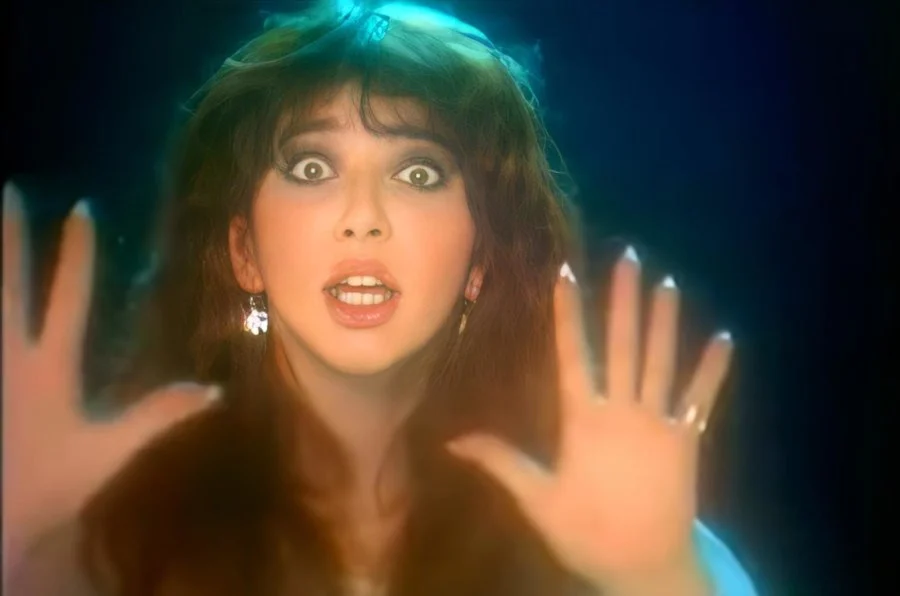
In January 1978, an unfamiliar voice arrived on British radio, singing from the perspective of a woman who had been dead for years. The song was “Wuthering Heights”, a remarkable debut single from 19-year-old Kate Bush, inspired by Emily Brontë’s novel of the same name. With its soaring vocals, dramatic piano arrangement and unsettling romantic imagery, it sounded unlike almost anything else in the charts.
Rather than introducing herself through a conventional love song, Bush adopted the voice of Catherine Earnshaw, the restless heroine whose relationship with Heathcliff lies at the heart of Brontë’s story. It was an unusual choice for a debut artist, transforming a nineteenth-century Gothic romance into a compelling piece of musical storytelling.
Within weeks, “Wuthering Heights” had reached number one in the UK, making Bush the first female artist to top the British singles chart with a song she had written entirely herself. Yet behind that success lay an extraordinary creative process, disagreements with her record company and a performance that challenged expectations of what a pop singer could be.
Nearly five decades later, the song remains one of Bush’s defining recordings. Its story reveals how a young songwriter stepped inside an existing fictional world and made its emotions feel entirely her own.
The Story Behind “Wuthering Heights”
Discovering Emily Brontë’s Story
Kate Bush’s fascination with Wuthering Heights began not with the novel itself, but with a television adaptation of Emily Brontë’s 1847 masterpiece.
As a teenager, Bush caught the closing moments of a BBC adaptation, encountering the disturbing image of Catherine’s ghost attempting to enter a house through a window. Although she hadn’t followed the complete story, the scene made a lasting impression.
Brontë’s novel explores the turbulent relationship between Catherine Earnshaw and Heathcliff, whose intense attachment is complicated by social expectations, jealousy and destructive choices. Its combination of passionate emotion and supernatural imagery offered Bush an unusually rich subject for a song.
After learning more about the story, she turned to the novel itself, drawing upon its characters and imagery without attempting to reproduce the entire narrative.
Reflecting on Catherine’s appeal in a February 1978 interview with Record Mirror, Bush explained:
When I first read Wuthering Heights I thought the story was so strong. This young girl in an era when the female role was so inferior and she was coming out with this passionate, heavy stuff. Great subject matter for a song.
She also described the challenge of transforming such an extensive story into a composition:
I loved writing it. It was a real challenge to precis the whole mood of a book into such a short piece of prose.
Rather than summarising Brontë’s novel, Bush concentrated on its emotional intensity, particularly Catherine’s desperate attachment to Heathcliff.
An intriguing coincidence added to her connection with the story: Bush and Emily Brontë share a birthday, 30 July, although they were born 140 years apart.
Writing the Song in a Single Night
Bush composed “Wuthering Heights” in March 1977, when she was just 18 years old.
Working at an upright piano in her flat, she reportedly completed the song in a matter of hours. Despite its elaborate melody and unusual narrative perspective, the composition emerged during a concentrated period of writing.
In the January 1979 Kate Bush Club newsletter, she recalled the atmosphere of that night:
I wrote in my flat, sitting at the upright piano one night in March at about midnight. There was a full moon and the curtains were open, and every time I looked up for ideas, I looked at the moon.
The image seems almost perfectly suited to the song that emerged: a ghost calling to her lost lover beneath a moonlit sky.
Bush had not yet read the entire novel when she wrote the composition. Instead, she drew upon the television adaptation, selected passages from the book and her understanding of Catherine’s emotional state.
What mattered most was her ability to imagine herself as the character.
The resulting song wasn’t a conventional account of doomed romance. It was a dramatic monologue in which Catherine herself would address Heathcliff, transforming a literary inspiration into an intensely personal performance.
Catherine Earnshaw: The Voice Behind the Lyrics
One of the most remarkable aspects of “Wuthering Heights” is its narrative perspective. Bush doesn’t describe Catherine Earnshaw’s story from a distance. Instead, she becomes Catherine, singing as though the character has returned from the dead to confront Heathcliff.
This decision gives the song an immediacy that distinguishes it from a straightforward literary adaptation. Rather than recounting events, Bush places listeners directly inside Catherine’s longing, frustration and desperation.
The Ghost at the Window
The song’s central image comes from one of the novel’s most unsettling scenes.
Early in Wuthering Heights, Mr Lockwood spends a night at the house and experiences a disturbing dream in which Catherine’s ghost appears outside his bedroom window. The apparition begs to be admitted, claiming to have wandered for twenty years.
Brontë presents the encounter through Lockwood’s frightened perspective, leaving the reader uncertain about the nature of what he has experienced.
Bush transforms this situation by allowing Catherine to speak for herself.
Instead of encountering the ghost through another character’s account, listeners hear her desperate attempts to reconnect with Heathcliff. The supernatural encounter becomes an expression of overwhelming emotional need.
This shift is central to the song’s effectiveness. Catherine is no longer simply a frightening apparition. She becomes a recognisable personality, capable of tenderness, accusation and almost unbearable longing.
The repeated appeals to Heathcliff reinforce the sense that her attachment has survived death, but without bringing her any peace.
Love, Obsession and Catherine’s Contradictions
Although “Wuthering Heights” is frequently understood as a tragic love song, the relationship at the heart of Brontë’s novel is considerably more complicated.
Catherine and Heathcliff share an intense connection, yet their relationship is marked by possessiveness, cruelty and destructive choices. Catherine ultimately marries Edgar Linton, whose wealth and social position offer a future that Heathcliff cannot provide.
Her decision exposes one of the novel’s central conflicts: the tension between personal desire and the expectations of society.
Bush doesn’t attempt to explain every aspect of this relationship. Instead, she concentrates on its emotional aftermath, presenting Catherine as a restless presence unable to separate herself from Heathcliff.
There’s something unsettling about this portrayal. Catherine’s longing is powerful, but it also suggests an obsession that has become impossible to escape.
The song therefore communicates more than romantic devotion. It captures the contradiction of a relationship that feels essential to both characters while repeatedly bringing them suffering.
How Bush Transforms the Novel
Brontë’s Wuthering Heights is a complex narrative involving multiple generations, shifting perspectives and events recounted long after they occur.
Bush condenses that material into a single dramatic situation: Catherine’s attempt to return to Heathcliff.
The song draws together ideas associated with different moments in the novel, including their childhood attachment, their later conflicts and the supernatural imagery surrounding Catherine’s death.
In doing so, Bush creates a version of Catherine defined primarily by her emotional intensity.
This isn’t quite the same character readers encounter in Brontë’s novel. Much of Catherine’s social position, personal history and contradictory behaviour has been stripped away. What remains is the overwhelming force of her attachment to Heathcliff.
Yet the adaptation preserves something essential about the original: the sense that Catherine’s feelings cannot be contained by ordinary boundaries, whether social, physical or supernatural.
Bush’s achievement lies in making that complicated emotional world accessible within a short song, without requiring listeners to know the novel beforehand.
Inside the Music: An Extraordinary Vocal and Instrumental Performance
The literary inspiration behind “Wuthering Heights” is unusual, but its musical arrangement is equally important to its character.
From the delicate piano introduction to Bush’s soaring vocals and Ian Bairnson’s expressive guitar solo, the recording combines melodic elegance with moments of intense drama.
What makes the composition particularly effective is the contrast between these elements. Beneath the theatrical performance lies a carefully structured song whose melody remains compelling even at its most unconventional.
The Piano and Melody
The opening piano establishes a gentle, almost delicate atmosphere before Bush’s voice enters and transforms the mood.
Throughout the composition, the piano provides an important melodic foundation, supporting vocal phrases that frequently take unexpected turns.
The verses move through winding melodies, creating a sense of anticipation as Bush shifts between different pitches and emotional intensities.
When the chorus arrives, the melody rises into a more urgent register. Catherine’s repeated calls to Heathcliff become increasingly insistent, giving the music a heightened dramatic quality.
Despite its unusual structure, “Wuthering Heights” remains remarkably accessible. Its central refrain is immediately recognisable, while the more intricate passages surrounding it reward closer listening.
That balance is one of the composition’s greatest strengths. Bush doesn’t abandon melody in pursuit of experimentation; she uses it to make an unconventional idea emotionally convincing.
Kate Bush’s Vocal Performance
Perhaps no aspect of “Wuthering Heights” attracted more attention in 1978 than Bush’s voice.
Her exceptionally high register, unusual pronunciation and dramatic phrasing were strikingly different from the vocal styles associated with much of contemporary pop.
Yet the performance is more than an exercise in vocal eccentricity.
Bush uses changes in pitch, tone and intensity to establish Catherine’s personality. At times, her delivery is delicate and pleading, suggesting vulnerability. Elsewhere, it becomes piercing and demanding, as though the character’s desperation can no longer be contained.
Certain words are elongated or given unexpected emphasis, creating a performance that sometimes resembles theatrical storytelling more than conventional singing.
These choices are particularly effective because Bush is portraying a ghost rather than an ordinary narrator. Catherine’s voice seems to exist somewhere between human vulnerability and supernatural intensity.
The resulting performance can sound strange, exaggerated or even unsettling, but those qualities are inseparable from the character Bush has created.
Her voice doesn’t simply accompany the narrative. It becomes the means through which Catherine’s conflicting emotions are expressed.
Andrew Powell’s Arrangement
Produced by Andrew Powell, “Wuthering Heights” combines Bush’s piano and vocals with guitar, bass, drums and carefully arranged instrumental textures.
The rhythm section provides a relatively steady foundation beneath her elaborate vocal phrasing, preventing the composition from becoming overwhelmed by its more dramatic passages.
The bass adds warmth and movement, while the drums introduce momentum without forcing the recording into a conventional rock arrangement.
Powell’s production gives Bush’s voice sufficient space to dominate the performance while allowing the musicians to contribute to its changing atmosphere.
There’s also an interesting contrast between the song’s subject and its sound. Although the lyrics describe a disturbing supernatural encounter, much of the instrumentation is surprisingly delicate and melodic.
Rather than relying on obvious musical darkness, the arrangement allows beauty and unease to coexist.
Ian Bairnson’s Guitar Solo
One of the recording’s most memorable moments arrives towards the end, when Ian Bairnson’s electric guitar takes over from Bush’s vocals.
The solo is particularly effective because it feels like a continuation of the song’s emotional narrative rather than a separate instrumental display.
Bairnson’s playing is fluid and melodic, with sustained notes and expressive bends that give the guitar an almost vocal quality.
Rather than relying on speed or technical complexity, he builds the passage around phrasing and emotional expression. The notes rise and fall with a sense of yearning, echoing the longing that has dominated Catherine’s story.
It’s possible to interpret the solo as an extension of her unresolved emotions, although this is a musical reading rather than a documented intention behind the arrangement.
The effect is especially powerful because the song doesn’t conclude with a conventional final vocal statement. Instead, the guitar carries the listener towards the ending, allowing the emotional tension to linger after Catherine’s voice has disappeared.
It’s an elegant conclusion to a recording in which every major musical element contributes to the atmosphere of the story.
Recording “Wuthering Heights” and the Disagreement with EMI
The Sessions for The Kick Inside
Bush recorded “Wuthering Heights” in 1977 during the sessions for her debut album, The Kick Inside.
Although she was still unknown to the wider public, EMI had signed her several years earlier, allowing her time to develop her songwriting before beginning her recording career.
Producer Andrew Powell brought considerable experience to the sessions, having worked with musicians associated with the Alan Parsons Project. The album also featured accomplished session players, including guitarist Ian Bairnson.
The challenge was translating Bush’s highly individual composition into a finished recording without losing its unusual character.
Powell’s production retained the theatrical intensity of her performance while giving the music the clarity and structure needed for a commercial release.
The collaboration also represented an important stage in Bush’s development. Although she would assume greater control over production on subsequent albums, The Kick Inside demonstrated how her ambitious songwriting could be realised within a professional studio environment.
Why Kate Bush Insisted on “Wuthering Heights”
One of the most significant decisions in Bush’s early career concerned which song should be released as her debut single.
EMI initially favoured “James and the Cold Gun”, a more conventional rock-oriented composition from The Kick Inside. Its familiar musical approach may have appeared a safer introduction to an unfamiliar artist.
Bush, however, believed that “Wuthering Heights” was the only appropriate choice.
Reflecting on the disagreement in Record Mirror in February 1978, she explained:
Wuthering Heights is so important to me. It had to be the single. To me it was the only one. I had to fight off a few other people’s opinions but in the end they agreed with me.
Her determination was remarkable for a young performer preparing to release her first record.
“Wuthering Heights” was unusually demanding, both musically and vocally, and its literary subject was hardly typical of mainstream pop. Yet those qualities were precisely what made it representative of Bush’s artistic identity.
Where “James and the Cold Gun” might have offered a more conventional introduction, “Wuthering Heights” immediately established her interest in character-driven songwriting, theatrical performance and unexpected musical ideas.
EMI eventually agreed to release it.
The decision would prove commercially successful, but its greater significance was artistic. Bush had ensured that her first public statement reflected the qualities that distinguished her as a songwriter.
The Single That Changed Everything
An Unconventional Arrival in 1978
“Wuthering Heights” was released in the UK on 20 January 1978, entering a musical landscape shaped by punk, disco, rock and emerging new wave.
Against those prevailing trends, Bush’s debut sounded remarkably different.
Its literary narrative, elaborate melody and theatrical vocal performance made it difficult to categorise, but those same qualities helped the recording attract attention.
Television appearances introduced audiences to the performer behind the extraordinary voice. Bush’s appearance on Top of the Pops in February 1978 was particularly important, bringing her distinctive singing and expressive presentation into British homes.
For viewers encountering her for the first time, she was an unusual presence. Her movements, facial expressions and vocal delivery suggested an artist whose approach to popular music extended well beyond simply performing a song.
The public response was enthusiastic, although her exceptionally high singing voice also divided opinion. Some listeners were captivated by its originality, while others found the delivery strange or exaggerated.
That contrast was part of the song’s character. Bush attracted attention not by adopting a familiar style, but by presenting something unmistakably her own.
Reaching Number One
In March 1978, “Wuthering Heights” reached number one on the UK Singles Chart, remaining there for four consecutive weeks.
It was an extraordinary achievement for a debut artist, particularly one whose first release had initially faced reservations from her record company.
The single also made chart history. Bush became the first female artist to reach number one in Britain with a song she had written entirely herself.
That distinction is especially significant given the nature of the composition. Rather than achieving her breakthrough with material supplied by established songwriters, Bush reached the top of the chart with an original work inspired by her own literary interests.
The song also enjoyed international success, reaching audiences in countries including Ireland, Australia and New Zealand.
Its popularity helped establish Bush as one of Britain’s most distinctive new performers and brought considerable attention to her debut album, The Kick Inside, released in February 1978.
The album demonstrated that “Wuthering Heights” was not an isolated experiment. Songs such as “The Man with the Child in His Eyes”, “Moving” and “The Saxophone Song” revealed an already individual approach to melody, storytelling and emotional expression.
Bush’s breakthrough was therefore more than a successful single. It introduced an artist whose musical imagination could connect with a mainstream audience without abandoning its unconventional character.
Bringing Catherine to Life: The Music Videos
The distinctive character of “Wuthering Heights” extended beyond its recording.
To promote the single, Bush created two performances that combined expressive dance, theatrical gestures and carefully chosen costumes, giving Catherine Earnshaw a visual identity.
Rather than simply standing before a camera and singing, she approached the song as an opportunity to portray its narrator physically.
The two promotional videos offer contrasting interpretations of the same character, demonstrating how movement and visual presentation could extend the storytelling already present in the music.
The White-Dress Video
In the white-dress version, Bush performs against a dark studio background, surrounded by atmospheric lighting and visual effects.
Dressed in a flowing white gown, she moves through a sequence of controlled gestures, extending her arms, turning her body and reaching towards the camera.
The simplicity of the setting places almost all the attention on her movements and facial expressions.
Rather than attempting to recreate the Yorkshire moors, the video presents Catherine as an isolated, almost weightless figure. The surrounding darkness removes any clear sense of place, allowing Bush’s performance to suggest someone existing between the physical and supernatural worlds.
Her gestures frequently resemble attempts to communicate with a person just beyond her reach.
The white costume reinforces Catherine’s ghostly identity, but Bush avoids portraying her as a conventional frightening apparition. Instead, she emphasises the character’s emotional vulnerability and desperation.
It’s a restrained visual interpretation of a song whose subject could easily have encouraged more elaborate Gothic imagery.
The Red-Dress Video
The alternative promotional video takes a noticeably different approach.
Bush wears a striking red dress and performs outdoors against a natural backdrop, giving the performance a stronger connection to the wild landscape associated with Brontë’s novel.
Where the white-dress version emphasises Catherine’s ghostly isolation, the red-dress performance feels more physical and energetic.
Bush moves across the landscape with sweeping arm gestures, dramatic turns and expressive movements that suggest both longing and frustration.
The red costume contrasts sharply with the surroundings, lending Catherine a greater sense of passion and emotional intensity.
Neither video attempts to recreate the novel’s narrative in detail. Instead, each presents a different aspect of the character: one emphasising her supernatural presence, the other her overwhelming emotional force.
Together, they demonstrate how Bush could approach the same song through contrasting visual interpretations.
Lindsay Kemp and the Importance of Dance
Bush’s choreography was rooted in an interest in movement and theatrical performance that had developed before her recording career began.
She had studied dance and mime with Lindsay Kemp, whose expressive approach encouraged performers to communicate emotion through gesture, movement and characterisation.
That influence is evident throughout both “Wuthering Heights” videos.
Bush’s movements are deliberately stylised, frequently resembling mime or contemporary dance rather than conventional pop choreography.
Her hands, arms and facial expressions become tools for conveying Catherine’s emotional state. At times, she appears to plead with an unseen figure; elsewhere, her gestures become more forceful and demanding.
The choreography also complements her vocal delivery, with delicate movements giving way to dramatic physical expression as the music intensifies.
This relationship between sound and movement would become an important feature of Bush’s later visual work, particularly as her music videos grew increasingly ambitious.
Yet the essential idea was already present in “Wuthering Heights”: the visual performance wasn’t simply decoration, but another means of bringing a fictional character to life.
The Enduring Legacy of “Wuthering Heights”
Nearly five decades after its release, “Wuthering Heights” remains one of Kate Bush’s most recognisable recordings.
Its lasting reputation extends beyond its original chart success. The song has been reinterpreted by other musicians, revisited by Bush herself and celebrated through events inspired by its distinctive choreography.
Perhaps most remarkably, it continues to sound unusual. Its eccentricities have never been entirely absorbed into the conventions of popular music, allowing it to retain much of the character that made it so striking in 1978.
Kate Bush’s 1986 New Vocal Version
Eight years after the original release, Bush returned to “Wuthering Heights” for her 1986 compilation The Whole Story.
Rather than recording an entirely new arrangement, she replaced the original lead vocal with a new performance, creating a version commonly identified as “Wuthering Heights (New Vocal)”.
The decision is particularly interesting because the original vocal was arguably the recording’s most distinctive feature.
By 1986, Bush’s voice had developed considerably. The extraordinarily high, youthful delivery of her debut had given way to a fuller, more controlled vocal style.
The difference between the recordings is immediately apparent.
Where the original often sounds fragile, piercing and almost feverish, the later version has greater weight and restraint.
Neither interpretation necessarily supersedes the other. Instead, they provide an opportunity to hear how Bush’s approach to the same character changed as she matured as a performer.
The 1978 recording remains inseparable from the audacity of her debut, while the 1986 version offers an intriguing alternative perspective on Catherine’s emotional world.
Cover Versions and Reinterpretations
“Wuthering Heights” has also attracted performers working across different musical genres.
American rock singer Pat Benatar included a version on her 1980 album Crimes of Passion, approaching the composition through a more forceful vocal performance and guitar-driven arrangement.
Her interpretation demonstrates how the song can function outside Bush’s distinctive theatrical style while retaining its dramatic melody.
Classical crossover singer Hayley Westenra has also recorded the song, emphasising its lyrical qualities through a contrasting vocal approach.
The Decemberists have performed “Wuthering Heights” too, a fitting choice for a band whose own work frequently explores literary themes and elaborate narratives.
These interpretations reveal an important quality of Bush’s songwriting. Although the original is closely associated with her extraordinary voice, the underlying melody and narrative are strong enough to survive substantial changes in musical style.
The song may be difficult to separate from Bush’s performance, but it isn’t dependent on imitation to remain compelling.
The Most Wuthering Heights Day Ever
Perhaps the most unusual demonstration of the song’s cultural longevity is The Most Wuthering Heights Day Ever, an event in which participants gather dressed in red to recreate Bush’s choreography from the outdoor promotional video.
Inspired by a large-scale performance created by the British theatre collective Shambush in 2013, the event developed into an international phenomenon, with gatherings taking place in cities around the world.
Participants perform the familiar movements together, transforming Bush’s original solo performance into a communal celebration.
The event is playful, but it also reveals something significant about the song’s legacy.
Few debut singles are associated with choreography recognisable enough to inspire mass recreations decades after their release.
In the case of “Wuthering Heights”, Bush’s visual interpretation of Catherine has become almost as culturally distinctive as the recording itself.
What began as a performance about longing, death and obsession has become an opportunity for collective creativity, humour and appreciation of her work.
A Lasting Place in Kate Bush’s Catalogue
Although “Wuthering Heights” established Bush’s reputation, her subsequent career would move into increasingly ambitious musical territory.
Albums such as Never for Ever, The Dreaming and Hounds of Love explored more complex arrangements, experimental recording techniques and extended narrative structures.
Her interest in storytelling remained, but its musical expression changed considerably.
In that sense, “Wuthering Heights” is both representative of Bush’s artistic imagination and unlike much of the music she would later create.
Its theatrical soprano, delicate arrangement and Gothic subject belong unmistakably to her earliest recordings, while its underlying ambition anticipates the increasingly adventurous work that followed.
The song remains an extraordinary example of how literature, melody and performance can combine to create something that feels entirely original.
The Song That Introduced Kate Bush to the World
When Kate Bush wrote “Wuthering Heights” at just 18 years old, she could hardly have chosen a more unconventional way to begin her recording career. Rather than following the familiar conventions of a debut single, she transformed Emily Brontë’s Gothic novel into a musical drama, giving Catherine Earnshaw a voice that was vulnerable, demanding and impossible to mistake for anyone else’s.
Its success was remarkable, but what makes the song endure is the confidence of its imagination. The intricate melody, theatrical vocals and expressive choreography all contribute to a singular artistic vision.
Bush would go on to create increasingly ambitious work, but “Wuthering Heights” remains an extraordinary introduction to her artistry.
And it all began with a ghost calling through a window.