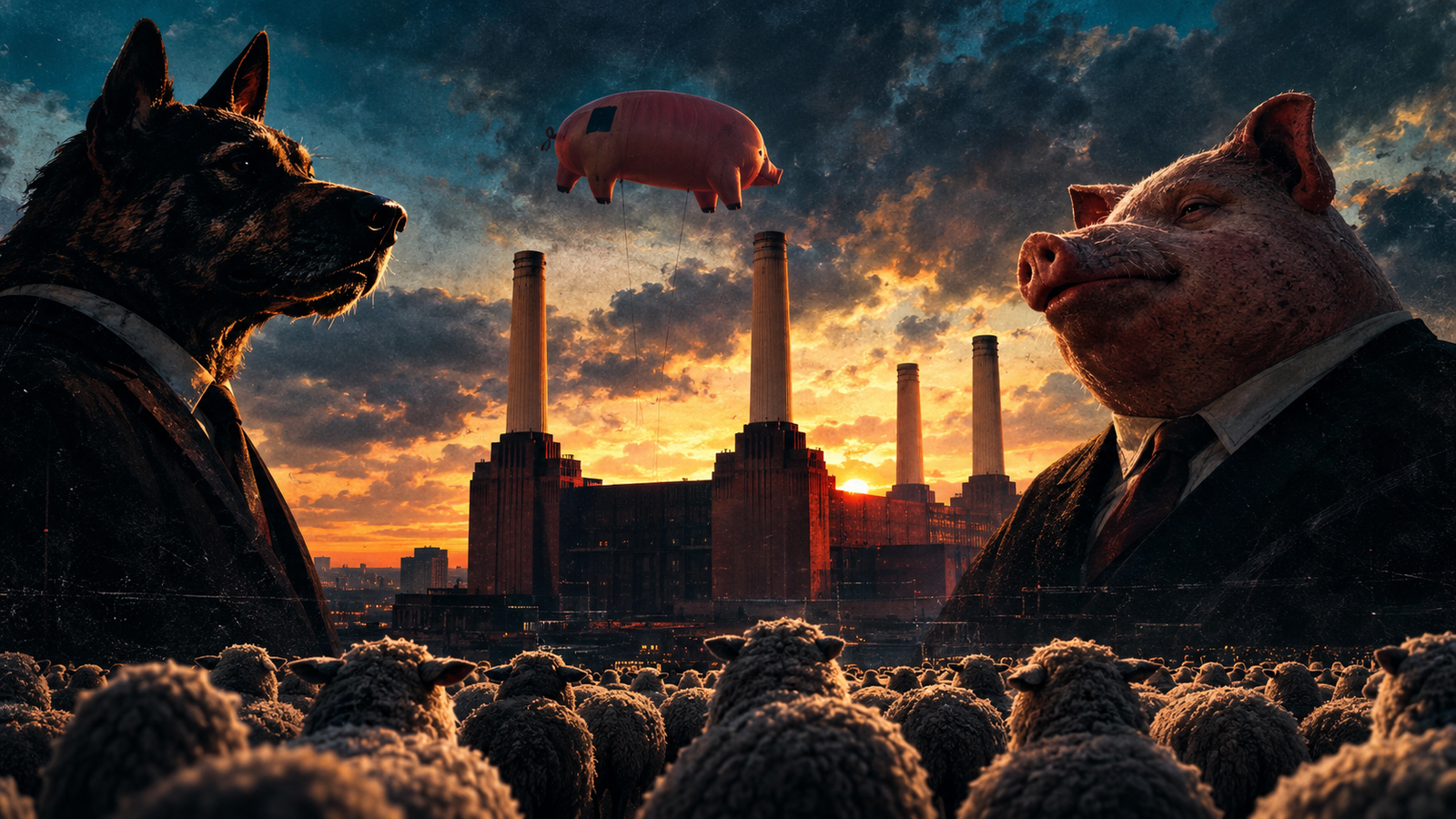
Nearly half a century after its release, Pink Floyd’s Animals remains an unsettling portrait of a society divided by power, greed and inequality. Released in 1977, the album transformed Roger Waters’ growing political frustrations into a bleak allegory in which ruthless competitors, self-serving authorities and exploited ordinary people are represented by dogs, pigs and sheep.
Drawing inspiration from George Orwell’s Animal Farm, Animals emerged from the economic uncertainty and political tensions of 1970s Britain. Yet its central concerns extend far beyond the circumstances of its creation. The pursuit of wealth at any cost, the hypocrisy of powerful figures and the pressures that encourage conformity remain familiar subjects today.
What makes Animals particularly compelling is its refusal to offer reassurance. Its characters inhabit a world where exploitation appears deeply embedded in society, and even rebellion raises uncomfortable questions about who ultimately holds power.
So why does an album rooted in the frustrations of 1977 continue to feel relevant? The answer lies not simply in its political anger, but in the patterns of human behaviour Waters sought to expose.
The Britain That Inspired Animals

When Pink Floyd released Animals in January 1977, Britain was experiencing considerable economic and political uncertainty. Inflation, unemployment and industrial disputes had contributed to public frustration, while debates about class, wealth and the influence of powerful institutions dominated much of the national conversation.
The country had recently sought financial assistance from the International Monetary Fund, reflecting the severity of Britain’s economic difficulties. Against this backdrop, Waters’ increasingly confrontational songwriting expressed a growing distrust of established power structures.
George Orwell’s Animal Farm provided an important starting point. While Orwell’s novel satirised the corruption of revolutionary ideals under Stalinism, Waters borrowed and reinterpreted its animal imagery to examine the class divisions, ruthless competition and hypocrisy he perceived in contemporary society.
The album’s three central compositions did not emerge fully formed. “Dogs” developed from “You’ve Got to Be Crazy”, while “Sheep” originated as “Raving and Drooling”. Both pieces had appeared in Pink Floyd’s live performances as early as 1974, before their transformation into the politically charged compositions heard on Animals.
The finished record was noticeably harsher than the band’s previous work. Where Wish You Were Here explored absence and disillusionment through reflective songwriting, Animals expressed its frustrations with considerably greater bitterness.
Its criticism also extended beyond any single political party or government. Waters presented a society in which ambition, authority and obedience could become mutually reinforcing forces, allowing exploitation to persist regardless of who occupied positions of power.
That broader perspective is central to understanding the album’s enduring appeal.
Dogs: The Cost of Ruthless Ambition
At the heart of Animals lies “Dogs”, a sprawling 17-minute examination of ambition, manipulation and the pursuit of success at any cost. Its characters are ruthless individuals who survive by exploiting others, treating relationships as opportunities for advancement rather than genuine human connections.
Waters portrays a world where deception becomes a necessary skill and vulnerability is regarded as weakness. The song’s most unsettling observation, however, is that those who succeed within this system are eventually consumed by it. Their lives become defined by suspicion, isolation and the constant fear of losing everything they have accumulated.
The music reinforces this descent. David Gilmour’s intricate guitar passages move between restrained beauty and aggressive intensity, while extended instrumental sections create an atmosphere of growing unease. The processed barking sounds add another disturbing dimension, blurring the boundary between the song’s animal imagery and its portrayal of human behaviour.
As the composition progresses, its initial confidence gradually gives way to paranoia and exhaustion.
The Modern Pursuit of Success
The song’s criticism of ruthless competition remains recognisable in contemporary society. Workplaces that reward personal advancement at the expense of colleagues, corporate cultures that prioritise profit above responsibility and attitudes that equate wealth with individual worth all invite comparisons with Waters’ fictional predators.
Yet “Dogs” is not simply an attack on successful or wealthy people. Its deeper concern is what happens when competition becomes so consuming that empathy, loyalty and personal relationships lose their value.
The characters appear to have mastered the rules of their world, but their achievements provide neither security nor happiness. Instead, they become trapped by the very system they have learned to exploit.
This makes “Dogs” more than a criticism of corporate ambition. It is a portrait of success stripped of meaning, where the relentless pursuit of power ultimately destroys the individual pursuing it.
Pigs: Power, Hypocrisy and Moral Authority
If “Dogs” examines those willing to exploit others in pursuit of success, “Pigs (Three Different Ones)” turns its attention towards figures who already possess power and influence.
Here, Waters directs his anger at individuals who present themselves as respectable or morally superior while displaying the very qualities they condemn in others.
The song’s three verses target different figures and types of authority, including British morality campaigner Mary Whitehouse. Her opposition to perceived indecency in broadcasting made her a prominent and controversial public figure during the 1970s.
Waters’ criticism is intensely personal, using biting sarcasm to challenge what he regards as hypocrisy and authoritarian attitudes.
Musically, the song is equally confrontational. Its heavy bass groove, distorted guitar and unsettling synthesiser effects create an atmosphere of contempt, while Gilmour’s talk-box guitar adds an almost mocking quality to the arrangement.
When Authority Becomes Hypocrisy
The song’s relevance extends beyond the individuals Waters criticised in 1977. Its central concern is the contradiction between the standards powerful figures demand from others and the behaviour they permit themselves.
That tension remains familiar in modern political and public life. Public figures who fail to follow their own rules, institutions that demand accountability without demonstrating it themselves and influential individuals who use moral arguments to discourage criticism all reflect aspects of the hypocrisy Waters sought to expose.
However, “Pigs” is not exclusively concerned with political corruption. Its anger is also directed at self-righteousness: the assumption that possessing authority, wealth or social standing grants someone the right to dictate how others should behave.
By transforming these figures into pigs, Waters strips away their carefully maintained respectability. Beneath their public image, he suggests, lie the same selfish instincts and prejudices they are so eager to condemn.
The distinction between genuine moral responsibility and the performance of moral superiority gives “Pigs (Three Different Ones)” much of its enduring satirical power.
Sheep: Obedience, Manipulation and Rebellion
While “Dogs” explores ruthless ambition and “Pigs (Three Different Ones)” attacks those who abuse authority, “Sheep” examines the people living beneath them.
Waters portrays ordinary individuals as a flock conditioned to accept their circumstances, following established rules without recognising the dangers surrounding them.
The imagery is deliberately unsettling. The sheep graze peacefully, seemingly unaware that their apparent security depends upon a system designed to exploit them. Their obedience makes them vulnerable, allowing those in power to maintain control with little resistance.
One of the song’s most striking moments is its distorted parody of Psalm 23. By transforming a familiar religious passage about guidance and protection into something threatening, Waters turns the language of reassurance into an instrument of control.
Yet “Sheep” contains an important reversal. Rather than remaining helpless, the flock eventually rises against its oppressors. The composition transforms from a portrait of submission into an eruption of collective anger, challenging the assumption that exploited people will remain passive indefinitely.
Musically, this transformation is extraordinary. Richard Wright’s atmospheric keyboard introduction establishes an almost deceptive tranquillity before the song develops into an increasingly aggressive performance. Its driving rhythm, processed vocals and explosive final passages give the rebellion a palpable sense of urgency.
The Danger of Unquestioning Conformity
The relationship between obedience and authority remains one of the album’s most recognisable themes. Social pressure, political messaging and the desire to belong can all influence how individuals form opinions and respond to those in positions of power.
In the digital age, social media has introduced additional complications. Algorithms can reinforce existing beliefs, while misleading information and emotionally charged narratives can spread rapidly. Although these technologies did not exist when Waters wrote “Sheep”, they raise familiar questions about independent thought and the influence of dominant narratives.
Reducing the song to a warning against conformity, though, overlooks its most significant development: the sheep fight back.
Their rebellion suggests that seemingly powerless individuals can challenge established hierarchies when they recognise their shared circumstances. Nevertheless, the violence of their uprising complicates any straightforward celebration of resistance.
The song’s conclusion leaves an uncomfortable question hanging over the listener: does overthrowing those in power necessarily create a better society, or can the same destructive patterns emerge again?
Why Animals Still Resonates Today

The political landscape has changed considerably since Animals appeared in 1977, but the behaviours Waters criticised remain recognisable. Competition can reward ruthlessness, authority can encourage hypocrisy, and public opinion remains vulnerable to manipulation.
What makes the album particularly effective is the relationship between its three central characters. The dogs pursue success through exploitation, the pigs exercise authority while claiming moral superiority, and the sheep endure the consequences until they finally resist.
Together, they form a society in which each group helps sustain the conditions that define it.
This interconnectedness gives Animals a significance beyond any individual political controversy. Waters is questioning not only those who possess power, but also the behaviours and relationships that allow unequal structures to persist.
A Warning Rather Than a Prediction
It would be misleading to suggest that Waters anticipated the precise political and technological challenges of the twenty-first century. The internet and social media have transformed how information circulates, while the nature of work and corporate influence has changed considerably since the 1970s.
Nevertheless, Animals provides a compelling perspective through which to examine modern society. Its themes encourage listeners to consider how power is acquired, how authority is justified and why people sometimes accept circumstances that work against their interests.
Importantly, the album offers little in the way of practical solutions. Even the rebellion in “Sheep” is violent and unsettling, leaving open the possibility that one oppressive hierarchy might simply be replaced by another.
Yet Animals is not entirely without tenderness.
The two brief sections of “Pigs on the Wing”, which open and close the record, provide a striking contrast to its bitterness. Their emphasis on companionship and mutual care suggests that meaningful human relationships might offer some protection against the hostility depicted elsewhere on the album.
This contrast reveals an important dimension of Waters’ criticism. Beneath the anger lies a concern about what happens when empathy disappears from society, and what might survive when individuals refuse to abandon it.
The Enduring Power of Animals
Nearly 50 years after its release, Animals remains one of Pink Floyd’s most provocative achievements. Its political anger emerged from the frustrations of 1970s Britain, but its examination of ambition, authority and conformity extends far beyond that period.
The album offers no simple answers. Its characters are trapped within a society shaped by exploitation, and even rebellion provides no guarantee of meaningful change. Yet the tenderness of “Pigs on the Wing” suggests that compassion and human connection still have a place within this bleak vision.
Ultimately, Animals remains relevant not because society has stood still since 1977, but because the struggle between power, self-interest and empathy continues to shape the world around us.