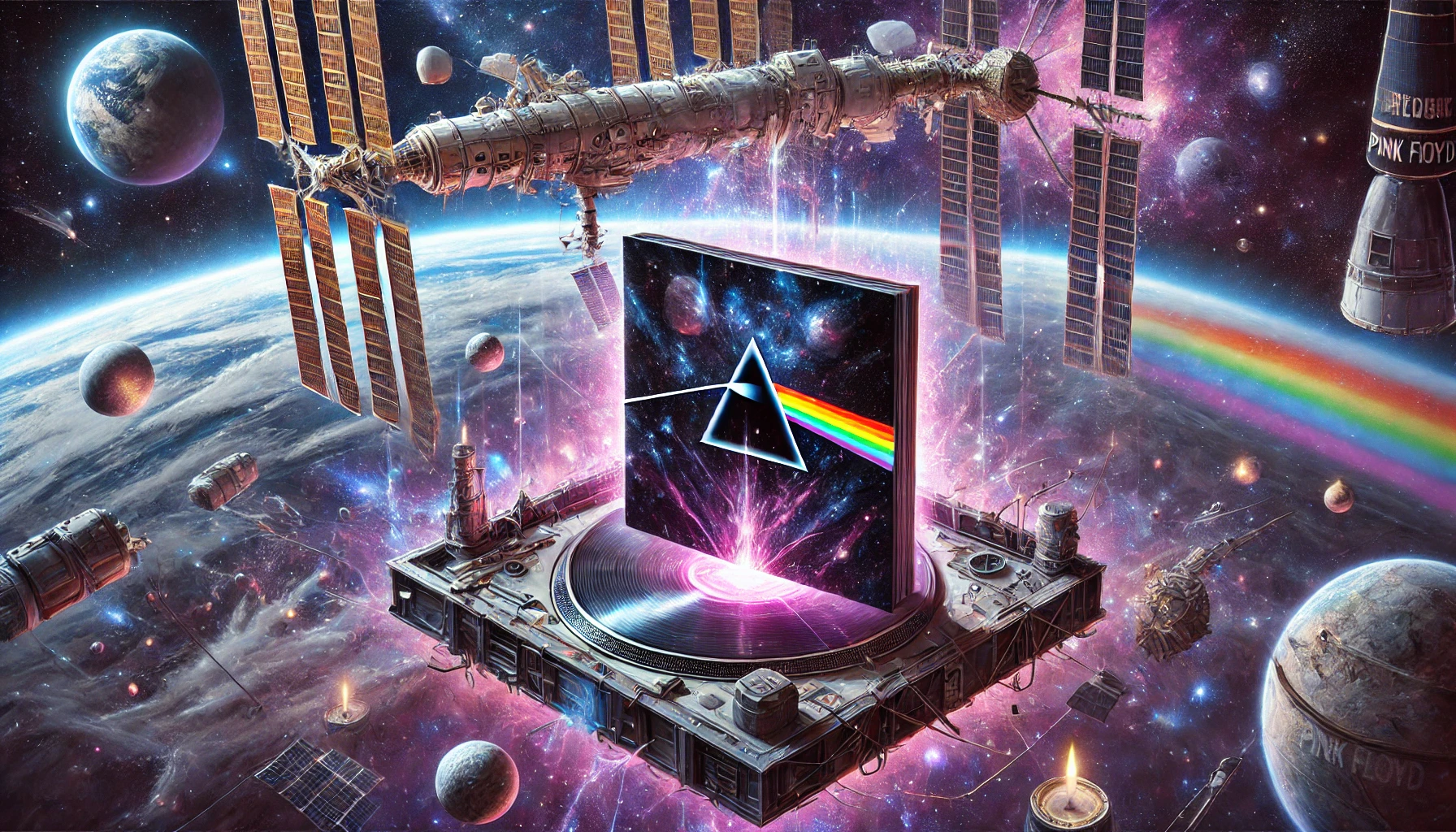
In November 1988, a cassette recording of Pink Floyd’s live album Delicate Sound of Thunder travelled far beyond any concert venue on Earth. Its destination was Mir, the Soviet space station orbiting hundreds of kilometres above the planet.
The recording became widely recognised as the first rock album played in space. It was an extraordinary destination for a band rebuilding its identity following Roger Waters’ departure, and an unlikely meeting of British rock music and Soviet space exploration during the final years of the Cold War.
But how did a Pink Floyd cassette find its way aboard a Soviet spacecraft? And what do we actually know about its journey into orbit?
The Album That Went Into Orbit

Before Delicate Sound of Thunder travelled into space, it had already marked an important turning point in Pink Floyd’s history.
Released in November 1988, the live album documented the band’s return to international touring following Roger Waters’ departure in 1985. With David Gilmour leading the group alongside Nick Mason and keyboardist Richard Wright, Pink Floyd had entered a new chapter, raising questions about whether they could continue successfully without one of their principal creative forces.
Their 1987 studio album, A Momentary Lapse of Reason, had introduced this new incarnation of the band. The accompanying tour provided an opportunity to establish its identity onstage, combining elaborate visual production with a repertoire spanning different periods of Pink Floyd’s career.
Recorded across five performances at Nassau Coliseum in Uniondale, New York, between 19 and 23 August 1988, Delicate Sound of Thunder captured the scale of that ambitious tour. The album brought together newer material, including “Learning to Fly”, “Sorrow” and “On the Turning Away”, with established favourites such as “Time”, “Wish You Were Here” and “Comfortably Numb”.
Gilmour’s expansive guitar playing remained central, while Wright’s atmospheric keyboards and the contributions of an enlarged touring ensemble gave the performances a distinctive character. The album reached number 11 in both the UK and US charts, demonstrating the band’s continued commercial appeal despite the changes in its membership.
Yet one of the recording’s most unusual achievements would have little to do with chart positions or concert attendance. Within days of its release, a cassette copy would accompany a Soviet space mission.
Pink Floyd Aboard Mir: What Actually Happened?
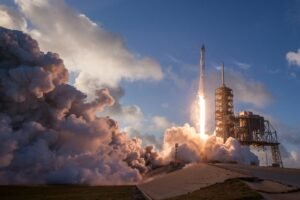
On 26 November 1988, a Soyuz TM-7 spacecraft lifted off from the Baikonur Cosmodrome in what was then the Kazakh Soviet Socialist Republic. Its destination was Mir, the Soviet Union’s orbiting space station.
The three-person crew consisted of Soviet cosmonauts Aleksandr Volkov and Sergei Krikalev, alongside French astronaut Jean-Loup Chrétien. Their mission combined scientific research with international cooperation, including experiments conducted as part of the French-Soviet Aragatz programme.
Among the items accompanying the crew was a cassette recording of Pink Floyd’s newly released live album.
According to the band’s official account, the cosmonauts took Delicate Sound of Thunder aboard Soyuz TM-7, leaving its plastic cassette case behind to save weight. The recording subsequently reached Mir, where it was played in orbit.
The spacecraft docked with the station on 28 November, bringing the album to a destination few musicians could ever have imagined.
David Gilmour and Nick Mason at the Launch
Pink Floyd’s connection to the mission extended beyond supplying the music. David Gilmour and Nick Mason travelled to Baikonur to witness the launch, joining invited guests that included French President François Mitterrand.
The musicians also recorded audio of the launch for possible use in a future project, according to Pink Floyd’s official account. However, there is no clear evidence that these recordings were subsequently incorporated into a released Pink Floyd composition.
Their attendance makes the episode particularly unusual. This was not simply a case of astronauts taking along a favourite recording without the band’s knowledge. Gilmour and Mason were present to witness the spacecraft carrying their music into orbit.
The circumstances also placed Pink Floyd within a significant international event. Chrétien’s participation formed part of an established programme of French-Soviet space cooperation, while Mitterrand’s presence demonstrated the mission’s diplomatic importance.
For the band, however, the most memorable aspect was considerably simpler: their music was travelling into space.
Was It Really the First Rock Album Played in Space?
The journey gave Delicate Sound of Thunder an enduring distinction. Pink Floyd’s official website describes it as the first rock album played in space, a claim also repeated in promotional material issued by the band’s record company.
However, that should not be confused with the broader suggestion that Pink Floyd introduced rock music to space.
Astronauts had taken personal music recordings beyond Earth long before 1988, including selections carried aboard NASA’s Apollo missions. Rock music was therefore not entirely new to spaceflight.
The distinction associated with Delicate Sound of Thunder concerns its status as a complete rock album rather than the first individual rock song heard in orbit. Even then, it is best understood as a widely reported milestone rather than an independently established record covering every recording carried on earlier missions.
What is well documented is that a Pink Floyd cassette travelled aboard Soyuz TM-7 and was played on Mir.
For a band whose music had long been associated with cosmic imagery, the circumstances were particularly fitting. But the episode also unfolded against a wider historical backdrop, at a time when relations between the Soviet Union and the West were beginning to change.
Music Across the Iron Curtain
When Delicate Sound of Thunder travelled into orbit, the Cold War was entering a period of profound change.
Under Soviet leader Mikhail Gorbachev, the policies of glasnost (openness) and perestroika (restructuring) were reshaping Soviet society. Cultural restrictions were gradually easing, while diplomatic relations between Moscow and Western governments were improving.
Western rock music had already attracted devoted audiences in the Soviet Union, despite decades of official suspicion towards certain foreign cultural influences. Recordings circulated through unofficial networks, including copies passed between friends on magnetic tape, allowing listeners to discover artists whose albums were not always readily available through conventional shops.
Pink Floyd were among the Western bands familiar to Soviet rock enthusiasts. Their experimental approach and increasingly elaborate live performances had helped establish an international following extending beyond the countries where their records were officially marketed.
Against this background, the presence of Delicate Sound of Thunder aboard Mir offered an intriguing cultural contrast. A British rock album, recorded during an American concert tour, had become part of a Soviet space mission involving both Soviet and French crew members.
The Soyuz TM-7 mission itself demonstrated the growing possibilities of international cooperation. Jean-Loup Chrétien’s participation in the Aragatz programme brought French scientific research aboard a Soviet spacecraft, and his mission included a spacewalk with Aleksandr Volkov.
The presence of Gilmour and Mason at Baikonur added an unexpected cultural dimension to the occasion.
Only a generation earlier, British rock musicians attending a Soviet spacecraft launch would have seemed an unlikely image of East-West relations. By 1988, however, the political climate had changed sufficiently for such an encounter to take place.
The cassette was a small detail within a much larger programme of scientific and diplomatic cooperation. Its significance should not be exaggerated, but it remains a distinctive illustration of how Western popular culture could find its way into an environment once closely associated with Soviet technological prestige.
For the cosmonauts, the album offered entertainment during their time in orbit. For those looking back at the event, its presence provides an unusual snapshot of the late 1980s, when political change, cultural exchange and space exploration briefly intersected.
Pink Floyd’s Long Association with Space
Although Delicate Sound of Thunder reached orbit in 1988, Pink Floyd’s association with space stretched back to the earliest years of their career.
Under Syd Barrett’s leadership, the band embraced the experimental possibilities of psychedelic rock, creating music that frequently departed from conventional structures. Their 1967 debut album, The Piper at the Gates of Dawn, opened with “Astronomy Domine”, a composition filled with references to planets, moons and celestial imagery.
The song begins with the voice of the band’s manager Peter Jenner reciting astronomical names through a megaphone, establishing an otherworldly atmosphere before the instruments launch into a turbulent mixture of guitar, organ and shifting rhythms.
Alongside compositions such as “Interstellar Overdrive”, it helped establish Pink Floyd’s early reputation for music associated with science fiction, exploration and the possibilities of unfamiliar worlds.
Yet the band’s relationship with cosmic imagery was never confined to literal descriptions of outer space.
From Astronomy Domine to The Dark Side of the Moon
As Pink Floyd developed throughout the 1970s, their music became increasingly concerned with human experience rather than the fantastical imagery of their psychedelic beginnings.
The Dark Side of the Moon, released in 1973, illustrates this distinction particularly well.
Despite its astronomical title, the album explores distinctly earthly concerns: time, mortality, conflict, money and psychological pressure. Its title functions as a metaphor rather than an attempt to describe the Moon itself.
Nevertheless, the album’s expansive arrangements, electronic textures and carefully constructed transitions helped reinforce Pink Floyd’s reputation for creating immersive musical experiences.
Their concerts developed that reputation further. Elaborate lighting, projections and increasingly ambitious stage designs transformed performances into audiovisual spectacles, making the visual presentation almost as recognisable as the music itself.
By the time Delicate Sound of Thunder was recorded in 1988, these elements had become central to Pink Floyd’s live identity.
There is an obvious temptation to describe their music as the perfect soundtrack for space travel. But there is no need to assume that the cosmonauts selected the album because of its atmospheric arrangements or the band’s association with astronomy.
The historical connection is compelling enough without inventing a deeper explanation.
In 1967, “Astronomy Domine” had imagined a journey through the heavens. Twenty-one years later, a recording of Pink Floyd’s live performances accompanied people who were actually travelling above Earth.
It was an unexpected development in the band’s history, connecting the imagined landscapes of their early music with the reality of human space exploration.
A Small Moment in Music and Space History
The journey of Delicate Sound of Thunder aboard Mir remains one of the more unusual episodes in Pink Floyd’s history. A live album recorded in New York during the band’s post-Waters resurgence had found its way onto a Soviet space station within months of being performed.
The cassette’s presence offers a fascinating glimpse into the personal side of space exploration. Behind the scientific experiments, complex machinery and international cooperation were people spending extended periods away from Earth, for whom familiar music could provide a connection to ordinary life.
For Pink Floyd, the episode added an unexpected dimension to a career already associated with musical experimentation and cosmic imagery. The band had spent decades creating sounds that encouraged listeners to imagine unfamiliar worlds, but this time their music had travelled beyond the one in which it was recorded.
And perhaps that is what makes the story so memorable. While Delicate Sound of Thunder was created to capture the experience of Pink Floyd performing on Earth, one of its most remarkable journeys took place far beyond the concert stage.