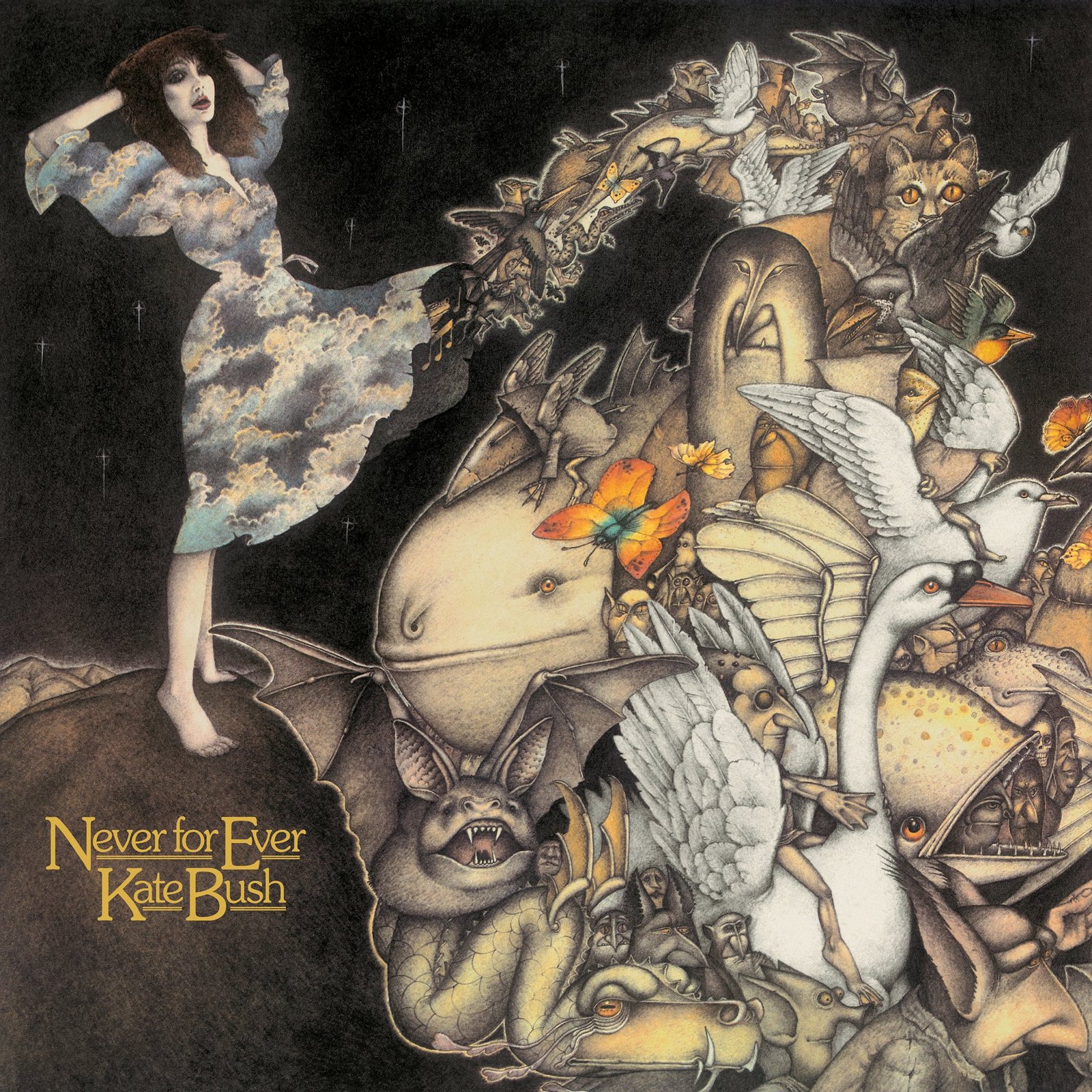
Released on 8 September 1980, Kate Bush’s third studio album, Never for Ever, marked a remarkable advance in the singer-songwriter’s artistic development. Following the success of The Kick Inside and the more uneven Lionheart, Bush returned with a record of greater confidence and musical sophistication.
Across its eleven tracks, Never for Ever brings together theatrical storytelling, intricate musical arrangements and an extraordinary range of emotional perspectives. Moving between accessible pop melodies, delicate introspection and moments of genuine unease, the album explores subjects as varied as romantic deception, artistic inspiration, mortality and the consequences of war. Each story finds its own musical setting, from the restless energy of “Babooshka” to the unnerving intimacy of “Breathing”.
The result is more than a continuation of her earlier work. Bush gives familiar musical forms strange new shapes without sacrificing the force of a melody. Never for Ever stands as a major achievement in its own right.
The Making of Never for Ever (1980)
Following the release of Lionheart in November 1978, Kate Bush entered a period of considerable artistic and professional change. Her first two albums had established her as a singular young songwriter. Recording, promotion and public appearances, however, had also exposed the limits of her control over the finished work.
For her third album, she sought a larger role in the arrangements and recording decisions that would bring her songs to life.
A New Chapter in Kate Bush’s Career
An important development between Lionheart and Never for Ever was Bush’s 1979 Tour of Life, an ambitious theatrical production that combined live music with dance, mime, elaborate costumes and visual storytelling.
Its performances showed how naturally Bush connected music with movement, character and dramatic presentation. Songs became scenes, shaped as much by gesture and staging as by the notes themselves.
It would remain her only conventional concert tour. Afterwards, the studio became an increasingly important place for developing ideas that had previously found expression onstage.
Bush’s growing interest in production was equally significant. Having worked with Andrew Powell on The Kick Inside and Lionheart, she chose to co-produce her third album with Jon Kelly, who had previously worked as an engineer on her recordings.
Co-production meant that Bush could shape the performances and arrangements as well as write and sing the songs. That practical experience mattered as much as the credit itself.
Recording at Abbey Road and Greater Creative Control
Much of Never for Ever was recorded at London’s Abbey Road Studios, with the principal sessions taking place in 1980. Its history of orchestral and popular recording appealed to a musician drawn to both traditions.
Bush later recalled the atmosphere of recording there:
“We recorded this album at Abbey Road studios. It was very exciting to be working in a building that had so much musical history – from Elgar to the Beatles, the walls had absorbed their time there. You could feel it.”
— Kate Bush, reflecting on the recording of Never for Ever
With Kelly and a skilled group of musicians, Bush retained links to her earlier sound while testing unfamiliar instrumental colours and studio techniques.
The question was no longer simply which instruments would accompany a song. It was what a particular sound might suggest about a place, a character or an emotion.
This growing curiosity coincided with her introduction to the Fairlight CMI, an early digital sampling instrument that would become increasingly important to her music. Although its role on Never for Ever was more limited than on some of her subsequent albums, it introduced new possibilities for incorporating recorded sounds into musical arrangements.
That curiosity would grow on later records. Here, it is already audible in the care with which each song acquires its own atmosphere.
Never for Ever: Sound and Production

Never for Ever marks a significant expansion of Kate Bush’s musical vocabulary. The piano-led songwriting, orchestral arrangements and theatrical vocals of her first two albums remain recognisable. However, the production introduces a wider range of textures, rhythms and instrumental combinations.
With Jon Kelly, she moves from delicate acoustic passages to driving rock, layered harmonies and unusual studio effects. The variety is audible from one track to the next.
The Fairlight CMI and Expanding Sonic Possibilities
One of the most important developments in Bush’s recording approach was her introduction to the Fairlight CMI. This early digital instrument could record, manipulate and replay sounds, offering possibilities beyond those of conventional synthesisers.
For a songwriter fascinated by atmosphere, recorded sound offered another expressive resource.
Its role on Never for Ever was still relatively limited. The album continued to rely heavily on piano, guitars, orchestration and live performances. Nevertheless, it marked the beginning of Bush’s fascination with digital sampling, which would become increasingly important on The Dreaming and Hounds of Love.
This developing interest in unusual sounds can be heard in the album’s arrangements. “Army Dreamers” features sharply defined percussive effects that reinforce its military subject matter. Meanwhile, “Breathing” combines layered voices, electronic textures and dramatic changes in intensity to create an atmosphere of mounting danger.
The important shift is conceptual: a recording could contain not just a performance, but sounds that suggested an entire imagined environment.
Instrumentation and Musical Arrangements
The album’s instrumental variety becomes particularly apparent when comparing its more accessible songs with its experimental material.
“Babooshka” opens with an insistent piano figure that immediately creates a sense of anticipation. As the song develops, the arrangement becomes increasingly forceful. Driving rhythms and sharp instrumental accents reflect the narrator’s growing jealousy and suspicion. The chorus provides a powerful melodic release without losing the tension established in the verses.
“The Wedding List” takes a more aggressive approach. Electric guitars, forceful percussion and sudden changes in emphasis reflect the urgency of its revenge narrative. The arrangement rarely allows the listener to settle, creating the impression of a confrontation moving towards an inevitable conclusion.
By contrast, “Delius (Song of Summer)” finds its strength in restraint. Floating vocal lines and delicate instrumental textures establish an almost dreamlike atmosphere. The song unfolds gradually, evoking the natural world associated with composer Frederick Delius rather than following a conventional pop structure.
“Blow Away (For Bill)” offers another example of carefully considered arrangement. Its gentle opening gradually develops into a fuller musical expression. The movement from intimacy towards something more uplifting reflects the song’s treatment of grief, remembrance and the possibility of life continuing beyond death.
The album’s most dramatic musical development occurs on “Breathing”. Beginning with a fragile sense of intimacy, the composition gradually becomes darker and more oppressive. Layered voices and increasingly dense instrumentation build towards an overwhelming climax. The music conveys the scale of the imagined catastrophe without losing sight of the vulnerable perspective at the centre of the song.
The distance between the hushed “Delius” and the ferocious “The Wedding List” is considerable. Hearing them on the same album reveals just how elastic Bush’s musical language had become.
Kate Bush’s Vocal Performances
Bush’s singing on Never for Ever is among the most versatile of her early career. She moves between tenderness, theatrical exaggeration and moments of genuine distress. Her ability to alter tone, register and phrasing allows her to inhabit characters whose experiences differ dramatically.
On “Babooshka”, her delivery changes as the narrator’s deception begins to unravel. The verses are comparatively controlled, suggesting a woman attempting to conceal her suspicions. In the chorus, Bush adopts a sharper and more forceful approach. The contrast reflects the emotional conflict beneath the character’s carefully constructed disguise.
“Army Dreamers” reveals a very different side of her singing. Bush adopts a gentle, almost lullaby-like delivery that makes the song’s account of a young soldier’s death particularly affecting. The restraint is essential. Rather than emphasising the tragedy through dramatic vocal gestures, she allows the sadness to emerge through the simplicity of her performance.
“The Infant Kiss” requires a more unsettling approach. Bush moves between tenderness, hesitation and growing alarm as the narrator struggles with emotions she cannot understand. Subtle changes in phrasing create a sense of psychological discomfort. The performance remains deliberately ambiguous, reflecting the disturbing nature of the song’s central narrative.
On “Breathing”, Bush explores a wider emotional range. Her voice begins with an intimate, vulnerable quality before becoming increasingly urgent. As the arrangement grows more intense, her delivery develops into an expression of fear and desperation. The performance gives the song’s extraordinary premise a powerful emotional centre.
Some of Bush’s vocal choices may initially seem excessive, particularly to listeners unfamiliar with her theatrical style. However, the exaggerated characterisations and sudden changes in delivery serve a clear purpose here. They distinguish the album’s narrators and reveal emotions that might otherwise remain hidden.
The production gives these performances room to develop. On quieter songs, small changes in Bush’s voice carry much of the emotional weight. Elsewhere, her singing becomes part of a larger musical drama.
Lyrics and Themes: Identity, Mortality and Transformation

Across Never for Ever, Kate Bush explores the instability of human experience. Her characters confront jealousy, desire, grief and the possibility of death, often finding themselves in circumstances beyond their understanding or control.
A recurring concern is transformation: the identities people adopt, the ways they change under pressure, and the gulf between how they see themselves and how others see them.
Disguise, Desire and Psychological Unease
“Babooshka” provides one of the album’s most compelling examinations of identity and mistrust. Its narrative follows a woman who disguises herself through anonymous letters to test her husband’s fidelity. Adopting the name Babooshka, she attempts to discover whether his affection can withstand temptation.
The deception produces an unexpected result. Her husband becomes attracted to the mysterious correspondent, unaware that she is his own wife. More painfully, the persona reminds him of the woman he originally fell in love with, before suspicion and insecurity began to damage their relationship.
Bush transforms this unusual premise into a study of jealousy and self-sabotage. The narrator’s attempt to expose her husband’s disloyalty ultimately reveals how far she has become separated from her former identity. Her disguise offers temporary control, but also creates the conditions for the betrayal she fears.
“The Infant Kiss” ventures into considerably more disturbing territory. Inspired by the 1961 film The Innocents, itself adapted from Henry James’s The Turn of the Screw, the song centres on a governess who becomes unsettled by her feelings towards a young boy.
The narrator believes that the child may be possessed by the spirit of an adult man. This possibility shapes her interpretation of his behaviour, creating a deeply troubling conflict between his apparent innocence and the adult identity she imagines beneath it.
Crucially, the song does not establish whether her suspicions are justified. The supernatural explanation may reflect genuine events within the story, or it may emerge from the governess’s own psychological disturbance. Bush leaves this uncertainty unresolved, forcing the listener to confront the narrator’s perceptions without accepting them as reliable.
The result is deliberately uncomfortable. Rather than presenting the attraction as romantic or desirable, the composition explores the frightening consequences of confused boundaries, distorted perception and feelings the narrator cannot reconcile with the child’s innocence.
“All We Ever Look For” examines a quieter form of dissatisfaction. Its characters search for fulfilment through imagined alternatives to their present lives, longing for opportunities, relationships or experiences that might provide a sense of purpose.
The song’s central tension lies in the distance between what people possess and what they believe will make them happy. Bush presents this longing with sympathy, recognising the appeal of possibility while questioning whether satisfaction can ever be found through endless searching.
Together, these songs show how an imagined alternative can become more powerful than reality. The fantasy may be seductive, but its consequences are rarely simple.
War, Death and Human Vulnerability
The album’s treatment of mortality becomes particularly affecting when Bush turns away from private relationships towards the consequences of violence and loss.
“Army Dreamers” tells the story of a young soldier who dies during military service. Rather than celebrating sacrifice or presenting warfare as heroic, Bush approaches the tragedy through the perspective of a grieving mother.
Her sorrow is accompanied by a painful sense of unrealised possibility. The young man might have followed another profession or lived an entirely different life, but those opportunities have disappeared with his death. The song’s repeated consideration of what he could have become makes its criticism of war deeply personal.
Bush avoids reducing the soldier to a political symbol. Instead, she emphasises the ordinary life that has been lost, allowing the mother’s grief to expose the distance between military ideals and their human consequences.
“Blow Away (For Bill)” explores death from another perspective. Written in memory of lighting director Bill Duffield, who died following an accident during Bush’s 1979 Tour of Life, the song considers whether something of a person’s creative spirit might survive their physical existence.
Its references to musicians who had died young place Duffield’s memory within a wider reflection on artistic loss. Rather than presenting death solely as an ending, Bush imagines the possibility of reunion and continuity through music.
The result is neither a conventional elegy nor a straightforward expression of religious belief. Its emotional force comes from the desire to find reassurance in the face of an absence that cannot be undone.
“Breathing” brings these concerns to their most terrifying conclusion. Sung from the perspective of an unborn child, the composition imagines the effects of nuclear catastrophe upon a life that has not yet entered the world.
The choice of narrator is crucial. An unborn child cannot understand the political decisions responsible for nuclear destruction, yet remains vulnerable to their consequences. Bush uses this innocence to expose the horrifying imbalance between human power and human responsibility.
The mother’s womb, ordinarily associated with protection, becomes a place threatened by contamination from the outside world. Even before birth, the child is unable to escape the consequences of humanity’s actions.
By presenting nuclear war through such an intimate perspective, Bush transforms an overwhelming global threat into something immediate and personal. The song’s horror lies not only in the possibility of destruction, but in the knowledge that those least responsible may suffer its consequences.
Art, Fantasy and the Supernatural
Elsewhere, Never for Ever explores the relationship between artistic imagination and experiences that resist ordinary explanation.
“Delius (Song of Summer)” pays tribute to the English composer Frederick Delius. Rather than offering a conventional biography, Bush creates a series of impressions inspired by his music, his connection with nature and the atmosphere surrounding his final years.
The song draws upon the world depicted in Ken Russell’s television film Song of Summer, which explores the relationship between Delius and the young composer Eric Fenby. Bush captures something of the film’s dreamlike quality, presenting artistic creation as an experience shaped by memory, landscape and human connection.
“The Wedding List” takes a considerably darker approach to cinematic storytelling. Inspired by François Truffaut’s film The Bride Wore Black, it follows a bride whose husband is killed on their wedding day. Consumed by grief, she pursues those responsible, transforming what should have been a celebration of love into a campaign of revenge.
The song’s central character is both sympathetic and frightening. Her suffering provides an understandable motive, but the determination with which she pursues vengeance gradually consumes her identity. Bush explores the point at which grief ceases to be an emotion and becomes the force governing an entire life.
“Violin” offers a contrasting celebration of artistic expression. Rather than constructing an elaborate fictional narrative, Bush embraces the physical excitement of music itself. The instrument becomes an object of fascination, provoking an almost uncontrollable response from the singer.
Its exaggerated enthusiasm provides an important counterpoint to the album’s darker material. Music is presented not simply as a means of expressing emotion, but as something capable of producing joy, energy and a sense of release.
These songs approach imagination from different directions. It can preserve a composer’s memory, turn grief into a dangerous obsession or release the sheer pleasure of making music.
Cohesion and Flow: How Never for Ever Works as an Album

One of the most impressive qualities of Never for Ever is how naturally its contrasting compositions sit alongside one another. The album moves between theatrical pop, delicate orchestration, aggressive rock and experimental arrangements. On paper, such variety might suggest a fragmented listening experience. In practice, the changes in mood give the record much of its character.
Rather than telling one continuous story, the sequence builds a changing emotional landscape. The listener is repeatedly unsettled, reassured and unsettled again.
The First Side and a Dramatic Change of Pace
The album opens with “Babooshka”, an effective introduction to its mixture of accessible melodies and unconventional storytelling. Its memorable chorus provides an immediate point of entry, while the increasingly dramatic arrangement establishes the theatrical character of the record.
Rather than maintaining that intensity, Bush follows it with “Delius (Song of Summer)”. The transition is striking. The sharp rhythms and emotional tension of the opening track give way to a brief, atmospheric composition that seems to exist outside conventional pop structures.
“Blow Away (For Bill)” continues this more reflective mood, but introduces a warmer and more expansive musical character. Its gradual development provides a natural bridge towards “All We Ever Look For”, whose melodic accessibility is balanced by an underlying sense of dissatisfaction.
The first side concludes with “Egypt”, one of the album’s most atmospheric recordings. Its spacious arrangement and mysterious imagery create a sense of distance from the everyday world. As a closing track for the original vinyl side, it leaves the listener suspended in an unfamiliar environment rather than offering a conventional resolution.
“The Wedding List” then opens the second side with a sudden burst of energy. Its forceful guitars and urgent delivery sharply contrast with the atmosphere of “Egypt”. The change is dramatic, but it gives the album a renewed sense of momentum.
The turn of the record becomes part of the drama. The listener moves from the hazy distance of “Egypt” into a world of immediate action and violence.
An Increasingly Dark Second Half
Following “The Wedding List”, the album moves into the exuberant intensity of “Violin”. Its energetic performance briefly provides a sense of release, with Bush celebrating the physical excitement of music.
However, the mood changes considerably with “The Infant Kiss”. The exuberance of the preceding track gives way to a quieter and more disturbing atmosphere. Its restrained arrangement demands closer attention, drawing the listener into a narrative defined by uncertainty and psychological discomfort.
The brief “Night Scented Stock” follows, providing an unusual transition between the album’s final compositions. Built around layered, wordless vocals, it creates a suspended, almost otherworldly atmosphere. Its placement offers a moment of stillness without fully relieving the unease established by “The Infant Kiss”.
“Army Dreamers” then introduces a deceptively gentle musical character. Its lilting rhythm and restrained vocal delivery initially seem to soften the album’s atmosphere. Yet the contrast between the music and its subject matter makes the song especially affecting.
The album concludes with “Breathing”, its most expansive and disturbing composition. Where “Army Dreamers” examines the consequences of war through an individual loss, “Breathing” imagines a catastrophe capable of threatening life on a far greater scale.
The transition between these final songs is one of the album’s most powerful decisions. Both explore vulnerability in the face of violence, but their musical approaches are markedly different. The intimacy of “Army Dreamers” gives way to the mounting tension and overwhelming climax of “Breathing”.
Ending the record here also changes how the preceding material is experienced. The album begins with the private anxieties of “Babooshka”, but finishes with a threat extending far beyond any individual relationship. Its emotional scope expands as the record progresses, even though the journey is not strictly linear.
The shifts between songs can be deliberately abrupt, particularly when the exuberance of “Violin” gives way to the unsettling restraint of “The Infant Kiss”. Yet these changes rarely weaken the listening experience. Instead, they reveal how carefully Bush balances individual compositions against the album’s broader progression.
The record ends without the comfort of a gentle return. After the final swell of “Breathing”, the silence feels deliberate and severe. It is a fitting end to an album whose pleasures are inseparable from its unease.
Standout Tracks and Moments from Never for Ever
The album’s best-known singles are outstanding, but its strength reaches well beyond them. Four songs are particularly revealing of Bush’s ability to turn an unusual idea into a compelling recording.
Babooshka
“Babooshka” works because its musical form mirrors the character’s split identity. The opening piano figure sounds tense and watchful. Bush’s phrasing in the verses is controlled, almost secretive, as if the narrator is testing how much she can reveal.
Then the chorus bursts open. The rhythm strikes harder, the vocal line leaps forward and the carefully maintained disguise seems to collapse into excitement. The shift is exhilarating, but it is also revealing: the character takes pleasure in a game that may destroy her relationship.
The contrast is structural, not merely theatrical. The music itself seems unable to contain the character’s suspicions. That tension makes “Babooshka” exhilarating even before its story is fully understood.
Army Dreamers
“Army Dreamers” is among Bush’s most affecting compositions. Its gentle, waltz-like rhythm initially suggests something comforting, but the song gradually reveals a devastating account of loss and unrealised potential.
The mother’s imagined alternatives to military life have already been explored in the lyrics. What makes the recording so affecting is the mismatch between its gentle movement and the weight of those lost possibilities.
The waltz-like sway gives the song an almost nursery-rhyme familiarity. Against that rhythm, Bush places clipped, recurring phrases and a vocal performance that rarely pushes for effect. The arrangement keeps circling back, as if the mother cannot move beyond the same questions. Its apparent simplicity is the source of its power.
Breathing
“Breathing” is the record’s most imposing performance. Its unborn narrator and nuclear setting have already been established; what deserves attention here is the way the recording turns a fragile voice into a vast, frightening soundscape.
At first, the space around Bush’s voice feels almost protective. That space steadily disappears as more sounds and voices enter. The song grows heavier without becoming merely louder; its tension comes from the sense that there is nowhere left to retreat.
A spoken passage describing the effects of a nuclear explosion breaks the musical flow. Its documentary quality makes the surrounding drama more chilling, before the final section swells into a mass of voices and instrumental force. Bush’s singing remains recognisably human within that scale.
It is a daring way to close an album. The final moments do not resolve the fear introduced at the beginning; they leave it suspended in the listener’s mind.
The Wedding List
“The Wedding List” attacks with the momentum of a revenge thriller. It sounds almost breathless from the outset.
The Truffaut-inspired story gives Bush a chance to make musical drama out of pursuit, interruption and sudden changes of mood.
The arrangement is immediately forceful. Driving percussion and electric guitars create a sense of urgency, while abrupt musical accents reflect the violence and unpredictability of the story. There is little opportunity for reflection as the narrative moves from one confrontation to another.
Bush’s performance is particularly impressive. Her delivery shifts between anger, determination and moments of near-hysterical excitement. These changes give the central character a frightening intensity, suggesting that revenge has become inseparable from her identity.
Its pleasures are almost cinematic: a sudden accent feels like a cut between scenes, while each surge of guitar and percussion pushes the action forward. Bush never lets the theatricality become shapeless. The song is tightly controlled even at its wildest.
Other Memorable Moments
The quality of Never for Ever is also evident in its less celebrated compositions.
“Delius (Song of Summer)” is one of the album’s most delicate achievements. Its unusual structure and floating vocal harmonies create an atmosphere that feels suspended between memory and imagination. Although brief, it leaves a strong impression through its restraint and sensitivity.
“Blow Away (For Bill)” offers some of Bush’s most compassionate songwriting. Its movement from quiet remembrance towards a more uplifting expression gives the song an emotional warmth that contrasts with the album’s darker material.
“All We Ever Look For” is particularly effective in its balance of melodic accessibility and introspection. Its shifting musical character captures the restless desire for something beyond ordinary experience, making it one of the album’s more understated pleasures.
“Egypt” deserves recognition for its expansive atmosphere. The arrangement creates a sense of mystery and distance, while Bush’s performance moves between fascination and theatrical intensity. Its unusual musical character makes it an absorbing conclusion to the record’s first side.
“Violin” provides one of the album’s most exuberant moments. Its aggressive energy and deliberately exaggerated vocal performance capture the physical excitement of music. Although its approach may divide listeners, its uninhibited enthusiasm offers an important contrast to the surrounding compositions.
“The Infant Kiss” is among the album’s most challenging songs. Its restrained musical setting and unsettling narrative demand careful attention, demonstrating Bush’s willingness to explore uncomfortable psychological territory without providing straightforward answers.
Finally, “Night Scented Stock” achieves a remarkable amount in its brief duration. Its layered, wordless vocals create an atmosphere of stillness and uncertainty, providing a memorable transition into the album’s final two compositions.
These shorter and stranger pieces alter the pace of the record. Without the weightless “Delius” or the wordless pause of “Night Scented Stock”, the more forceful songs would land differently. Their value becomes clearest when the album is heard from beginning to end.
Artistic Innovation and Legacy of Never for Ever

Kate Bush had never relied on conventional pop formulas. “Wuthering Heights” was an unlikely chart-topping debut single, and her first two albums had already established a highly individual voice. Never for Ever showed that this originality could flourish as she gained more control over the recording process.
Commercial Success and Historical Significance
Released on 8 September 1980, Never for Ever entered the UK Albums Chart at number one. In doing so, Bush became the first British female solo artist to achieve a number-one album in the UK.
The milestone mattered because the record reached the top without narrowing its range of subjects or sounds.
The album also produced three successful UK singles. “Breathing” reached number 16, followed by “Babooshka” at number five and “Army Dreamers” at number 16. Their success demonstrated Bush’s ability to reach a broad audience with songs that differed considerably in tone and subject matter.
“Babooshka” was especially important in maintaining her commercial visibility. Its memorable chorus and theatrical performance made it one of her most recognisable early recordings. Yet the success of “Army Dreamers” and “Breathing” was equally revealing. Both addressed disturbing subjects that rarely appeared in mainstream chart music.
The public response gave her reason to trust an audience willing to follow unfamiliar ideas.
A Turning Point in Bush’s Creative Independence
The longer-term importance of Never for Ever becomes clearer when viewed alongside the albums that followed.
Co-producing the record with Jon Kelly gave Bush greater involvement in the recording process than she had enjoyed on The Kick Inside and Lionheart. This experience helped develop the practical skills and confidence required to take further control of her music.
That progression became particularly apparent on The Dreaming in 1982. Produced by Bush herself, the album pushed her interest in unusual sounds, complex arrangements and unconventional song structures much further. Its demanding character marked a substantial development in her approach to recording.
Hounds of Love, released in 1985, would later demonstrate how that experimental approach could coexist with remarkable commercial success. Its combination of distinctive songwriting and the ambitious conceptual sequence The Ninth Wave reflected an artist working with considerable creative freedom.
Never for Ever should not be reduced to a rehearsal for those later records. Where The Dreaming would often fracture familiar structures, its predecessor usually lets a clear melody carry an unusual idea. That is a creative choice, not a compromise. Its success lies in making room for the delicate “Delius”, the fierce “The Wedding List” and the uncompromising “Breathing” on the same record.
The album also marks a practical turning point: Bush was learning to make production decisions that would soon become central to her working life. Its legacy is both the music itself and the greater freedom it helped her secure.
Closing Thoughts: Kate Bush’s Artistic Ambitions Take Shape

With Never for Ever, Kate Bush delivered a record of unusual confidence and emotional range. Its ambition is apparent not in a single grand gesture, but in the care given to eleven very different songs.
The theatrical snap of “Babooshka”, the sorrowful sway of “Army Dreamers” and the terrifying scale of “Breathing” could hardly sound less alike. Yet each finds exactly the musical language it needs.
Not every moment offers immediate accessibility. The exaggerated enthusiasm of “Violin” and the disturbing psychological territory of “The Infant Kiss” may challenge listeners more than the album’s familiar singles. Yet these songs are essential to its character. Bush embraces unusual perspectives and unconventional musical approaches, trusting her audience to follow wherever the material leads.
What stays with the listener is not just the ingenuity of the arrangements, but the strength of the songs beneath them. The melodies endure; the smaller details continue to emerge on repeat listens.
Later albums would take Bush into more radical territory, but this one needs no defence as a transitional work. It is a complete and compelling statement, capable of delighting, troubling and moving its audience without ever settling for the expected.
Official Tune Tempest Rating: 10/10
Never for Ever earns its 10/10 through the strength of its songs and the boldness of their execution. Its final silence is as difficult to forget as its opening chorus.
A masterpiece on its own terms.