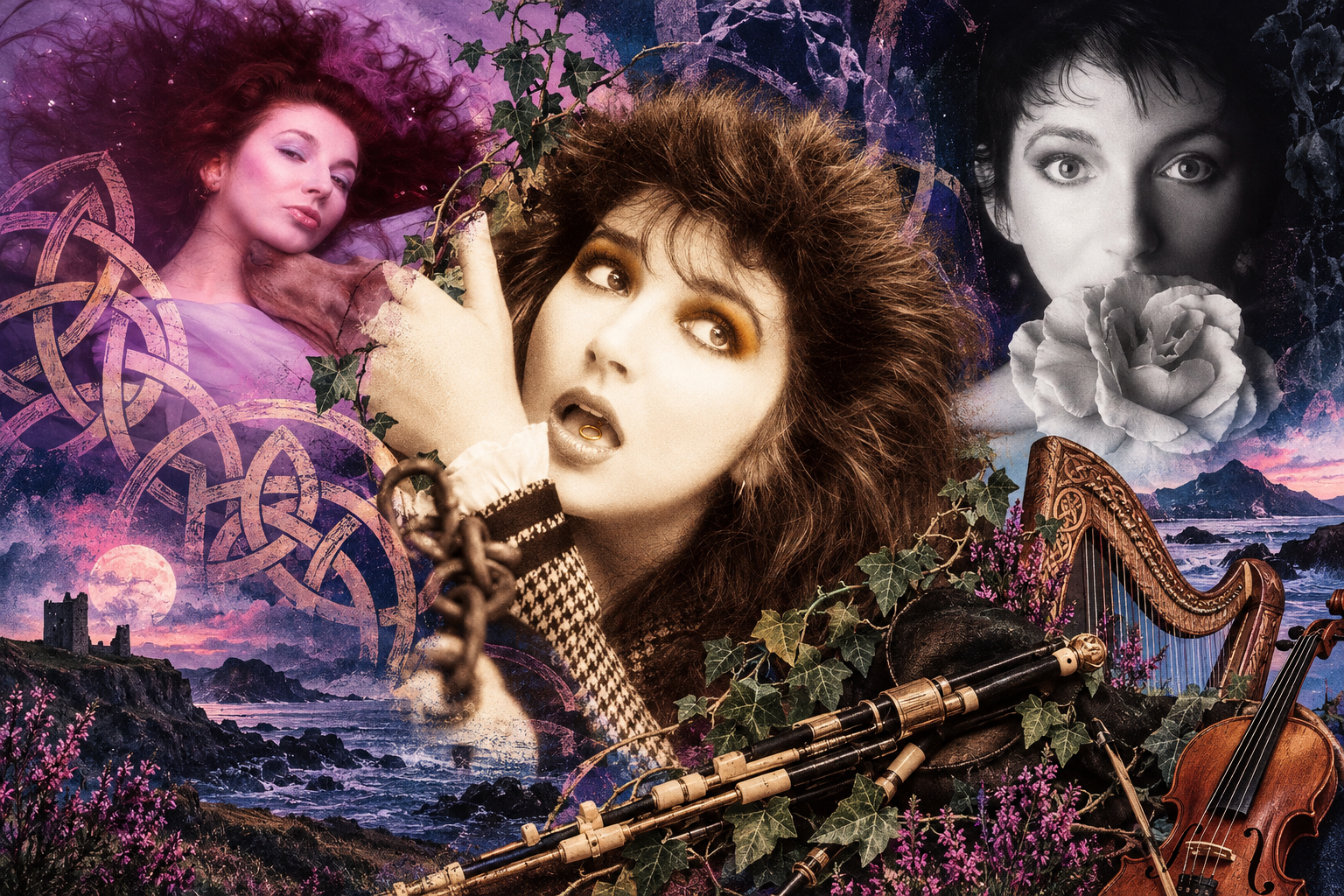
There is something unmistakable about the sound of uilleann pipes cutting through a Kate Bush song. Against her intricate arrangements, unconventional rhythms and electronic textures, these traditional instruments might seem out of place. Yet some of her most extraordinary music emerges from precisely this meeting of tradition and experimentation.
Bush’s connection to Irish music was deeply personal. Through her mother’s family, she grew up surrounded by musical traditions that would eventually find their way into her own recordings. But rather than simply reproducing familiar sounds, she discovered how they could bring new dimensions to her increasingly adventurous songwriting.
From the dramatic instrumental passages of The Dreaming to the life-affirming urgency of Hounds of Love and the intimate textures of The Sensual World, Bush found remarkably different uses for these traditions. Working alongside accomplished musicians from Ireland and beyond, she created songs in which the old and the new didn’t merely coexist; they transformed one another.
A Connection That Began Long Before Fame
Kate Bush’s relationship with Irish traditional music began at home. Her mother, Hannah Daly, grew up near Dungarvan in County Waterford and was an accomplished Irish dancer. Although Bush was raised in Kent, the music of her mother’s homeland remained a familiar presence throughout her childhood.
The Bush household was unusually musical. Her father, Robert, played piano, while her older brothers, John and Paddy, pursued their own musical and artistic interests. Traditional songs and instrumental performances were part of family life, introducing Bush to sounds that existed beyond the conventions of contemporary pop.
Its influence extended beyond the instruments she would eventually use. Bush has suggested that the ornamental flourishes in her singing may have originated in her exposure to Irish music. The melodic turns and expressive phrasing of traditional performance offered possibilities that would later become part of her distinctive vocal style.
Celtic music is a broad term encompassing several distinct traditions, including those of Ireland, Scotland, Wales and Brittany. Although each has its own character, instruments such as the fiddle, harp, whistles and various forms of bagpipes feature prominently across these musical cultures. Irish traditional music, which would become particularly important to Bush, is closely associated with the expressive uilleann pipes, the rhythmic accompaniment of the Irish bouzouki and the lively melodies of jigs and reels.
As Bush’s songwriting became increasingly adventurous, these early influences took on a more deliberate role. Rather than attempting to recreate traditional music, she began inviting accomplished musicians into her experimental arrangements, allowing their playing to become an essential part of the songs themselves.
The Dreaming (1982) — An Unexpected Collaboration
By the time Kate Bush recorded The Dreaming, she was increasingly willing to dismantle conventional song structures in pursuit of something more theatrical and unpredictable. Nowhere is her fascination with Irish traditional music more striking than on “Night of the Swallow”, a song in which two seemingly different musical worlds collide.
The song unfolds as an argument between a woman and her lover, who is determined to undertake a dangerous flight. Bush’s vocal performance moves between pleading, frustration and defiance, while the verses maintain a tense, almost claustrophobic atmosphere. Then the arrangement suddenly opens into a rush of traditional Irish instrumentation, as though the music itself has escaped the confines of the argument.
These passages feature some of Ireland’s most respected traditional musicians, including uilleann piper Liam O’Flynn, fiddler Seán Keane and bouzouki player Dónal Lunny. Their playing brings an exhilarating momentum to the recording, but it also sharpens the song’s central conflict. Where the woman’s words express fear and resistance, the instrumental passages suggest the irresistible freedom her lover is chasing.
What makes “Night of the Swallow” remarkable is that Bush doesn’t soften either musical approach to accommodate the other. The restless, experimental verses and vigorous traditional passages retain their individual identities, making their collision all the more dramatic. Irish music becomes more than a change in texture: it gives the song’s opposing desires their own musical voices.
Rather than treating tradition as something separate from contemporary experimentation, Bush discovered how its energy could intensify a thoroughly modern piece of musical storytelling.
Hounds of Love (1985) — Tradition, Dreams and Survival
On Hounds of Love, Kate Bush found a more deeply integrated role for Irish traditional music. Where “Night of the Swallow” had brought contrasting styles into dramatic confrontation, the album’s second side, The Ninth Wave, used traditional instrumentation to help tell a story of survival.
Its most striking appearance comes in “Jig of Life”. At this point in the suite, the woman stranded at sea encounters a vision of her older self, who urges her to resist death and embrace the life still waiting to be lived. The music responds with an explosive burst of Irish dance rhythms, transforming the atmosphere from dreamlike uncertainty into something fiercely physical.
The interplay of traditional instruments gives the song an almost communal energy. After the isolation and disorientation of the preceding tracks, the sound of musicians playing together feels like a sudden return to the living world. The jig isn’t simply a celebration; its relentless momentum becomes an expression of determination, pushing against the temptation to surrender.
Irish instrumentation also appears more subtly elsewhere in the suite. On “And Dream of Sheep”, John Sheahan’s whistle introduces a fragile, human quality to the otherwise restrained arrangement. Its gentle melodic presence contrasts with the terrifying circumstances of the story, offering a moment of apparent comfort that is inseparable from the danger of falling asleep.
Liam O’Flynn’s uilleann pipes also contribute to the atmosphere of “Hello Earth”, a composition that moves between earthly vulnerability and an almost cosmic sense of distance. Here, Irish instrumentation forms one part of a much wider musical landscape, which also includes a Georgian choral passage drawn from a separate musical tradition.
Bush’s connection with Irish traditional song found another expression in “My Lagan Love”, released as the B-side to “Cloudbusting”. Rather than incorporating traditional instruments into one of her own compositions, she interpreted an existing song associated with the Irish folk tradition. Her sparse, atmospheric treatment places the expressive qualities of her voice at the centre, revealing a more intimate side of her relationship with this music.
Together, these recordings demonstrate how Bush could draw upon the same musical heritage to express everything from vulnerability to an overwhelming determination to survive.
The Sensual World (1989) — Where Irish Music Comes to the Fore
By 1989, Irish traditional music had become an increasingly natural part of Kate Bush’s musical vocabulary. On The Sensual World, its presence is less about dramatic contrasts and more about the subtle ways an instrument can express longing, memory and desire. Rather than interrupting her arrangements, traditional sounds often seem to emerge from within them.
The album’s title track offers perhaps the clearest example. Inspired by Molly Bloom’s closing monologue in James Joyce’s Ulysses, “The Sensual World” transforms an intensely literary source into something physical and immediate. Davy Spillane’s uilleann pipes, John Sheahan’s fiddle and Dónal Lunny’s bouzouki contribute to an arrangement that feels both intimate and expansive. The traditional instruments weave around Bush’s breathless vocal performance, reinforcing the song’s sense of awakening rather than simply providing an Irish backdrop.
On “Never Be Mine”, the effect is markedly different. Spillane’s pipes introduce a plaintive quality to a song preoccupied with the distance between desire and reality. Their sustained, expressive phrases seem to linger over emotions that the lyrics cannot resolve. Where the traditional passages of “Night of the Swallow” had suggested movement and escape, here the music gives shape to something painfully out of reach.
Elsewhere, the influence is quieter still. The Celtic harp heard on “The Fog” and “Between a Man and a Woman” is played by Alan Stivell, the Breton musician whose work helped bring renewed attention to the harp traditions of Brittany. His contributions add delicate acoustic detail to arrangements shaped by Bush’s sophisticated studio production. Davy Spillane’s whistle playing on “The Fog” provides another distinctive traditional voice.
These contributions also demonstrate that Bush’s interests extended beyond Irish music alone. While her family background gave her a particularly strong connection to Ireland, she remained open to the different musical traditions associated with the wider Celtic world.
What distinguishes The Sensual World from her earlier experiments is the confidence of the integration. Traditional instruments no longer appear primarily at moments of heightened drama or sudden rhythmic release. They become part of the album’s emotional language, capable of expressing tenderness, uncertainty and yearning with remarkable subtlety.
Tradition Meets Technology — Two Worlds, One Sound
One of the most fascinating aspects of Bush’s relationship with traditional music is how comfortably it coexists with her fascination for recording technology. Throughout the 1980s, she embraced sampling, synthesisers and increasingly elaborate studio techniques, yet repeatedly returned to instruments whose distinctive character emerged from the nuances of live performance.
On The Dreaming and Hounds of Love, the Fairlight CMI allowed Bush to manipulate recorded sounds and create unfamiliar textures, while traditional musicians contributed the intricate phrasing, rhythmic variations and individual expression of their playing. The contrast gave her arrangements an extraordinary range, allowing acoustic and electronic sounds to interact in unexpected ways.
Crucially, these instruments were never simply decorative additions intended to make her recordings sound more traditional. The breath and ornamentation of the uilleann pipes, the attack of a fiddle and the rhythmic movement of a bouzouki offered different possibilities for shaping a song. Bush recognised those qualities and incorporated them into the structure and emotional direction of her compositions.
Her achievement lay in making these approaches feel inseparable, creating music that could embrace centuries-old performance traditions without abandoning the possibilities of modern experimentation.
More Than an Influence — An Irish Musical Connection
Kate Bush’s relationship with Irish traditional music did not end with The Sensual World. In 1996, she recorded “Mná na hÉireann” (“Women of Ireland”) for Dónal Lunny’s Common Ground project, returning to the tradition not as an influence on her own songwriting, but as music worthy of interpretation in its own right.
Across her recordings, what stands out is the variety of ways she drew upon this musical heritage. The exhilarating instrumental passages of “Night of the Swallow”, the defiant energy of “Jig of Life” and the aching melancholy of “Never Be Mine” share a musical connection, yet each uses it to express something entirely different.
Just as importantly, these recordings reflect genuine musical collaboration. Bush worked with musicians who brought their own experience, traditions and individual styles to her compositions, allowing their performances to shape the music rather than simply embellish it.
In Bush’s hands, Irish traditional music was never a relic of the past. It was a living, expressive force, capable of sounding as adventurous and unpredictable as anything she created in the studio.