In December 1966, a basement venue on London’s Tottenham Court Road opened its doors to a new kind of musical experience. Known as the UFO Club, it brought together experimental rock, psychedelic light shows and a growing counterculture eager to challenge the conventions of popular entertainment.
Among its earliest attractions was Pink Floyd, a relatively unknown band whose performances were already moving beyond traditional rhythm and blues. Led creatively by Syd Barrett, the group combined unusual songwriting with extended instrumental passages, distorted guitars and an increasingly adventurous approach to sound.
At UFO, those experiments found an audience willing to embrace them. The club became an important meeting place for London’s underground movement, while Pink Floyd’s appearances helped establish their reputation as one of its most distinctive acts.
But what made UFO different from an ordinary music venue? And how did a series of performances in a London basement become part of Pink Floyd’s journey towards their first recordings and wider recognition?
The Birth of the UFO Club
The UFO Club opened on Friday, 23 December 1966, in the basement of the Blarney Club, an Irish dance hall at 31 Tottenham Court Road, beneath London’s Berkeley Cinema.
Its founders were two influential figures in the emerging counterculture: John “Hoppy” Hopkins, a photographer, activist and organiser, and Joe Boyd, an American record producer who had become involved in London’s experimental music scene.
Both had connections to the London Free School, a community initiative whose events had featured Pink Floyd earlier that year. Hopkins was also a co-founder of International Times, an underground newspaper launched in October 1966 that provided an alternative voice for London’s developing counterculture.
The idea behind UFO was partly practical. The underground movement needed somewhere its musicians, artists and audiences could gather regularly, while International Times required financial support. A weekly club offered an opportunity to address both.
Boyd found the Blarney Club, and the organisers initially booked two Friday nights, 23 and 30 December, to test whether the idea would attract an audience.
Early promotional material featured both the names UFO and Nite Tripper, reflecting the organisers’ competing suggestions for the venture. UFO soon became the established name.
More Than an Ordinary Music Venue
Unlike a conventional concert venue, UFO was conceived as an all-night gathering combining different forms of experimental entertainment.
Live music shared the programme with films, poetry, performance art and projected imagery. The Blarney Club’s existing dance floor provided a setting for events that began late in the evening and continued into the early morning, when London’s public transport resumed.
Pink Floyd and Soft Machine became the club’s principal early musical attractions, helping establish an identity that differed considerably from London’s more conventional live music circuit.
UFO was also a meeting place for the people shaping the emerging underground movement. Musicians, artists, writers and organisers could encounter one another regularly, exchanging ideas in an environment where unfamiliar approaches were welcomed.
For Pink Floyd, this was particularly valuable. The band had already begun experimenting with extended instrumental passages, but UFO offered a setting in which those explorations were central to the attraction rather than a departure from what audiences expected.
Pink Floyd’s Early UFO Performances
When Pink Floyd appeared at UFO’s opening night, they were already developing a reputation within London’s underground scene.
Their earlier performances at events organised by the London Free School, particularly at All Saints Church Hall in Notting Hill, had introduced audiences to a group increasingly interested in improvisation, unusual sounds and the possibilities of live experimentation.
UFO gave the band a more regular platform.
While their earlier engagements had included conventional clubs and rhythm-and-blues performances, the audience at UFO was interested in music that challenged established expectations. Pink Floyd’s developing approach was therefore well suited to the venue.
The band appeared repeatedly during the club’s early months, sharing its emerging reputation with Soft Machine. Although Pink Floyd’s period as a principal attraction was relatively brief, their association with UFO became one of the defining relationships of London’s psychedelic underground.
A Band Finding Its Audience
By late 1966, Pink Floyd were moving beyond the short, self-contained arrangements associated with their rhythm-and-blues beginnings.
Their performances incorporated extended instrumental passages in which repetition, feedback and changes in texture could become as important as melody. Rather than treating improvisation as a brief opportunity for individual solos, the musicians increasingly explored how an entire piece could develop through their interaction.
This approach had roots in the band’s earlier performances, including lengthy engagements at venues such as the Countdown Club. UFO did not invent their experimental tendencies, but it provided an audience particularly receptive to them.
The club’s importance can also be seen in the attention it attracted beyond its regular visitors.
On 13 January 1967, filmmaker Peter Whitehead recorded Pink Floyd performing at UFO. Two weeks later, on 27 January, the band was filmed there for Granada Television’s Scene Special, broadcast in March.
These surviving recordings provide valuable evidence of Pink Floyd’s early performances, capturing a band whose reputation was beginning to extend beyond the relatively small underground community.
They also reveal how quickly the group was attracting wider interest. Within weeks of UFO opening, Pink Floyd were appearing before television cameras and preparing to enter the recording industry.
Syd Barrett and the Psychedelic Sound
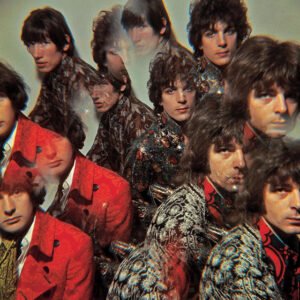
At the centre of Pink Floyd’s early musical identity was Syd Barrett, whose approach to songwriting and guitar playing distinguished the group from many of their contemporaries.
Barrett’s background in art and his interest in unconventional sounds encouraged him to explore possibilities beyond familiar blues-based guitar techniques.
He experimented with feedback, echo and unusual methods of producing sound from his instrument. Rather than using the guitar exclusively for riffs and melodies, he could transform it into a source of sustained tones, distortion and unpredictable textures.
Yet Barrett’s contribution extended beyond experimentation. His songwriting combined memorable melodies with eccentric storytelling, playful language and unexpected musical ideas.
The contrast between these two approaches became one of early Pink Floyd’s defining characteristics.
Interstellar Overdrive: Experimentation Without Boundaries
Perhaps no composition better illustrates the band’s developing live sound than “Interstellar Overdrive”.
Built around a forceful, descending guitar riff, the instrumental provided a recognisable starting point before opening into extended passages of improvisation. The musicians could move away from the central theme, exploring changes in rhythm, texture and intensity before eventually returning to it.
Roger Waters’ bass helped establish the rhythmic foundation, while Nick Mason’s drumming moved between steady patterns and looser, more unpredictable passages. Richard Wright’s organ added sustained tones, contrasting melodies and unusual harmonies that expanded the music beyond Barrett’s guitar.
The result was not simply an extended solo. It was a collective performance in which the musicians responded to one another, allowing the arrangement to develop beyond a predetermined sequence of musical ideas.
This approach was particularly suited to UFO, where audiences were receptive to performances that departed from conventional song structures.
On 11 and 12 January 1967, Pink Floyd worked with Joe Boyd at Sound Techniques Studios in Chelsea, recording “Interstellar Overdrive” and “Nick’s Boogie” for filmmaker Peter Whitehead’s Tonite Let’s All Make Love in London project.
The lengthy recording of “Interstellar Overdrive” offers an important example of the band’s improvisational approach during this period. It should, however, be distinguished from the footage Whitehead filmed at UFO on 13 January and the separate Granada Television recordings made later that month.
Together, these recordings provide a rare opportunity to hear and see aspects of Pink Floyd’s experimental identity before the release of their debut album.
Two Sides of Syd Barrett
It would be misleading to suggest that Pink Floyd’s early music consisted entirely of lengthy instrumental experiments.
Barrett was also developing a distinctive style of songwriting that combined unusual subject matter with concise, often surprisingly accessible melodies.
“Arnold Layne”, recorded in January 1967 and released as the band’s debut single in March, demonstrated this different side of his creativity. Its eccentric narrative and carefully constructed arrangement contrasted with the expansive improvisations associated with Pink Floyd’s underground performances.
That creative range would become central to The Piper at the Gates of Dawn. Songs such as “Lucifer Sam”, “Matilda Mother” and “Bike” revealed Barrett’s gift for unusual but memorable compositions, while “Astronomy Domine” and “Interstellar Overdrive” explored more expansive musical territory.
What made Pink Floyd distinctive was their ability to move between these approaches without treating them as incompatible.
Barrett’s imagination provided much of the creative direction, but Waters, Wright and Mason were essential collaborators in transforming those ideas into performances that could evolve beyond their original structures.
At UFO, this combination of melodic invention and collective improvisation helped establish a musical identity that belonged neither entirely to conventional pop nor to experimental music.
Music, Light Shows and the Underground Experience
For audiences entering the UFO Club, the music was only one part of the experience.
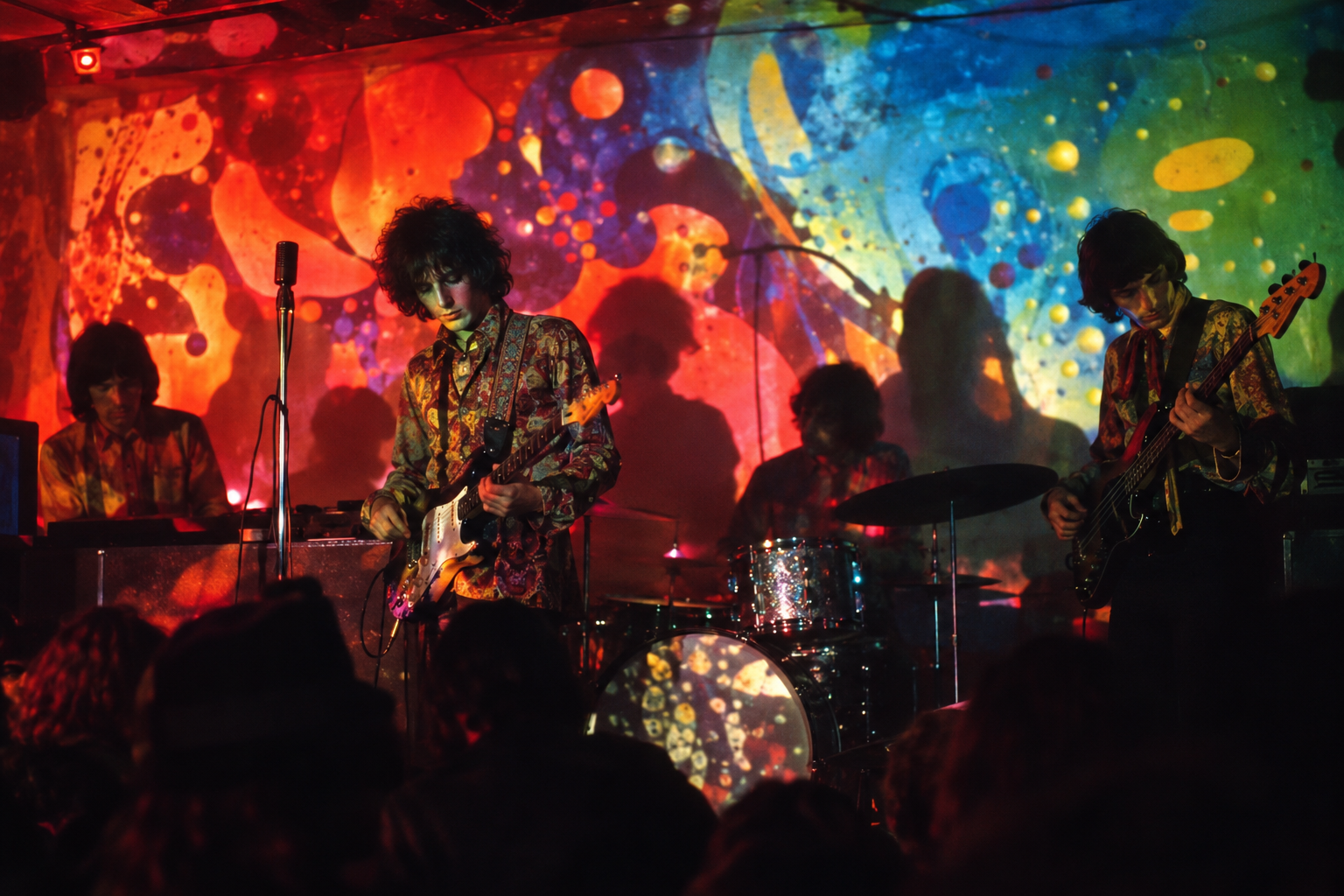
The venue brought together live performances, experimental films, projected images and constantly changing lighting effects. Rather than presenting musicians beneath conventional stage lights, UFO encouraged an approach in which sound and visual art could become parts of the same event.
Coloured liquids and oils were manipulated between transparent surfaces and projected onto walls, ceilings and performers. As the materials moved, they produced shifting abstract patterns, creating images that changed throughout the evening.
These effects relied on comparatively simple equipment, but their unpredictability complemented the experimental character of the music.
Pink Floyd Beneath the Lights
Pink Floyd had already experimented with lighting and projections before UFO opened, notably during their appearances at the London Free School’s events at All Saints Church Hall.
At UFO, these visual elements became closely associated with the band’s emerging identity.
Rather than presenting themselves through the conventional gestures of rock performance, the musicians could appear surrounded by projected colours and patterns. Their instruments and bodies became part of a changing visual environment.
Photographer Adam Ritchie’s surviving images and recollections offer a particularly valuable record of these early performances. His photographs captured the projections surrounding the band, documenting an atmosphere that would have been difficult to convey through conventional concert photography.
The relationship between music and imagery was especially effective during extended instrumentals. As the band moved through passages of feedback, organ textures and shifting rhythms, the projections continued to develop around them.
The visual effects were not necessarily synchronised with every musical change. Instead, sound and imagery existed alongside one another, creating combinations that could vary from performance to performance.
The Artists Behind the Visual Experience
The psychedelic light shows at UFO were not solely Pink Floyd’s creation.
Artists Mark Boyle and Joan Hills were among the figures who helped establish the club’s visual identity. Their work through the Sensual Laboratory incorporated liquid projections, experimental film and unconventional materials to create changing environments.
Boyle and Hills presented work at UFO’s opening event on 23 December 1966 and subsequently provided visual environments for the club. They also developed a particularly important collaboration with Soft Machine, another group central to UFO’s early history.
Their involvement demonstrates how the venue encouraged musicians and visual artists to work together rather than treating lighting as a purely decorative addition.
Pink Floyd were important participants in this developing approach, but the psychedelic light show emerged through the contributions of numerous artists, technicians and performers.
A New Approach to Live Performance
The significance of these experiments becomes clearer when considering how Pink Floyd’s concerts developed in subsequent years.
Their later performances incorporated increasingly sophisticated lighting systems, large-scale projections and elaborate stage designs. By the 1970s, visual presentation had become an essential part of the band’s identity, particularly during tours associated with The Dark Side of the Moon and Wish You Were Here.
Those productions were far more ambitious than the equipment available at UFO, and they developed through numerous collaborations and technological advances.
Nevertheless, the underlying principle was recognisable: music and imagery could work together to create an experience extending beyond the songs themselves.
From Underground Favourites to National Recognition
By early 1967, Pink Floyd were attracting attention beyond the audiences who gathered at UFO each Friday night.
Their experimental performances and Barrett’s distinctive songwriting had made them an increasingly intriguing prospect for the recording industry.
On 28 February 1967, the band signed with EMI Records. The following day, they began recording material for their debut album at Abbey Road Studios, working with producer Norman Smith.
For musicians who had spent much of the previous year developing their sound in clubs and experimental gatherings, the move into a major recording studio represented an important transition.
Arnold Layne and See Emily Play
Pink Floyd’s debut single, “Arnold Layne”, was released on 10 March 1967.
Written by Barrett, the song told the peculiar story of a man who stole women’s clothing from washing lines. Despite objections from some radio broadcasters to its subject matter, the single reached number 20 on the UK chart.
Its success was followed by “See Emily Play”, released on 16 June 1967. Associated with the band’s Games for May concert at London’s Queen Elizabeth Hall, the song combined Barrett’s melodic imagination with unusual instrumental textures and studio effects.
It became an even greater commercial success, reaching number six in the UK.
The singles demonstrated that Pink Floyd could translate their unconventional musical identity into recordings capable of reaching a mainstream audience. Their reputation was no longer dependent entirely on experimental live performances.
Beyond the UFO Club
As Pink Floyd’s popularity increased, their concerts began reaching considerably larger audiences.
On 30 April 1967, the band performed around dawn at the 14-Hour Technicolor Dream, an all-night countercultural gathering held at Alexandra Palace in London. Organised in support of International Times, the event brought together musicians, artists, poets and thousands of attendees.
Less than two weeks later, Pink Floyd staged Games for May at Queen Elizabeth Hall on 12 May.
The concert incorporated elaborate lighting, projections and experimental sound effects. It also featured an early sound-panning device that would later become known as the Azimuth Co-ordinator, allowing the band to move sound around the auditorium.
These performances demonstrated how ideas associated with the underground scene could be adapted for larger and more ambitious settings.
Pink Floyd’s growing popularity also changed their relationship with UFO. Their expanding schedule of recording sessions, television appearances and concerts made regular appearances at the club increasingly impractical.
Their association did not end immediately, however.
On 2 June 1967, Pink Floyd returned to UFO for a fundraising performance supporting co-founder John Hopkins following his arrest for drug possession.
By this stage, the band had opportunities extending far beyond the club that had helped establish their early reputation.
The Piper at the Gates of Dawn
On 4 August 1967, Pink Floyd released their debut album, The Piper at the Gates of Dawn.
Recorded at Abbey Road, the album brought together the contrasting musical approaches that had characterised their early development. Barrett’s eccentric songwriting appeared alongside more expansive compositions, reflecting the band’s ability to combine concise melodies with instrumental experimentation.
The album reached number six on the UK chart, confirming that Pink Floyd’s appeal now extended beyond the underground audiences who had first embraced their music.
Yet their increasing recognition also brought new pressures. The demands of recording, promotion and touring were growing, while Barrett’s increasingly unpredictable behaviour was beginning to create difficulties within the band.
Those developments would shape the next chapter of Pink Floyd’s history.
For UFO, the band’s breakthrough represented both an achievement and a turning point. The venue had helped provide an audience for an experimental group that was now attracting national attention, but that success also carried Pink Floyd into a much wider musical world.
The UFO Club’s Legacy
The UFO Club’s original home on Tottenham Court Road was short-lived. During 1967, the venture moved to the larger Roundhouse in North London, where the increased costs and difficulties of sustaining regular events contributed to its eventual closure in October.
Its existence had lasted less than a year, but its influence extended beyond the musicians who appeared on its stage.
UFO brought together experimental rock, visual art, film and London’s emerging counterculture at a moment when the conventions of live performance were changing rapidly. It provided a meeting place for artists interested in exploring what music and visual presentation could achieve together.
For Pink Floyd, the club arrived at a particularly important point. They were already developing their experimental identity, but UFO offered a regular audience and an environment in which that approach could flourish.
Their subsequent success depended on many influences, opportunities and creative decisions. UFO did not create their sound, nor was it solely responsible for their breakthrough. It did, however, help establish the band as one of the most distinctive attractions of London’s psychedelic underground.
By the time The Piper at the Gates of Dawn appeared in August 1967, Pink Floyd were reaching audiences far beyond Tottenham Court Road.
The UFO Club may have occupied a relatively small basement, but for a brief period, it offered a glimpse of how radically the possibilities of rock performance were beginning to change.