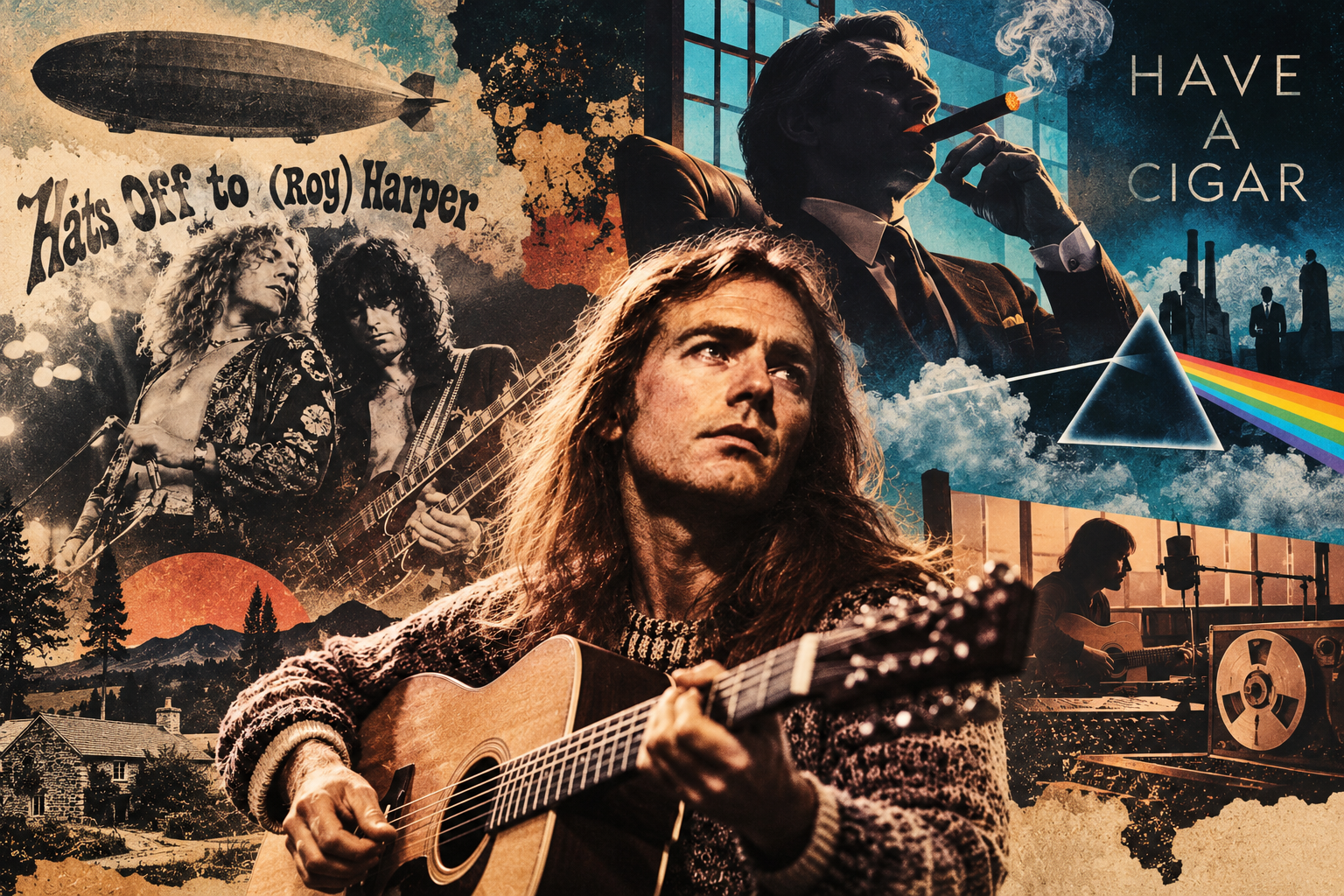
Roy Harper never achieved the commercial success of Led Zeppelin or Pink Floyd, yet his name occupies an unusual place in the history of both bands. Led Zeppelin paid tribute to him on their third album, while Pink Floyd invited him to deliver one of the most recognisable guest vocal performances in progressive rock.
These connections were more than passing encounters. Harper belonged to a generation of British musicians who challenged the boundaries between folk, rock and experimental songwriting, earning the admiration of artists whose fame would eventually far exceed his own.
But Harper was never simply a supporting figure in somebody else’s story. His ambitious compositions, uncompromising lyrics and fiercely independent approach produced a body of work that remains distinctive within British music.
So what brought this unconventional singer-songwriter into the worlds of Led Zeppelin and Pink Floyd, and what do those relationships reveal about the artist behind the famous collaborations?
Roy Harper: The Outsider of British Folk
By the mid-1960s, Britain’s folk scene was undergoing a transformation. Musicians were moving beyond traditional arrangements, experimenting with increasingly personal songwriting and drawing influences from jazz, blues and rock. Among them was Roy Harper, a singer-songwriter whose music rarely fitted comfortably into any single category.
Born in Manchester in 1941, Harper developed an individual approach shaped by his unconventional experiences, literary interests and distrust of established authority. After becoming a familiar presence on London’s folk circuit, particularly at venues such as Les Cousins in Soho, he released his debut album, Sophisticated Beggar, in 1966.
Even in his early recordings, Harper showed little interest in following expectations. His songs could be intimate and melodic, but they were equally capable of becoming lengthy, confrontational or deliberately unconventional. Rather than treating folk music as a fixed tradition, he approached it as a means of exploring his own ideas.
Beyond Traditional Folk Music
Albums such as Flat Baroque and Berserk (1970) and Stormcock (1971) demonstrated how far Harper was prepared to stretch his songwriting. The latter contained just four extended compositions, allowing musical and lyrical ideas to develop beyond familiar verse-and-chorus structures.
His lyrics were equally distinctive. Personal reflection frequently sat alongside political criticism, philosophical questions and an outspoken rejection of social conventions. His songs could be challenging, provocative and resistant to straightforward interpretation.
What made this approach particularly interesting was the contrast between his acoustic instrumentation and the scale of his ambitions. Harper explored subjects and structures associated with progressive rock while retaining the directness of a singer accompanying himself on guitar.
He was neither a traditional folk revivalist nor a conventional rock musician. His work occupied a space between the two, sharing the adventurous spirit of Britain’s emerging progressive movement without abandoning its acoustic foundations.
That independence helped earn Harper the respect of fellow musicians, including members of Led Zeppelin, whose musical interests extended well beyond the heavy blues-rock sound that had established their reputation.
Roy Harper and Led Zeppelin: A Friendship Built on Musical Freedom
Roy Harper’s relationship with Led Zeppelin developed as the boundaries between British folk and rock were becoming increasingly fluid. Although their music differed considerably, they shared interests in blues traditions, acoustic experimentation and songwriting that resisted conventional structures.
Their connection dates back to the 1970 Bath Festival of Blues and Progressive Music, where Harper and Led Zeppelin were part of the same expanding British rock scene.
By then, Zeppelin had achieved international success, while Harper remained a respected figure within the musical underground. Nevertheless, Page and Plant recognised something valuable in his refusal to compromise his artistic identity.
That admiration soon received an unusually public acknowledgement.
Hats Off to (Roy) Harper: Led Zeppelin’s Unusual Tribute
Released in October 1970, Led Zeppelin III marked a significant development in the band’s sound. Alongside the heavy rock of “Immigrant Song” and “Out on the Tiles”, the album explored acoustic arrangements, traditional influences and more reflective songwriting.
Its closing track, “Hats Off to (Roy) Harper”, offered something different again.
Built around Jimmy Page’s heavily processed slide guitar and Robert Plant’s distorted vocals, the recording draws upon the American blues tradition, particularly material associated with Bukka White. Its abrasive, deliberately rough-edged character stands apart from the more melodic acoustic compositions elsewhere on the album.
Despite its title, Harper neither wrote nor performed on the track. The dedication acknowledged the respect Led Zeppelin held for him rather than representing a direct musical collaboration.
That distinction matters. Page and Plant already possessed extensive interests in folk and blues, and their acoustic experimentation developed through several influences. It would be misleading to attribute that direction primarily to Harper.
Nevertheless, naming a song after him introduced his name to a much wider audience. More importantly, it demonstrated the esteem in which he was held by musicians operating at a very different level of commercial success.
Jimmy Page and Roy Harper: The Same Old Rock
The relationship became more substantial when Jimmy Page contributed to Harper’s 1971 album Stormcock.
Page played guitar on “The Same Old Rock”, a composition lasting more than twelve minutes that demonstrates Harper’s ability to move beyond conventional folk songwriting.
Rather than following a familiar structure, the song develops through contrasting passages, with Harper’s acoustic guitar and vocals providing the foundation for an increasingly elaborate arrangement. Page’s playing introduces another melodic voice, complementing Harper’s intricate guitar patterns without overwhelming the composition.
The collaboration is particularly revealing because Page was working within Harper’s musical world rather than the other way around. His contribution enriched an ambitious recording that remained unmistakably Harper’s creation.
Page was credited under the pseudonym S. Flavius Mercurius, an unusual detail that adds to the album’s history.
Their musical relationship continued beyond Stormcock. Page appeared alongside Harper in concert, contributed to other recordings and eventually collaborated with him on the 1985 album Whatever Happened to Jugula?
These projects provide stronger evidence of their creative connection than attempts to identify Harper’s influence in individual Led Zeppelin songs.
Did Roy Harper Influence Led Zeppelin’s Music?
Harper’s relationship with Led Zeppelin is sometimes presented as evidence that he helped inspire the band’s increasingly acoustic direction during the early 1970s.
There are certainly similarities between their musical interests. Both explored the expressive possibilities of acoustic guitar, drew upon folk and blues traditions, and resisted the idea that rock music needed to follow conventional structures.
However, similarities do not necessarily establish direct influence.
Led Zeppelin’s acoustic development drew upon Page and Plant’s own musical backgrounds, including their interest in traditional music and the songwriting sessions associated with Bron-Yr-Aur in Wales.
Harper’s importance to the band is better understood through the friendship and mutual admiration he inspired. The tribute on Led Zeppelin III acknowledged his reputation, while Page’s subsequent contributions to Harper’s recordings demonstrated that their connection extended beyond personal respect.
Pink Floyd would recognise Harper’s abilities in a very different way. Rather than naming a song after him, they would invite him to perform one.
Roy Harper and Pink Floyd: The Voice Behind “Have a Cigar”
By 1975, Pink Floyd had become one of the world’s most successful rock bands. The extraordinary popularity of The Dark Side of the Moon had transformed their career, bringing new pressures and an increasingly complicated relationship with the music industry.
These tensions became central to Wish You Were Here, an album exploring absence, alienation and the commercial machinery surrounding popular music.
One of its most pointed compositions was “Have a Cigar”, Roger Waters’ sarcastic portrayal of a record executive whose enthusiasm for a band’s success barely conceals his financial motivations.
Yet the voice delivering those lyrics belonged neither to Waters nor to David Gilmour.
Instead, Pink Floyd turned to Roy Harper, who happened to be recording at Abbey Road Studios during the same period.
How Roy Harper Came to Sing “Have a Cigar”
Pink Floyd began recording Wish You Were Here at Abbey Road in January 1975, returning for further sessions throughout the year. Harper was also working there, recording material for his album HQ.
The musicians already knew one another, and Harper’s presence offered an unexpected solution to a problem with “Have a Cigar”.
Waters had intended to sing the composition himself, but he was dissatisfied with his vocal performance. Gilmour was also involved in attempts to find a suitable vocal arrangement, and the band had not settled on a version that worked.
Harper’s eventual involvement was remarkably informal.
Gilmour later recalled that Harper was a familiar presence around Abbey Road and had expressed an interest in contributing to Pink Floyd’s recordings. His recollection suggests that the decision emerged spontaneously during the sessions rather than through a deliberate search for an outside vocalist.
Harper recorded the lead vocal, bringing a powerful and theatrical quality to the song. His delivery transformed Waters’ lyrics into something resembling an exaggerated sales pitch, full of confidence, sarcasm and barely concealed insincerity.
The performance impressed Gilmour, although Waters subsequently expressed reservations. He felt that Harper’s interpretation was more overtly cynical and theatrical than he would have preferred.
That disagreement is particularly interesting because it reveals how differently the song could be interpreted. Where Waters later imagined a more vulnerable delivery, Harper approached the narrator as an almost grotesque embodiment of music-industry arrogance.
Regardless of those differing opinions, his recording became the version released on Wish You Were Here.
The Irony Behind “Have a Cigar”
“Have a Cigar” takes aim at an industry that treats artistic achievement primarily as a commercial opportunity.
Its narrator flatters an imaginary band with promises of fame and fortune while revealing an almost comical ignorance of the musicians themselves. The song’s most famous joke comes when the supposed executive asks which member of Pink Floyd is actually called Pink.
Beneath the humour lies a criticism of people who profit from music without understanding the artists responsible for creating it.
Harper’s interpretation makes that criticism particularly effective. Rather than delivering the lyrics as an openly angry protest, he adopts the confident manner of someone who genuinely believes the promises being made.
His vocal cuts through the song’s insistent bass line, Richard Wright’s keyboards and Gilmour’s muscular guitar work, adding a theatrical edge to an already forceful arrangement.
There is also an interesting irony in his involvement.
Harper had spent much of his career resisting commercial expectations, frequently pursuing compositions that offered little concession to mainstream tastes. Here he was, temporarily assuming the role of a fictional industry representative obsessed with turning music into profit.
That contrast gives his performance an additional dimension, although the song’s criticism remains fundamentally Waters’ creation.
Harper did not write “Have a Cigar” or shape the wider concept of Wish You Were Here. His contribution was more specific: he provided the voice that brought one of its central characters to life.
From Abbey Road to Knebworth
Harper’s association with Pink Floyd was not confined to the recording studio.
On 5 July 1975, he joined the band onstage at the Knebworth Festival in Hertfordshire, performing “Have a Cigar” before the album had been released.
Harper was also among the festival’s supporting performers, alongside artists including Captain Beefheart and the Steve Miller Band. His appearance with Pink Floyd offered audiences an early opportunity to hear a composition that would become one of the defining tracks of their next album.
When Wish You Were Here arrived in September 1975, Harper’s performance introduced his voice to listeners who might never have encountered his solo recordings.
Yet the collaboration did not represent a permanent change in direction for either artist. Pink Floyd continued developing their conceptual approach to rock, while Harper remained committed to his own songwriting.
What the recording demonstrated was not that Harper had transformed Pink Floyd’s sound, but that his abilities were distinctive enough for the band to invite him into one of their most important projects.
Beyond Led Zeppelin and Pink Floyd: Roy Harper’s Own Musical Legacy

For listeners discovering Roy Harper through “Have a Cigar” or Led Zeppelin’s tribute, his solo catalogue offers a rather different experience.
His most ambitious recordings rarely resemble conventional folk albums, favouring extended compositions, philosophical lyrics and arrangements that move between delicate acoustic passages and expansive rock.
Three albums from the 1970s illustrate this particularly well: Stormcock, Lifemask and HQ.
Stormcock (1971): Folk Music Without Boundaries
Released in 1971, Stormcock is arguably the clearest expression of Harper’s unconventional approach to songwriting.
Containing just four extended compositions, the album abandons the familiar structure of short, self-contained folk songs. Instead, Harper allows his music to unfold gradually, building intricate acoustic guitar passages around lyrics exploring religion, society, personal relationships and humanity’s place in the world.
“The Same Old Rock”, featuring Jimmy Page, demonstrates how effectively Harper could combine acoustic intimacy with progressive ambition. Its criticism of organised religion is characteristic of his willingness to confront subjects that many contemporary songwriters approached more cautiously.
Yet the album’s achievement extends beyond its famous guest appearance.
On “Me and My Woman”, Harper moves between personal reflection and broader questions about humanity and the environment, with David Bedford’s string arrangement adding a dramatic dimension to the music.
What makes Stormcock remarkable is that its complexity rarely feels like an attempt to imitate progressive rock. Harper approaches extended songwriting from a different direction, using the flexibility of folk music to accommodate ideas that would struggle to fit within a conventional three-minute song.
The result is an album that feels both intimate and expansive, demonstrating that musical ambition need not depend upon electric guitars or elaborate studio effects.
Lifemask (1973): Philosophy, Politics and Experimentation
If Stormcock demonstrated Harper’s willingness to challenge musical conventions, Lifemask pushed that ambition into even more demanding territory.
Released in 1973, the album combines relatively accessible compositions with one of Harper’s most extraordinary recordings: “The Lord’s Prayer”.
Occupying almost 23 minutes, the piece is a sprawling examination of humanity’s relationship with religion, society and the natural world. Its shifting musical passages and dense, often confrontational lyrics demand considerable attention, but they also reveal the extraordinary scope of Harper’s imagination.
Jimmy Page plays throughout the composition, providing another important connection between the two musicians.
Elsewhere, Lifemask offers a more immediate side of Harper’s songwriting. “Highway Blues” balances melodic accessibility with introspection, while “South Africa” addresses the divisions and injustices of apartheid through the language of a love song.
The contrast is revealing. Harper could write affecting, relatively straightforward songs, but he was equally willing to pursue an idea across an entire side of an album.
Rather than treating commercial accessibility as an essential requirement, he allowed each composition to determine its own shape.
HQ (1975): Harper Embraces Rock
By the time Harper released HQ in 1975, his music had developed a more pronounced rock character.
The album features musicians including guitarist Chris Spedding and drummer Bill Bruford, whose contributions give several compositions a harder, more forceful sound.
It also brings Harper’s connections with Led Zeppelin and Pink Floyd together in an especially interesting way.
David Gilmour and John Paul Jones contributed to the backing track for “The Game”, an ambitious opening composition that combines driving rock instrumentation with Harper’s characteristic social criticism. Chris Spedding subsequently added the song’s striking guitar solo.
The recording demonstrates that Harper’s relationships with these musicians were not confined to admiration or occasional guest appearances. He could bring established rock performers into his own musical world without surrendering control of its direction.
Yet HQ is perhaps best remembered for its closing track, “When an Old Cricketer Leaves the Crease“.
Accompanied by the Grimethorpe Colliery Band, with an arrangement by David Bedford, the song uses cricket as a starting point for a poignant reflection on ageing, memory and mortality.
Its restrained delivery contrasts sharply with the more confrontational material elsewhere on the album. Beneath its distinctly English imagery lies a universal awareness of passing time and the inevitability of change.
It remains one of Harper’s most affecting compositions, demonstrating that his songwriting could be profoundly moving without relying upon musical complexity or political provocation.
An Artist Who Refused Easy Categorisation
Taken together, these recordings reveal why Harper occupies such an unusual position in British music.
He could be a folk singer, a progressive composer, a political commentator or a rock musician, sometimes moving between these identities within the same album.
His willingness to experiment did not always make his music accessible, but it produced a catalogue whose most compelling moments stand independently of his associations with more famous artists.
Led Zeppelin’s tribute and Pink Floyd’s invitation to sing “Have a Cigar” may have introduced Harper to a wider audience, but albums such as Stormcock, Lifemask and HQ explain why he was worthy of that attention in the first place.
Roy Harper’s Place in British Rock History
Roy Harper’s connections with Led Zeppelin and Pink Floyd offer a fascinating glimpse into the creative relationships that shaped British rock during the 1970s. From the tribute on Led Zeppelin III to his unmistakable vocal performance on “Have a Cigar”, he earned recognition from musicians whose commercial success far exceeded his own.
Yet these associations tell only part of his story.
His recordings reveal an artist whose ambitions were never confined to traditional folk music. Whether experimenting with extended compositions, confronting uncomfortable subjects or writing deeply personal songs, Harper pursued an approach that remained distinctly his own.
He did not need to shape Led Zeppelin’s sound or influence Pink Floyd’s songwriting to justify his place in rock history. His music provides a compelling argument on its own.
For many listeners, Led Zeppelin and Pink Floyd remain the introduction to Roy Harper. The greater discovery is the music he created under his own name.