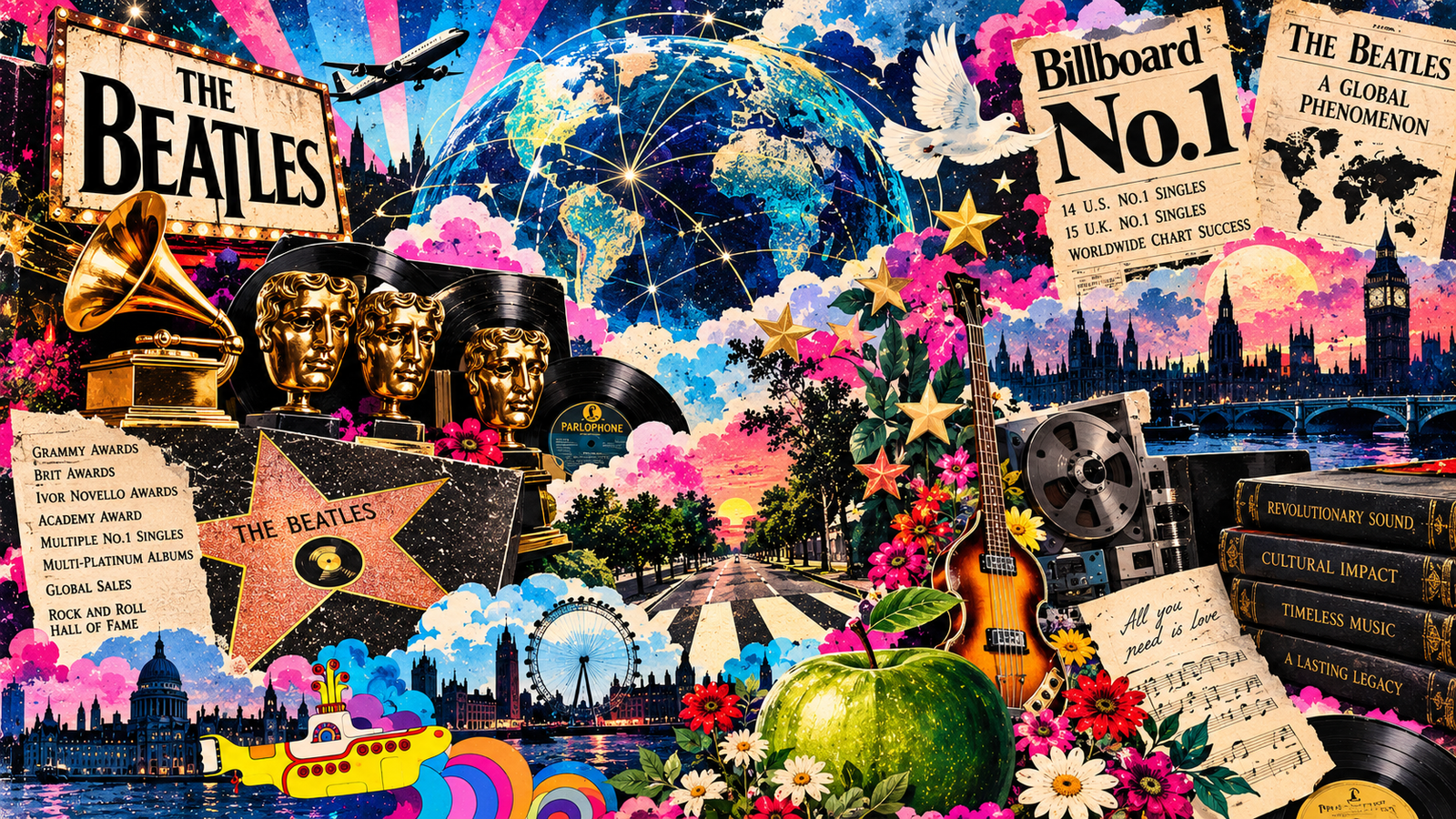
Few bands have matched the commercial success, artistic development and cultural influence of The Beatles. Between their first British chart appearance in 1962 and their breakup in 1970, John Lennon, Paul McCartney, George Harrison and Ringo Starr transformed from promising Liverpool musicians into one of the most celebrated groups in popular music history.
Their accomplishments were extraordinary in both scale and variety. The Beatles achieved 20 number-one singles on the American Billboard Hot 100, topped the UK singles chart 18 times and produced albums that helped redefine expectations of popular music. Their work also earned major industry awards, royal recognition and a lasting place in cultural history.
What makes these achievements particularly striking is how rapidly the band developed. Within a few years, they progressed from energetic rock and roll performances to elaborate studio productions, exploring new musical possibilities without losing their enormous international audience.
From unprecedented chart records to groundbreaking albums and an enduring influence on modern recording, The Beatles’ greatest achievements reveal why their legacy remains so significant.
From Liverpool to International Success

The Beatles’ rise to international fame was built on years of live performances, musical experimentation and an increasingly confident songwriting partnership.
Their origins can be traced to 1957, when John Lennon was performing with a Liverpool skiffle group called the Quarrymen. Paul McCartney joined later that year, followed by George Harrison in 1958. After several changes in personnel and identity, the group adopted the name The Beatles in 1960.
Influenced by American rock and roll and rhythm and blues, they developed their sound through demanding performances in Hamburg and regular appearances at Liverpool’s Cavern Club. These formative years sharpened their musicianship, stage presence and vocal harmonies.
Brian Epstein, George Martin and the First Recordings
A major turning point came in November 1961, when local record-store manager Brian Epstein saw The Beatles perform at the Cavern Club. He subsequently became their manager, helping professionalise their presentation and pursue a recording contract.
After an unsuccessful audition for Decca Records on 1 January 1962, the group attracted the interest of EMI’s Parlophone label and producer George Martin.
They auditioned for Martin in June 1962, and Ringo Starr replaced drummer Pete Best that August, completing the lineup that would achieve worldwide fame.
Their debut single, Love Me Do, was released on 5 October 1962 and reached number 17 on the British chart. The follow-up, Please Please Me, arrived in January 1963, reaching number two on the Record Retailer chart while topping several competing British listings.
The success established Lennon and McCartney as promising songwriters and gave The Beatles the national exposure they needed.
The Breakthrough of 1963
Released on 22 March 1963, the band’s debut album, Please Please Me, captured much of the energy of their live performances.
Remarkably, ten of its fourteen tracks were recorded during a single session on 11 February. The album reached number one in Britain that May and remained there for 30 weeks before being replaced by their second LP, With the Beatles.
Meanwhile, singles including From Me to You and She Loves You established the group as Britain’s leading pop attraction.
By the end of 1963, The Beatles had progressed from regional favourites to national stars. Their breakthrough in the United States followed in early 1964, beginning a period of international success that would establish some of the most remarkable records in chart history.
The Beatles’ Record-Breaking Chart Success
The Beatles’ commercial achievements remain among the most impressive in popular music. Their ability to dominate the British and American charts simultaneously demonstrated the extraordinary international demand for their recordings.
While their success began with relatively straightforward pop singles, they continued to attract enormous audiences as their songwriting and musical arrangements became increasingly ambitious.
An Unprecedented American Chart Record
The band’s American breakthrough accelerated when I Want to Hold Your Hand reached number one on the Billboard Hot 100 on 1 February 1964.
Just over two months later, they achieved something unprecedented.
On 4 April 1964, The Beatles occupied all five leading positions on the Billboard Hot 100:
Can’t Buy Me Love
Twist and Shout
She Loves You
I Want to Hold Your Hand
Please Please Me
Another seven Beatles recordings appeared elsewhere on the chart, giving the group twelve entries in total.
The achievement was especially remarkable because their American recordings were being issued through several labels, including Capitol, Swan, Tollie and Vee-Jay. Despite this fragmented release history, demand for the band’s music was overwhelming.
Their chart dominance continued throughout the decade. Between 1964 and 1970, The Beatles achieved 20 number-one singles on the Billboard Hot 100, a record that remains one of their defining commercial accomplishments.
Among those hits was Hey Jude, which spent nine consecutive weeks at number one in 1968, becoming their longest-running American chart-topper.
Eighteen UK Number-One Singles
The Beatles enjoyed similarly remarkable success in Britain.
Their first number-one single on the chart now recognised by the Official Charts Company was From Me to You in 1963. It began a succession of hits that included She Loves You, I Want to Hold Your Hand, A Hard Day’s Night, Help! and We Can Work It Out.
By 1969, the group had accumulated seventeen UK number-one singles.
Their musical development did not prevent them from producing successful records. Songs such as All You Need Is Love, Hey Jude and Get Back demonstrated how their changing artistic interests could coexist with widespread commercial appeal.
Not every celebrated release reached the summit. The double A-side Penny Lane / Strawberry Fields Forever, for example, peaked at number two in Britain in 1967, despite becoming one of their most admired singles.
More than five decades after the group’s breakup, Now and Then reached number one in November 2023, becoming The Beatles’ eighteenth UK chart-topper.
The release established a span of approximately 60 years and six months between their first and most recent British number-one singles.
Record-Breaking Albums
The band’s commercial achievements extended beyond individual songs.
Their debut album, Please Please Me, spent 30 consecutive weeks at number one in Britain, while Sgt. Pepper’s Lonely Hearts Club Band enjoyed 27 weeks at the summit during its original chart run.
Across their catalogue, The Beatles have achieved 15 UK number-one albums, placing them among the most successful album artists in British chart history.
Their recordings also continued to attract substantial audiences after the group’s breakup, with compilations, remastered editions and archival releases introducing their music to successive generations.
Yet their most significant achievement was not simply the number of records they sold. The Beatles maintained extraordinary commercial popularity while continually expanding the musical possibilities of their albums.
Albums That Changed Popular Music

The Beatles’ artistic development during the 1960s helped change expectations of what popular music could accomplish.
Working closely with producer George Martin and the engineers at EMI Studios, they explored increasingly sophisticated approaches to songwriting, instrumentation and recording. Their albums became opportunities for experimentation rather than simply collections of potential hit singles.
Four releases illustrate this remarkable progression.
Rubber Soul (1965): A New Musical Direction
Released in December 1965, Rubber Soul represented an important stage in The Beatles’ development as songwriters.
Tracks such as In My Life, Nowhere Man and Girl explored more reflective themes, while the arrangements incorporated influences from folk rock, soul and contemporary pop.
George Harrison’s use of the sitar on Norwegian Wood (This Bird Has Flown) was particularly significant. Although Indian instruments had appeared in Western recordings before, the song introduced the sitar to an enormous mainstream pop audience and anticipated Harrison’s deeper engagement with Indian classical music.
Every track on Rubber Soul was an original composition, reflecting the band’s growing confidence in their own material.
The album did not invent the idea of the LP as an artistic statement, but its success helped reinforce the growing importance of albums within popular music.
Revolver (1966): Expanding the Possibilities of Recording
Released in August 1966, Revolver demonstrated how far The Beatles were prepared to experiment.
The album moved between sharply contrasting musical styles. Eleanor Rigby featured a striking string arrangement without conventional rock instrumentation, while Taxman introduced a more explicitly political dimension to George Harrison’s songwriting.
Perhaps its most adventurous recording was Tomorrow Never Knows. Built around a hypnotic drum pattern and Indian-influenced sounds, the track incorporated tape loops, manipulated vocals and other unconventional studio effects.
Working with Martin, engineer Geoff Emerick and the wider recording team, The Beatles explored how recorded sounds could be altered, layered and combined into arrangements that went beyond the possibilities of a conventional live performance.
These techniques were not entirely new, having precedents in experimental music and earlier studio recordings. Their achievement was in incorporating them into accessible, commercially successful pop music.
Revolver demonstrated that ambitious production and musical experimentation could become central features of a mainstream album.
Sgt. Pepper’s Lonely Hearts Club Band (1967): The Album as an Event
Having abandoned touring in 1966, The Beatles devoted greater attention to their studio recordings.
The following year, they released Sgt. Pepper’s Lonely Hearts Club Band, an elaborate album combining psychedelic rock, music hall influences, orchestral arrangements and imaginative production techniques.
Paul McCartney’s idea of presenting the group as a fictional band provided a loose conceptual framework. Songs including Lucy in the Sky with Diamonds, She’s Leaving Home and A Day in the Life demonstrated the extraordinary range of their musical ambitions.
The album’s visual presentation was equally important. Its elaborate sleeve, created by artists Peter Blake and Jann Haworth with photography by Michael Cooper, became one of the most recognisable images in popular music.
Sgt. Pepper was not the first concept album, nor did its songs form a continuous narrative. Its significance lay in bringing ambitious recording, distinctive visual design and the idea of an album-length artistic experience together with enormous commercial success.
The result helped strengthen the perception that rock albums could be substantial creative works, worthy of the same critical attention traditionally given to more established musical forms.
Abbey Road (1969): A Remarkable Final Recording Achievement
By 1969, personal and business disagreements were placing considerable strain on The Beatles. Despite these tensions, they produced one of their most accomplished studio albums.
Released in September, Abbey Road combined polished arrangements with some of the band’s most memorable late-period compositions.
George Harrison’s Something and Here Comes the Sun demonstrated his development as a songwriter, while Come Together and Because highlighted the group’s continuing musical versatility.
The album’s second side was particularly ambitious. A sequence of shorter compositions was assembled into an extended medley, creating a flowing musical structure that brought together contrasting melodies and arrangements.
The use of the Moog synthesiser also reflected the band’s continuing interest in emerging musical technology.
Although Let It Be was released afterwards, in May 1970, Abbey Road was the final album The Beatles recorded together as a group.
Its sophisticated production provided a remarkable conclusion to their studio career.
A Lasting Contribution to Album-Making
Between Rubber Soul and Abbey Road, The Beatles underwent an extraordinary artistic transformation in just four years.
Their achievements were collaborative. George Martin, recording engineers and additional musicians played essential roles in translating the band’s ideas into finished recordings.
Rather than inventing every technique they employed, The Beatles helped demonstrate how adventurous songwriting, ambitious production and enormous commercial popularity could coexist.
In doing so, they contributed to the growing importance of the rock album as a major creative format.
Grammy Awards and Major Musical Honours
The Beatles’ commercial achievements were accompanied by increasing recognition from the music industry.
Although their earliest popularity was closely associated with Beatlemania, their songwriting and recording ambitions earned awards that reflected a growing appreciation of rock music as an artistic form.
Their First Grammy Awards
The Beatles received their first Grammy Awards at the seventh annual ceremony in 1965, recognising recordings released during the previous year.
They won Best New Artist and Best Performance by a Vocal Group for A Hard Day’s Night.
These victories represented an important milestone for a British group whose American breakthrough had occurred only a year earlier.
Their success demonstrated that rock and roll performers could gain recognition from established music-industry institutions, rather than being judged exclusively through record sales and teenage popularity.
Sgt. Pepper’s Historic Grammy Success
The band’s most significant Grammy recognition during their original career came in 1968.
Sgt. Pepper’s Lonely Hearts Club Band won Album of the Year, becoming the first rock album to receive the honour. It also won Best Contemporary Album.
The awards recognised the record’s artistic ambitions and sophisticated production, marking an important moment in the growing acceptance of rock music within the American recording industry.
The achievement was particularly significant because The Beatles had moved away from regular live performances to concentrate on developing their recordings.
Their increasingly elaborate studio work was now receiving some of the industry’s highest honours.
Grammy Recognition Across Generations
The Beatles’ awards continued long after their breakup.
At the 1997 Grammy Awards, Free as a Bird, developed from an unfinished John Lennon recording, won Best Pop Performance by a Duo or Group with Vocal and Best Music Video, Short Form.
The accompanying Beatles Anthology documentary series also won Best Music Video, Long Form.
Further recognition arrived in February 2025, when Now and Then won Best Rock Performance at the 67th Grammy Awards.
According to the Recording Academy, The Beatles have received eight Grammy Awards from 25 nominations.
The 2025 victory was especially remarkable, arriving more than sixty years after the band’s first Grammy successes.
Ivor Novello Awards and Songwriting Recognition
The Beatles also received recognition in Britain through the Ivor Novello Awards, which celebrate achievements in songwriting and composition.
Their early success brought attention to the Lennon–McCartney partnership, whose compositions helped establish the group as far more than accomplished performers.
Songs such as She Loves You demonstrated their ability to combine memorable melodies with enormous commercial appeal. As their career progressed, their writing became increasingly sophisticated, incorporating a wider range of musical influences and lyrical subjects.
George Harrison also emerged as an important songwriter, contributing celebrated compositions including While My Guitar Gently Weeps, Something and Here Comes the Sun.
Together, these achievements reinforced The Beatles’ reputation as musicians whose songwriting abilities were central to their success.
Royal Recognition and Cultural Significance
By the middle of the 1960s, The Beatles had become figures of national importance.
Their international popularity brought considerable attention to British music, while their success challenged traditional assumptions about the cultural value of popular entertainment.
This changing status became particularly evident in 1965, when all four members received royal honours.
The Beatles Receive Their MBEs
In June 1965, it was announced that John Lennon, Paul McCartney, George Harrison and Ringo Starr would each be appointed a Member of the Order of the British Empire (MBE).
The honours were recommended by Prime Minister Harold Wilson and recognised the band’s contribution to Britain’s cultural prominence and commercial success overseas.
On 26 October 1965, The Beatles attended an investiture at Buckingham Palace, where Queen Elizabeth II presented them with their medals.
For musicians who had spent their formative years performing in Liverpool and Hamburg clubs, the occasion represented an extraordinary change in status.
Their success had carried them from the British entertainment industry’s margins into one of the country’s most established institutions.
Why the Honours Were Controversial
The announcement was not universally welcomed.
Some existing recipients objected to a pop group receiving an honour traditionally associated with military service, public administration and other established forms of national contribution. Several returned their decorations in protest, while the decision also generated criticism in Parliament.
The controversy revealed a wider disagreement about what constituted an achievement worthy of official recognition.
Supporters pointed to the band’s international popularity, contribution to British exports and cultural influence. Critics questioned whether commercial entertainers deserved the same distinction as individuals recognised for public or military service.
The debate illustrated how rapidly attitudes towards popular music were changing.
The band’s relationship with the honours also became more complicated. On 25 November 1969, John Lennon returned his MBE medal, citing Britain’s involvement in the Nigeria–Biafra conflict and support for American policy in Vietnam.
His accompanying letter also included an irreverent reference to his single Cold Turkey slipping down the charts.
Lennon’s decision reflected his increasingly public political activism and demonstrated how the band’s cultural prominence could extend into debates far beyond music.
A Changing Place for Popular Culture
The Beatles’ royal recognition formed part of a broader transformation in British society.
During the 1960s, popular music became an increasingly visible expression of youth culture and national identity, particularly as British performers achieved international success.
The Beatles were not solely responsible for these developments. They emerged alongside musicians, filmmakers, designers and other creative figures who were challenging established conventions.
Nevertheless, their enormous visibility made them powerful representatives of the changing cultural landscape.
Receiving MBEs in 1965 therefore represented more than another accolade. It marked a moment when the achievements of popular musicians were formally acknowledged by the British establishment, even as the controversy surrounding the decision exposed how contested that recognition remained.
The Beatles’ Influence Beyond Music
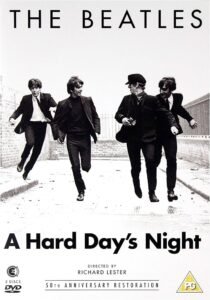
The Beatles’ impact extended beyond their albums and singles, influencing cinema, promotional filmmaking and the wider entertainment industry.
Their success demonstrated how a popular music group could establish a distinctive creative identity across different media, while their international audience helped bring emerging artistic approaches into the mainstream.
A Hard Day’s Night and the Evolution of Music Films
In 1964, The Beatles made their feature-film debut in A Hard Day’s Night, directed by Richard Lester.
Rather than following the conventional formula of a musical built around individual performances, the film presented a fictionalised account of the band’s hectic daily life.
Its energetic editing, documentary-inspired camerawork and irreverent humour captured both their personalities and the absurdity of Beatlemania.
The film received critical acclaim and demonstrated that a production starring popular musicians could possess a distinctive artistic identity.
Its visual style also influenced the development of music videos, particularly through rapid editing, unconventional camera angles and imaginative sequences built around individual songs.
The Beatles returned to cinema with Help! in 1965, another Lester-directed production that embraced colourful visuals, surreal comedy and elaborate musical sequences.
Together, the films helped expand expectations of how popular musicians could be presented on screen.
Promotional Films and the Rise of the Music Video
As The Beatles’ international popularity increased, appearing personally on every television programme became impractical.
Specially produced promotional films offered an alternative, allowing broadcasters to feature the band without requiring them to attend each studio.
During the mid-1960s, The Beatles recorded promotional clips for songs including We Can Work It Out, Paperback Writer and Rain.
Their films for Strawberry Fields Forever and Penny Lane, directed by Peter Goldmann in 1967, adopted an increasingly experimental approach, using unusual editing and imagery rather than simply presenting conventional performances.
Promotional music films existed before The Beatles, but the band’s work helped demonstrate their creative possibilities to a mass audience.
These developments anticipated the increasingly elaborate music videos that would become a central feature of the recording industry in subsequent decades.
Changing Expectations of Recording and Production
The Beatles also contributed to a changing understanding of the recording studio.
During their early career, sessions largely focused on capturing performances. As their ambitions developed, they increasingly treated recording as a creative process that could produce sounds impossible to reproduce on stage.
Working with George Martin and engineers including Geoff Emerick and Ken Townsend, they explored tape manipulation, automatic double tracking and increasingly elaborate arrangements.
Their decision to abandon touring in 1966 gave them greater freedom to pursue these possibilities.
Although many techniques had precedents elsewhere, The Beatles helped bring experimental production methods to a vast popular audience.
Their work also highlighted the importance of producers and engineers as creative collaborators, reinforcing the studio’s growing role in modern music-making.
Influencing Generations of Musicians
The Beatles’ songwriting and willingness to experiment influenced countless subsequent artists.
Their music demonstrated how memorable melodies could coexist with unusual arrangements, varied instrumentation and increasingly personal lyrics.
Later groups such as Electric Light Orchestra and Oasis drew inspiration from different aspects of their work, while their recordings continued to provide reference points for musicians and producers across numerous genres.
Their influence was not confined to a particular sound. Perhaps their most important example was the freedom they demonstrated to develop artistically without abandoning commercial success.
Through their films, promotional recordings and creative approach to music-making, The Beatles helped reshape expectations of what a successful popular group could achieve.
An Enduring Legacy After 1970
The Beatles’ breakup in 1970 brought their original recording career to an end, but their cultural significance continued to grow.
Archival releases, documentaries and renewed critical recognition introduced their music to new generations, while their influence remained evident in the work of subsequent musicians.
Recognition in the Rock and Roll Hall of Fame
In 1988, The Beatles were inducted into the Rock and Roll Hall of Fame, recognising their contribution to rock music and their wider cultural influence.
Mick Jagger of The Rolling Stones delivered their induction speech, reflecting the respect the group had earned among fellow musicians.
The individual members also received recognition for their careers beyond The Beatles.
John Lennon was inducted as a solo artist in 1994, followed by Paul McCartney in 1999 and George Harrison in 2004. Ringo Starr received the Award for Musical Excellence in 2015.
These honours acknowledged both the band’s collective achievements and the distinctive contributions of its members.
The Beatles Anthology: Rediscovering Their History
One of the most significant developments in the band’s post-breakup history arrived during the 1990s with The Beatles Anthology.
The project combined an extensive television documentary series with three collections of previously unreleased recordings, alternate takes and live performances.
Featuring interviews with McCartney, Harrison and Starr alongside archival material, it offered an unusually detailed account of the group’s development.
The project also produced two new Beatles singles: Free as a Bird in 1995 and Real Love in 1996.
Both were developed from unfinished John Lennon home recordings, with the three surviving members contributing new performances under the production of Jeff Lynne.
Three decades later, the project received a major expansion.
In November 2025, Anthology 4 introduced additional archival recordings and updated mixes of Free as a Bird and Real Love. The documentary series was also restored and expanded from eight to nine episodes, including previously unseen footage of the surviving Beatles working together during the original project.
The releases offered fresh insight into the band’s recording process and demonstrated the continuing interest in their history.
Now and Then: The Beatles’ Final Song
Perhaps the most remarkable late achievement came in November 2023 with the release of Now and Then.
Originally recorded as a home demo by John Lennon in the late 1970s, the song had been considered during the original Anthology sessions but remained unfinished because of difficulties separating Lennon’s voice from the accompanying piano.
Advances in audio technology eventually made it possible to isolate his vocal with greater clarity.
Paul McCartney and Ringo Starr completed the recording, incorporating guitar parts George Harrison had contributed during the 1990s.
The resulting single brought all four Beatles together on a new release more than fifty years after the group’s breakup.
Its UK chart success and subsequent Grammy victory demonstrated the remarkable longevity of their appeal.
A recording begun decades earlier had become a contemporary hit, connecting different generations of musicians, technology and listeners.
A Legacy That Continues to Evolve
More than half a century after their breakup, The Beatles remain a major presence in popular music.
Their catalogue continues to attract listeners through remastered recordings, expanded editions and archival projects. Their songwriting, recording techniques and artistic development remain subjects of study among musicians, producers and historians.
Their cultural importance is also reflected in the enduring popularity of Liverpool’s Beatles landmarks and the famous Abbey Road crossing, both of which attract visitors from around the world.
What makes their legacy particularly remarkable is the relatively short period in which their greatest achievements occurred.
Between 1962 and 1970, The Beatles progressed from an emerging Liverpool group to internationally celebrated recording artists, creating a body of work that combined enormous commercial appeal with constant artistic development.
Their chart records, awards and honours provide measurable evidence of that success. Their deeper achievement lies in how they changed expectations of what popular musicians could accomplish.
The Beatles did not simply dominate the music industry of the 1960s. They helped reshape it, leaving a catalogue and creative legacy that continues to influence popular music more than half a century after their final recordings together.