By 1994, Pink Floyd had little left to prove commercially. Their continuation without Roger Waters had survived legal disputes, attracted enormous audiences and established David Gilmour as the band’s creative leader. Yet the success of A Momentary Lapse of Reason (1987) had left an important question unanswered: could Pink Floyd recover the collaborative spirit that once made their music so distinctive?
Released in the UK on 28 March 1994, The Division Bell offered a more convincing answer.
With Richard Wright assuming a greater role alongside Gilmour and Nick Mason, the album marked a significant development in the band’s post-Waters identity. Its music was frequently more spacious, patient and rooted in the interplay between its principal musicians, moving away from some of the heavily constructed arrangements that had characterised its predecessor.
That change is particularly noticeable in Wright’s atmospheric keyboards, which provide a welcome counterbalance to Gilmour’s expressive guitar playing. Together, they help create some of Pink Floyd’s most affecting later compositions, from the haunting instrumental “Marooned” to the reflective grandeur of “High Hopes”.
Lyrically, the album explores communication, emotional distance and the difficulty of understanding one another. These recurring concerns give the music a thematic identity without imposing the elaborate narratives that had characterised Roger Waters’ final years with the band.
Nevertheless, The Division Bell is not without limitations. Its unhurried arrangements occasionally drift into familiar territory, some compositions struggle to justify their length, and the polished production can conceal a shortage of genuinely adventurous ideas.
What emerges is a record that rarely attempts to reinvent Pink Floyd, but often succeeds in rediscovering what made their music compelling in the first place.
The Making of The Division Bell
A More Collaborative Pink Floyd
The circumstances surrounding The Division Bell were considerably more stable than those in which Pink Floyd had recorded their previous studio album.
A Momentary Lapse of Reason had emerged amid uncertainty over the band’s future, with Gilmour assuming creative control while Wright and Mason made comparatively limited contributions. Its subsequent world tour, however, helped establish a more cohesive working relationship between the three musicians.
Following the tour, the band members pursued other projects before beginning work on new material in January 1993. By then, the commercial success of Gilmour’s Pink Floyd was firmly established, allowing greater attention to be directed towards the creative process itself.
This change proved particularly important for Wright, whose role had been restricted during the making of A Momentary Lapse of Reason. Now formally restored as a member of the band, he contributed keyboards, vocals and songwriting, bringing renewed prominence to a musical personality that had been fundamental to Pink Floyd’s earlier identity.
Wright’s understated approach to harmony and atmosphere had helped shape recordings such as The Dark Side of the Moon and Wish You Were Here. His greater involvement allowed the keyboards to interact more naturally with Gilmour’s guitar, creating arrangements that depended less upon a single dominant musical voice.
Mason also contributed to the album’s more recognisable band character. His restrained drumming provided a rhythmic foundation that contrasted with the heavily programmed elements of its predecessor, even though additional musicians and studio technology remained part of the recording process.
This was not a complete return to Pink Floyd’s collaborative methods of the 1970s. Gilmour remained the principal creative figure, and outside contributors continued to play important roles. Nevertheless, The Division Bell emerged from a more settled musical partnership, giving the album a collective identity that had frequently been missing from the band’s previous release.
Recording at Britannia Row and the Astoria
Work began at Britannia Row Studios in London, where Gilmour, Wright and Mason spent time improvising and developing instrumental ideas together. Recording subsequently continued aboard Gilmour’s houseboat studio, the Astoria, and at other London facilities.
Rather than beginning with a fully established collection of songs, the musicians explored guitar passages, keyboard textures and rhythmic ideas that could gradually develop into complete compositions.
This approach encouraged a degree of spontaneity, particularly in the instrumental material. “Cluster One”, for example, emerged from the interaction between Gilmour’s guitar and Wright’s keyboards, allowing atmosphere and musical dialogue to establish the composition’s character.
Gilmour again worked with producer Bob Ezrin, while engineer Andy Jackson played an important role in shaping the album’s detailed sound. The production remained elaborate, incorporating additional musicians, backing vocalists and orchestral arrangements by Michael Kamen.
However, the balance between technology and performance had shifted.
Where A Momentary Lapse of Reason frequently relied upon conspicuous electronic textures and tightly controlled rhythms, The Division Bell generally placed greater emphasis on the relationship between guitar, keyboards and drums.
The result was not necessarily a less sophisticated recording. Rather, its sophistication was more often directed towards creating space around individual performances.
This distinction would become one of the album’s defining strengths.
Polly Samson and the Album’s Lyrics
Another important development was the involvement of writer Polly Samson, who collaborated with Gilmour on much of the album’s lyrical material.
Their work established recurring concerns with communication, emotional distance, regret and reconciliation. These subjects were particularly appropriate for a band whose recent history had been dominated by disagreements and the breakdown of longstanding relationships.
However, the lyrics should not be interpreted exclusively as commentary on Roger Waters or Pink Floyd’s internal conflicts.
Songs such as “Keep Talking” and “High Hopes” approach their subjects through broader human experiences, examining the difficulty of understanding others and the complicated relationship between memory and the passage of time.
Other contributors added different perspectives. Nick Laird-Clowes received songwriting credits on “Poles Apart” and “Take It Back”, while Anthony Moore supplied the lyrics for Wright’s “Wearing the Inside Out”.
This combination of writers helped establish a recognisable thematic identity, although the results were not uniformly successful. Some songs express their concerns with considerable emotional subtlety, while others rely upon familiar sentiments that lack the distinction of Pink Floyd’s strongest lyrical work.
Nevertheless, the recurring concern with communication gives The Division Bell a sense of unity without returning to the elaborate conceptual structures associated with Waters.
The Meaning Behind the Album’s Title
The album’s title was suggested by writer Douglas Adams, drawing upon the division bells used to summon members of the British Parliament for a vote.
The phrase offered an appropriate description of a record concerned with disagreement, separation and the difficulties of reaching an understanding.
It also carried an obvious resonance with Pink Floyd’s history. The band’s previous decade had been marked by legal disputes, personal disagreements and the breakdown of relationships that had once produced some of rock music’s most celebrated recordings.
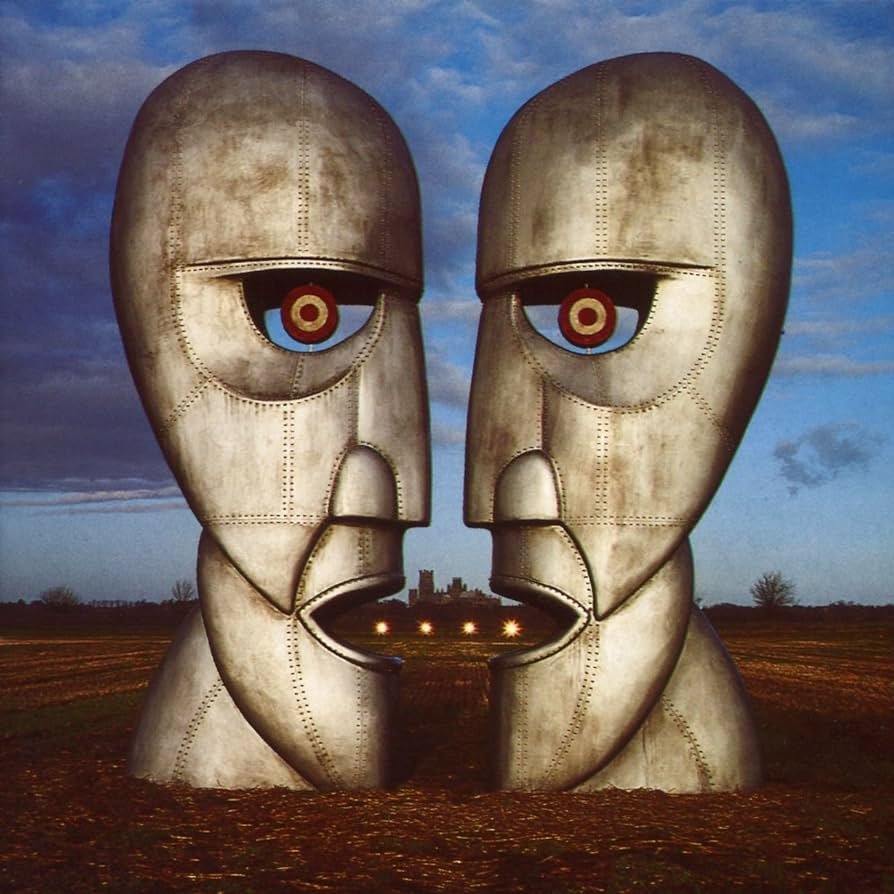
The cover artwork, designed by Storm Thorgerson and his collaborators, reinforced these concerns through two enormous sculpted faces positioned opposite one another in a landscape.
Viewed from the appropriate perspective, the separate sculptures combine to create the impression of a single face, suggesting both division and connection.
The image provides an effective visual expression of the album’s central ideas while continuing Pink Floyd’s tradition of ambitious, distinctive sleeve artwork.
More importantly, the title and imagery reflect the circumstances in which the music was created. Where A Momentary Lapse of Reason had been concerned with establishing Pink Floyd’s future, The Division Bell emerged from musicians who could approach that future with greater confidence, even while reflecting upon the divisions of their past.
The Sound of The Division Bell

David Gilmour’s Guitar: Expression Over Excess
David Gilmour’s guitar remains central to The Division Bell, but its relationship with the surrounding instruments is often more balanced than on the band’s previous studio album.
His playing retains its familiar characteristics: sustained notes, carefully controlled bends and melodic phrases that favour emotional expression over technical complexity. Yet the greater presence of Wright’s keyboards allows the guitar to operate within a broader musical conversation.
“Marooned” is perhaps the clearest example. Gilmour’s slow-moving melodies drift across the surrounding keyboards, with subtle changes in pitch and tone communicating a sense of isolation without the assistance of lyrics.
“High Hopes” demonstrates a different strength. Its closing lap-steel guitar solo extends the emotional character of the composition beyond the final vocal lines, providing a conclusion that feels inseparable from the song itself.
Elsewhere, Gilmour adopts a more forceful approach. “What Do You Want from Me” features blues-influenced playing that brings welcome energy to the album, while “Keep Talking” combines muscular guitar passages with an unusual use of the talk box.
However, his familiar techniques occasionally become predictable. Several compositions build towards extended solos, relying upon the guitar to provide an emotional climax that the preceding musical material does not always earn.
The performances themselves are rarely disappointing. The greater question is whether the songwriting consistently gives them something distinctive to express.
At its strongest, The Division Bell demonstrates how effective Gilmour’s playing can be when supported by equally compelling musical ideas. At its weakest, the guitar becomes the most memorable element of compositions that offer relatively little beyond another impressive solo.
Richard Wright’s Keyboards: Restoring a Familiar Identity
If Gilmour provides the album’s most recognisable musical voice, Richard Wright is arguably responsible for its most significant improvement over A Momentary Lapse of Reason.
His keyboards restore a harmonic sensitivity that had been less prominent on the previous record. Rather than simply filling the background with synthesiser textures, Wright frequently establishes a composition’s emotional character or introduces subtle movement beneath Gilmour’s guitar.
The opening instrumental “Cluster One” demonstrates this relationship particularly well. Delicate guitar phrases and restrained keyboard passages develop gradually, with neither musician dominating the arrangement.
On “Marooned”, Wright’s sustained textures create a spacious foundation for Gilmour’s expressive playing. The instruments complement one another without competing for attention, allowing the music to develop through changes in tone and atmosphere rather than conventional melodic progression.
“Wearing the Inside Out” offers another perspective on Wright’s importance. His return to a prominent lead-vocal role, his first on a Pink Floyd studio recording since The Dark Side of the Moon, introduces a quieter and more vulnerable musical character.
Supported by atmospheric keyboards and Dick Parry’s saxophone, the composition feels unusually intimate within an album frequently concerned with expansive arrangements.
These moments demonstrate that Wright’s contribution extends beyond individual instrumental parts. His understanding of harmony, restraint and musical space provides a counterbalance to Gilmour’s more expansive approach.
Not every keyboard passage is especially inventive, and some remain content to sustain familiar atmospheric textures. Nevertheless, Wright’s renewed presence gives The Division Bell a musical depth that its predecessor often struggled to achieve.
Nick Mason and the Rhythm Section
Nick Mason’s drumming contributes to the album’s greater sense of cohesion, particularly through his ability to support a composition without drawing unnecessary attention to himself.
His approach has rarely depended upon technical display. Instead, Mason’s playing provides a steady foundation that allows the surrounding instruments to establish their own momentum.
On “What Do You Want from Me”, the rhythm section supports the song’s blues-influenced arrangement, giving Gilmour’s guitar a firm foundation. “Keep Talking” adopts a more deliberate pulse, allowing its layered keyboards and vocal passages to develop without competing rhythmic elements.
Elsewhere, Mason’s restrained playing suits the album’s slower compositions, where subtle changes in dynamics are often more important than dramatic rhythmic shifts.
The recordings are not entirely free from the controlled production techniques associated with A Momentary Lapse of Reason. Additional percussion, programming and studio processing remain part of the overall sound.
Nevertheless, the greater prominence of Mason’s playing contributes to the impression of a working band rather than a collection of performances assembled around Gilmour.
Production: Spacious but Occasionally Too Comfortable
Produced by Gilmour and Bob Ezrin, The Division Bell retains the meticulous attention to sound that had characterised Pink Floyd’s recordings for decades.
The production is expansive, with instruments carefully positioned within arrangements that frequently move between intimate passages and enormous crescendos.
“Cluster One” and “Marooned” benefit particularly from this spacious approach. Individual instruments are given room to develop, allowing subtle changes in tone and volume to become important elements of the music.
“High Hopes” similarly demonstrates the production’s strengths. Its measured opening, prominent bell sounds and gradual instrumental expansion create a sense of scale without immediately overwhelming the song’s reflective character.
However, the polished presentation is not always an advantage.
At times, every instrument appears to occupy its expected position, with crescendos arriving precisely when anticipated. The sound is impressive, but its smoothness can reduce the sense of uncertainty that made Pink Floyd’s earlier experimentation so compelling.
Where albums such as Meddle and Wish You Were Here had expanded the band’s musical possibilities, The Division Bell is more concerned with refining an established approach.
That distinction does not diminish its emotional appeal. Much of the album’s pleasure comes from hearing familiar musical qualities performed with renewed confidence.
Nevertheless, its technical sophistication should not be mistaken for artistic innovation.
Themes and Lyrical Direction

Communication and the Distance Between People
Communication provides the central connection between the songs on The Division Bell, although the album does not follow a continuous narrative.
Throughout the record, relationships are shaped by misunderstandings, unspoken feelings and the difficulty of expressing what matters. Some compositions examine the consequences of emotional distance, while others consider whether damaged relationships can be repaired.
This gives the album a recognisable identity without imposing the elaborate conceptual framework associated with The Wall or The Final Cut.
The involvement of Polly Samson helped shape a more personal lyrical perspective. Where Roger Waters had frequently examined the political and social circumstances responsible for alienation, Gilmour and Samson generally concentrate upon the emotional consequences of separation itself.
“Keep Talking” addresses these concerns most explicitly.
The song explores the frustration of emotional isolation and the importance of maintaining communication, even when understanding seems difficult.
Its most distinctive element is the inclusion of Stephen Hawking’s synthesised voice, which introduces an unexpected perspective on the human need for connection.
The contrast between Hawking’s electronically generated speech and Gilmour’s natural vocal delivery gives the composition an unusual character, reinforced by the interaction between atmospheric keyboards and the guitar’s talk-box effects.
However, the lyrical message is less sophisticated than its presentation. The central argument is straightforward, offering encouragement rather than a particularly revealing examination of why communication breaks down.
Nevertheless, “Keep Talking” succeeds because its musical arrangement gives a familiar sentiment a distinctive identity.
Poles Apart: Estrangement and Unresolved Conflict
“Poles Apart” approaches the breakdown of relationships from a more confrontational perspective.
Rather than encouraging reconciliation directly, the song examines the distance that develops between individuals whose lives and ambitions have taken different directions.
Given Pink Floyd’s history, interpretations connecting its lyrics to former band members are understandable. Passages have frequently been associated with both Syd Barrett and Roger Waters, although reducing the entire composition to biographical references risks overlooking its broader emotional concerns.
At its centre is the unsettling experience of recognising how profoundly someone has changed, particularly when that transformation challenges memories of an earlier relationship.
The song’s shifting tone suggests affection, disappointment and resentment without resolving those emotions into a single judgement.
This gives “Poles Apart” a sharper emotional character than some of the album’s more general reflections. It also demonstrates that The Division Bell is not exclusively concerned with peaceful reconciliation.
Some divisions remain painful precisely because they cannot easily be repaired.
High Hopes: Nostalgia and Lost Possibilities
If communication provides the album’s central theme, “High Hopes” offers its most affecting exploration of memory and regret.
The song looks back upon youth as a period of possibility, when ambitions appeared limitless and the future remained largely undefined.
Rather than presenting nostalgia as uncomplicated happiness, the lyrics recognise the distance between remembered expectations and the realities of adulthood.
The past appears brighter partly because it can no longer be recovered. Experiences once taken for granted acquire greater significance through their absence, while the passage of time transforms ordinary memories into symbols of lost possibility.
This perspective gives “High Hopes” an emotional depth that distinguishes it from much of the surrounding material.
The song also invites reflection upon Pink Floyd’s own history. By 1994, the band had experienced extraordinary success, creative disagreements and the loss of relationships that had once defined its identity.
Although the lyrics need not be interpreted as a direct account of those events, their concern with unrealised possibilities gives them an obvious resonance.
What makes “High Hopes” particularly effective is its refusal to offer an easy resolution.
The past cannot be restored, and the possibilities associated with youth cannot simply be recovered through determination or optimism. Instead, the song acknowledges the complicated relationship between achievement and regret, suggesting that even a successful life may be accompanied by an awareness of what has been lost.
This emotional ambiguity is one of the album’s greatest lyrical strengths.
Isolation, Freedom and Reconciliation
Other compositions explore the consequences of division through contrasting perspectives.
“Wearing the Inside Out”, written by Richard Wright and Anthony Moore, examines emotional withdrawal and the difficulty of reconnecting with the outside world.
Its understated language suits Wright’s restrained vocal delivery, presenting isolation as something that can become familiar even when the desire for connection remains.
“A Great Day for Freedom” broadens the album’s concerns beyond personal relationships, drawing upon the political transformations associated with the fall of the Berlin Wall.
The song contrasts the optimism surrounding liberation with the uncertainty and disappointment that followed, questioning whether the removal of physical barriers necessarily produces greater understanding.
Its subject is compelling, although the writing remains relatively general, relying upon familiar observations about hope and disillusionment rather than examining the historical circumstances in greater depth.
“Coming Back to Life” adopts a more optimistic perspective, exploring emotional renewal and the possibility of moving beyond painful experiences. “Lost for Words”, by contrast, examines the frustration of attempting reconciliation when hostility remains unresolved.
Together, these songs suggest that communication is important but not always sufficient to repair a damaged relationship.
That is a more interesting idea than the album’s occasional reliance upon straightforward messages about compassion and understanding might initially suggest.
The lyrical quality remains uneven, with some compositions relying upon broad sentiments that lack the specificity of Pink Floyd’s strongest writing. Nevertheless, The Division Bell establishes a coherent emotional identity, allowing familiar human experiences to become the foundation of a more reflective album.
Standout Tracks and Musical Highlights
High Hopes: A Remarkable Closing Statement
If one composition captures the emotional and musical ambition of The Division Bell, it is “High Hopes”.
As the album’s closing track, it provides a sense of resolution that much of the preceding material deliberately avoids. Its measured progression, evocative atmosphere and extraordinary closing guitar passage combine to create one of Pink Floyd’s finest recordings of their later career.
The opening establishes a reflective mood through prominent bell sounds and a restrained piano melody. Rather than immediately introducing a full arrangement, the composition allows these elements to create a sense of space before Gilmour’s vocal enters.
As the song develops, additional instruments gradually expand its musical character. The rhythm section remains measured, while keyboards and orchestral textures contribute to an increasingly substantial arrangement without overwhelming the central melody.
This progression is particularly effective because each instrumental addition feels connected to the atmosphere established at the beginning.
Gilmour’s vocal performance is among his most affecting. His restrained delivery suits the song’s reflective character, communicating melancholy without excessive theatricality.
However, it is the closing lap-steel guitar solo that transforms “High Hopes” into something exceptional.
The sustained notes and expressive bends extend the emotional meaning of the composition beyond its lyrics. Gilmour allows individual phrases to unfold slowly, creating a sense of longing that becomes increasingly powerful as the arrangement develops.
Unlike some of the album’s other extended solos, this passage feels essential rather than ornamental. The music has been moving towards this conclusion from the beginning, and the guitar provides a release that words alone could not achieve.
There is also a remarkable sense of finality to the performance. Although Pink Floyd would subsequently release further material, “High Hopes” has acquired the character of a farewell, reflecting upon the passage of time while allowing the music itself to suggest what cannot be recovered.
It is a composition that demonstrates Gilmour’s greatest strengths as both a guitarist and a musical arranger.
More importantly, it proves that Pink Floyd could still produce work of considerable emotional depth without depending upon the confrontational conceptual approach of their earlier albums.
“High Hopes” is not merely the strongest song on The Division Bell. It deserves recognition among the band’s most accomplished later recordings.
Marooned: Emotion Without Words
“Marooned” provides perhaps the clearest demonstration of the renewed musical relationship between David Gilmour and Richard Wright.
An entirely instrumental composition, it develops through expressive guitar passages supported by spacious keyboards and a restrained rhythmic foundation.
The opening establishes an atmosphere of isolation, with Wright’s sustained textures creating a sense of distance before Gilmour’s guitar gradually emerges.
Rather than developing through conventional verses or choruses, the composition relies upon changes in tone, phrasing and instrumental intensity.
Gilmour’s playing is particularly impressive. His use of sustained notes and controlled bends gives the guitar an almost vocal quality, allowing individual phrases to suggest uncertainty, melancholy and longing without the assistance of lyrics.
Wright’s contribution is equally important. His keyboards subtly alter the harmonic character of the music as Gilmour’s playing becomes increasingly expressive, while Mason’s restrained drumming supports its gradual development.
This interplay gives “Marooned” a naturalness that had frequently been missing from A Momentary Lapse of Reason.
The musicians appear comfortable allowing the music to unfold at its own pace, resisting the temptation to fill every moment with elaborate instrumentation.
However, the composition’s emphasis on atmosphere also limits its structural development. Listeners expecting the ambition of earlier Pink Floyd instrumentals may find it somewhat static.
Nevertheless, the emotional clarity of Gilmour’s performance gives the piece a compelling identity.
Its achievement was recognised when “Marooned” won the Grammy Award for Best Rock Instrumental Performance at the 1995 ceremony.
Few compositions on The Division Bell capture the relationship between technical control and emotional expression quite so effectively.
Keep Talking: A Distinctive Musical Identity
“Keep Talking” is one of the album’s most immediately recognisable songs, largely because of its unusual incorporation of Stephen Hawking’s synthesised voice.
Musically, it combines a steady rhythmic foundation with layered keyboards, restrained vocal passages and expressive guitar playing, creating an arrangement that balances accessibility with Pink Floyd’s established atmospheric character.
Hawking’s electronically generated speech emerges against a spacious instrumental background, establishing a distinctive identity before Gilmour’s vocal enters.
The contrast between the synthetic quality of the spoken voice and the warmth of the surrounding instrumentation gives the composition an unusual character.
As the song develops, its arrangement becomes more substantial. Mason’s deliberate drumming provides momentum, while Wright’s keyboards maintain a sense of space beneath the increasingly prominent guitar.
Gilmour’s use of the talk box introduces another distinctive element, allowing his guitar to produce speech-like sounds that complement Hawking’s contribution.
This interaction between human expression and electronically altered sound is one of the composition’s most successful musical ideas.
Nevertheless, “Keep Talking” is not without weaknesses. Its central melodic material is relatively straightforward, and the arrangement occasionally relies upon familiar Pink Floyd techniques rather than introducing particularly adventurous developments.
Some instrumental passages also extend the composition without substantially expanding its musical ideas.
Despite these limitations, the recording remains effective because its various elements contribute to a recognisable identity.
It is not among Pink Floyd’s most ambitious compositions, but it demonstrates how familiar techniques can still produce compelling results when used with a clear sense of purpose.
Wearing the Inside Out: Richard Wright’s Quiet Triumph
“Wearing the Inside Out” occupies a distinctive position on The Division Bell, offering a more intimate musical perspective than many of the surrounding compositions.
Wright’s lead vocal immediately sets it apart. His understated delivery lacks the commanding presence of Gilmour’s singing, but that restraint becomes one of the song’s greatest strengths.
Soft keyboards, measured percussion and atmospheric guitar provide a spacious foundation, while Dick Parry’s saxophone contributes a warm, melancholy quality that complements Wright’s reflective performance.
Rather than building towards an enormous instrumental climax, the composition develops through subtle changes in texture and intensity.
This gives the music an unusually personal character. Wright’s voice remains central, with the surrounding instruments supporting rather than overwhelming its emotional vulnerability.
Gilmour’s guitar contributes melodic passages that are expressive without becoming unnecessarily prominent, demonstrating the value of allowing the composition’s quieter elements to determine its direction.
The result recalls Pink Floyd’s ability to create an atmosphere through restraint rather than sheer scale.
Admittedly, the song’s unhurried pace and subdued melody may limit its immediate appeal. Some passages remain understated to the point of feeling slightly prolonged.
Nevertheless, these limitations are relatively minor when considered alongside the quality of Wright’s performance.
“Wearing the Inside Out” demonstrates that his renewed involvement was not simply a matter of restoring familiar keyboard sounds. He offered a contrasting musical personality capable of creating moments that Gilmour’s more expansive approach might never have produced.
It is one of the album’s most quietly rewarding compositions.
Coming Back to Life: Gilmour at His Most Expressive
“Coming Back to Life” is built around one of David Gilmour’s greatest strengths: his ability to transform a relatively simple composition through expressive guitar playing.
The song begins with an extended instrumental introduction, allowing sustained guitar notes to emerge gradually from a restrained keyboard background.
Gilmour’s phrasing is patient, with individual notes lingering rather than relying upon technical complexity. As the rhythm section and vocal melody enter, the arrangement becomes warmer and more confident, reflecting the composition’s movement towards emotional renewal.
The central melody is accessible, while the rhythm section provides a steady foundation that allows the guitar to remain the principal expressive element.
However, “Coming Back to Life” also illustrates one of the album’s recurring limitations.
Its musical development follows a relatively predictable pattern, moving from a restrained opening towards increasingly prominent guitar passages without introducing many unexpected ideas.
The composition is enjoyable, but much of its appeal depends upon Gilmour’s performance rather than particularly distinctive songwriting.
There are moments when the polished arrangement approaches conventional mainstream rock, lacking the unpredictability associated with Pink Floyd’s most adventurous work.
Nevertheless, the quality of the guitar playing remains difficult to dismiss.
Gilmour gives the song a sincerity that prevents its straightforward structure from becoming entirely ordinary.
Poles Apart: Ambition and Uneven Development
“Poles Apart” is one of the album’s more ambitious compositions, combining an intimate opening with contrasting instrumental passages and changes in musical atmosphere.
The song begins with acoustic guitar and a restrained vocal melody, creating a reflective setting that differs from the expansive arrangements surrounding it.
As the composition develops, however, its structure becomes less conventional.
A darker instrumental passage introduces theatrical effects and an unsettled atmosphere, interrupting the song’s initial direction before the music returns to a more recognisable melodic framework.
This contrast recalls Pink Floyd’s longstanding interest in incorporating unusual sounds and dramatic shifts within extended compositions.
Yet the transition is not entirely convincing.
The central instrumental section creates an interesting atmosphere, but it feels somewhat detached from the surrounding material, as though two different musical ideas have been combined without fully establishing their relationship.
The closing guitar passages are expressive, although they also follow the familiar pattern of allowing Gilmour’s playing to provide the composition’s principal emotional release.
Despite these structural weaknesses, “Poles Apart” remains one of the album’s more interesting tracks.
Its willingness to move beyond a straightforward song arrangement provides welcome variety, even if the results are not entirely successful.
The Remaining Compositions
Beyond its principal highlights, The Division Bell contains several compositions that contribute to the album’s character without consistently matching the quality of its strongest material.
“Cluster One” provides an effective introduction, establishing a spacious atmosphere through the interaction between Wright’s keyboards and Gilmour’s guitar. Its restrained development is appealing, although it functions more convincingly as an opening statement than as a substantial instrumental work in its own right.
“What Do You Want from Me” introduces welcome energy through its blues-influenced arrangement and forceful guitar playing. The song is immediate and enjoyable, but its conventional structure offers relatively little that feels distinctive within Pink Floyd’s wider catalogue.
“A Great Day for Freedom” develops from a restrained piano-led arrangement towards an expressive guitar conclusion. However, its familiar melodic progression and polished production occasionally make the emotional intensity feel more carefully constructed than naturally earned.
“Take It Back” is among the album’s most accessible compositions, combining bright guitar textures with a strong rhythmic pulse and memorable chorus. Its directness provides useful contrast, although its polished sound moves closer to mainstream rock than the band’s more adventurous material.
“Lost for Words” offers a gentler acoustic arrangement, with Gilmour’s restrained vocal and melodic guitar providing an appealing sense of intimacy. The song is pleasant, but its relatively straightforward development makes it less memorable than the album’s finest moments.
None of these compositions is without merit. Each contributes something to the record’s musical variety, whether through rhythmic energy, melodic accessibility or atmospheric restraint.
The difficulty is that several rely upon established musical techniques without developing them into particularly distinctive statements.
As a result, the album’s considerable length occasionally becomes noticeable, particularly when polished but relatively conventional songs separate its more compelling achievements.
Where The Division Bell Falls Short
Familiar Sounds, Fewer Surprises
One of the principal weaknesses of The Division Bell is its reluctance to move beyond the musical identity Pink Floyd had already established.
By 1994, the band possessed an immediately recognisable collection of musical characteristics: spacious keyboard arrangements, unhurried rhythms, atmospheric effects and Gilmour’s expressive guitar playing.
These qualities had contributed to some of rock music’s most remarkable recordings, and their continued presence was undoubtedly welcome. However, familiarity becomes a limitation when it begins to replace invention.
Throughout the album, compositions frequently develop through established patterns. Restrained openings expand into elaborate arrangements, with extended guitar passages providing the emotional climax.
The approach remains effective on “High Hopes”, where the musical progression feels inseparable from the composition’s emotional character. Elsewhere, the same techniques produce less convincing results.
Some tracks recreate the atmosphere of earlier Pink Floyd recordings without introducing musical ideas strong enough to distinguish them.
This does not mean the band needed to abandon its established sound or pursue experimentation for its own sake. Musical maturity can be expressed through refinement as effectively as reinvention.
The difficulty is that Pink Floyd’s greatest achievements had often emerged from an unwillingness to settle for familiar solutions. The Division Bell rarely demonstrates that same creative restlessness.
An Album That Occasionally Outstays Its Welcome
At approximately 66 minutes, The Division Bell is a substantial listening experience, and its length occasionally works against its strengths.
The album’s unhurried character is often appealing. Compositions such as “Marooned” and “High Hopes” benefit from the space afforded to their instrumental passages, allowing subtle changes in tone and dynamics to become important elements of the music.
However, not every track justifies a similarly expansive approach.
Several compositions develop at a leisurely pace without introducing sufficient melodic or structural variation. The arrangements remain pleasant, but their progression can feel more prolonged than purposeful.
This becomes particularly noticeable when the album is heard in its entirety. The succession of restrained introductions, polished instrumental passages and extended guitar conclusions occasionally creates a sense of repetition.
The problem is not simply that the album contains slow music. Pink Floyd had repeatedly demonstrated that extended compositions could be compelling when supported by strong musical development.
Rather, The Division Bell sometimes confuses allowing a composition room to breathe with giving it more time than its ideas require.
A more selective approach might have produced a tighter and more consistently engaging album without sacrificing its reflective character.
A Stronger Band, but Not Quite a Creative Renaissance
Perhaps the album’s most revealing limitation is that its renewed sense of collaboration does not consistently translate into equally adventurous songwriting.
Wright’s greater involvement undoubtedly strengthens the music, while Mason’s drumming and Gilmour’s guitar performances contribute to a more convincing collective identity.
Yet the presence of these familiar musical personalities does not automatically recreate the creative circumstances responsible for Pink Floyd’s finest work.
During the band’s most celebrated period, contrasting approaches had frequently pushed compositions into unexpected territory. Musical disagreements could be destructive, but the tension between different creative instincts also contributed to the group’s distinctive identity.
By 1994, Pink Floyd had become a more settled musical partnership.
That stability allowed the musicians to work with greater confidence, producing an album that feels considerably more cohesive than its predecessor. However, the resulting music is often more comfortable than challenging.
The distinction prevents The Division Bell from reaching the heights of Pink Floyd’s greatest achievements.
It is a convincing demonstration that Gilmour, Wright and Mason could still make compelling music together, but not quite the creative renaissance that its finest moments occasionally suggest.
Legacy and Lasting Significance

Commercial Success and the 1994 Tour
When The Division Bell arrived in March 1994, the musical landscape was considerably different from the one Pink Floyd had helped shape during the 1970s.
Alternative rock, grunge and emerging electronic styles had transformed popular music, while many progressive rock groups associated with the previous generation had experienced declining commercial fortunes.
Pink Floyd, however, remained an extraordinary exception.
The Division Bell reached number one in both the UK and the United States, demonstrating that the band’s audience remained substantial more than two decades after its commercial breakthrough.
Its success reflected both the appeal of the new material and the enduring cultural significance of the group. Pink Floyd had accumulated an exceptionally devoted international following, and their reputation ensured considerable interest in any new release.
The album was accompanied by an enormous tour, beginning in Miami on 30 March 1994 before continuing across North America and Europe.
Gilmour, Wright and Mason were supported by an expanded touring ensemble, including bassist Guy Pratt, guitarist Tim Renwick, keyboardist Jon Carin and saxophonist Dick Parry.
The production was characteristically ambitious. Elaborate lighting, projections, lasers and theatrical effects transformed the concerts into immersive visual spectacles, continuing a tradition that had become central to Pink Floyd’s live identity.
Songs from The Division Bell, including “High Hopes”, “Keep Talking” and “What Do You Want from Me”, appeared alongside established favourites.
Selected concerts also featured complete performances of The Dark Side of the Moon, reinforcing the connection between the band’s contemporary identity and its most celebrated period.
Yet this emphasis on the past was revealing.
Although The Division Bell provided the occasion for the tour, Pink Floyd’s live appeal remained closely connected to recordings made decades earlier. Their ability to perform those compositions on an enormous scale was impressive, but it also highlighted the difficulty of escaping the expectations created by their own history.
Nevertheless, the tour confirmed that Pink Floyd remained one of rock music’s most formidable live attractions.
It would also prove to be their final full-scale concert tour.
Pulse: Capturing Pink Floyd’s Final Major Tour
The 1994 concerts were subsequently documented through P·U·L·S·E, released in 1995 as a live album, with concert footage also issued on video.
The recordings captured performances from the European leg of the tour, combining material from The Division Bell with selections from the band’s extensive catalogue.
A complete performance of The Dark Side of the Moon formed one of the album’s principal attractions.
For listeners who had followed Pink Floyd’s uncertain development after Waters’ departure, P·U·L·S·E demonstrated how confidently the remaining musicians had established their live identity.
The performances were carefully arranged, with the expanded touring ensemble providing the resources required to reproduce the band’s elaborate studio recordings.
The newer material also benefited from the concert setting. “High Hopes” retained its reflective atmosphere while allowing Gilmour’s closing guitar passage to become an even more substantial emotional statement.
“Keep Talking” similarly translated its layered studio arrangement into an effective live performance.
However, P·U·L·S·E also demonstrated the extent to which Pink Floyd had become an institution built around its established musical legacy.
The concerts celebrated the band’s history as much as its contemporary achievements, presenting familiar compositions through an increasingly sophisticated combination of music and visual spectacle.
This was not necessarily a weakness. Pink Floyd’s extensive catalogue deserved to be heard, and the performances frequently demonstrated the enduring quality of the material.
Nevertheless, P·U·L·S·E remains particularly important as a document of the band’s final major touring period, capturing a group that had achieved remarkable confidence and technical sophistication.
The Final Studio Album of a Working Pink Floyd
Although few listeners could have known it in 1994, The Division Bell would become Pink Floyd’s final studio album of entirely new material developed by the Gilmour, Wright and Mason lineup.
Following the tour, the musicians pursued other activities rather than immediately beginning another Pink Floyd recording project.
The band would reunite with Roger Waters for a brief performance at Live 8 in 2005, but this did not lead to a renewed studio partnership.
Wright’s death in 2008 made any further reunion of the group’s classic 1970s lineup impossible.
In 2014, Pink Floyd released The Endless River, an album developed largely from instrumental recordings originating during the Division Bell sessions.
Completed by Gilmour and Mason with additional recording and production, the project served partly as a tribute to Wright and the musical relationship that had shaped the band’s later years.
Although The Endless River became Pink Floyd’s final studio album, its origins distinguish it from The Division Bell.
Rather than emerging from an entirely new period of collective songwriting, it revisited material created during the sessions that had produced the 1994 record.
This gives The Division Bell particular historical importance.
It represents the final occasion on which Gilmour, Wright and Mason developed a substantial collection of new Pink Floyd compositions as an active recording partnership.
That context inevitably influences how the album is heard today.
“High Hopes”, in particular, has acquired an almost valedictory character, its reflections upon lost possibilities providing an unexpectedly fitting conclusion to Pink Floyd’s final album of newly developed songs from that lineup.
However, The Division Bell was not originally conceived as a deliberate farewell. Its retrospective emotional weight emerges partly from events that followed its release.
The album deserves to be assessed first as a musical achievement rather than simply as the closing chapter of a remarkable career.
Reconsidering the Album’s Place in Pink Floyd’s History
More than three decades after its release, The Division Bell occupies a distinctive position within Pink Floyd’s catalogue.
It is neither a radical reinvention nor a straightforward continuation of the band’s most celebrated period.
Instead, it represents a mature group rediscovering elements of its musical identity after years of internal conflict and uncertainty.
Its importance is particularly apparent when compared with A Momentary Lapse of Reason. Where the earlier album often relied upon elaborate production to recreate Pink Floyd’s familiar sound, The Division Bell places greater emphasis on the interaction between Gilmour, Wright and Mason.
That renewed collaboration gives the music a warmth and naturalness that distinguishes it from its predecessor.
The album also contains several compositions worthy of the band’s wider legacy. “High Hopes” stands among Pink Floyd’s finest later recordings, while “Marooned” and “Wearing the Inside Out” demonstrate the expressive possibilities of the musicians’ contrasting approaches.
Nevertheless, its achievements remain qualified by familiar weaknesses.
The album rarely challenges Pink Floyd’s established musical vocabulary, and some compositions depend too heavily upon atmosphere, polished arrangements and extended guitar passages.
Its reflective character is often appealing, but the absence of sustained experimentation prevents it from matching the creative ambition of the band’s greatest recordings.
Perhaps that is the most appropriate way to understand The Division Bell.
It does not attempt to redefine Pink Floyd in the manner of The Dark Side of the Moon or Wish You Were Here. Instead, it demonstrates that the musicians could still create affecting music through the qualities they had spent decades developing.
For listeners seeking the unpredictable experimentation of the band’s earlier years, it may feel overly comfortable.
For those who value Gilmour’s expressive guitar playing, Wright’s atmospheric keyboards and the patient development of Pink Floyd’s later compositions, it offers considerable rewards.
Its legacy therefore rests upon something more substantial than commercial success or historical finality.
The Division Bell captures a band that had rediscovered much of its musical confidence, producing an album that was not consistently groundbreaking but was frequently moving, carefully crafted and unmistakably its own.
Final Verdict: A More Convincing Pink Floyd, but Not Quite a Masterpiece

The Division Bell represents a significant improvement over A Momentary Lapse of Reason, capturing a band that had rediscovered much of the musical chemistry missing from its uncertain return seven years earlier.
With Richard Wright assuming a more substantial creative role alongside David Gilmour and Nick Mason, the album feels less like an attempt to reconstruct Pink Floyd’s familiar sound and more like a genuine collaboration between musicians who understand one another’s strengths.
That renewed partnership produces some remarkable results.
“High Hopes” stands among the finest compositions of Pink Floyd’s later career, combining reflective songwriting with an extraordinary closing guitar performance. “Marooned” demonstrates the emotional possibilities of Gilmour and Wright’s instrumental interplay, while “Wearing the Inside Out” offers a quieter, more vulnerable perspective that enriches the album’s character.
Elsewhere, “Keep Talking” and “Coming Back to Life” provide memorable moments, even if their musical foundations are less adventurous.
The album also benefits from a more consistent lyrical identity. Its exploration of communication, emotional distance and reconciliation gives the songs a meaningful connection without imposing the elaborate conceptual structures associated with Roger Waters’ final years in the band.
However, The Division Bell is not without shortcomings.
At approximately 66 minutes, the album occasionally feels longer than its material requires. Several compositions develop through familiar arrangements without introducing sufficiently distinctive ideas, while the polished production can make the music feel overly comfortable.
There is a noticeable difference between rediscovering Pink Floyd’s established musical identity and expanding its creative possibilities.
Where the band’s greatest recordings frequently challenged expectations, The Division Bell is more concerned with refining an approach that had already been developed decades earlier.
Nevertheless, that familiarity does not diminish the genuine emotional power of its strongest moments.
Gilmour’s guitar playing remains exceptional, Wright’s renewed presence restores an essential dimension to the band’s sound, and Mason’s restrained drumming contributes to a more natural sense of musical interaction.
Together, they create an album that may lack the sustained invention of Pink Floyd’s finest work but possesses a warmth, maturity and cohesion that its predecessor struggled to achieve.
The Division Bell is not a groundbreaking reinvention or an unquestionable masterpiece. It is something more modest, but still deeply rewarding: a confident, occasionally beautiful record from musicians who had rediscovered the value of making music together.
For a band whose previous decade had been defined by division, that achievement carries considerable significance.
Official Tune Tempest Rating: 8/10