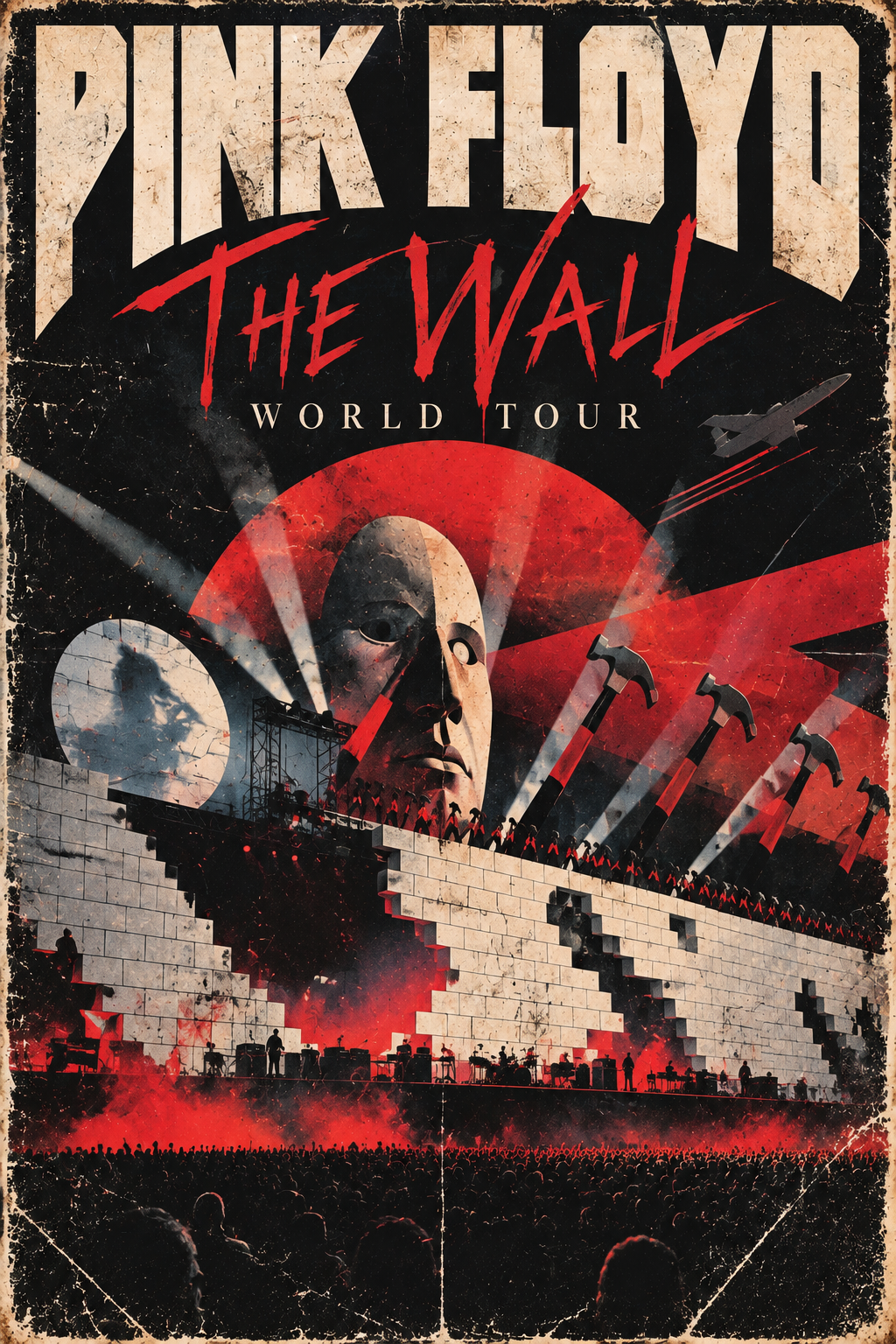
In February 1980, Pink Floyd unveiled a concert in which the stage gradually disappeared behind an enormous wall. As the musicians performed their acclaimed double album The Wall, a team of stagehands assembled hundreds of white bricks, slowly separating the band from the audience. By the end of the first half, the barrier was complete.
What followed was unlike a conventional rock performance. Gerald Scarfe’s grotesque animations filled the wall, enormous inflatable characters emerged above the stage, and carefully positioned sound effects surrounded the audience. Eventually, the structure itself came crashing down.
The production was a remarkable feat of theatrical engineering, but its ambition came at a considerable cost. Staged in just four cities between 1980 and 1981, the original concerts demanded enormous resources at a time when relationships within Pink Floyd were becoming increasingly strained.
How did a concept born from Roger Waters’ frustration with stadium audiences become one of rock’s most elaborate live productions?
From Alienation to The Wall

The origins of The Wall can be traced to Pink Floyd’s 1977 In the Flesh tour, when the band were enjoying enormous commercial success but Roger Waters was becoming increasingly uncomfortable with performing in large stadiums.
Following The Dark Side of the Moon and Wish You Were Here, Pink Floyd had moved far beyond the smaller venues where they developed their reputation. Their audiences had grown considerably, but Waters felt that the intimacy between musicians and listeners was disappearing.
His frustration reached a breaking point during the tour’s final concert at Montreal’s Olympic Stadium on 6 July 1977.
The Incident That Inspired The Wall
During the performance, Waters became irritated by a disruptive spectator near the stage. He eventually beckoned the fan towards him and spat in his face.
The incident disturbed Waters, prompting him to question how he had developed such hostility towards someone who had come to see the band perform.
It also crystallised an idea: what if he could build a wall between himself and the audience?
That image gradually evolved into the story of Pink, a fictional rock star whose emotional isolation develops through a succession of traumatic experiences.
The death of his father during the Second World War, an oppressive education, a troubled marriage and the pressures of fame all contribute to the psychological barriers he constructs around himself.
The narrative drew heavily on Waters’ life, particularly the death of his father, Eric Fletcher Waters, at Anzio in 1944. Elements of Pink’s character also reflected former Pink Floyd frontman Syd Barrett, whose psychological difficulties and departure from the band had left a lasting impression.
Released in November 1979, The Wall explored grief, isolation, authoritarianism and the destructive consequences of emotional withdrawal.
However, Waters had always envisioned something beyond a studio album.
He wanted the wall to become a physical part of the accompanying concerts, with a real structure gradually constructed between the musicians and their audience.
The idea challenged one of the fundamental expectations of a rock concert: that audiences should be able to see and connect with the performers.
Instead, Pink Floyd would deliberately obstruct that connection.
Turning the metaphor into reality required a production unlike anything the band had previously attempted.
Building an Impossible Concert
To realise Waters’ vision, Pink Floyd worked with stage designers Mark Fisher and Jonathan Park, who faced the extraordinary challenge of constructing a wall during a live performance.
The structure needed to rise in time with the music, conceal the musicians, accommodate projections and theatrical effects, and eventually collapse without endangering the performers or audience.
The design demanded careful coordination between the band’s musical arrangements and an extensive technical crew.
Constructing the Wall
According to Pink Floyd’s official historical archive, the production used 450 foldable cardboard bricks to create a wall approximately 33 feet high and 260 feet wide.
Throughout the first half, stagehands dressed as construction workers carried the lightweight blocks into position, gradually filling the space between the performers and spectators.
The construction followed Pink’s increasing psychological withdrawal. As his emotional barriers grew, so did the physical structure separating the band from the audience.
During “Goodbye Cruel World”, the final opening was closed, leaving the musicians concealed behind the completed wall.
For spectators accustomed to watching a band perform, the effect was deliberately disorientating. The musicians they had paid to see were now largely invisible.
The structure also presented practical challenges. It had to remain stable while supporting the demands of the show’s projections, lighting and carefully timed appearances by performers.
Once completed, the wall became the central visual surface for the second half of the concert.
Bringing the Wall Down
The most dramatic engineering challenge came at the performance’s conclusion.
During “The Trial”, Pink’s psychological struggle reached its climax as the characters responsible for his emotional isolation appeared in a grotesque courtroom sequence.
The verdict demanded that the wall be torn down.
At the musical climax, the enormous structure collapsed towards the stage in a controlled sequence, sending its lightweight bricks tumbling into a heap of debris.
The destruction was carefully choreographed, requiring precise timing and extensive preparation.
It was an extraordinary piece of theatrical engineering, but its effectiveness came from the simplicity of the underlying idea. The barrier that had been constructed throughout the performance was finally destroyed.
The Spectacle Behind the Wall
Although the wall provided the show’s central image, its theatrical world owed much to British cartoonist and illustrator Gerald Scarfe.
Scarfe had developed the distinctive artwork associated with The Wall, creating grotesque characters that represented the fears, memories and relationships shaping Pink’s psychological decline.
For the concerts, his designs became enormous inflatable figures and animated sequences, transforming the stage into a disturbing visual representation of the album’s narrative.
Gerald Scarfe’s Nightmarish Characters
Among the production’s most memorable features were the giant inflatable puppets representing figures from Pink’s troubled life.
The Schoolmaster appeared as a grotesque symbol of oppressive authority, while the Mother embodied the suffocating influence of overprotection. The Wife was depicted through equally unsettling imagery, reflecting Pink’s increasingly distorted view of his relationships.
Scarfe deliberately exaggerated their proportions and expressions, turning familiar figures into monstrous caricatures.
The effect was both theatrical and psychological. Rather than portraying Pink’s experiences realistically, the characters represented how those experiences had become distorted within his mind.
Towering above the musicians, the inflatables also gave the production a scale rarely associated with traditional stage drama.
The Marching Hammers and Animated Projections
Once the wall was complete, it became a vast screen for Scarfe’s animations.
Among the most recognisable were the marching hammers, whose rigid formations and mechanical movements represented authoritarianism, conformity and the suppression of individuality.
Their appearance during “Waiting for the Worms” accompanied Pink’s descent into a violent authoritarian fantasy.
Other animated sequences explored war, oppressive education, consumerism and the breakdown of personal relationships.
During “The Trial”, Scarfe’s imagery brought together several of the album’s central characters in a surreal courtroom drama. The animation provided a visual expression of Pink’s internal struggle as the story approached its conclusion.
These sequences were particularly effective because they communicated aspects of the narrative that could not easily be conveyed through a conventional band performance.
Sound, Lighting and Special Effects
The concerts also made extensive use of the surround-sound techniques Pink Floyd had explored throughout the 1970s.
Voices, aircraft noises and other effects appeared to move around the auditorium, extending the performance beyond the physical stage.
Lighting played an equally important role, isolating performers in dramatic pools of light or transforming the wall into a surface for projections.
One of the opening sequence’s most spectacular moments involved a replica Stuka dive bomber travelling towards the stage, accompanied by explosive effects.
The aircraft evoked the violence of war, a recurring influence on Pink’s emotional development and a deeply personal subject for Waters.
Rather than existing as unrelated displays of technical extravagance, these elements reinforced the atmosphere and narrative of the performance.
The result was a concert in which the stage itself became an extension of the music.
The Music Behind the Spectacle
Reproducing The Wall live was an ambitious musical undertaking in its own right.
Unlike Pink Floyd’s earlier concerts, which frequently included extended improvisation and evolving arrangements, this production required a carefully structured performance. The music had to remain coordinated with the wall’s construction, animations, lighting and other theatrical effects.
Although the concerts largely followed the studio album’s running order, several compositions were expanded and additional material was included.
These changes made the live production a distinctive interpretation of The Wall, rather than a straightforward recreation of the recording.
Comfortably Numb: Above the Wall
Perhaps the show’s most celebrated musical moment came during “Comfortably Numb”.
With the wall fully constructed, Roger Waters delivered the song’s verses from below, while David Gilmour appeared high above the structure for the choruses.
Illuminated against the darkness, Gilmour seemed almost detached from the theatrical world unfolding beneath him.
His elevated position created a striking contrast with Waters, while the song’s soaring melodies provided a moment of emotional release.
The concluding guitar solo was particularly memorable. Extended beyond the studio recording, Gilmour’s performance became one of the defining musical moments of the entire production.
The staging was spectacular, but it was the combination of his playing, the composition and the visual contrast that made the sequence so effective.
What Shall We Do Now? and the Expanded Arrangements
One of the most interesting differences between the album and the concerts was the inclusion of “What Shall We Do Now?”
Originally intended for The Wall, the composition was omitted from the finished studio recording because of the limitations of the vinyl format, although its lyrics remained on the original sleeve.
Restored for the live performances, the song followed “Empty Spaces” and developed the album’s examination of consumerism, material possessions and attempts to fill emotional emptiness.
It was accompanied by a striking animated sequence from Scarfe in which consumer objects accumulated and transformed into increasingly grotesque imagery.
Other compositions also changed in performance.
“Another Brick in the Wall, Part 2” featured an extended instrumental passage, giving Gilmour additional space for his guitar work, while “Run Like Hell” became a particularly forceful part of the show’s second half.
Another significant addition was “The Last Few Bricks”, an instrumental sequence drawing on musical ideas from elsewhere in the album.
Its purpose was partly practical: the passage provided time for the stage crew to complete the wall before “Goodbye Cruel World”.
Yet it also demonstrated how the production’s technical demands could shape the music itself.
The Musicians Behind the Production
Although Waters was the principal creative force behind The Wall, the concerts depended on the contributions of the entire band.
His performances carried much of the narrative, shifting between vulnerability, bitterness and the aggressive persona Pink adopts during the story’s darker passages.
Gilmour’s vocals and guitar provided an important contrast, particularly on “Mother”, “Young Lust”, “Run Like Hell” and “Comfortably Numb”.
Nick Mason’s drumming anchored the elaborate arrangements, while Richard Wright’s keyboards supplied the atmospheric textures essential to Pink Floyd’s sound.
However, Wright’s participation came under unusual circumstances.
Following serious disagreements during the recording of The Wall, he had been dismissed from the band and returned for the concerts as a salaried musician.
The production also employed an additional group of performers known as the Surrogate Band.
Its musicians included bassist Andy Bown, guitarist Snowy White, keyboardist Peter Wood and drummer Willie Wilson, alongside backing vocalists. Andy Roberts replaced White for the 1981 concerts.
The surrogate musicians appeared at the beginning of the show, initially presenting themselves as Pink Floyd before the actual band emerged.
This deception reinforced the production’s preoccupation with the identity of the performer and the relationship between musicians and their audience.
It was another example of Waters using the conventions of a rock concert to question the nature of the experience itself.
The Original 1980–81 Concerts: Ambition at a Cost
Despite the commercial success of The Wall, the accompanying concerts were remarkably limited.
Between February 1980 and June 1981, Pink Floyd staged 31 performances across four cities: Los Angeles, Uniondale in New York, London and Dortmund.
The enormous production was too expensive and technically demanding for a conventional touring schedule. Each engagement required extensive preparation, specialised equipment and a large crew.
As a result, the concerts became rare opportunities to experience a production that could not easily be transported from venue to venue.
Four Cities, 31 Performances
The first concert took place at the Los Angeles Memorial Sports Arena on 7 February 1980.
The opening night immediately demonstrated the practical risks involved in such an elaborate production. During the first number, a stage curtain caught fire, temporarily interrupting the performance.
Despite the incident, the Los Angeles engagement continued before the show moved to the Nassau Veterans Memorial Coliseum in Uniondale.
The production subsequently appeared at London’s Earls Court in August 1980, before returning in February 1981 for a series of performances at the Westfalenhallen in Dortmund, West Germany.
Its final engagement took place at Earls Court in June 1981.
The concerts were staged across five engagements:
- Los Angeles Memorial Sports Arena: February 1980
- Nassau Veterans Memorial Coliseum, Uniondale: February 1980
- Earls Court, London: August 1980
- Westfalenhallen, Dortmund: February 1981
- Earls Court, London: June 1981
The limited geographical reach contributed to the concerts’ enduring reputation. Despite the album’s worldwide popularity, relatively few fans could experience its original theatrical production.
The Financial Burden of The Wall
The show’s extraordinary ambition came with substantial financial consequences.
Transporting the equipment, employing the technical crew and repeatedly assembling the elaborate stage structure required considerable expenditure.
The restricted number of performances made recovering those costs especially difficult, and the original production reportedly operated at a loss.
Richard Wright’s employment arrangement became particularly notable.
Having been dismissed as a member of Pink Floyd, he performed as a salaried musician rather than sharing the financial responsibilities of the remaining members.
Consequently, Wright was paid for his participation while Waters, Gilmour and Mason bore the consequences of the show’s losses.
It was an unusual situation for a band already experiencing serious internal tensions, highlighting how the creative and financial relationships between its members had become increasingly complicated.
The Concert Film That Never Materialised
The final Earls Court performances in June 1981 were also connected to plans for a film adaptation of The Wall.
At one stage, the proposed film was intended to incorporate footage from the live concerts, preserving the production’s elaborate staging on screen.
The June performances were filmed with this possibility in mind.
However, director Alan Parker ultimately moved away from the idea of integrating the concert footage into the finished film.
Instead, Pink Floyd – The Wall, released in 1982, became a separate cinematic interpretation starring Bob Geldof as Pink and incorporating Scarfe’s animations.
The original concert footage was not used as initially planned, leaving the live production without the widely released film document that might have introduced it to a much larger audience.
This contributed to the almost mythical reputation the performances acquired among Pink Floyd fans.
The Final Performance
The original production concluded at Earls Court on 17 June 1981.
It would prove to be the final occasion on which Waters, Gilmour, Mason and Wright performed together as Pink Floyd until their brief reunion at Live 8 in 2005.
By then, the disagreements surrounding The Wall had contributed to a deeply fractured working relationship.
Waters went on to dominate the creative direction of the band’s next studio album, The Final Cut, released in 1983 without Wright’s involvement.
Waters subsequently left Pink Floyd in the mid-1980s, leading to a prolonged dispute over the band’s future.
The original Wall concerts therefore occupy a particularly significant place in the group’s history.
They represented an extraordinary achievement in theatrical production, but also marked the closing chapter of Pink Floyd’s most celebrated four-member line-up.
Why The Wall Changed Live Music

Pink Floyd were not the first musicians to incorporate theatrical staging into rock concerts.
By the late 1970s, elaborate lighting, projections and stage effects had become increasingly common, while artists such as Alice Cooper had already demonstrated the dramatic possibilities of rock theatre.
What distinguished The Wall was the degree to which its staging was integrated into a single, continuous narrative.
The wall was not merely scenery. Its construction, concealment of the musicians and eventual destruction were fundamental to the story.
Likewise, Scarfe’s animations, the surrogate musicians and the carefully coordinated sound effects helped transform the album’s themes into a theatrical experience.
A Lasting Influence on Concert Design
The production demonstrated how large-scale engineering could become part of the artistic language of a concert.
Mark Fisher subsequently developed an influential career in stage design, working on major productions for artists including the Rolling Stones and U2.
His work on The Wall became an important early example of the possibilities created by combining architecture, engineering and live performance.
The concerts also anticipated the increasingly elaborate visual productions that would become associated with major stadium tours in subsequent decades.
Yet their significance lies as much in their artistic purpose as their technical ambition.
The effects were designed around a narrative, rather than simply providing an impressive backdrop for familiar songs.
Preserving the Original Performances
For many years, fans who had not attended the concerts relied on photographs, audience recordings and accounts from those who had witnessed them.
In 2000, Pink Floyd released Is There Anybody Out There? The Wall Live 1980–81, an official live album assembled from recordings of the original production.
The release preserved the band’s expanded arrangements, including “What Shall We Do Now?” and “The Last Few Bricks”, offering listeners a clearer understanding of how The Wall had been adapted for the stage.
Roger Waters later returned to the concept on an even larger scale, notably with his 1990 Berlin performance and the extensive The Wall Live tour between 2010 and 2013.
Those later productions introduced the work to new audiences, but they were distinct from the original Pink Floyd concerts.
The 1980–81 performances remain inseparable from the particular circumstances in which they were created: the band’s commercial success, Waters’ artistic ambitions and the tensions threatening its future.
The Enduring Legacy of Pink Floyd’s The Wall
Pink Floyd’s original Wall concerts achieved something remarkable. They transformed an album about emotional isolation into a theatrical experience in which the audience could watch that isolation take physical form.
The production demanded extraordinary creativity, technical precision and financial commitment. Yet behind the spectacle, the musicians responsible for bringing it to life were growing increasingly divided.
That contradiction gives the concerts a significance beyond their elaborate staging.
Pink Floyd built a wall to explore the distance between people. In doing so, they created one of the most memorable performances of their career, just as the relationships holding the band together were beginning to collapse.