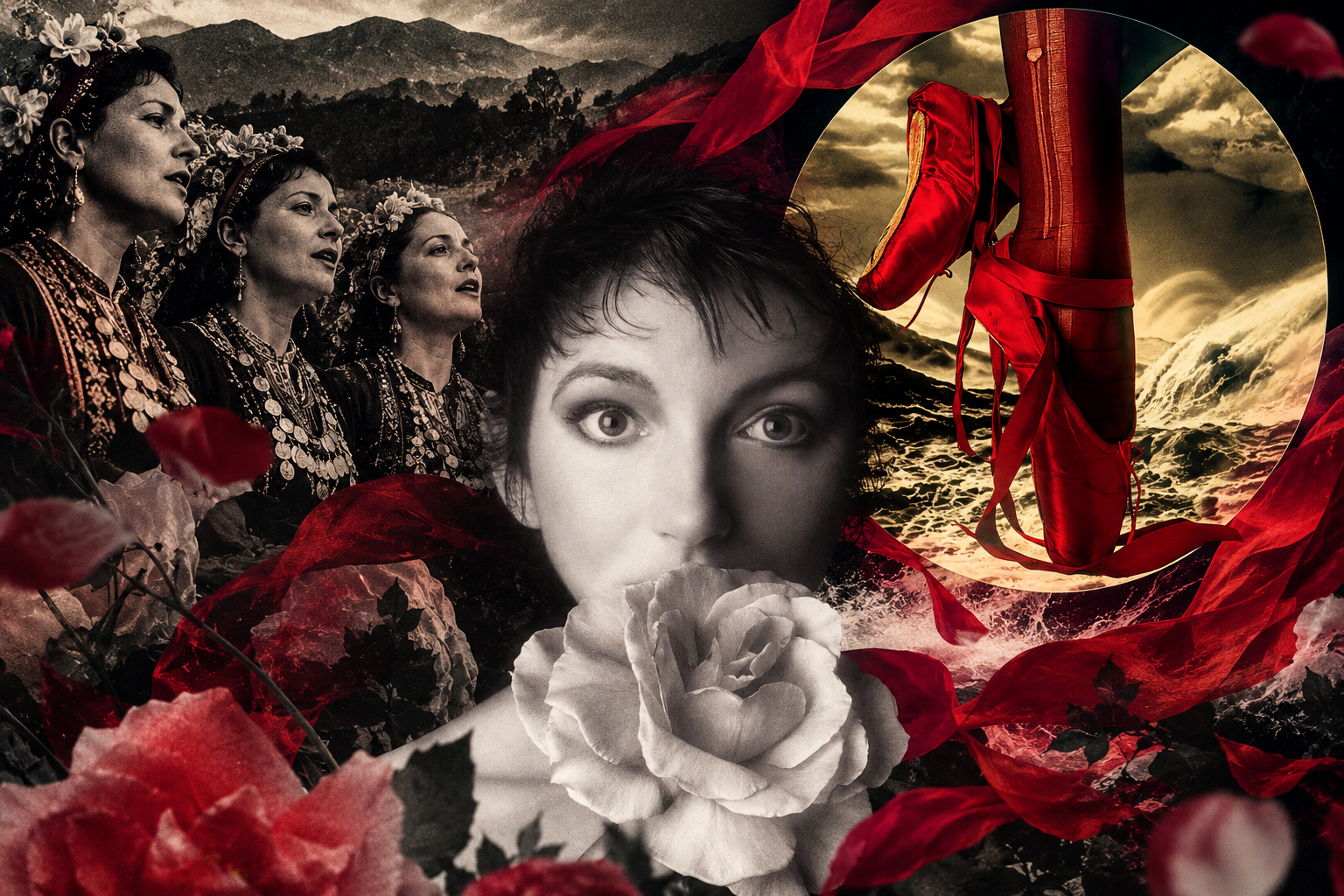
Few voices sound quite like those of Trio Bulgarka. Their powerful, tightly woven harmonies, rooted in the traditions of Bulgarian folk music, possess a striking intensity that can feel both beautiful and unsettling. They were an unlikely addition to the elaborate world of Kate Bush’s music, yet their collaboration would produce some of the most distinctive moments in her discography.
The partnership first emerged on The Sensual World (1989), where the trio’s extraordinary vocal arrangements brought an entirely different dimension to Bush’s songwriting. Their contributions were far more than atmospheric embellishments, becoming an essential part of the music itself. Four years later, the singers returned for The Red Shoes, extending a creative relationship that brought together two very different musical traditions.
But how did a British art-pop musician come to work with three Bulgarian folk singers, and what made their voices such a remarkable match?
Who Were Trio Bulgarka?
Long before their collaboration with Kate Bush, Trio Bulgarka had established themselves as accomplished performers of traditional Bulgarian folk music. Formed in the 1970s, the ensemble brought together three singers whose individual voices and regional musical backgrounds created an exceptionally distinctive sound.
Yanka Rupkina, from the Strandzha region of southeastern Bulgaria, was renowned for her commanding voice and expressive interpretations of traditional songs. Eva Georgieva, associated with the folk traditions of northeastern Bulgaria, brought extensive experience as a performer, while Stoyanka Boneva contributed another distinctive regional singing tradition. Together, their contrasting vocal qualities formed a powerful combination.
All three had connections to Bulgaria’s celebrated state radio folk ensemble, whose recordings helped bring Bulgarian vocal traditions to international attention. Their singing drew upon techniques in which close harmonies, sustained notes and occasionally clashing intervals create a sound quite different from conventional Western popular music.
Rather than smoothing away these tensions, the singers embraced them. Individual voices could emerge prominently before rejoining the ensemble, while subtle changes in pitch and vocal intensity gave their performances a remarkable sense of movement.
The trio developed an international following through concerts and recordings, including their 1988 album The Forest Is Crying, released through Joe Boyd’s Hannibal label. Their performances demonstrated how three voices could create an astonishing range of musical textures without relying on elaborate instrumentation.
By the time Kate Bush encountered their music, Trio Bulgarka were already respected artists in their own right. Their eventual collaboration would not be a case of an established pop musician introducing three unknown singers to the world, but a meeting between musicians with different backgrounds and a shared appreciation for the expressive possibilities of the human voice.
How Kate Bush Discovered Trio Bulgarka
Kate Bush’s fascination with Bulgarian folk singing began through her brother Paddy, whose interest in traditional music from around the world had already introduced her to numerous unfamiliar sounds. Following the completion of Hounds of Love in 1985, Paddy played her a recording of Trio Bulgarka, and the effect was immediate.
Bush was astonished by the emotional intensity of their singing. Their voices possessed a power and complexity unlike anything she had encountered in conventional pop music, and she began considering how they might fit into her own compositions.
However, the prospect of collaborating with them was initially daunting. Bush admired their musical abilities and wanted to find arrangements that would make the most of their distinctive qualities rather than simply using them as conventional backing singers.
The idea remained with her as work progressed on The Sensual World. Instead of imitating Bulgarian vocal techniques or sampling existing recordings, Bush wanted to work directly with the singers themselves.
The opportunity eventually came through producer Joe Boyd, whose Hannibal Records label had released Trio Bulgarka’s music. Boyd helped establish contact, and Bush travelled to Sofia to meet the three women.
The meeting presented an immediate challenge: Bush spoke no Bulgarian, while the singers spoke no English. Translators helped bridge the language barrier, but the musicians quickly developed a connection that extended beyond spoken conversation.
The recording sessions subsequently took place at Angel Studios in London, where the trio’s contributions were recorded for The Sensual World. Their vocal arrangements were guided by Bulgarian arranger Dimitar Penev, whose involvement helped preserve the character of their traditional singing within Bush’s compositions.
For Bush, the experience was significant beyond the music itself. Having spent much of her recording career working predominantly with male musicians, she found the opportunity to collaborate so closely with three women particularly rewarding.
What had begun with a recording played by her brother had developed into a creative partnership. The results would become some of the most memorable passages on The Sensual World, with the singers contributing to three songs in remarkably different ways.
The Sensual World: A Remarkable First Collaboration
Released in October 1989, The Sensual World marked the first appearance of Trio Bulgarka on a Kate Bush album. Their voices featured on three compositions: “Deeper Understanding”, “Never Be Mine” and “Rocket’s Tail”.
Rather than using the singers in the same way throughout the album, Bush found different roles for their voices, ranging from an imaginary computer’s reassuring presence to the explosive opening of a rock composition.
Deeper Understanding
One of the album’s most forward-looking compositions, “Deeper Understanding” tells the story of an isolated individual who develops an increasingly consuming relationship with a computer. Written years before the internet became part of everyday life, the song explores the unsettling possibility of technology replacing genuine human companionship.
Trio Bulgarka provide the voice of the computer itself, transforming what might otherwise have been an artificial, mechanical presence into something unexpectedly warm and comforting. Their harmonies offer the affection and reassurance that the protagonist cannot find in the outside world.
The contrast is central to the song’s effect. Bush’s verses establish a world of emotional isolation, while the computer’s responses introduce an enveloping chorus of human voices. The change in vocal texture makes the machine seem almost nurturing, even as the listener recognises the disturbing implications of the relationship.
Yanka Rupkina also receives an individual solo vocal credit, her distinctive voice helping to give the computer’s responses an almost maternal quality.
Rather than simply providing backing vocals, the singers become characters within the narrative. It is an imaginative reversal of expectations: some of the most recognisably human sounds on the recording belong to a machine.
Never Be Mine
On “Never Be Mine”, the trio’s contribution is more restrained but no less effective. The song explores the painful recognition that an imagined relationship can sometimes be more beautiful than the reality it might become.
Bush’s delicate vocal delivery is complemented by Davy Spillane’s mournful uilleann pipes and Eberhard Weber’s expressive bass playing. Trio Bulgarka enter this arrangement with sustained harmonies that extend the song’s sense of longing.
Unlike the dramatic vocal exchanges of “Deeper Understanding”, their singing feels almost like an echo of Bush’s own emotions. The voices sit within the arrangement rather than dominating it, allowing the composition’s melancholy to develop gradually.
The combination of Bulgarian singing and Irish instrumentation is particularly effective. The uilleann pipes provide a plaintive melodic presence, while the trio’s harmonies introduce another layer of emotional tension.
Neither element feels included merely for its unfamiliar sound. Both contribute to a composition concerned with memory, desire and the distance between imagination and reality.
Rocket’s Tail
If “Never Be Mine” demonstrates the trio’s sensitivity, “Rocket’s Tail” reveals the extraordinary power of their voices.
Named after Bush’s cat, Rocket, the song begins with an almost ceremonial vocal arrangement. Yanka Rupkina takes a prominent solo role, supported by the other singers and Bush herself.
Their voices rise and intertwine, creating a sense of anticipation before the composition undergoes a dramatic transformation.
David Gilmour’s electric guitar suddenly tears through the arrangement, accompanied by a driving rock rhythm. The shift is startling: what begins as an intricate vocal performance erupts into something approaching a full-blown rock celebration.
Yet the Bulgarian singers are not simply displaced by the instrumentation. Their voices remain central to the recording, retaining their distinctive character even as the music grows louder and more forceful.
Rupkina’s commanding performance is particularly memorable. Her sustained vocal lines possess enough strength to hold their own against Gilmour’s guitar, creating an exhilarating contrast between the human voice and amplified instrumentation.
The song’s arrangement makes this confrontation feel purposeful rather than arbitrary. The restrained opening gives the listener time to appreciate the singers’ individual qualities, making the sudden arrival of the rock instrumentation all the more dramatic.
Of the three collaborations on The Sensual World, “Rocket’s Tail” is perhaps the most striking example of what Bush and Trio Bulgarka could achieve together. Neither musical approach is diminished by the other; instead, their contrasting qualities become the source of the song’s extraordinary energy.
Across these three recordings, Bush found different purposes for the trio’s voices: the comforting illusion of human connection, the expression of unfulfilled longing and the exhilarating force of a musical explosion.
The Red Shoes: A Musical Partnership Revisited
Four years after The Sensual World, Kate Bush reunited with Trio Bulgarka for her seventh studio album, The Red Shoes (1993).
Their voices appeared on three songs: “The Song of Solomon”, “Why Should I Love You?” and “You’re the One”. This time, however, the singers were working within an album that frequently favoured more direct songwriting, prominent instrumentation and an extensive cast of guest musicians.
Where their contributions to The Sensual World had often been immediately recognisable, their presence on The Red Shoes was generally more understated.
The Song of Solomon
“The Song of Solomon” offers perhaps the most natural continuation of the partnership established on The Sensual World. Drawing inspiration from the biblical Song of Songs, Bush presents an intimate declaration of romantic and physical desire, rejecting elaborate expressions of devotion in favour of something more immediate and honest.
Trio Bulgarka’s harmonies provide a striking counterpoint to Bush’s intimate lead vocal. Their collective sound gives the composition an almost ceremonial quality, suggesting something larger than the personal relationship at its centre.
The contrast is particularly effective because the song itself is relatively restrained. The singers are given space within the arrangement, their harmonies rising around Bush’s vocal without obscuring its directness.
There is also something fitting about the combination of these voices. Bush’s individual performance is deeply personal, while the trio introduce a collective presence, as though the emotions expressed in the song extend beyond a single person.
Rather than competing for attention, the different vocal parts reinforce one another, making this one of the most effective uses of Trio Bulgarka on The Red Shoes.
Why Should I Love You?
Of all the songs featuring Trio Bulgarka, “Why Should I Love You?” is perhaps the most unusual in terms of its musical construction.
The composition famously features Prince, who contributed vocals, instruments and arrangement ideas, alongside additional vocals from Lenny Henry. The result is a densely layered mixture of pop, funk, gospel-influenced harmonies and electronic production, quite different from the spacious arrangements that had previously showcased the Bulgarian singers.
Within this busy musical environment, Trio Bulgarka become part of a much larger vocal ensemble. Their contribution is less immediately distinguishable than on “Rocket’s Tail” or “The Song of Solomon”, with numerous voices and instruments competing for attention.
This reveals an interesting limitation of the arrangement. The distinctive qualities that made the trio so compelling can become difficult to appreciate when surrounded by so many musical elements.
Their presence contributes to the recording’s exuberant character, but the arrangement rarely allows their individual voices to command attention.
Nevertheless, “Why Should I Love You?” remains a fascinating example of Bush bringing musicians from very different backgrounds into the same composition. It is an ambitious experiment, even if the results do not showcase Trio Bulgarka as effectively as their earlier collaborations.
You’re the One
The album’s closing track, “You’re the One”, finds Bush confronting the painful aftermath of a relationship. Built around a slow, emotionally charged arrangement, the song features expressive guitar playing from Jeff Beck and Hammond organ from Gary Brooker.
Trio Bulgarka contribute backing vocals that deepen the composition’s atmosphere of longing and resignation. Their harmonies sit behind Bush’s increasingly impassioned performance, reinforcing the emotional weight of a song concerned with the difficulty of letting go.
Unlike “Rocket’s Tail”, there is no dramatic confrontation between contrasting musical styles. Instead, the singers become part of a broader arrangement rooted in the language of a rock ballad.
Their presence becomes particularly effective as the song builds, with the additional voices lending greater weight to Bush’s delivery without shifting attention away from the central performance.
As the final song on The Red Shoes, “You’re the One” also provides a fitting conclusion to Trio Bulgarka’s recorded collaborations with Bush. Their voices, which had brought such an unexpected character to The Sensual World, now accompanied one of her most openly vulnerable performances.
The differences between the two albums are revealing. While The Sensual World frequently allowed the trio’s voices to shape the identity of a composition, The Red Shoes more often incorporated them into elaborate arrangements alongside other musicians.
Both approaches demonstrated the singers’ versatility, although their earlier recordings generally provided more opportunities for their distinctive vocal qualities to emerge.
What Made Their Collaboration So Special?
What made Kate Bush’s partnership with Trio Bulgarka so compelling was not simply the contrast between British art-pop and Bulgarian folk music. It was the personal and creative understanding that developed between musicians who initially had no shared spoken language.
Bush had long treated the human voice as an instrument capable of expressing far more than conventional melody and lyrics. From the layered vocal arrangements of The Dreaming to the theatrical storytelling of Hounds of Love, she frequently used her voice to create characters, textures and emotional contrasts.
Trio Bulgarka approached singing through a different tradition, one built around close vocal interaction, powerful projection and the subtle tensions created by individual voices moving together.
Despite these differences, their musical instincts proved remarkably compatible. Both Bush and the trio understood how a voice could communicate emotion without relying entirely on words.
The collaboration also represented something personally meaningful for Bush. Reflecting on the experience, she spoke about the strong female presence that emerged from working with three other women in the studio, something she had rarely experienced to the same extent during her recording career.
It was a creative relationship built on admiration rather than an attempt to reshape the singers into conventional pop performers. Their voices retained the qualities that had first fascinated Bush, while her compositions offered unfamiliar settings in which those qualities could be explored.
That mutual respect is perhaps the most important reason the partnership worked. The musicians did not need to share the same language or musical upbringing to recognise what each could bring to the recordings.
A Collaboration Unlike Any Other
Kate Bush’s collaboration with Trio Bulgarka remains one of the most distinctive creative partnerships in her career. Across six recordings on The Sensual World and The Red Shoes, the singers brought their extraordinary vocal abilities to compositions ranging from intimate reflections on loneliness to some of Bush’s most adventurous musical experiments.
Yanka Rupkina, Eva Georgieva and Stoyanka Boneva were accomplished artists long before their involvement with Bush, and their contributions deserve recognition as performances in their own right, not simply unusual additions to a British pop record.
Perhaps nowhere is the partnership more vividly captured than in “Rocket’s Tail”, where three Bulgarian folk singers and David Gilmour’s electric guitar create a musical encounter that seems improbable on paper but sounds entirely convincing.
Decades later, these recordings remain compelling not because they erased the differences between two musical worlds, but because they allowed those differences to produce something neither could have created in quite the same way alone.