
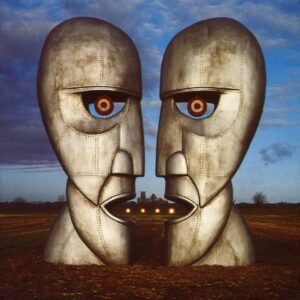
The Division Bell reached number one on both sides of the Atlantic, yet commercial success has never guaranteed it the same respect afforded to Pink Floyd’s earlier albums.
Released on 28 March 1994, the record arrived seven years after A Momentary Lapse of Reason and more than a decade after Roger Waters’ departure. Although Pink Floyd remained enormously popular, their ability to produce worthwhile music without their former bassist and principal lyricist continued to attract considerable scrutiny.
For some, The Division Bell represented little more than David Gilmour revisiting the band’s established sound. Its expansive arrangements, atmospheric keyboards and extended guitar passages were unmistakably Pink Floyd, but critics questioned whether familiarity had replaced innovation.
Yet that criticism overlooks an important distinction: an album does not necessarily lack artistic value simply because it refuses to reinvent the musicians who created it.
The Division Bell may not possess the conceptual ambition of The Dark Side of the Moon, Wish You Were Here or The Wall, but dismissing it as an exercise in nostalgia ignores some of the most accomplished and emotionally affecting music of Pink Floyd’s later career.
A Pink Floyd Album That Feels Like a Band
One of the strongest arguments in favour of The Division Bell is the renewed creative relationship between David Gilmour, Richard Wright and Nick Mason.
Its predecessor, A Momentary Lapse of Reason, had been a commercially successful return, but its recording relied heavily on Gilmour and contributions from outside musicians. Wright’s involvement was limited, while Mason did not perform all the drum parts.
The Division Bell emerged from a different approach. Beginning in 1993, the three musicians developed material together through extended sessions, allowing ideas to emerge from their interaction rather than simply constructing songs around Gilmour’s existing compositions.
The difference is particularly apparent in Wright’s contributions. His keyboards had been essential to the band’s classic sound, creating the atmospheric foundations upon which Gilmour’s guitar could develop. On The Division Bell, that relationship once again becomes a defining characteristic.
“Cluster One” demonstrates their musical understanding through a restrained exchange between piano and guitar, while “Marooned” transforms relatively simple melodic ideas into an expansive instrumental performance. Neither composition attempts to replicate the experimental unpredictability of early Pink Floyd, but both reveal the expressive possibilities of musicians who understand how to complement one another.
Wright also takes lead vocals on “Wearing the Inside Out”, bringing an understated vulnerability that distinguishes it from the album’s more elaborate compositions.
These moments matter because they reveal something frequently overlooked in discussions of the band’s later years. Pink Floyd’s identity was never dependent upon one individual alone. Waters’ conceptual writing had been enormously important, but Wright’s atmospheric keyboards, Gilmour’s expressive guitar and Mason’s measured drumming were equally recognisable elements of their musical character.
The Division Bell allows those qualities to emerge with a confidence that its predecessor sometimes lacked.
Does Familiarity Really Mean Creative Stagnation?
Perhaps the most persistent criticism of The Division Bell is that it sounds too much like Pink Floyd.
Its spacious arrangements, carefully constructed instrumental passages and soaring guitar solos are immediately recognisable. There is little of the experimentation that characterised The Piper at the Gates of Dawn, or the conceptual ambition that defined The Wall.
But expecting musicians to continually reinvent themselves can become an unreasonable measure of artistic success, particularly when their established musical language remains capable of producing meaningful work.
The Division Bell is undoubtedly familiar, yet familiarity is not the same as imitation.
Gilmour’s guitar playing remains remarkably expressive, while Wright’s keyboards bring warmth and depth to compositions that might otherwise feel conventional. The album’s polished production also allows quieter musical details to emerge, rewarding listeners willing to engage with its more reflective atmosphere.
That does not mean every song succeeds. “Take It Back” leans towards conventional radio-friendly rock, while “Coming Back to Life” occasionally stretches its musical ideas further than necessary. At more than an hour long, the album could arguably have benefited from a more selective approach.
Yet these weaknesses do not invalidate its strongest material. The tendency to judge The Division Bell against Pink Floyd’s most revolutionary achievements can obscure the fact that it was never attempting to be another Dark Side of the Moon.
Instead, it presents a group of experienced musicians working within an established style, occasionally finding new emotional depth in familiar musical ideas. That is a more modest achievement, but not an insignificant one.
More Than an Album About Roger Waters
Another reason The Division Bell deserves greater consideration is its lyrical focus.
The album explores communication, fractured relationships and the difficulty of overcoming emotional distance. Given Pink Floyd’s troubled history, songs such as “Poles Apart” and “Lost for Words” have understandably been associated with the band’s disagreements with Roger Waters.
Those interpretations are relevant, but they should not define the entire record.
Working with collaborators including Polly Samson, Gilmour developed lyrics that frequently extend beyond the band’s personal history. “Keep Talking”, incorporating the electronically generated voice of Stephen Hawking, considers the importance of communication in a world where genuine understanding often proves elusive.
Elsewhere, the writing explores resentment, regret and the uncomfortable recognition that some relationships cannot be repaired.
The lyrics are not always as incisive as Waters’ strongest work, and their themes occasionally lack subtlety. Nevertheless, their more reflective perspective suits the album’s musical character.
Rather than constructing an elaborate narrative about alienation or social conflict, The Division Bell examines smaller, more personal difficulties. Its emotional concerns may be less ambitious than those of Pink Floyd’s celebrated concept albums, but they are no less recognisable.
High Hopes: Proof That Pink Floyd Still Had Something to Say
If one composition demonstrates why The Division Bell should not be dismissed, it is “High Hopes”.
Closing the album, the song reflects on youth, memory and the distance between early ambitions and the realities of adulthood. Written by Gilmour and Samson, its imagery draws upon Gilmour’s upbringing in Cambridge, where his early experiences were intertwined with those of future Pink Floyd members Syd Barrett and Roger Waters.
There is a poignancy to hearing a musician whose career had already spanned three decades reflect upon the passing of time. The song’s nostalgia is not simply an idealisation of the past, but an acknowledgement that certain experiences and relationships cannot be recovered.
Musically, “High Hopes” captures Pink Floyd at their most affecting. Its tolling bell, measured arrangement and gradual orchestral development create an atmosphere of melancholy that culminates in one of Gilmour’s most memorable lap-steel guitar solos.
The performance is powerful not because it introduces anything radically new, but because every element contributes to the same emotional purpose. The guitar expresses the regret and longing established by the lyrics, bringing the composition to a conclusion that feels both expansive and deeply personal.
In retrospect, “High Hopes” also carries the weight of a farewell. Although Pink Floyd would release The Endless River two decades later, that largely instrumental album was assembled primarily from recordings originating during the Division Bell sessions.
“High Hopes” therefore remains a particularly fitting conclusion to the band’s final major period of studio songwriting. It is difficult to hear such a composition and conclude that Pink Floyd had nothing meaningful left to offer.
For a closer examination of the individual songs and production, explore our full review of The Division Bell.
Why The Division Bell Deserves Reconsideration
The Division Bell is not a flawless album, nor does it belong automatically alongside Pink Floyd’s most influential achievements.
Its production can feel overly polished, some compositions lack urgency, and its reliance on familiar musical ideas occasionally limits its sense of discovery. Those criticisms are reasonable and should not be ignored.
But there is a difference between recognising an album’s limitations and allowing them to define its entire reputation.
Too often, The Division Bell is discussed primarily in terms of what it lacks: Roger Waters’ writing, the experimentation of the band’s early years or the conceptual ambition of their 1970s masterpieces.
Such comparisons overlook what the album actually offers. It captures a renewed musical partnership between Gilmour, Wright and Mason, contains some of the band’s finest later instrumental work and concludes with a song that stands comfortably among their most affecting compositions.
More importantly, it demonstrates that Pink Floyd could still create worthwhile music without attempting to recreate the circumstances that produced their greatest records.
The Division Bell may not have changed the direction of rock music, but it was never necessary for it to do so. Its strengths lie in atmosphere, musicianship and emotional expression rather than reinvention.
The Division Bell does not need to rival Pink Floyd’s greatest albums to deserve a place among their most rewarding. Its achievement lies not in reinventing the band’s sound, but in demonstrating how much that sound could still communicate.