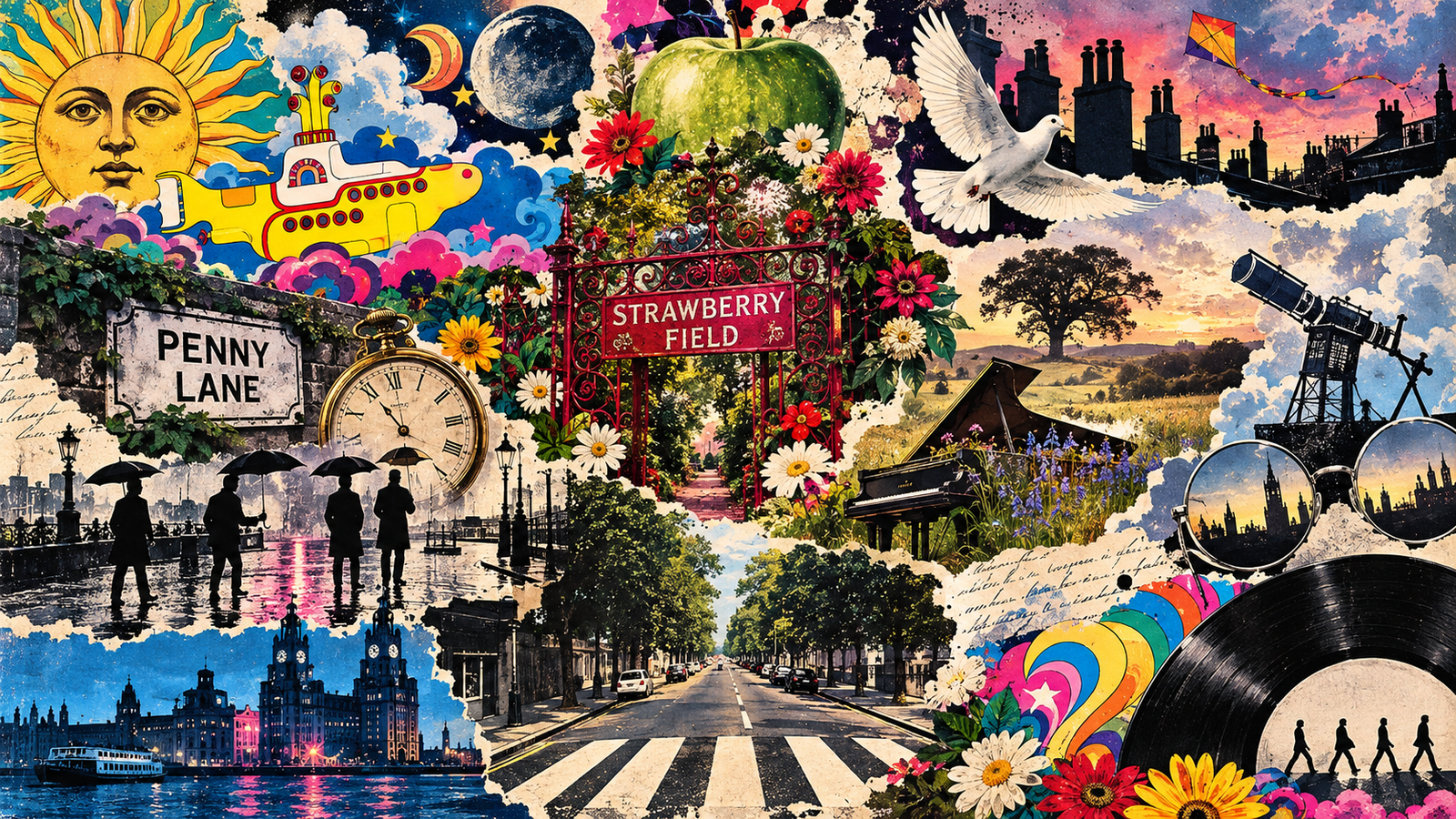
John Lennon, Paul McCartney, George Harrison and Ringo Starr became household names during an extraordinary period of cultural change. Their early recordings captured the excitement of a new generation, while their later work explored increasingly ambitious songwriting, unconventional arrangements and the creative possibilities of the recording studio.
Yet behind their remarkable success was a far more complicated story. Years of demanding performances in Liverpool and Hamburg had shaped their musical identity long before Beatlemania emerged. As international fame arrived, the pressures of touring, changing personal relationships and competing artistic ambitions gradually transformed the dynamics within the group.
Their evolution was unusually rapid. Between the release of Love Me Do in 1962 and their breakup in 1970, The Beatles progressed from energetic pop singles to albums such as Revolver, Sgt. Pepper’s Lonely Hearts Club Band and Abbey Road, each reflecting a different stage in their creative development.
The Early Years: Before The Beatles
Long before Beatlemania, the four musicians who would become The Beatles were growing up in different parts of Liverpool, each developing an interest in music through their own experiences.
For Lennon, McCartney and Harrison, that enthusiasm would eventually bring them together in a teenage skiffle group. Ringo Starr’s journey followed a separate path before their careers converged.
John Lennon: The Beginnings of the Quarrymen
John Winston Lennon was born on 9 October 1940 in Liverpool. Following his parents’ separation, he was raised primarily by his Aunt Mimi and Uncle George Smith at their home in Woolton.
His childhood was marked by complicated family relationships, particularly with his mother, Julia, who encouraged his musical interests and introduced him to the banjo. Although Lennon was often rebellious at school, he developed a strong enthusiasm for rock and roll, particularly the music of Elvis Presley and other American performers.
In 1956, he formed the Quarrymen with friends from Quarry Bank High School. Initially playing skiffle, a style combining elements of folk, blues and jazz, the group gradually incorporated more rock and roll into its repertoire.
The Quarrymen provided Lennon with his first sustained experience of performing in a band. More importantly, they created the circumstances for a meeting that would transform his musical future.
Paul McCartney: A Partnership Begins
James Paul McCartney was born on 18 June 1942 in Liverpool. Music was an important part of his upbringing, particularly through his father Jim, an amateur musician who played piano and had previously led a jazz band.
McCartney’s childhood was also marked by tragedy. His mother, Mary, died of breast cancer in October 1956, when he was fourteen. The loss would later become an important point of understanding between McCartney and Lennon, whose mother Julia died in 1958.
Already developing his abilities on guitar and piano, McCartney became particularly interested in American rock and roll.
On 6 July 1957, he attended a church fête at St Peter’s Church in Woolton, where the Quarrymen were performing. Introduced to Lennon by their mutual friend Ivan Vaughan, McCartney impressed him with his ability to play and sing songs including Eddie Cochran’s Twenty Flight Rock. Lennon subsequently invited McCartney to join the group.
The meeting established the foundations of a songwriting partnership that would become central to The Beatles’ identity. Their shared musical interests were accompanied by contrasting personalities and creative instincts, qualities that would both strengthen and complicate their relationship in later years.
George Harrison: The Youngest Member
George Harrison was born on 25 February 1943 in Liverpool, making him the youngest of the four future Beatles.
Growing up in a working-class household, Harrison developed a fascination with guitars and American rock and roll. Artists such as Carl Perkins and Chuck Berry influenced his early playing, while his determination to master the instrument quickly distinguished him among his peers.
Harrison became friends with McCartney while they were pupils at the Liverpool Institute. Recognising his abilities, McCartney introduced him to Lennon and the Quarrymen in early 1958.
Lennon initially considered Harrison too young to join the group, but his guitar playing eventually overcame those reservations. He became a member during 1958, completing the central trio that would remain together throughout The Beatles’ career.
Although initially recognised primarily as the group’s lead guitarist, Harrison would develop into an increasingly accomplished songwriter, bringing musical interests that broadened the band’s creative direction.
Ringo Starr: A Different Route into Music
Richard Starkey, later known as Ringo Starr, was born on 7 July 1940 in Liverpool.
His early life was disrupted by serious health problems, including lengthy periods in hospital that interrupted his education. Despite these difficulties, he developed an enthusiasm for music and became particularly interested in drumming.
During the 1950s, Starr began performing with local groups, including the Eddie Clayton Skiffle Group. He later joined Rory Storm and the Hurricanes, one of Liverpool’s most popular live bands.
His experience with the Hurricanes took him beyond Merseyside, including performances in Hamburg, where he became acquainted with the musicians who would eventually become his bandmates.
Unlike Lennon, McCartney and Harrison, Starr had not been part of the Quarrymen. By the time he joined The Beatles in August 1962, however, he was already an experienced professional drummer.
His distinctive playing style and personality would become essential parts of the group’s musical identity.
Liverpool, Hamburg and the Formation of The Beatles
From the Quarrymen to The Beatles
The Quarrymen underwent several changes during the late 1950s as their music moved away from skiffle towards American rock and roll.
An important addition was Stuart Sutcliffe, a friend of Lennon’s from Liverpool College of Art. Although he had limited experience as a musician, Sutcliffe purchased a bass guitar and joined the developing group in 1960.
Around this period, the musicians experimented with several names, including the Silver Beetles, before settling on The Beatles.
An opportunity to perform in Hamburg during the summer of 1960 provided the experience they needed. Before travelling to Germany, they recruited drummer Pete Best, whose mother Mona operated the Casbah Coffee Club, another important venue in Liverpool’s emerging rock and roll scene.
The five-piece lineup of Lennon, McCartney, Harrison, Sutcliffe and Best departed for Hamburg in August 1960.
Hamburg: Where The Beatles Found Their Sound
The Beatles began performing at the Indra Club in Hamburg’s St Pauli district on 17 August 1960, before moving to the nearby Kaiserkeller.
Their working conditions were demanding. The musicians played for hours each night, performing a mixture of rock and roll, rhythm and blues and popular standards for audiences who expected constant entertainment.
These lengthy engagements transformed their abilities. With so much time on stage, they developed greater confidence, expanded their repertoire and learned to respond instinctively to one another’s playing.
Hamburg also exposed them to an influential circle of young artists and photographers, including Astrid Kirchherr and Klaus Voormann. Their friendships introduced the group to new artistic influences and helped shape the distinctive visual identity that would emerge during the following years.
The first engagement ended under difficult circumstances. Harrison was deported for being underage, while McCartney and Best encountered problems with the German authorities following a fire incident at their accommodation.
The Beatles returned to Hamburg in April 1961, performing at the Top Ten Club. By this stage, their musical confidence had developed considerably, and the city remained an important part of their early career.
Stuart Sutcliffe’s Departure and the Cavern Club
During the group’s Hamburg years, Stuart Sutcliffe developed a close relationship with Astrid Kirchherr and became increasingly committed to pursuing his artistic studies.
He eventually left The Beatles in 1961 to remain in Hamburg, with McCartney assuming the role of bass guitarist.
Tragically, he died from a brain haemorrhage on 10 April 1962, aged just twenty-one. His death deeply affected Lennon and the other musicians who had known him.
They had made their first appearance under the Beatles name at the Cavern Club on 9 February 1961, with Sutcliffe and Best still in the lineup. The venue soon became central to their local success.
Its intimate atmosphere encouraged a close relationship between the musicians and their audience. Their energetic performances, increasingly confident harmonies and distinctive humour helped attract a devoted following.
Brian Epstein Enters the Picture
On 9 November 1961, Brian Epstein visited the Cavern Club to watch The Beatles perform during a lunchtime session.
Epstein managed the record department of his family’s NEMS business in Liverpool and had become aware of the group through their local popularity and interest in a recording they had made in Hamburg with singer Tony Sheridan.
That recording, My Bonnie, had been issued in Germany in 1961 under the credit Tony Sheridan and the Beat Brothers.
Impressed by the group’s performances and potential, Epstein began pursuing the possibility of becoming their manager. They agreed in principle to work together in late 1961 and signed a formal management agreement in January 1962.
Epstein brought a more organised approach to their career. He encouraged greater professionalism, helped refine their stage presentation and sought opportunities with record companies.
His influence was important, but he did not create their musical identity. The Beatles had already developed considerable confidence and a loyal following through years of performing together.
1962–1963: The Beatles’ First Breakthrough
The Decca Audition and Meeting George Martin
On 1 January 1962, The Beatles travelled to Decca Records’ studios in London for an audition arranged by Epstein.
Still featuring Pete Best on drums, they recorded fifteen songs, combining familiar rock and roll material with original Lennon–McCartney compositions.
The audition was unsuccessful. Decca declined to sign the group, a decision that would later become one of the most frequently discussed missed opportunities in popular music history.
Epstein nevertheless continued approaching record companies. His persistence eventually brought The Beatles to the attention of George Martin, a producer working for EMI’s Parlophone label.
On 6 June 1962, the group attended a recording test at EMI Studios on Abbey Road in London.
Martin recognised their potential, particularly their personalities and songwriting abilities, although he had reservations about aspects of their musicianship and recording sound.
Ringo Starr Joins The Beatles
Although Pete Best had accompanied the group through their demanding Hamburg performances and early success in Liverpool, the other members and their management decided to replace him.
Ringo Starr, already familiar to the group through his work with Rory Storm and the Hurricanes, was invited to join in August 1962. Best was dismissed by Epstein on 16 August, and Starr made his first official appearance as a Beatle two days later.
The decision was painful and controversial, particularly among some Liverpool fans who had supported the earlier lineup.
Nevertheless, Starr quickly became an important part of the band’s identity. His dependable drumming, distinctive personality and existing familiarity with the other musicians helped establish the partnership that would become internationally famous.
Love Me Do and Their First Recordings
The Beatles released their debut Parlophone single, Love Me Do, on 5 October 1962.
Written by Lennon and McCartney, the song combined a simple, memorable melody with a prominent harmonica part played by Lennon. Its understated arrangement contrasted with some of the more polished pop recordings dominating the British charts.
The single reached number 17 on the Record Retailer chart, a modest but encouraging achievement for a relatively unknown group.
Its recording history was more complicated than the finished song suggested. The Beatles recorded different versions featuring Pete Best, Ringo Starr and session drummer Andy White. Starr played drums on the original UK single, while White performed on the version subsequently used for the debut album.
Their follow-up, Please Please Me, arrived on 11 January 1963 and represented a considerable step forward.
Faster and more energetic, the song showcased the group’s developing vocal harmonies and ability to produce distinctive original material.
It reached number one on several contemporary British charts, including those published by New Musical Express and Melody Maker. However, it peaked at number two on the Record Retailer chart, the listing subsequently adopted for the official UK chart history.
Recording Their Debut Album
The success of Please Please Me encouraged Parlophone to move quickly with a full-length album.
On 11 February 1963, The Beatles entered EMI Studios for an intensive recording session that captured ten of the fourteen tracks eventually included on their debut LP.
Rather than constructing an elaborate studio production, George Martin aimed to preserve the energy of the group’s live performances. The album combined original compositions with covers that had become familiar parts of their stage repertoire.
Among the recordings was Twist and Shout, featuring an exceptionally forceful vocal performance from Lennon, who was suffering from a cold during the session.
Released on 22 March 1963, Please Please Me demonstrated the band’s versatility, moving between energetic rock and roll, romantic ballads and tightly arranged vocal performances.
The album reached number one in Britain in May and remained there for thirty consecutive weeks, eventually being replaced by the group’s second LP, With the Beatles.
The Arrival of Beatlemania
Throughout 1963, The Beatles’ popularity grew at an extraordinary pace.
Their increasingly frequent appearances on radio and television introduced them to audiences across Britain, while a demanding schedule of concerts and package tours brought them into direct contact with enthusiastic fans.
The release of From Me to You in April gave the group their first number-one single on the chart now recognised as the official UK listing.
Their success accelerated with She Loves You, released in August. Its memorable chorus and exuberant vocal delivery helped make it one of the defining British pop singles of the decade.
As crowds became larger and more excitable, the press increasingly used the term Beatlemania to describe the extraordinary enthusiasm surrounding the group.
Their appearance on Sunday Night at the London Palladium on 13 October 1963 attracted enormous attention, while their performance at the Royal Variety Performance the following month demonstrated how far their reputation had grown.
Their growing fame also placed increasing demands on their personal lives. Constant travel, public appearances and intense media attention left little room for privacy, foreshadowing pressures that would become even greater as their international popularity expanded.
1964–1965: Conquering America
International success, however, was far from guaranteed. British performers had historically struggled to establish a lasting presence in the American market, and The Beatles’ earliest US releases had attracted relatively little attention.
That changed dramatically with I Want to Hold Your Hand. Released in America in December 1963, the single reached number one on the Billboard Hot 100 on 1 February 1964, just days before the group arrived in New York.
The Ed Sullivan Show and the British Invasion
On 7 February 1964, The Beatles landed at New York’s newly renamed John F. Kennedy International Airport, where thousands of excited fans and journalists awaited their arrival.
Two days later, on 9 February, the group made their first live appearance on The Ed Sullivan Show. An estimated 73 million viewers watched the broadcast, making it one of the most famous television performances in popular music history.
The Beatles performed songs including All My Loving, Till There Was You, She Loves You, I Saw Her Standing There and I Want to Hold Your Hand. Their energetic performances and playful personalities immediately captured the attention of American audiences.
The appearance helped establish The Beatles as the leading figures of what became known as the British Invasion, a period during which British groups achieved unprecedented popularity in the United States.
Artists including The Rolling Stones, The Animals and The Dave Clark Five would also enjoy considerable American success, contributing to a major shift in the international music industry.
Beatlemania Becomes a Worldwide Phenomenon
Throughout 1964, Beatlemania expanded into an international phenomenon.
The Beatles travelled extensively, performing across Europe, North America and other territories as demand for their appearances continued to grow.
Their concerts were frequently accompanied by overwhelming noise from enthusiastic audiences. Screaming fans sometimes made it difficult for the musicians to hear their instruments or one another, creating increasingly challenging conditions for live performances.
The band’s fame also placed considerable restrictions on their freedom. Hotels, airports and concert venues required extensive security arrangements, while ordinary activities became difficult without attracting public attention.
Despite these pressures, The Beatles maintained a remarkably demanding schedule of recording, touring, television appearances and promotional commitments.
A Hard Day’s Night: The Beatles on Film
The Beatles’ growing popularity soon extended into cinema.
Released in July 1964, A Hard Day’s Night was their first feature film, directed by Richard Lester.
Rather than presenting a conventional fictional musical, the film offered a humorous, loosely fictionalised account of the band’s experiences during the height of Beatlemania.
Its energetic editing, documentary-inspired camerawork and playful dialogue captured the personalities that had helped make The Beatles so popular.
The film also demonstrated their ability to appeal beyond the recording industry. Its critical and commercial success established them as convincing screen personalities while introducing their music to an even wider audience.
The accompanying soundtrack represented another important development. Unlike their first two British albums, the UK edition of A Hard Day’s Night consisted entirely of Lennon–McCartney compositions.
Songs such as If I Fell, And I Love Her and the title track revealed the partnership’s growing confidence, combining the excitement of their earlier recordings with increasingly sophisticated melodies and arrangements.
Touring America and Meeting Bob Dylan
During the summer of 1964, The Beatles undertook their first major concert tour of North America.
The schedule was demanding, with performances taking place in large venues before audiences whose enthusiasm often overwhelmed the available sound equipment.
In August 1964, The Beatles met American singer-songwriter Bob Dylan at the Delmonico Hotel in New York.
Dylan’s approach to songwriting, particularly his increasingly personal and socially observant lyrics, became an important influence on the band’s developing artistic interests.
For Lennon in particular, the influence of Dylan’s songwriting would become increasingly apparent in more introspective compositions.
Help! and the Pressures of Fame
By 1965, The Beatles were firmly established as international superstars.
Their second feature film, Help!, was released in July, again directed by Richard Lester. Unlike the relatively grounded humour of A Hard Day’s Night, the film embraced a more elaborate comic adventure, with colourful locations and increasingly surreal situations. Its accompanying album demonstrated the band’s continuing musical development.
The title track, written primarily by Lennon, appeared to be another energetic pop single, but its lyrics expressed feelings of vulnerability and uncertainty beneath the upbeat arrangement.
Lennon would later describe the song as a genuine expression of his emotional state during a period when the pressures of fame were becoming increasingly difficult.
Other recordings revealed a growing willingness to explore different musical approaches. McCartney’s Yesterday, featuring a string quartet arranged by George Martin, offered a striking contrast to the band’s conventional guitar-driven sound.
The song demonstrated that The Beatles could move beyond the established format of a four-piece rock group without losing their distinctive songwriting identity.
Shea Stadium and the Limits of Live Performance
On 15 August 1965, The Beatles performed at Shea Stadium in New York before approximately 55,600 people.
The concert became one of the defining events of Beatlemania, demonstrating the extraordinary scale of the band’s popularity.
Performing in a baseball stadium represented a major development in the presentation of rock music, although large outdoor concerts had existed before The Beatles.
The musicians performed through a sound system poorly suited to the size of the venue, while the constant screaming of the audience made it difficult to hear their own playing.
Although the spectacle was remarkable, the experience reinforced a growing problem: The Beatles were becoming increasingly disconnected from the music they were performing on stage.
Their recordings were developing in sophistication, but concert conditions offered little opportunity to reproduce that complexity.
1965–1967: From Pop Stars to Studio Innovators

Over the following two years, The Beatles would undergo their most dramatic artistic transformation. They abandoned live performances, embraced increasingly ambitious recording techniques and produced albums that helped redefine expectations of popular music.
Rubber Soul: A More Mature Musical Direction
Released on 3 December 1965, Rubber Soul marked an important stage in The Beatles’ development.
Although their songwriting had been evolving throughout the previous year, the album demonstrated a more sustained interest in introspective lyrics, varied instrumentation and sophisticated arrangements.
Lennon’s In My Life reflected on memory and personal relationships, while Nowhere Man moved beyond conventional romantic themes to explore feelings of isolation and uncertainty.
McCartney’s You Won’t See Me and I’m Looking Through You also suggested a growing willingness to address difficulties within relationships rather than presenting love exclusively through idealised pop lyrics.
Musically, the group continued exploring influences beyond traditional rock and roll. George Harrison’s use of the sitar on Norwegian Wood (This Bird Has Flown) introduced an Indian instrument into one of the band’s most prominent recordings, anticipating his deeper engagement with Indian classical music.
The album’s significance lay not in a complete rejection of their earlier sound, but in the confidence with which The Beatles incorporated new ideas into their established songwriting style.
Revolver: Experimentation Without Limits
The Beatles continued developing these ideas during the recording of Revolver, released on 5 August 1966.
Working closely with producer George Martin and recording engineer Geoff Emerick, they began treating the studio as a creative environment in which sounds could be manipulated and combined in increasingly unconventional ways.
Eleanor Rigby featured a string octet rather than the band’s conventional instrumentation, while Harrison’s Love You To incorporated Indian classical influences more extensively than their previous recordings.
Lennon’s I’m Only Sleeping included reversed guitar passages, and Tomorrow Never Knows employed tape loops, heavily processed vocals and an insistent drum pattern to create one of the group’s most experimental recordings.
These techniques had precedents in earlier music, but The Beatles were helping bring them into mainstream pop.
Revolver represented a decisive stage in that transformation, demonstrating how far the group’s ambitions had progressed in just a few years.
Controversy and the Final American Tour
In March 1966, an interview with John Lennon appeared in the London Evening Standard, during which he discussed the declining influence of Christianity in Britain and remarked that The Beatles were more popular than Jesus.
The comments attracted relatively little immediate controversy in Britain. However, when they were republished in the United States that summer, they provoked an angry reaction among some religious groups and radio stations.
Public protests followed, including organised record burnings and calls for Beatles music to be removed from radio playlists.
Lennon attempted to clarify his remarks during the band’s American tour, explaining that he had been commenting on the changing influence of religion rather than claiming any personal superiority.
Earlier that summer, The Beatles had encountered problems during their visit to the Philippines, where a misunderstanding surrounding an invitation to an event hosted by First Lady Imelda Marcos led to hostile publicity and a deeply uncomfortable departure.
Their final American tour was consequently overshadowed by security concerns, relentless media attention and growing frustration with the practical realities of live performance.
Concerts had become increasingly disconnected from their developing musical interests. Audiences frequently screamed throughout performances, while inadequate sound systems made it difficult for the musicians to hear themselves. On 29 August 1966, The Beatles performed at Candlestick Park in San Francisco.
Although they did not publicly announce it at the time, the concert became their final scheduled performance before a paying audience.
Leaving the Stage Behind
For the first time since achieving international fame, they were no longer required to organise their creative activities around a demanding concert schedule.
The change also allowed them to pursue musical ideas that would have been difficult to reproduce using the live equipment available at the time.
Their recordings had already begun incorporating elaborate arrangements, additional musicians and increasingly complex studio effects. Freed from the expectation of performing these songs on stage, they could now experiment without the same practical limitations.
The period also gave the individual members greater opportunities to pursue interests outside the band.
Lennon appeared in Richard Lester’s film How I Won the War, McCartney became increasingly involved in London’s experimental arts scene, and Harrison continued exploring Indian music and philosophy.
These separate experiences would contribute to their subsequent recordings, although they also reflected the growing independence of the four musicians.
Sgt. Pepper’s Lonely Hearts Club Band: Reinventing The Beatles
The Beatles began new sessions at EMI Studios in November 1966, recording material that would eventually become Sgt. Pepper’s Lonely Hearts Club Band.
Their earliest sessions produced Strawberry Fields Forever and Penny Lane, two songs inspired by childhood memories of Liverpool.
Although originally considered for the developing album, both were released together as a double A-side single in February 1967 and omitted from the finished LP.
The recordings demonstrated the band’s increasingly ambitious approach to production. Strawberry Fields Forever, in particular, combined different takes, unusual instrumentation and extensive studio manipulation to create a distinctive atmosphere.
As the album developed, McCartney proposed the idea of presenting The Beatles as a fictional musical group, allowing them to move beyond the familiar public image that had defined their earlier career.
Released on 26 May 1967 in Britain, Sgt. Pepper’s Lonely Hearts Club Band became one of the defining albums of the psychedelic era.
Its songs explored a remarkable range of musical styles, from the theatrical title track and music-hall influences of When I’m Sixty-Four to the orchestral arrangements of She’s Leaving Home.
The closing track, A Day in the Life, brought together contrasting Lennon and McCartney compositions, with dramatic orchestral passages arranged under George Martin’s direction.
The album’s elaborate cover artwork and presentation reinforced the impression of a carefully conceived creative project.
Although Sgt. Pepper was not the first concept album, and its songs did not form a continuous narrative, its success demonstrated the growing possibilities of the LP as an artistic format.
The Summer of Love and All You Need Is Love
The release of Sgt. Pepper coincided with the growing prominence of psychedelic culture and the countercultural movements associated with the Summer of Love.
The Beatles were closely connected with these developments, although their individual attitudes towards spirituality, politics and contemporary culture were not always identical.
Their growing international visibility was particularly evident on 25 June 1967, when they participated in Our World, a pioneering live international satellite television broadcast.
For the programme, The Beatles performed All You Need Is Love from EMI Studios, accompanied by musicians and invited guests.
The song’s simple refrain and message of universal love resonated with the optimistic ideals associated with the period.
Its broadcast to an estimated audience of hundreds of millions demonstrated the extraordinary reach of popular music in an increasingly connected world.
The Death of Brian Epstein
On 27 August 1967, Brian Epstein was found dead at his London home, aged thirty-two. His death was ruled accidental and attributed to an overdose of sleeping medication.
Epstein had managed the group since 1961, guiding their transformation from a successful Liverpool act into international superstars. Although the musicians had become increasingly independent in their creative decisions, he remained responsible for much of the organisation surrounding their career. His death left a considerable gap in the band’s management structure.
At the time, The Beatles were in Bangor, North Wales, attending a seminar on Transcendental Meditation led by Maharishi Mahesh Yogi. They returned to London following the news.
Without Epstein’s guidance, the musicians would increasingly find themselves making decisions about management, finances and the future of the group.
These difficulties did not immediately cause their breakup, but they contributed to tensions that would become increasingly apparent during the following years.
1968–1969: Growing Tensions Within the Band
At the same time, the four musicians were developing increasingly distinct interests. Lennon was moving towards more personal and experimental forms of expression, McCartney remained strongly committed to the band’s creative projects, Harrison was becoming a more confident songwriter, and Starr was pursuing opportunities beyond drumming.
India and the Search for a New Direction
In February 1968, The Beatles travelled to Rishikesh, India, to study Transcendental Meditation with Maharishi Mahesh Yogi.
Their interest in meditation had developed during the previous year, particularly through Harrison, whose fascination with Indian music and spirituality had become an important part of his personal life.
The visit offered an opportunity to escape the pressures of international fame and concentrate on their personal wellbeing. Accompanied by friends and partners, the musicians spent time meditating, reflecting and writing new material.
The retreat also proved remarkably productive creatively. Lennon and McCartney composed numerous songs that would later appear on The Beatles, commonly known as the White Album.
Starr returned to Britain after approximately ten days, while McCartney departed in March. Lennon and Harrison remained longer but eventually left in April amid growing dissatisfaction with the Maharishi.
Lennon later cited allegations about the Maharishi’s conduct, but those claims remain disputed and should not be treated as established fact.
Despite the disappointing conclusion for some members, the trip had a lasting impact. It encouraged a period of introspection and produced material that would shape the band’s next album.
The White Album: Four Distinct Creative Voices
Recording sessions for The Beatles began in May 1968 at EMI Studios.
Released on 22 November, the double album presented an unusually diverse collection of songs, moving between acoustic folk, blues, hard rock, music hall and experimental sound collage.
Unlike the more unified presentation of Sgt. Pepper’s Lonely Hearts Club Band, the White Album frequently emphasised the individual musical interests of its composers.
Lennon’s contributions ranged from the intimate Julia to the abrasive Yer Blues and experimental Revolution 9. McCartney explored contrasting styles through songs including Blackbird, Martha My Dear and Helter Skelter.
Harrison’s growing confidence was evident in While My Guitar Gently Weeps, which featured a guitar contribution from Eric Clapton, while Starr received his first sole Beatles songwriting credit with Don’t Pass Me By.
The album’s variety was one of its greatest strengths, but the recording process exposed growing tensions.
Rather than consistently developing songs as a collective unit, the musicians increasingly worked on individual compositions, sometimes recording with only some members present.
McCartney’s detailed involvement in arrangements occasionally frustrated the others, while Lennon was increasingly interested in pursuing unconventional musical ideas.
Harrison also became dissatisfied with the limited attention given to some of his compositions.
Ringo Starr Temporarily Leaves the Band
One of the clearest signs of these difficulties came in August 1968, when Ringo Starr temporarily left The Beatles.
During the recording of Back in the U.S.S.R., Starr became frustrated with the atmosphere in the studio and felt increasingly disconnected from the other musicians.
He later recalled believing that the other three were closer to one another than they were to him.
After leaving the sessions, Starr travelled to Sardinia with his family, where he spent time aboard a yacht belonging to actor Peter Sellers.
During his absence, McCartney played drums on Back in the U.S.S.R. and Dear Prudence.
The remaining Beatles encouraged Starr to return, reassuring him that he remained an essential member of the group.
When he resumed recording in September, his drum kit had been decorated with flowers as a gesture of welcome.
John Lennon, Yoko Ono and Changing Relationships
John Lennon had met Japanese artist Yoko Ono in November 1966, and their relationship became increasingly close during the following years.
By 1968, Lennon and Ono were romantically involved, while Lennon’s marriage to Cynthia Lennon was coming to an end.
Ono’s growing presence in the recording studio represented a significant change in the band’s established working environment.
Previously, The Beatles had generally maintained a distinction between their personal relationships and the collaborative process of recording. Lennon’s decision to involve Ono more directly in his creative activities challenged that convention.
Her presence sometimes contributed to discomfort and disagreement among the other members, but it would be misleading to portray her as the cause of the band’s breakup.
The Beatles were already experiencing tensions involving songwriting, management, finances and their increasingly different ambitions.
For Lennon, his relationship with Ono was part of a broader personal and artistic transformation. He was becoming more interested in experimental art, political activism and developing an identity outside the group.
These changes gradually affected his commitment to The Beatles as his principal creative partnership.
Apple Corps and Growing Business Problems
In 1968, they publicly launched Apple Corps, an ambitious business organisation intended to give them greater control over their creative and commercial activities.
Its ventures included Apple Records, publishing, retail and other projects designed to support artists and encourage experimentation.
Without Brian Epstein’s management, the musicians struggled to establish a consistent approach to their business affairs. Several Apple ventures proved expensive or unsuccessful, while disagreements emerged over spending and decision-making.
Although Apple Records would release important recordings by The Beatles and other artists, the organisation’s early financial difficulties highlighted the challenges of combining ambitious creative ideas with practical business management.
The Get Back Sessions and George Harrison’s Departure
In January 1969, The Beatles began rehearsing and recording a new project initially known as Get Back.
McCartney hoped that returning to a more straightforward approach to music-making might restore some of the collaborative energy that had characterised their earlier career.
The plan involved rehearsing new material, recording performances with relatively limited studio manipulation and filming the process for a television project.
Sessions began at Twickenham Film Studios on 2 January, but the environment quickly proved difficult.
The musicians were working to an unfamiliar schedule in a large film studio, with cameras documenting their interactions. Their differing levels of enthusiasm and increasingly strained relationships made productive collaboration challenging. Harrison was particularly frustrated by the atmosphere and his position within the group. On 10 January, he temporarily left The Beatles following disagreements during rehearsals.
Following discussions, Harrison agreed to return on the understanding that the project would move away from Twickenham and abandon plans for a conventional televised concert.
The group subsequently resumed work at Apple’s headquarters on Savile Row, where the atmosphere became more productive.
Keyboardist Billy Preston joined the sessions, contributing to several recordings and helping create a more relaxed working environment.
The Rooftop Performance
On 30 January 1969, The Beatles performed an unannounced concert on the rooftop of Apple’s headquarters at 3 Savile Row in London.
Joined by Billy Preston, they played a selection of songs developed during the Get Back sessions, including Get Back, Don’t Let Me Down and I’ve Got a Feeling.
The performance attracted attention from office workers, pedestrians and nearby residents, eventually drawing police officers responding to complaints about the noise. After approximately forty minutes, the concert came to an end.
The rooftop performance became the final occasion on which Lennon, McCartney, Harrison and Starr performed together in public.
The footage later became one of the most recognisable moments in Beatles history, capturing a group that could still produce compelling music together despite the difficulties surrounding their partnership.
1969–1970: Abbey Road and the Breakup

The Management Dispute: Allen Klein and Lee Eastman
By early 1969, Apple Corps was experiencing financial and organisational difficulties, prompting discussions about appointing new professional management.
John Lennon favoured Allen Klein, an American businessman who had worked with artists including The Rolling Stones. George Harrison and Ringo Starr also supported Klein’s appointment, believing he could improve the band’s financial position.
Paul McCartney, however, preferred Lee Eastman, a New York entertainment lawyer and the father of his wife, Linda.
McCartney distrusted Klein and was concerned about the implications of allowing him to control the group’s business affairs. The other members, meanwhile, were uncomfortable with the possibility of McCartney’s father-in-law managing their interests.
In May 1969, Lennon, Harrison and Starr signed a management agreement with Klein, while McCartney refused to do so.
Recording Abbey Road
The sessions that produced Abbey Road took place across several months, with the main period of recording occurring during the summer.
George Martin returned as producer, working alongside engineers including Geoff Emerick and Phil McDonald.
Although the atmosphere was not always harmonious, the musicians approached the album with considerable professionalism. In contrast to the unsettled Get Back project, Abbey Road developed into a carefully produced collection of songs.
Lennon’s Come Together opened the record with a distinctive rhythm and understated vocal performance, while McCartney’s Oh! Darling showcased his powerful singing.
George Harrison contributed two of his most celebrated compositions, Something and Here Comes the Sun, reflecting his growing confidence as a songwriter.
Ringo Starr also provided Octopus’s Garden, a light-hearted composition that offered a contrast to some of the album’s more elaborate arrangements.
The second side featured an extended medley, largely developed through McCartney and Martin’s efforts to connect several shorter compositions into a flowing musical sequence.
The Final Recording Sessions
Lennon, McCartney, Harrison and Starr continued to disagree over musical and business matters, and they did not always participate equally in every recording session.
One particularly significant occasion occurred on 20 August 1969, when all four Beatles attended a session during final mixing and editing work on Abbey Road, including I Want You (She’s So Heavy).
It was the last documented occasion on which all four attended EMI Studios together; work on the album continued without all four present.
Abbey Road was released in Britain on 26 September 1969 and became another major commercial and critical success.
Although Let It Be would be released the following year, Abbey Road was the final album The Beatles recorded together.
John Lennon Decides to Leave
Lennon had become increasingly involved in recording and performing with Yoko Ono, while his work with the Plastic Ono Band offered an alternative creative identity outside the group.
On 13 September, Lennon performed with the Plastic Ono Band at the Toronto Rock and Roll Revival festival, an experience that strengthened his enthusiasm for pursuing independent projects.
Shortly afterwards, during a meeting with McCartney and Starr on 20 September, Lennon announced that he wanted to leave The Beatles. Harrison was not present at the meeting.
With important business negotiations still taking place and Abbey Road awaiting release, the musicians and their representatives agreed to keep Lennon’s decision private.
Paul McCartney’s Announcement in April 1970
By early 1970, McCartney was increasingly concentrating on his first solo album.
Recorded largely at his home and at Morgan and EMI Studios, McCartney represented a more independent approach to music-making, with Paul performing most of the instruments himself.
The album was scheduled for release in April, creating further tensions over the timing of competing Beatles and solo projects.
On 10 April 1970, the British press reported comments from a question-and-answer statement accompanying promotional copies of McCartney.
In the statement, McCartney indicated that he did not foresee an active songwriting partnership with Lennon and that he had no immediate plans to work with The Beatles.
Although he did not explicitly announce the band’s permanent dissolution, his comments were widely interpreted as confirmation that The Beatles had broken up.
For fans who had followed the group throughout the 1960s, the apparent end of The Beatles marked the conclusion of an extraordinary period in popular music.
Lennon had already privately expressed his intention to leave months earlier, while the group’s business arrangements remained unresolved.
McCartney’s announcement made the separation public, but it did not bring an immediate legal end to the partnership.
Let It Be: The Final Album Released
Despite the breakup becoming public knowledge, The Beatles still had one more album awaiting release.
The recordings made during the January 1969 Get Back sessions had remained unfinished while the group concentrated on other projects.
In early 1970, American producer Phil Spector was brought in to prepare the material for release. Spector reworked several recordings, adding orchestral and choral arrangements to certain tracks.
His treatment of The Long and Winding Road proved particularly controversial. McCartney objected to the elaborate production, which differed considerably from the more restrained approach originally associated with the Get Back project.
Released on 8 May 1970 in Britain, Let It Be became The Beatles’ final studio album to appear during the original release era.
The accompanying documentary film, released later that month, presented footage from the January 1969 sessions, including the rooftop performance.
Although the album contained memorable songs such as Across the Universe, Get Back and the title track, its release was overshadowed by the knowledge that the band had effectively separated.
The distinction between the group’s final recordings and final release remains important: Abbey Road was their last recorded album, while Let It Be was their last studio album released.
The Legal Dissolution of The Beatles
Their shared business interests, recording contracts and financial arrangements remained closely connected.
McCartney became increasingly concerned about the management of the group’s affairs under Allen Klein.
On 31 December 1970, he initiated legal proceedings against Lennon, Harrison and Starr, seeking the dissolution of their partnership.
The action was not intended to prevent the other members from pursuing their careers. Rather, McCartney sought to separate his financial interests from the existing business structure.
In March 1971, the High Court ruled in McCartney’s favour, leading to the appointment of a receiver to oversee the partnership’s affairs.
Further negotiations followed, and the members eventually signed a formal dissolution agreement in December 1974. The legal and financial process continued beyond that agreement.
Although The Beatles had ceased functioning as a recording group by 1970, untangling their shared business interests proved considerably more difficult.
Why Did The Beatles Break Up?
Brian Epstein’s death had removed an important managerial figure, leaving the musicians increasingly responsible for decisions they were not always equipped to make collectively.
Their creative ambitions were also changing. Lennon wanted greater freedom to pursue experimental work and projects with Yoko Ono, while Harrison had accumulated a growing collection of compositions that received limited space on Beatles albums.
McCartney remained committed to organising the group’s musical activities, but his efforts sometimes created friction with the others. Starr, meanwhile, had experienced his own frustrations during the increasingly difficult recording sessions.
Business disagreements intensified these problems, particularly the dispute over Allen Klein and Lee Eastman.
The pressures of fame, years of demanding work and the natural development of four increasingly independent personalities also contributed to their separation.
Yoko Ono’s presence in the studio became a visible source of tension, but portraying her as the principal cause of the breakup ignores the wider difficulties that had developed within the band.
Life After The Beatles
The breakup did not end the four musicians’ careers. It gave each the freedom to pursue ideas that had become increasingly difficult to accommodate within a single group. Their solo successes also showed how much of The Beatles’ character had come from the interplay of distinct personalities.
John Lennon: Personal Songs and Political Activism
Lennon had begun recording with Yoko Ono and the Plastic Ono Band before the breakup. His 1970 album John Lennon/Plastic Ono Band stripped away much of the polish associated with late-period Beatles recordings, addressing childhood loss, anger and vulnerability in songs including Mother and Working Class Hero.
Imagine followed in 1971, balancing intimate songwriting with political and social themes. Lennon and Ono moved to New York that year and became involved in activism as well as music. After several further releases, he largely withdrew from the recording industry following the birth of their son Sean in 1975.
Lennon returned with Double Fantasy, released in November 1980, but was murdered outside his New York home on 8 December, aged forty. His death ended any possibility of a reunion involving all four Beatles.
Paul McCartney: Wings and Beyond
McCartney’s self-titled debut appeared in April 1970, followed by Ram, recorded with Linda McCartney, in 1971. Later that year they formed Wings, a group that became one of the decade’s major commercial successes despite numerous lineup changes.
Band on the Run and Venus and Mars demonstrated McCartney’s melodic range, while Live and Let Die and Mull of Kintyre became enduring hits. After Wings ended in 1981, he continued recording and touring as a solo artist, collaborating with musicians including Stevie Wonder and Michael Jackson and exploring classical composition alongside popular music.
George Harrison: A Songwriter Comes Into His Own
Harrison’s All Things Must Pass, released in November 1970, drew on songs accumulated during the final Beatles years. Its success, particularly My Sweet Lord and What Is Life, established him as a major solo performer.
His commitment to Indian music and spirituality also informed his humanitarian work. With Ravi Shankar, Harrison organised the Concert for Bangladesh at Madison Square Garden in August 1971, helping draw attention to a humanitarian emergency and establishing an influential model for benefit concerts.
He later enjoyed renewed success with Cloud Nine and the Traveling Wilburys, alongside involvement in film production through HandMade Films. Harrison died of cancer on 29 November 2001, aged fifty-eight.
Ringo Starr: Hits, Collaborations and Touring
Starr’s early solo releases included the standards collection Sentimental Journey and the country-influenced Beaucoups of Blues, both released in 1970. His subsequent singles It Don’t Come Easy, Photograph and You’re Sixteen became major hits.
His 1973 album Ringo featured contributions from Lennon, McCartney and Harrison, although the three did not all perform together on the same track. Starr also worked in film and television, including narrating the original British series of Thomas the Tank Engine & Friends. In 1989, he began touring with his All-Starr Band, bringing together musicians from different groups and eras.
Friendships, Anthology and Now and Then
The breakup initially left bitter feelings, particularly between Lennon and McCartney, but their relationship improved during the 1970s. The former members occasionally played on one another’s records: Lennon, Harrison and Starr collaborated on I’m the Greatest in 1973, while McCartney worked separately with his old bandmates. A full reunion never took place.
In the 1990s, McCartney, Harrison and Starr helped create The Beatles Anthology, combining interviews, archival recordings and a television documentary. Working with producer Jeff Lynne, they added new performances to Lennon’s home demos for Free as a Bird (1995) and Real Love (1996).
A third demo, Now and Then, remained unfinished because Lennon’s voice could not then be separated clearly enough from his piano. Decades later, Peter Jackson’s team used machine-learning-assisted audio separation to isolate Lennon’s original vocal, allowing McCartney and Starr to complete the song using material Harrison had recorded in the 1990s. Released on 2 November 2023, it was presented as the final Beatles song. The technology recovered Lennon’s recorded performance; it did not generate a new vocal imitation.
These later collaborations could not recreate the band as it had existed in the 1960s, but they showed that the music and relationships formed in Liverpool continued to connect its members long after the breakup.
The Enduring Legacy of The Beatles
More than half a century after their breakup, The Beatles remain among the most influential groups in popular music history. Their recordings continue to attract new listeners, while their songwriting and creative approach have left a lasting impression on generations of musicians.
What makes their story particularly remarkable is how much they accomplished in such a short period. Between the release of Love Me Do in 1962 and their separation in 1970, four musicians from Liverpool developed from an energetic rock and roll group into artists whose ambitions extended far beyond the expectations of popular music at the time.
Their evolution reflected both their individual talents and the strength of their collaboration. Lennon and McCartney’s songwriting partnership provided much of the band’s early creative direction, while Harrison’s developing musical interests and Starr’s distinctive drumming contributed essential elements to their sound.
Working alongside George Martin and other collaborators, they explored new approaches to recording, instrumentation and arrangement. Their willingness to experiment helped expand the creative possibilities available to mainstream pop and rock musicians.
Yet The Beatles’ history was never simply a progression from one success to another. Their extraordinary fame brought considerable pressure, while changing personal relationships and increasingly independent ambitions gradually undermined the partnership that had made their achievements possible.
The disagreements surrounding their breakup revealed the difficulties of sustaining such an intense creative relationship. Nevertheless, their separation did not diminish the importance of the music they had produced together.
From the clubs of Liverpool and Hamburg to the recording studios of Abbey Road, The Beatles’ journey remains a remarkable example of artistic growth, collaboration and change.
Their greatest legacy is not merely that they became one of the world’s most successful bands, but that they continually challenged their own creative boundaries.
The Beatles’ story may have ended as a functioning group in 1970, but the music they created together continues to shape how popular music is written, recorded and experienced.