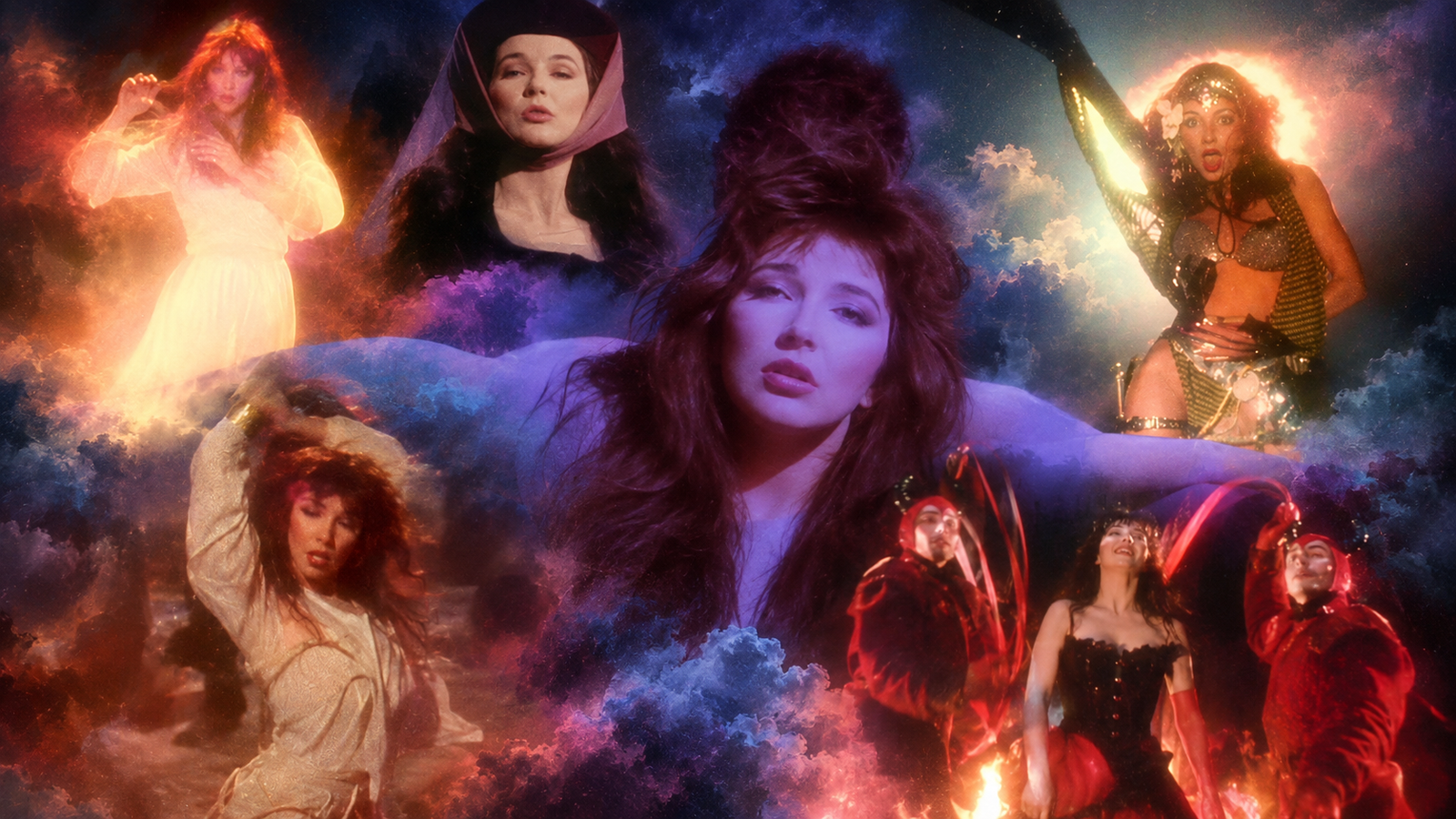
For Kate Bush, music has never been confined to sound alone. From the flowing red dress and expressive choreography of “Wuthering Heights” to the cinematic storytelling of “Cloudbusting,” her music videos have become an essential part of her artistic identity, bringing her songs to life through movement, character and imagination.
Emerging before MTV transformed the music video into a defining feature of popular culture, Bush recognised its potential as an artistic medium. Drawing upon her training in dance and mime, she created performances that could be intimate, theatrical, surreal or cinematic, finding different ways to extend the stories and emotions within her songs.
Across the decades, her approach evolved from the relatively simple productions of the late 1970s to elaborate short films, ambitious ensemble performances and experimental animation. This chronological journey explores the music videos and visual projects that have accompanied Bush’s remarkable career, revealing how her imagination developed both in front of and behind the camera.
1978–1979: Establishing a Visual Identity
When Kate Bush emerged in 1978, promotional films were already an established part of popular music, although they had yet to achieve the cultural prominence they would enjoy during the MTV era. Her earliest videos immediately stood apart through their emphasis on choreography, theatrical characterisation and expressive movement.
Rather than simply performing to the camera, Bush frequently adopted the perspective of her songs’ narrators, using dance and gesture to communicate their stories.
Wuthering Heights (1978)
Two official videos were created for Bush’s debut single, each offering a different visual interpretation of Catherine Earnshaw, the ghostly narrator of Emily Brontë’s Wuthering Heights.
The original UK version features Bush dressed in white, performing against a dark, mist-filled studio backdrop. A second version, created for the American market, places her outdoors in a flowing red dress, dancing against a wooded landscape.
Both feature the distinctive sweeping arm movements and expressive gestures that became inseparable from the song. The red-dress version, in particular, has achieved an extraordinary cultural afterlife, inspiring countless recreations and mass-participation performances around the world.
The Man with the Child in His Eyes (1978)
In contrast to the dramatic choreography of “Wuthering Heights,” this video adopts a more intimate presentation, with Bush seated and performing directly to the camera.
Its restrained staging places greater emphasis on her facial expressions and subtle movements, allowing the song’s reflective atmosphere to take precedence over theatrical spectacle. The result illustrates how Bush could adapt her visual performances to suit the character of individual compositions.
Hammer Horror (1978)
Drawing upon the song’s theatrical subject matter, “Hammer Horror” features Bush performing alongside a male dancer in a dramatic sequence built around movement, shadow and contrasting lighting.
The choreography resembles a confrontation between two characters, with the dancers’ interactions creating an atmosphere of tension and unease. Its gothic imagery and stylised movements reflect Bush’s fascination with the relationship between dance, theatre and cinema.
Wow (1979)
Taken from her second album, Lionheart, “Wow” explores the world of theatrical performance, a subject reflected in its accompanying video.
Bush adopts exaggerated gestures and expressive poses, drawing upon the traditions of stage acting and mime. Rather than presenting an elaborate storyline, the production uses her physical performance to evoke the song’s theatrical setting and satirical character.
Them Heavy People (1979)
“Them Heavy People” brings a more playful energy to Bush’s early visual work, incorporating lively choreography and interactions with supporting performers.
Its ensemble presentation differs from the solitary performances of her earliest videos, revealing her growing interest in coordinating movement between multiple dancers. The production also reflects the influence of theatrical entertainment and choreographed stage performance on her developing style.
These early videos established several characteristics that would remain central to Bush’s visual work: a close relationship between music and movement, an interest in adopting different characters, and a willingness to treat the camera as an extension of the stage.
1980–1981: Theatre, Character and Experimentation
With the release of Never for Ever in 1980, Bush began exploring more elaborate visual concepts. Costumes, narrative settings and supporting performers assumed greater importance, while the subject matter of her videos expanded to encompass darker themes, including war and nuclear destruction.
Babooshka (1980)
One of Bush’s most recognisable early videos, “Babooshka” features her portraying two contrasting identities within the same story.
Appearing first as a suspicious wife dressed in black, she subsequently transforms into the glamorous and imposing Babooshka, wearing an elaborate metallic costume inspired by fantasy imagery. The striking contrast between these appearances provides a memorable visual representation of the song’s themes of jealousy, deception and mistaken identity.
The production demonstrates how costume and characterisation could become as important to Bush’s videos as choreography itself.
Breathing (1980)
“Breathing” adopts a considerably darker atmosphere, reflecting the song’s anxieties about nuclear warfare and radioactive contamination.
Bush appears within a womb-like environment, representing an unborn child experiencing the effects of a polluted world. The confined setting, unsettling imagery and increasingly intense performance create one of the most disturbing visual works of her early career.
It also demonstrates her willingness to address serious contemporary concerns through a medium more commonly associated with entertainment and promotion.
Army Dreamers (1980)
Set in a misty woodland, “Army Dreamers” combines military imagery with carefully choreographed movement to depict the loss of a young soldier.
Bush appears as a grieving mother surrounded by uniformed figures, while explosions and changing scenes introduce a sense of danger and instability. The contrast between the song’s gentle rhythm and the video’s wartime imagery gives the production its distinctive atmosphere.
Its more developed narrative anticipates the increasingly cinematic approach Bush would adopt during the following decade.
Sat in Your Lap (1981)
Released as a single in 1981, ahead of The Dreaming, “Sat in Your Lap” introduces a more surreal and energetic visual style.
Bush appears among dancers and extravagantly costumed characters, including figures wearing elaborate headpieces and theatrical masks. Rapid movement, unusual staging and deliberately exaggerated performances reflect the song’s restless pursuit of knowledge.
The video’s combination of absurdist imagery, mime and dance provides an early indication of the experimental direction that would define her next album.
1982: The Dreaming Era
Kate Bush’s fourth album, The Dreaming, marked a turning point in her artistic development. Released in September 1982, it was her first entirely self-produced album, characterised by unconventional arrangements, experimental recording techniques and an increasingly adventurous approach to songwriting.
Its accompanying videos reflected this independence, moving between surreal imagery, theatrical comedy and expressive dance without attempting to establish a consistent visual formula.
The Dreaming (1982)
The video for the album’s title track draws upon the song’s Australian setting and its themes of mining, exploitation and the destruction of Aboriginal land.
Bush appears in a series of theatrical scenes incorporating industrial imagery, unusual costumes and performers representing different aspects of the song’s narrative. The production reflects the album’s experimental character, although its depiction of Aboriginal people also invites consideration within the historical and cultural context of its creation.
There Goes a Tenner (1982)
Taking inspiration from the song’s unsuccessful bank robbery, “There Goes a Tenner” adopts a playful approach to crime storytelling.
Bush appears alongside a group of accomplices in a stylised robbery scenario, using exaggerated expressions, period-inspired costumes and comic timing to bring the characters to life.
Its humorous presentation provides a striking contrast to the darker imagery of the album’s title track, demonstrating Bush’s ability to explore different genres within the music video format.
Suspended in Gaffa (1982)
“Suspended in Gaffa” returns to a more performance-centred approach, placing Bush inside a rustic barn surrounded by wooden beams and an otherwise relatively simple setting.
Her energetic movements, sudden changes of expression and increasingly animated choreography provide the video’s main focus. Rather than relying on elaborate sets or a developed storyline, the production allows Bush’s physical performance to communicate the song’s sense of frustration and longing.
Together, these videos illustrate the creative freedom of The Dreaming era. Bush was experimenting with different approaches to performance and storytelling, establishing the foundations for the considerably larger productions that would follow.
1985–1986: The Cinematic Ambition of Hounds of Love
With the release of Hounds of Love in 1985, Bush entered a new phase of visual creativity. Her music videos became increasingly ambitious, combining sophisticated choreography with cinematic storytelling, elaborate production design and carefully developed narratives.
The album’s success coincided with the growing international influence of MTV, but Bush’s videos frequently departed from the conventional performance-led format, exploring techniques more commonly associated with dance films, television drama and cinema.
Running Up That Hill (1985)
“Running Up That Hill” features Bush performing an expressive contemporary dance routine alongside French dancer Michael Hervieu.
Dressed in matching grey costumes, the pair move through a sequence of carefully coordinated interactions before becoming separated by crowds of masked figures. Their movements provide the central visual focus, with Bush avoiding the conventional approach of singing directly to the camera.
The video remains one of her most recognisable performances, illustrating her belief that choreography could communicate a song’s emotional content without relying on literal storytelling.
Cloudbusting (1985)
One of Bush’s most ambitious music videos, “Cloudbusting” takes the form of a cinematic short film inspired by Peter Reich’s memoir A Book of Dreams.
Directed by Julian Doyle, the production stars Donald Sutherland as Wilhelm Reich, the controversial psychoanalyst and inventor, with Bush portraying his young son, Peter.
Filmed partly in the Oxfordshire countryside, the video follows the relationship between father and son, culminating in the operation of an enormous machine designed to influence the weather.
Its historical inspiration, elaborate production and accomplished performances distinguish it from conventional promotional videos of the period. The film remains one of the clearest examples of Bush’s ambition to bring fully developed narratives to the screen.
Hounds of Love (1986)
For the album’s title track, Bush drew upon the atmosphere of classic suspense cinema, particularly the films of Alfred Hitchcock.
The video follows a woman pursued through a series of dramatic encounters, incorporating period-inspired costumes, striking lighting and carefully staged moments of tension.
Directed by Bush herself, the production reflects her growing involvement behind the camera, using the visual language of cinema to create a distinctive atmosphere around the song.
The Big Sky (1986)
“The Big Sky” takes a more exuberant approach, featuring Bush alongside a large ensemble of dancers and musicians.
Energetic choreography, colourful costumes and increasingly elaborate group sequences create an atmosphere of celebration. The production contrasts sharply with the restrained contemporary dance of “Running Up That Hill” and the historical drama of “Cloudbusting.”
Its large-scale ensemble performance also demonstrates Bush’s ability to coordinate theatrical spectacle while maintaining the playful character of the song.
Experiment IV (1986)
Released to accompany Bush’s greatest-hits compilation The Whole Story, “Experiment IV” continued her exploration of cinematic storytelling.
Directed by Bush, the video depicts a secret military project attempting to transform sound into a deadly weapon. Its science-fiction and horror influences are reinforced by a cast that includes Dawn French, Hugh Laurie and Peter Vaughan.
Bush appears in multiple roles, including the terrifying manifestation of the experimental sound itself. Combining dark humour, elaborate makeup and a developed storyline, the production ranks among her most ambitious narrative videos.
The variety of these five productions is particularly striking. Within a relatively short period, Bush moved between contemporary dance, historical drama, suspense, ensemble performance and science-fiction horror, demonstrating how differently individual songs could be interpreted on screen.
1989–1990: The Sensual World Era
Released in October 1989, The Sensual World brought another shift in Bush’s visual approach. Its accompanying videos ranged from atmospheric outdoor performances to intimate human drama, reflecting the contrasting musical and emotional qualities of the album.
The Sensual World (1989)
For the album’s title track, Bush appears in a flowing red dress, moving through a woodland landscape surrounded by falling leaves and shifting natural light.
Directed by Bush, the video draws upon the song’s literary connection to James Joyce’s Ulysses, translating its sensual atmosphere into a sequence of graceful movements and evocative natural imagery.
Its relatively simple presentation allows the relationship between performer, music and landscape to take precedence over elaborate narrative construction.
This Woman’s Work (1989)
One of Bush’s most emotionally direct videos, “This Woman’s Work” presents a dramatic narrative featuring actor Tim McInnerny as a man confronting the possibility of losing his partner.
Set largely within a hospital, the video alternates between his anxious wait and memories of their relationship. Bush appears as a singer within the unfolding story, providing a visual connection between its emotional narrative and the song.
Originally written for John Hughes’s 1988 film She’s Having a Baby, the composition received a standalone video that demonstrated Bush’s ability to communicate powerful emotions through restrained acting and cinematic editing.
Love and Anger (1989)
“Love and Anger” returns to a more energetic performance style, featuring Bush alongside a colourful ensemble of musicians and dancers.
David Gilmour, who played guitar on the recording, appears in the video, which moves between individual performances and lively group sequences.
Its shifting settings and theatrical staging provide a contrast to the intimate atmosphere of “This Woman’s Work,” while recalling the ensemble-based approach Bush had explored during the previous decade.
These three videos reveal an artist comfortable moving between different forms of visual expression, from naturalistic settings and understated drama to energetic musical performance.
1993–1994: The Red Shoes and Film
With the release of The Red Shoes in November 1993, Bush undertook her most extensive filmmaking project.
Rather than creating a collection of entirely independent videos, she developed a musical short film that connected several of the album’s songs within a single fantastical narrative.
Inspired by Hans Christian Andersen’s fairy tale and Michael Powell and Emeric Pressburger’s 1948 film The Red Shoes, the project brought together dance, fantasy and cinema, drawing upon artistic influences that had fascinated Bush throughout her career.
The Line, the Cross & the Curve (1993–1994)
Written and directed by Bush, The Line, the Cross & the Curve premiered in 1993 before receiving a commercial home-video release in 1994.
Running for approximately 50 minutes, the film features six songs from The Red Shoes, with the title track appearing more than once.
Bush plays a dancer who encounters a mysterious woman, portrayed by Miranda Richardson, and becomes trapped by a pair of enchanted red shoes that compel her to dance uncontrollably.
The film also features Lindsay Kemp, the celebrated dancer and mime artist who had taught Bush during her formative years. His appearance creates a direct connection between the project and the theatrical influences that helped shape her early performances.
Several sequences were subsequently presented as individual promotional videos, allowing the songs to exist both independently and as parts of the larger film.
Rubberband Girl (1993)
“Rubberband Girl” received two principal video treatments.
The original version, drawn from the opening sequence of The Line, the Cross & the Curve, features Bush rehearsing with her band and performing an energetic dance routine with a male partner.
An alternative video was produced for the American market, featuring Bush in different outfits and studio settings, including scenes in sunglasses and a leather jacket.
The contrasting versions reflect the different promotional approaches taken to the single, while highlighting the importance of movement and physical performance within the song’s visual identity.
And So Is Love (1994)
Drawn from The Line, the Cross & the Curve, “And So Is Love” presents a quieter and more atmospheric sequence.
Bush appears alone in a dimly lit room, accompanied by candlelight, before encountering a bird and a small mouse. These unusual events form part of the film’s developing fantasy narrative, giving the video an enigmatic quality when viewed independently.
Its restrained presentation contrasts with the energetic choreography of “Rubberband Girl,” demonstrating the film’s movement between different emotional and visual settings.
The Red Shoes (1994)
The title track provides some of the film’s most memorable imagery, centred on the enchanted shoes that force Bush’s character into an increasingly frantic dance.
Featuring elaborate choreography and appearances by Miranda Richardson and Lindsay Kemp, the sequence brings together the theatrical and fantastical elements that define the wider production.
Its imagery also recalls the ballet traditions and cinematic influences behind the album’s concept.
Lily (1993)
Although “Lily” was not released as a conventional single from the album, it forms an important sequence within The Line, the Cross & the Curve.
The scene introduces the mystical character Lily, portrayed by Lily Conford, who offers guidance and protection to Bush’s character as she attempts to escape the enchanted shoes.
Its ritualistic imagery and theatrical presentation contribute to the film’s atmosphere of fantasy and transformation.
Moments of Pleasure (1993)
“Moments of Pleasure” provides one of the film’s more reflective passages, contrasting with the elaborate dance sequences elsewhere in the production.
Its imagery centres on memory and remembrance, with Bush’s performance conveying a sense of intimacy amid the larger fantastical narrative.
The sequence demonstrates how the film could accommodate quieter emotional moments alongside its more extravagant visual ideas.
Eat the Music (1993)
Among the most colourful productions of Bush’s career, “Eat the Music” features an exuberant celebration of dance, fruit and vibrant costumes.
Bush appears among performers moving across a floor covered with fruit, creating a playful spectacle that contrasts with the film’s darker sequences.
The standalone promotional version also differs from the film sequence, incorporating additional performance footage and unusual comic imagery.
Bush’s Most Ambitious Film Project
The Line, the Cross & the Curve brought together many of the interests that had shaped Bush’s earlier videos, from contemporary dance and theatrical characterisation to elaborate costumes and cinematic storytelling.
Although Bush later expressed dissatisfaction with aspects of the finished film, it remains a distinctive undertaking within her career. By connecting several songs through an original narrative, she extended her visual ambitions beyond the conventional boundaries of the music video.
Following The Red Shoes, Bush stepped away from releasing new studio albums for more than a decade. When she returned with Aerial in 2005, her approach to moving images would be noticeably different.
2005–2012: A Different Visual Approach
Following her extended absence from new studio releases, Bush returned in 2005 with Aerial.
Her later visual projects increasingly favoured animation, atmospheric imagery and carefully constructed short films over the elaborate dance performances of her earlier career. Although these productions became less frequent, they continued to explore different ways of bringing her music to the screen.
King of the Mountain (2005)
Released as the lead single from Aerial, “King of the Mountain” was accompanied by an atmospheric video directed by animator and filmmaker Jimmy Murakami.
Combining live-action imagery with animation, the production features mysterious figures, shifting landscapes and clothing caught in powerful winds.
Its unusual visual presentation reflects the song’s elusive atmosphere, offering a markedly different experience from Bush’s earlier performance-driven videos.
Deeper Understanding (2011)
For her 2011 album Director’s Cut, Bush revisited several songs from The Sensual World and The Red Shoes, including “Deeper Understanding.”
The accompanying video, directed by Bush, stars Robbie Coltrane as a man who develops an increasingly consuming relationship with a computer programme. The production also features Frances Barber, Noel Fielding and Bush’s son Albert McIntosh.
Combining dark humour with unsettling digital imagery, the short film gives a new visual dimension to a song originally recorded more than two decades earlier.
The Visual World of 50 Words for Snow (2011–2012)
Released in November 2011, 50 Words for Snow inspired a series of short animated pieces rather than conventional full-length promotional videos.
These productions accompanied selected passages from the album’s compositions, using different animation techniques to evoke its wintry atmosphere and imaginative narratives.
Wild Man (2011)
The first animated piece released to accompany 50 Words for Snow, “Wild Man” uses illustrated animation to depict the mysterious creature at the centre of the song.
Created by Finn and Patrick at Brandt Animation, the approximately two-and-a-half-minute film presents a snowy Himalayan landscape inspired by the legend of the Yeti.
Its restrained movement and atmospheric imagery provide a visual counterpart to the song without attempting to illustrate its entire narrative.
Mistraldespair (2011)
Accompanying a short passage from “Misty,” “Mistraldespair” is a two-and-a-half-minute stop-motion animation directed by Bush and created with animator Tommy Thompson.
Featuring carefully constructed puppets, the film depicts an unusual encounter between a woman and a snowman. Its slow, intimate movements demonstrate Bush’s interest in the expressive possibilities of traditional stop-motion techniques.
The production was particularly significant for Bush, marking her first experience directing this form of animation.
Eider Falls at Lake Tahoe (2012)
Released in January 2012, “Eider Falls at Lake Tahoe” accompanies an excerpt from the album’s song “Lake Tahoe.”
Directed by Bush, the film uses intricate black-and-white shadow puppetry to tell the story of a mysterious woman and her beloved dog.
The puppets were created by Robert Allsopp, with cinematographer Roger Pratt among those contributing to the production. Bush particularly valued the simplicity of the technique, which allowed the entire piece to be created through carefully controlled physical movement and lighting.
These three animated films demonstrate the variety of techniques Bush was willing to explore. Rather than recreating the theatrical performances of her earlier career, she increasingly allowed illustrated characters, puppets and animated environments to occupy the centre of her visual work.
2024: Little Shrew and a Return to Animation
More than a decade after the visual projects accompanying 50 Words for Snow, Bush returned to filmmaking in October 2024 with Little Shrew (Snowflake), a short animated film written and directed by Bush herself.
Inspired by the war in Ukraine, the project was created to draw attention to the experiences of children living through armed conflict. It also demonstrated how Bush could revisit an existing recording and give it an entirely new visual context.
Little Shrew (Snowflake) (2024)
Set to an edited version of “Snowflake” from her 2011 album 50 Words for Snow, the four-minute film follows a small shrew travelling through a devastated city in search of a mysterious presence called Hope.
Bush collaborated with illustrator Jim Kay, whose artwork helped establish the film’s distinctive black-and-white appearance. Animation studio Inkubus subsequently brought the characters and environments to life, with Hope represented by a glowing yellow light.
The production also incorporates a photograph by Ukrainian photojournalist Maksim Levin, who was killed while documenting the Russian invasion of Ukraine in 2022.
Released in support of the children’s charity War Child, Little Shrew uses its delicate animation and existing musical accompaniment to draw attention to the human consequences of war.
The film also represents a continuation of Bush’s interest in visual storytelling without appearing as the central performer, allowing fictional characters and animated imagery to communicate the narrative.
Kate Bush’s Visual Legacy
From the expressive choreography of “Wuthering Heights” to the cinematic ambition of “Cloudbusting” and the delicate animation of Little Shrew, Kate Bush’s music videos reveal an artist continually searching for new ways to bring her imagination to the screen.
Her visual work has never been defined by a single technique or aesthetic. Dance, theatre, comedy, suspense, fantasy and animation have all played a part, reflecting the extraordinary variety of her songwriting. As her career progressed, her increasing involvement in directing also allowed her to exercise greater creative independence over the presentation of her music.
What makes these videos particularly compelling is their ability to stand alongside the songs without merely illustrating them. They introduce characters, settings and ideas that can deepen the listener’s experience while remaining distinctive works in their own right.
Together, they offer a fascinating parallel history of Bush’s career, revealing how her imagination has extended far beyond the recording studio. For Kate Bush, the music video has never simply been a way of promoting a song. It has been another way of telling its story.