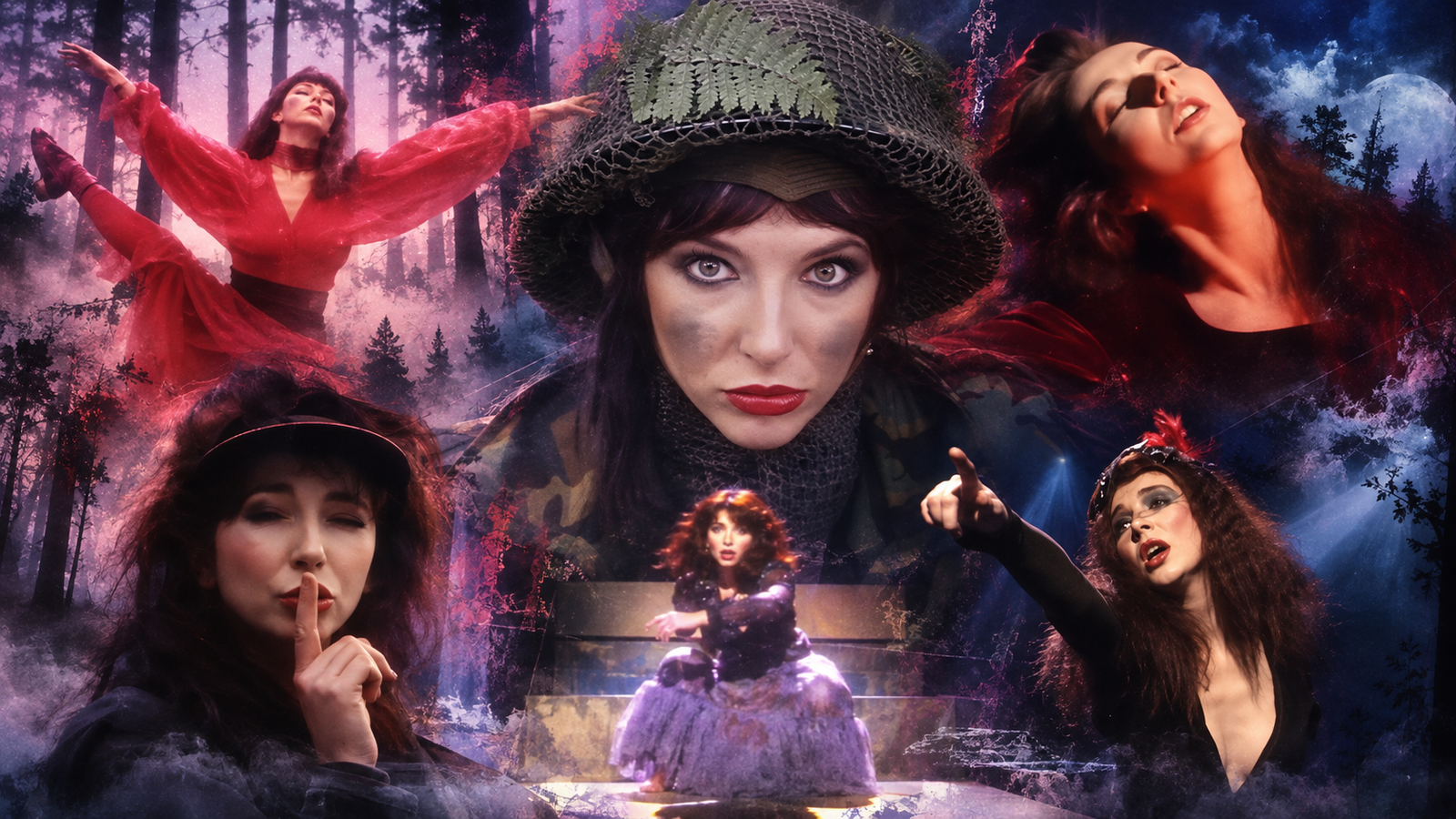
In 1978, nineteen-year-old Kate Bush reached number one in the UK with “Wuthering Heights“, a debut single inspired by Emily Brontë’s novel. Its theatrical vocals, unusual composition and literary subject matter immediately distinguished her from her contemporaries.
Over the following decades, Bush developed from a young singer-songwriter into an accomplished producer, creating albums that explored human relationships, psychological fears, literature and the natural world. Her music drew upon rock, folk, classical influences and emerging recording technologies, while her performances and music videos brought those ideas into a visual world of their own.
Her career has rarely followed a conventional path. After an ambitious tour in 1979, she largely withdrew from live performance, later allowing twelve years to pass between studio albums. Her unexpected return to the stage in 2014 and the renewed success of “Running Up That Hill” in 2022 introduced her work to audiences separated by generations.
Behind those remarkable moments is the story of a musician whose creative interests continued to evolve, even as her public appearances became increasingly rare.
Early Life and Musical Beginnings (1958–1977)
Catherine Bush was born on 30 July 1958 in Bexleyheath, Kent, and grew up at East Wickham Farm, a centuries-old farmhouse in southeast London. The youngest of three children, she was raised in a household where music and artistic expression were part of everyday life.
Her father, Robert, was a doctor who played the piano, while her Irish mother, Hannah, had a background in traditional Irish dancing. Her older brothers, John and Paddy, were also creatively inclined. John pursued poetry and photography, while Paddy developed an interest in folk music and unusual instruments, later becoming a frequent collaborator on Kate’s recordings.
Bush began teaching herself the piano at around eleven and soon started composing her own songs. By her early teens, she had accumulated a substantial collection of original material, much of it exploring subjects far removed from conventional teenage pop. Literature, unusual characters and dramatic situations already occupied an important place in her imagination.
David Gilmour and the EMI Record Deal
Bush’s first attempts to attract record company interest were unsuccessful. A family connection eventually brought her recordings to the attention of Pink Floyd guitarist David Gilmour, who recognised the potential in her songwriting.
Impressed by the young musician, Gilmour helped arrange more professional recordings, including a 1975 session with producer Andrew Powell and engineer Geoff Emerick. Among the songs recorded was “The Man with the Child in His Eyes”, which Bush had written several years earlier and would later include on her debut album.
These recordings helped secure her a contract with EMI while she was still a teenager. Rather than immediately releasing her music, the company allowed her time to develop her abilities and prepare for a professional career.
Bush used this period to study dance and mime, including lessons with Lindsay Kemp, whose theatrical approach to movement had also influenced David Bowie. She additionally worked with mime teacher Adam Darius, developing the physical expressiveness that would become central to her performances and music videos.
In 1977, she began performing in London pubs with the KT Bush Band, gaining experience in front of live audiences before completing her debut album.
By the end of that year, Bush had developed an unusual combination of skills: a substantial catalogue of self-written songs, experience with professional recording and a performance style informed as much by theatre and movement as by popular music.
In January 1978, those qualities would be introduced to a national audience.
Wuthering Heights and Sudden Fame (1978–1979)
Kate Bush’s debut single, “Wuthering Heights”, was released on 20 January 1978. Inspired by Emily Brontë’s novel, the song was an unusual choice for a new artist: its shifting melody, high-pitched vocals and lyrics written from the perspective of Catherine Earnshaw’s ghost were far removed from conventional pop songwriting.
EMI had initially favoured the more straightforward rock song “James and the Cold Gun” as her first single, but Bush argued successfully for “Wuthering Heights”. The decision proved decisive. In March, the song reached number one in the UK, remaining there for four weeks and making Bush the first female artist to top the British singles chart with a song she had written entirely herself.
Her debut album, The Kick Inside, followed in February and reached number three in the UK. Produced by Andrew Powell, it brought together songs Bush had written during her teenage years, including “The Man with the Child in His Eyes”, “Moving” and “The Saxophone Song”.
Fame arrived quickly. Television appearances, interviews and promotional commitments introduced Bush to an industry that often placed as much emphasis on her appearance and unusual voice as on her abilities as a composer. Her expressive performances and distinctive music videos attracted attention, but sometimes overshadowed the songwriting behind her recordings.
Lionheart and the Demands of Success
With The Kick Inside still enjoying commercial success, Bush was encouraged to record a follow-up. Lionheart arrived in November 1978, just nine months after her debut.
Although it reached number six in the UK and produced the popular single “Wow”, the album had been assembled under considerable time pressure, drawing heavily upon songs written before Bush’s breakthrough. She later expressed dissatisfaction with the rushed circumstances of its creation.
The experience exposed a tension between the demands of the record industry and the time Bush wanted to devote to developing her music.
In 1979, she undertook her first major concert tour, the Tour of Life. Combining live music with choreography, mime, costumes and elaborate staging, it demonstrated her ambition to develop the visual presentation of her songs beyond conventional concert performance.
The production was physically demanding and overshadowed by the death of lighting engineer Bill Duffield following an accident during preparations. Despite its artistic achievements, Bush would not undertake another full concert production for 35 years.
By the end of 1979, she had released two successful albums, achieved a historic number-one single and completed an ambitious theatrical tour. Her early success had established her reputation, but the experience also encouraged her to reconsider how she wanted to make music.
Finding Her Own Artistic Voice (1980–1982)
Following the Tour of Life, Bush concentrated on recording, taking a more active role in the arrangements and production of her songs.
Her third album, Never for Ever, arrived in September 1980 and was co-produced with engineer Jon Kelly. It marked a progression from her earlier recordings, combining piano-led compositions with synthesizers, unusual sound effects and increasingly ambitious arrangements.
The album also revealed an interest in darker subject matter. “Army Dreamers” examined the loss of a young soldier, while “Breathing” imagined nuclear catastrophe from the perspective of an unborn child. Alongside the commercially successful “Babooshka”, these songs demonstrated Bush’s ability to explore unsettling themes within accessible popular music.
Never for Ever entered the UK Albums Chart at number one. It became the first chart-topping album by a British female solo artist and the first album by any female solo artist to enter the UK chart at the summit.
Its commercial success coincided with Bush’s growing confidence in the recording studio, setting the stage for a more radical change in her working methods.
The Dreaming: Taking Control
That change arrived with The Dreaming, released in September 1982. For the first time, Bush took sole responsibility for producing an entire studio album.
The recording process was lengthy and demanding. Working closely with musicians and engineers, she experimented with layered vocals, unconventional percussion and the Fairlight CMI, a digital instrument capable of recording and manipulating sounds. These techniques became fundamental to how the songs were constructed.
The resulting album was her most challenging work to date. Songs such as “Sat in Your Lap”, “Get Out of My House” and “Houdini” explored psychological tension and dramatic storytelling through arrangements that frequently departed from traditional pop structures.
Its contemporary reception was mixed. Although The Dreaming reached number three in the UK, it sold less than her previous albums, and some critics struggled with its dense, unpredictable sound.
The experience nevertheless established a working approach that would define much of Bush’s subsequent career. She had overseen an album from its earliest ideas through to its final production, accepting the creative and commercial risks that came with doing so.
The challenge now was to find a way of sustaining that level of involvement without repeating the exhausting studio sessions of The Dreaming.
Hounds of Love and International Recognition (1983–1993)
Following The Dreaming, Bush established a recording studio at her family home. Having access to her own equipment allowed her to experiment with arrangements and develop ideas over longer periods, without relying entirely on booked sessions in commercial studios.
This change became central to the creation of Hounds of Love, which she worked on throughout much of 1983 and 1984 before its release in September 1985.
The album brought together two contrasting approaches to songwriting. Its first half contained some of her most accessible material, including “Running Up That Hill (A Deal with God)”, “Cloudbusting” and the title track. The second, The Ninth Wave, was a continuous seven-song narrative about a woman struggling to survive after being lost at sea.
Hounds of Love reached number one in the UK, while “Running Up That Hill” became Bush’s biggest international hit to that point, introducing her music to a wider audience, particularly in the United States.
The album also marked an important reconciliation between the experimentation of The Dreaming and the melodic accessibility of her earlier recordings. Bush had developed a sound that accommodated both elaborate musical storytelling and commercially successful singles.
New Directions and The Red Shoes
The success continued with The Whole Story, a compilation released in 1986 that reached number one in the UK. That same year, Bush appeared alongside Peter Gabriel on “Don’t Give Up”, a duet that became one of her best-known collaborations.
Her next studio album, The Sensual World, arrived in October 1989. Drawing inspiration from literature, relationships and physical experience, it featured contributions from the Bulgarian vocal ensemble Trio Bulgarka and musicians including David Gilmour. The album reached number two in the UK and included “This Woman’s Work”, originally written for the film She’s Having a Baby.
Bush’s seventh studio album, The Red Shoes, followed in November 1993. Its creation coincided with a difficult period in her personal life, including the death of her mother, Hannah, in 1992.
The album featured contributions from Prince, Eric Clapton and Jeff Beck, reflecting Bush’s interest in collaborating with musicians from different backgrounds.
Inspired by the 1948 film of the same name, The Red Shoes was accompanied by Bush’s short film, The Line, the Cross and the Curve, which she wrote, directed and starred in. Although she later expressed dissatisfaction with the finished film, it continued her exploration of the relationship between music, movement and cinema.
The Red Shoes reached number two in the UK, maintaining her commercial success into the 1990s.
After fifteen years of regular releases, however, Bush was approaching a different stage of her life. The completion of the album was followed by a prolonged period away from public attention, during which her priorities and approach to recording would change considerably.
A Life Beyond the Spotlight (1994–2011)
Following The Red Shoes, Bush gradually stepped away from the cycle of recording, promotion and public appearances that had occupied much of her adult life.
Her relationship with guitarist Danny McIntosh and the birth of their son, Albert, known as Bertie, in 1998 became central to this period. Bush later explained that she had deliberately prioritised raising her son over completing another album, recognising that his childhood was something she could not revisit.
The extended absence encouraged speculation about whether she intended to release music again. Bush rejected the suggestion that she had become a recluse. She continued writing and recording, but preferred to keep her family life separate from the public attention surrounding her career.
Her next album would emerge gradually from those years rather than from a conventional recording and promotional schedule.
Aerial: Returning on Her Own Terms
In November 2005, twelve years after The Red Shoes, Bush released her eighth studio album, Aerial.
The double album reflected the circumstances in which it had been created. Its first disc, A Sea of Honey, explored subjects ranging from motherhood and domestic life to memory and loss. Among its most personal songs were “Bertie”, written for her son, and “A Coral Room”, which addressed the death of her mother.
The second disc, A Sky of Honey, was a continuous musical work inspired by the changing light, sounds and atmosphere of a summer’s day. Its emphasis on nature and the passage of time demonstrated a quieter, more reflective aspect of Bush’s songwriting.
Aerial reached number three in the UK and received widespread critical acclaim. Its success challenged the assumption that her long absence from public view had diminished interest in her music.
It also reflected a change in subject matter. The dramatic characters and psychological conflicts of earlier albums remained part of Bush’s musical world, but domestic experiences and the observation of nature had become increasingly important sources of inspiration.
Two Albums in One Year
Bush’s next major releases arrived in 2011, marking an unusually productive year by the standards of her later career.
In May, she released Director’s Cut, revisiting selected songs from The Sensual World and The Red Shoes. Some were substantially reworked, while others received new vocal performances or arrangements. The project allowed her to reconsider recordings she felt could benefit from a different approach.
Six months later came 50 Words for Snow, her first album of entirely new material since Aerial.
Built around seven extended compositions, the album explored winter through stories involving snow, isolation, relationships and the passage of time. Its restrained, largely piano-led arrangements contrasted with the densely layered production of much of her earlier work.
The album reached number five in the UK and continued Bush’s interest in extended compositions and atmospheric storytelling.
By the end of 2011, she had established a slower rhythm of working, releasing music when she considered it ready rather than following a regular schedule. What few anticipated was that her next major project would take her away from the recording studio and back to the concert stage.
Before the Dawn and an Enduring Legacy (2014–Present)
In March 2014, Kate Bush surprised audiences by announcing her first full concert production in 35 years. The Before the Dawn residency at London’s Hammersmith Apollo initially comprised fifteen performances, with seven additional dates added following extraordinary demand. All 22 concerts sold out within fifteen minutes.
Running from August to October, the production was far removed from a conventional greatest-hits concert. Bush performed alongside a full band, but devoted much of the evening to theatrical interpretations of The Ninth Wave from Hounds of Love and A Sky of Honey from Aerial.
The shows combined music, film, puppetry and elaborate staging, developing ideas she had first explored during her 1979 Tour of Life on a considerably larger scale.
The residency received widespread acclaim, and a three-disc live album followed in 2016. It remains her most substantial return to live performance since the 1970s.
Running Up That Hill: A New Generation Discovers Kate Bush
Another unexpected chapter arrived in 2022, when “Running Up That Hill (A Deal with God)” featured prominently in the fourth season of Netflix’s Stranger Things.
The song played an important role in the storyline of Max Mayfield, portrayed by Sadie Sink. Used during some of the season’s most emotionally intense scenes, it became associated with the character’s struggle against a supernatural threat.
Its inclusion gave the recording a new dramatic context, allowing viewers unfamiliar with Bush’s music to connect with the song through the experiences of a character they had come to know.
The response was extraordinary. Originally released in 1985, “Running Up That Hill” had reached number three in the UK. Thirty-seven years later, renewed interest propelled it to number one, where it remained for three weeks.
The achievement gave Bush her second British chart-topping single, establishing a then-record 44-year gap between her number-one hits, following “Wuthering Heights” in 1978.
Its success extended internationally, with the song reaching number three on the US Billboard Hot 100, a higher position than any of her previous American singles.
The revival also spread across streaming platforms and social media, introducing younger listeners to a recording that had already been part of popular music for nearly four decades.
Bush welcomed the resurgence, expressing particular delight that a new generation was discovering her work.
In 2023, she was inducted into the Rock & Roll Hall of Fame, recognising a career whose influence extended across several generations of musicians.
A Career on Her Own Terms
Kate Bush’s music has always drawn upon an unusually broad range of interests. Literature, cinema, theatre, folk traditions and experimental recording techniques have all contributed to a catalogue that moves between intimate songwriting and elaborate musical narratives.
Her development as a producer was especially important. From The Dreaming onwards, she increasingly shaped not only the songs themselves but the sounds, arrangements and dramatic environments through which they were presented.
Her influence can be heard in artists as varied as Tori Amos, Björk and Florence Welch, although her own recordings have resisted any straightforward musical category.
Equally distinctive has been her relationship with public attention. Bush has rarely toured, allowed long intervals between albums and maintained a clear separation between her creative work and private life. Yet those absences have never entirely removed her music from public consciousness.
The contrast between two moments in her career is particularly striking. In 1978, “Wuthering Heights” made a teenage songwriter an unexpected chart sensation. In 2022, a song she had recorded at the age of twenty-six reached number one for the first time, finding an audience largely too young to remember its original release.
Forty-four years separated those chart-topping singles. The voice, the songwriters around her and the music industry had all changed enormously in the meantime. Yet the recording that brought Bush back to number one was the same one she had created in 1985.
Few careers offer such a remarkable illustration of how music can outlive the circumstances in which it was made.